
If you installed a heat pump, replaced an exterior door, or upgraded your electrical panel last year, the IRS owes you money. Under the Energy Efficient Home Improvement Credit (Section 25C), qualifying homeowners can claim up to $3,200 directly against their federal tax bill when filing their 2025 returns.
There is critical context to understand before you file: Congress accelerated the end of these programs. The One Big Beautiful Bill Act, signed into law on July 4, 2025, terminated both the 25C and the Residential Clean Energy Credit (Section 25D) for any property installed after December 31, 2025. For renovations completed in 2025, the credits remain fully intact. For future projects, they do not exist.
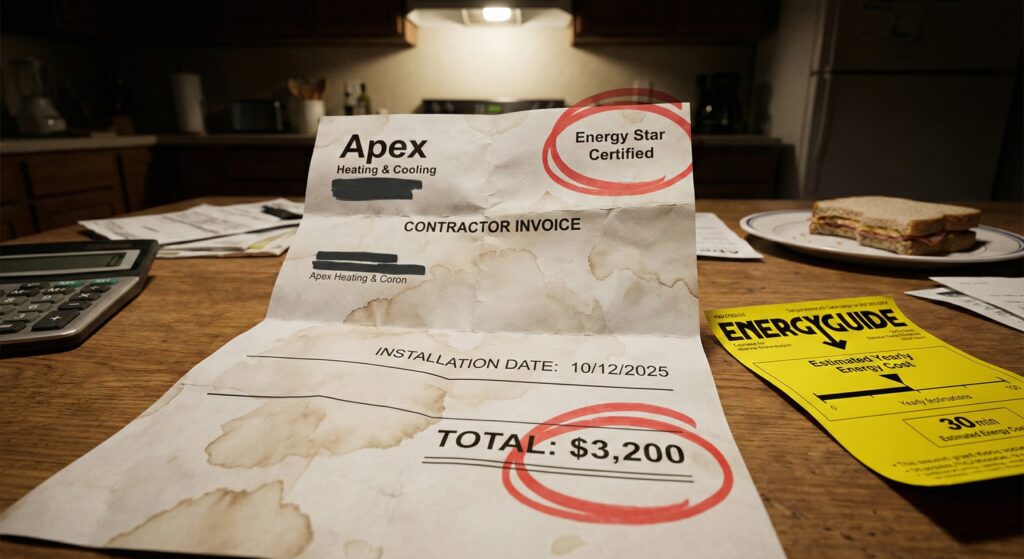
How the $3,200 Breaks Down
The $3,200 annual ceiling is not a single bucket you can fill however you choose. The IRS divides it into two distinct sub-limits with competing internal caps.
The first is a $2,000 ceiling for heat pumps, heat pump water heaters, biomass stoves, and biomass boilers. That is the larger opportunity. The second is a $1,200 combined limit covering all remaining “energy property”: central A/C units, furnaces, insulation, electrical panel upgrades, windows, doors, and home energy audits.
Within that $1,200 tier, per-item caps compete against each other. Windows and skylights are capped at $600 total. Exterior doors carry a $250-per-door limit with a $500 maximum across all doors. Home energy audits qualify for a separate sub-credit of up to $150. Spending heavily on insulation alone can claim up to $1,200, but combine it with windows or an A/C upgrade and the combined ceiling does not move.
The PIN Requirement That Will Sink Unprepared Filers
This is the single largest new compliance risk on 2025 returns. The IRS now requires taxpayers to include a Product Identification Number (PIN) on Form 5695 for any qualifying item installed on or after January 1, 2025.
The PIN is a 17-character code assigned by the manufacturer, who must register with the IRS as a “Qualified Manufacturer” (QM). For installations completed in 2025 specifically, the IRS permits a shorter 4-character QM Code as a temporary substitute for the full PIN.
Manufacturers are legally required to label qualifying products with the PIN, whether printed on packaging, etched on the product, or included inside the box. If documentation was discarded, contact the manufacturer directly; they are obligated to provide the number on request. The IRS has stated unambiguously that the credit will be denied for qualifying items where the PIN is absent from the return.
The Home Energy Audit Trap
The $150 audit credit disqualifies more filers than any other line item on Form 5695. The auditor must hold active certification from a program recognized by the U.S. Department of Energy, such as the Building Performance Institute (BPI) or the Residential Energy Services Network (RESNET).
They must also deliver a signed written report that includes their Employer Identification Number (EIN) or equivalent taxpayer identification number, an attestation of their certification program, and itemized cost-savings estimates for each recommended improvement. A general contractor’s walkthrough, no matter how thorough, does not satisfy this standard.
Solar and Battery Storage: A Completely Separate Credit
Solar panels, home batteries, and geothermal systems operate under a different statute: Section 25D, the Residential Clean Energy Credit. This credit equals 30% of total installed cost with no annual cap.
A $20,000 solar installation generates a $6,000 credit. The 25D credit is entirely separate from the 25C limit; a homeowner who maximized both in 2025 could claim $9,200 or more depending on solar costs. The One Big Beautiful Bill Act eliminated 25D for all expenditures made after December 31, 2025, cutting the credit’s previously scheduled run through 2034 short by nearly a decade.
If your system was installed and fully operational by December 31, 2025, you still collect the full 30%.
2025 Energy Credit Limits at a Glance
Documents to Secure Before Filing
Missing paperwork is the primary reason the IRS disallows these credits. Keep the following records permanently:
- Manufacturer’s Certification Statement: Confirms the product meets applicable Energy Star or IRS efficiency standards for 2025
- PIN or QM Code: The 17-character Product Identification Number (or 4-character QM Code for 2025 installations), required on Form 5695 for specified items
- Dated invoice or installation contract: Proof the item was placed in service between January 1 and December 31, 2025
- Auditor’s signed written report: Required for the audit credit; must include the auditor’s EIN, certification program name, and itemized improvement estimates
The 2025 filing season is the final year homeowners can claim 25C and 25D credits simultaneously. The documentation standards are stricter than any prior cycle. Get the paperwork right, and the IRS effectively becomes a partial co-investor in last year’s renovation. Miss a PIN or file with an unqualified auditor’s report, and that money simply stays with the government.
Disclaimer: This article is for informational purposes only and does not constitute financial or legal advice. Always consult a qualified tax professional and verify details at IRS.gov.

Evan Cole Editor-in-Chief | Breaking News & Public Policy
“From Washington to Wall Street, and Main Street to Hollywood—Evan Cole connects the dots.”
As the Editor-in-Chief at Newskilo, Evan leads a dynamic team of journalists dedicated to uncovering the truth behind the headlines. With over 15 years in digital media, Evan has a reputation for cutting through the noise.
While he is widely recognized for his deep analysis of U.S. fiscal policy (IRS & Stimulus), Evan’s expertise extends to global current events, corporate accountability, and cultural trends. Whether he is breaking down a complex government bill, exposing a tech giant’s failure, or analyzing the societal impact of a viral celebrity moment, Evan’s goal is simple: To tell the stories that shape our world with clarity, accuracy, and integrity.