
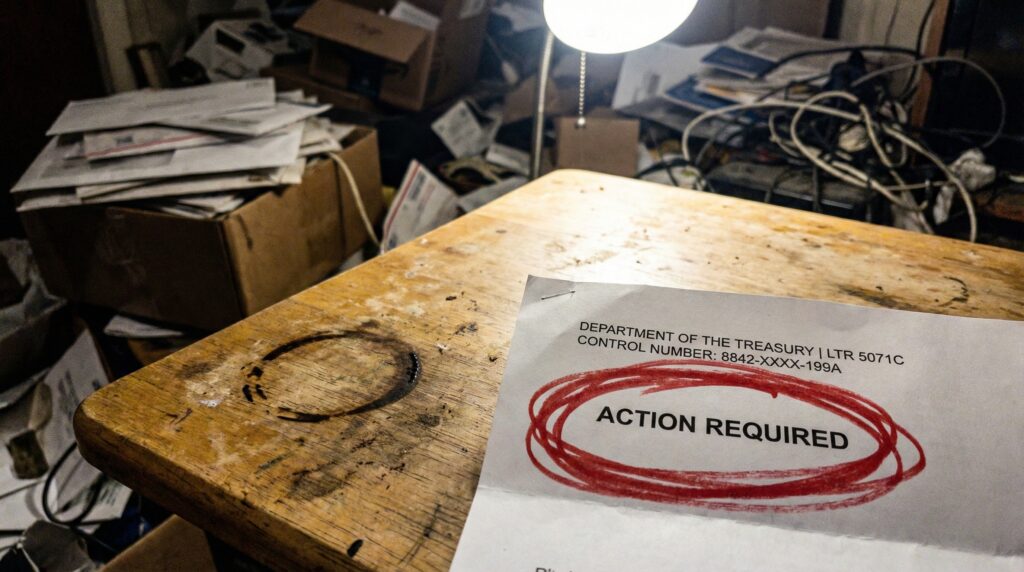
I almost lost my 2026 tax refund because I thought the government was trying to scam me. If you are checking your bank account every morning waiting on a direct deposit, and you receive a plain white envelope from the Department of the Treasury, do not throw it away.
It is not junk mail. It is not a credit card offer. It is likely Letter 5071C, and it means the IRS has completely frozen your tax refund until you prove you are actually you.
This is the bottom line: Your money will not be deposited until you complete the steps inside that letter. The IRS has massively increased its fraud detection filters for the 2026 tax season. Because of this, thousands of legitimate taxpayers are getting caught in the crossfire. I was one of them.
Here is exactly what happened to me and how I unlocked my frozen refund in about fifteen minutes.
The 2026 Identity “Trap”
I filed my taxes early this year, expecting a smooth $4,250 return. I watched the “Where’s My Refund” tool change from “Received” to a frustrating “Still Processing” message. Weeks went by. I assumed it was just the usual mid-February PATH Act delay.
Then, a generic-looking letter arrived. It looked incredibly suspicious. The paper was thin, the logo looked a bit off, and it demanded I go online to verify my identity. My first instinct was to shred it. We are constantly warned about phishing scams, right?
But before destroying it, I decided to do some digging. I quickly realized this was a legitimate, mandatory security checkpoint.
| Feature | Real IRS Letter 5071C | Fake Scam Letter |
| Website Link | Directs ONLY to idverify.irs.gov | Directs to a weird .com or .net link |
| Information Requested | Asks you to log in via ID.me | Asks you to email your SSN or pay a fee |
| Control Number | Contains a 14-digit specific code | Demands payment via gift cards |
How to Verify and Get Your Money
If you are holding Letter 5071C right now, take a deep breath. You are not being audited, and you are not in trouble. The system simply flagged your 2025 return because something looked slightly different—maybe you moved, changed jobs, or the system just randomly selected you.
Here is the exact process I followed to clear the hold:
- Locate your Control Number: Look at the top right corner of the letter. You will need this 14-digit code.
- Gather your documents: Have your 2025 tax return, your 2024 tax return, and a valid photo ID sitting on the table in front of you.
- Go to the official site: Type the URL directly into your browser. Go to IRS.gov and navigate to the “Identity Verification” section. Never click links in random text messages.
- Use ID.me: You will need to log in or create an ID.me account, which involves taking a quick selfie with your smartphone to match your ID.
The Waiting Game After Verification
Once I finished the facial scan and answered a few questions about my W-2, a green checkmark appeared. The system stated my identity was verified and my return would re-enter the processing queue.
Do not expect the money the next morning. The IRS officially states it can take up to 9 weeks to process after verification. However, in my experience, once the hold is lifted, the transcript usually updates with a direct deposit date within two to three weeks.
If you have a pile of unopened mail sitting on your kitchen counter, go check it right now. Your delayed tax refund might just be trapped inside a crumpled envelope.
Disclaimer: This article is for informational purposes only and does not constitute financial or legal advice. Always consult official government resources.

Evan Cole Editor-in-Chief | Breaking News & Public Policy
“From Washington to Wall Street, and Main Street to Hollywood—Evan Cole connects the dots.”
As the Editor-in-Chief at Newskilo, Evan leads a dynamic team of journalists dedicated to uncovering the truth behind the headlines. With over 15 years in digital media, Evan has a reputation for cutting through the noise.
While he is widely recognized for his deep analysis of U.S. fiscal policy (IRS & Stimulus), Evan’s expertise extends to global current events, corporate accountability, and cultural trends. Whether he is breaking down a complex government bill, exposing a tech giant’s failure, or analyzing the societal impact of a viral celebrity moment, Evan’s goal is simple: To tell the stories that shape our world with clarity, accuracy, and integrity.