
The 2026 tax season marks a definitive shift in federal enforcement. For the first time, the IRS has fully operationalized its AI-enhanced “Discriminant Function” (DIF) system.
This is not a pilot program. It is a live dragnet.
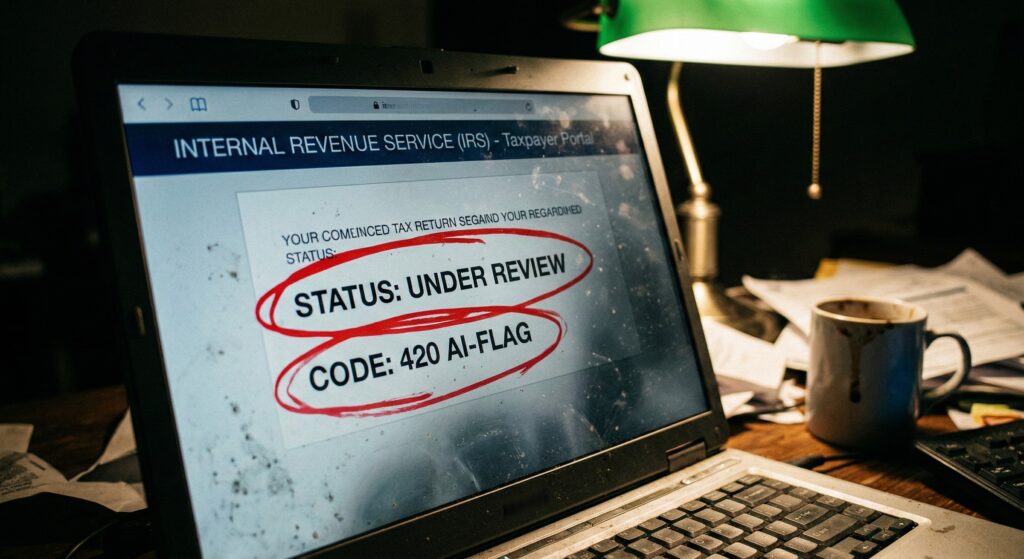
The agency is using machine learning to target high-income earners (specifically those over $400,000), complex partnerships, and “lifestyle discrepancies” with unprecedented precision. If your reported income does not align with your digital footprint, you are statistically more likely to trigger a Transaction Code 420 (Audit Indicator) or Code 424 (Examination Request) on your transcript this year.
The “LPC” Dragnet: Why Partnerships Are Exposed
The most significant operational change is the Large Partnership Compliance (LPC) program.
Historically, the IRS struggled to audit complex pass-through entities like hedge funds, real estate holdings, or law firms. The paperwork was simply too dense for human agents to parse effectively.
That era is over.
New AI models now scan thousands of Schedule K-1s in seconds. They specifically hunt for “balance sheet discrepancies”: instances where your end-of-year numbers do not perfectly match the following year’s starting numbers. If the algorithm detects a mismatch, it bypasses manual review and alerts a human auditor immediately.
3 New AI Triggers for 2026
The IRS is no longer just looking for math errors. They are looking for behavioral anomalies.
1. The “Lifestyle” Check AI tools now cross-reference your reported income with third-party data aggregators. This includes property records, vehicle registrations, and even credit card transaction volumes.
- The Trigger: Reporting $30,000 in income while purchasing a $1.2 million home or registering a luxury vehicle. The system flags this “lifestyle mismatch” automatically.
2. Digital Asset Matching With renewed scrutiny on cryptocurrency, AI connects wallet addresses to taxpayer identities faster than humanly possible.
- The Trigger: Trading digital assets but failing to check the “Yes” box on Form 1040 regarding virtual currency. If the IRS receives a 1099-DA or similar form from an exchange and you didn’t disclose it, the audit selection is nearly automatic.
3. Round Number Syndrome The algorithms are trained to spot “perfect” numbers. Real business expenses are rarely round.
- The Trigger: Listing exactly “$5,000” for advertising or “$2,000” for travel on Schedule C. Consistent round numbers suggest estimation rather than actual record-keeping. This is a primary AI target for 2026.+1
Who Is Actually at Risk?
Fear is widespread, but the data shows the IRS is laser-focused on specific brackets.
| Income Bracket | Audit Risk Level | Primary AI Trigger |
| <$100k | Low | Math Errors / EITC Validation |
| $400k – $1M | High | Schedule C Expenses vs. Revenue |
| >$1M | Critical | Partnership (K-1) Discrepancies |
How to “Audit-Proof” Your Return
You cannot hide from the algorithm. You must file with it in mind.
- Explain the “Why”: If you have a massive, unusual deduction, use Form 8275 (Disclosure Statement) to explain it upfront. AI models often skip returns that include explicit legal justifications.
- Avoid “Ghost” Income: Ensure every 1099-K, 1099-NEC, and W-2 is reported exactly. The Automated Underreporter (AUR) system is ruthless. It does not sleep. It does not make mistakes.
- Don’t Panic: If you receive a CP2000 Notice proposing changes, remember that it is often automated. It is not a final judgment. You can and should contest it with proof.
Disclaimer: This article provides analysis of current IRS enforcement trends. Always consult official government resources.

Evan Cole Editor-in-Chief | Breaking News & Public Policy
“From Washington to Wall Street, and Main Street to Hollywood—Evan Cole connects the dots.”
As the Editor-in-Chief at Newskilo, Evan leads a dynamic team of journalists dedicated to uncovering the truth behind the headlines. With over 15 years in digital media, Evan has a reputation for cutting through the noise.
While he is widely recognized for his deep analysis of U.S. fiscal policy (IRS & Stimulus), Evan’s expertise extends to global current events, corporate accountability, and cultural trends. Whether he is breaking down a complex government bill, exposing a tech giant’s failure, or analyzing the societal impact of a viral celebrity moment, Evan’s goal is simple: To tell the stories that shape our world with clarity, accuracy, and integrity.