
Q: I saw Code 570 on my transcript. Now I’m getting emails to “unlock” my money. Is this legit?
A: Absolutely not. If you are checking your 2025 tax transcript and see Transaction Code 570 (Additional Account Action Pending) followed by Code 971 (Notice Issued), you are in a holding pattern. But here is the critical warning for the 2026 tax season: scammers are actively scraping social media for people complaining about these specific codes.
They will email or DM you claiming they are “tax advocates” who can remove the freeze for a “small processing fee” of $50 or $100. Do not pay them. No one outside the IRS can lift a 570 freeze.
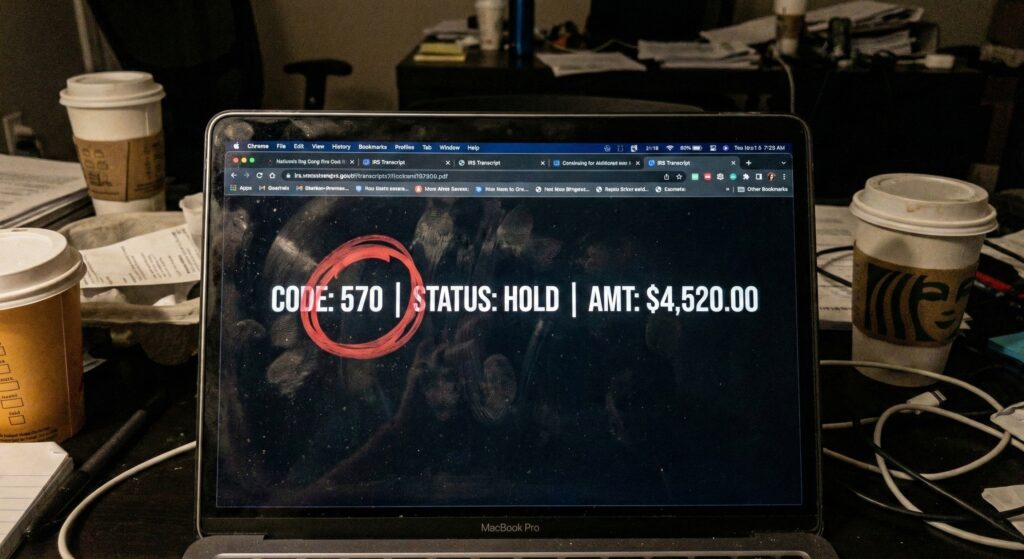
Q: What do these codes actually mean for my refund date?
Let’s cut to the chase.
- Code 570: This stops the refund clock. The IRS system has flagged a discrepancy—usually wages that don’t match what your employer reported, or an ID verification need.
- Code 971: This means a letter is in the mail explaining why the freeze happened.
If you see these, your 21-day timeline is gone. You are likely looking at a 45 to 60-day review period.
Q: How can I spot the “Refund Unlock” scam?
These scams look official. They might use the IRS logo and reference a specific (fake) “Batch #2026-X.” They prey on your panic.
Look at this example scenario:
“Subject: URGENT: Refund of $4,520.00 frozen. Click here to verify identity and release funds immediately.”
Real IRS agents do not email you about specific refund amounts unsolicited. They use the US Postal Service.
Q: Comparison: What is the difference between the codes?
Many people confuse the two. Here is the breakdown:
| Transaction Code | Status Meaning | Action Required? |
| Code 570 | Refund Frozen / On Hold | Wait for update. Do not call yet. |
| Code 971 | Letter/Notice Sent | Yes. Read the letter carefully. |
| Code 846 | Refund Issued | None. Money is on the way. |
Q: What should I actually do if I’m stuck?
First, breathe. Most 570 codes resolve themselves within a few weeks without you doing anything. If you see a 971, wait for the physical letter (usually a CP05 or CP12 notice).
Watch for these Red Flags in emails:
- Requests for payment via Gift Cards or Crypto to “expedite” processing.
- Links that do not end in
.gov. - Grammar errors like “Kindly verify your kindly details.”
- Threats that your refund will be “deleted” in 24 hours.
If you are unsure about your status, always log in directly through the official IRS.gov “Where’s My Refund?” tool or access your Online Account. Never click links in unexpected text messages or emails.
Disclaimer: This article is for informational purposes only and does not constitute financial or legal advice. Always consult official government resources.

Evan Cole Editor-in-Chief | Breaking News & Public Policy
“From Washington to Wall Street, and Main Street to Hollywood—Evan Cole connects the dots.”
As the Editor-in-Chief at Newskilo, Evan leads a dynamic team of journalists dedicated to uncovering the truth behind the headlines. With over 15 years in digital media, Evan has a reputation for cutting through the noise.
While he is widely recognized for his deep analysis of U.S. fiscal policy (IRS & Stimulus), Evan’s expertise extends to global current events, corporate accountability, and cultural trends. Whether he is breaking down a complex government bill, exposing a tech giant’s failure, or analyzing the societal impact of a viral celebrity moment, Evan’s goal is simple: To tell the stories that shape our world with clarity, accuracy, and integrity.