
WASHINGTON — The Internal Revenue Service released its first comprehensive filing season statistics late Monday, revealing a surprising financial trend for 2026: early tax refunds are significantly larger than expected. The agency confirmed that the average direct deposit issued through early February is $2,290, a sharp 10.9% increase compared to the same period last year.
While social media hashtags like #TrumpBonus and #Stimulus2026 are trending, the reality isn’t a new government check—it’s a structural shift in the tax code. For millions of households, the combination of widened tax brackets and inflation-indexed deductions has resulted in a “silent raise” that is finally materializing in their bank accounts.
KEY TAKEAWAYS
- Avg. Refund (Feb): $2,290 (Up ~$225 from 2025)
- Growth Rate: +10.9% Year-Over-Year
- Filing Status: Pending (Millions of EITC/CTC claims processing now)
- Reason: Inflation adjustments & Standard Deduction hikes.
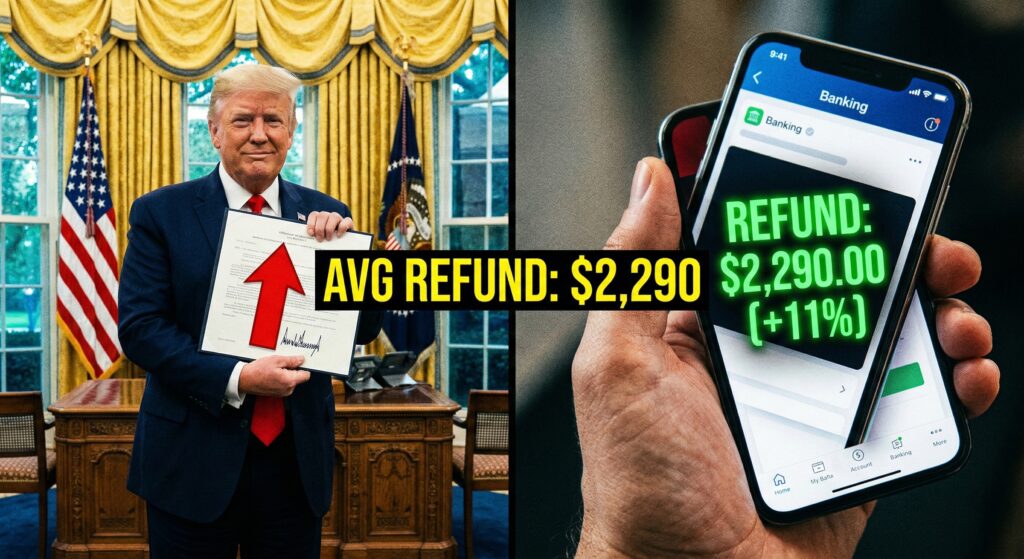
The Viral “Rumor” vs. Reality
TikTok users are posting screenshots of $2,300+ deposits, claiming the government is “secretly sending money.”
The Reality: This is simply your own money returning home, but the “bucket” is bigger this year. Because the Standard Deduction jumped to $32,200 (married) and tax brackets were adjusted for inflation, less of your 2025 paycheck was actually taxable. If your employer didn’t lower your withholding aggressively enough, the IRS now owes you that difference back—with interest in some cases.
“It’s a math equation, not a miracle,” says Eleanor Vance, a senior tax analyst at Capital Insight. “The ‘11% bump’ we are seeing is largely due to the fact that the tax floor was raised. People earned more money, but the IRS taxed less of it. That delta is what you’re seeing in these February direct deposits.”

Who Gets Paid? (The “Batch” Breakdown)
The $2,290 figure is an average, meaning many families are seeing much more. The data suggests that early filers (mostly simple returns) are banking this cash now, but the “Big Wave” is still pending.
| Metric | Feb 2025 (Last Year) | Feb 2026 (Current) | Change |
| Avg. Refund | $2,065 | $2,290 | +10.9% |
| Total Payouts | $16.7 Billion | $16.9 Billion | +1.9% |
| Filing Volume | High | Slightly Lower | -5.2% |
- The “Pending” Factor: The data excludes millions of families claiming the Earned Income Tax Credit (EITC) and Child Tax Credit (CTC). Under the PATH Act, those refunds were legally frozen until mid-February.
- Prediction: As those “Path Act” refunds hit accounts this week, the average refund amount is expected to surge past $3,000.
The “Fine Print”
While the dollar amounts are up, the processing speed for some is slowing down. The IRS noted a slight dip in total filings (-5.2%) compared to last year, suggesting taxpayers are waiting longer to gather documents.
“Do not spend the money before it hits,” Vance warned. “The ‘Pending’ status on the IRS tracker is accurate. If you claimed the Child Tax Credit, your file was likely sitting in a digital holding cell until last week. The floodgates are opening now, but patience is the currency of the realm.”
Political Impact
The Administration is seizing on this “11% Bonus” as proof that their economic policies are working for the middle class. By highlighting the larger refund checks, the White House is framing the tax season as a victory lap for the 2025 inflation adjustments. However, critics argue that a large refund simply means the government over-withheld money from workers’ paychecks during a high-inflation year.
> TRACK YOUR REFUND AT IRS.GOV
NOTE: This report analyzes early-season IRS filing statistics for the 2026 tax year. Refund amounts vary based on individual income, withholding, and credits. Always verify your status with the ‘Where’s My Refund’ tool.

Evan Cole Editor-in-Chief | Breaking News & Public Policy
“From Washington to Wall Street, and Main Street to Hollywood—Evan Cole connects the dots.”
As the Editor-in-Chief at Newskilo, Evan leads a dynamic team of journalists dedicated to uncovering the truth behind the headlines. With over 15 years in digital media, Evan has a reputation for cutting through the noise.
While he is widely recognized for his deep analysis of U.S. fiscal policy (IRS & Stimulus), Evan’s expertise extends to global current events, corporate accountability, and cultural trends. Whether he is breaking down a complex government bill, exposing a tech giant’s failure, or analyzing the societal impact of a viral celebrity moment, Evan’s goal is simple: To tell the stories that shape our world with clarity, accuracy, and integrity.