
Stop sorting receipts. Seriously for most Americans filing their 2025 taxes right now, the Standard Deduction has jumped high enough that itemizing your mortgage interest, donations, and state taxes is no longer worth the effort. And for seniors, a brand-new stacking bonus makes this the most generous filing season in recent memory.
Here is exactly what the numbers look like and what the articles getting this wrong are missing.
The Core Numbers for 2025
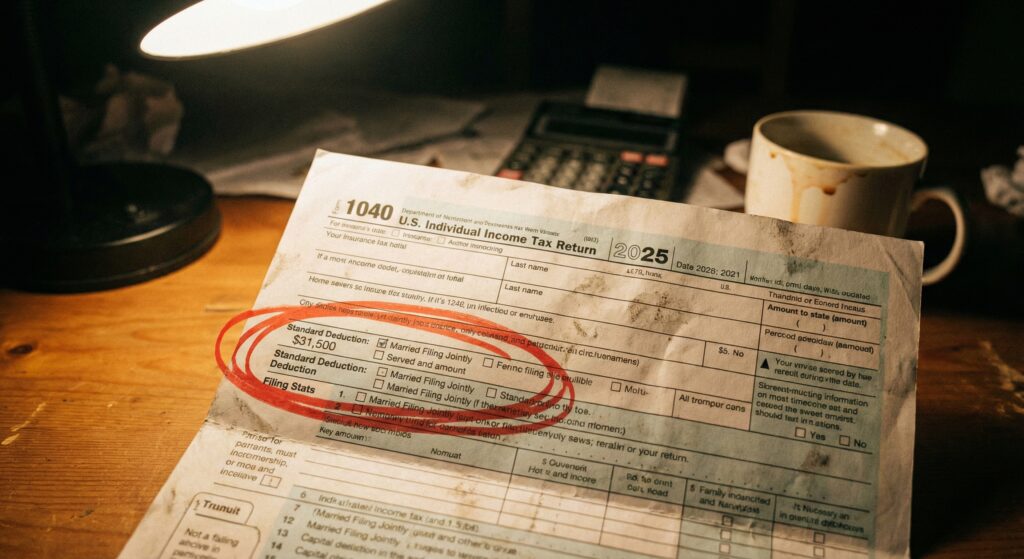
The One Big Beautiful Bill Act (OBBBA), signed into law on July 4, 2025, permanently raised the standard deduction above what the IRS had originally projected. These are the amounts you claim on your 2025 return filed right now in 2026:
| Filing Status | Standard Deduction |
|---|---|
| Single | $15,750 |
| Married Filing Jointly | $31,500 |
| Head of Household | $23,625 |
| Married Filing Separately | $15,750 |
The logic is simple: if your combined itemized deductions mortgage interest, charitable contributions, state and local taxes (capped at $10,000) do not exceed these thresholds, you leave money on the table by itemizing.
The Senior Stacking Bonus (Three Layers Deep)
This is where most articles get it wrong. If you were 65 or older by December 31, 2025, you do not just get one extra deduction you potentially get three stacked on top of each other.
Layer 1 The base standard deduction: Same as everyone else ($15,750 single / $31,500 MFJ).
Layer 2 The age-based bump: A long-standing IRS rule adds $2,000 for single filers age 65+ and $1,600 per qualifying spouse for married filers.
Layer 3 The new OBBBA Senior Bonus: On top of everything above, the OBBBA adds an additional $6,000 per eligible person age 65+. A married couple where both spouses are 65 or older can claim $12,000 total from this bonus alone not $6,000 as some outlets have reported.
What this looks like in real dollars:
| Filer Type | Base | Age Bump | OBBBA Bonus | Potential Total |
|---|---|---|---|---|
| Single, 65+ (income ≤ $75k) | $15,750 | +$2,000 | +$6,000 | $23,750 |
| Married, both 65+ (income ≤ $150k) | $31,500 | +$3,200 | +$12,000 | $46,700 |
The Phase-Out: Who Actually Qualifies for the $6,000?
One important clarification that most coverage is getting wrong: the $6,000 OBBBA bonus does not cut off sharply at $75,000. It phases out gradually starting at $75,000 modified AGI for single filers and $150,000 for married filers, and only disappears entirely above $175,000 (single) or $250,000 (MFJ).
That means a single filer earning $100,000 still qualifies for a partial senior bonus of roughly $4,500, not zero. The 6% phase-out rate is slow enough that middle-income seniors still capture meaningful savings.
Should You Itemize at All?
For 9 out of 10 filers, the answer in 2026 is no. Use this quick test:
- Add up your mortgage interest paid in 2025
- Add your state and local taxes (capped at $10,000)
- Add your cash and non-cash charitable donations
- If the total is less than your standard deduction amount above, take the standard deduction and stop there
The standard deduction requires no documentation, carries no audit red flags for the deduction itself, and for 2025 is higher than it has ever been.
One Step Most Filers Skip
When you open your tax software, look for the question asking about age as of December 31, 2025. Many platforms do not automatically apply the senior bonus you have to indicate your birth year. Missing that checkbox means you walk away without the age bump or the OBBBA $6,000, both of which you are fully entitled to.
This article covers tax year 2025, filed in early 2026, and reflects rules as updated by the One Big Beautiful Bill Act signed July 4, 2025. Tax rules can change; always verify current figures at IRS.gov or consult a licensed CPA before filing.

Evan Cole Editor-in-Chief | Breaking News & Public Policy
“From Washington to Wall Street, and Main Street to Hollywood—Evan Cole connects the dots.”
As the Editor-in-Chief at Newskilo, Evan leads a dynamic team of journalists dedicated to uncovering the truth behind the headlines. With over 15 years in digital media, Evan has a reputation for cutting through the noise.
While he is widely recognized for his deep analysis of U.S. fiscal policy (IRS & Stimulus), Evan’s expertise extends to global current events, corporate accountability, and cultural trends. Whether he is breaking down a complex government bill, exposing a tech giant’s failure, or analyzing the societal impact of a viral celebrity moment, Evan’s goal is simple: To tell the stories that shape our world with clarity, accuracy, and integrity.