
If your 2025 return did not go out by April 15, 2026, the IRS is not sending agents. It is sending a bill. The agency’s automated system has already flagged your account and begun calculating two separate penalties on top of compounding daily interest. The size of that bill depends almost entirely on one thing: whether you owe money.
If the IRS owes you a refund, there is no penalty for filing late. You have three years from the original due date, until April 15, 2029, to claim that money before it is permanently forfeited to the U.S. Treasury. If you owe the IRS, the meter started running at 12:01 a.m. on April 16.
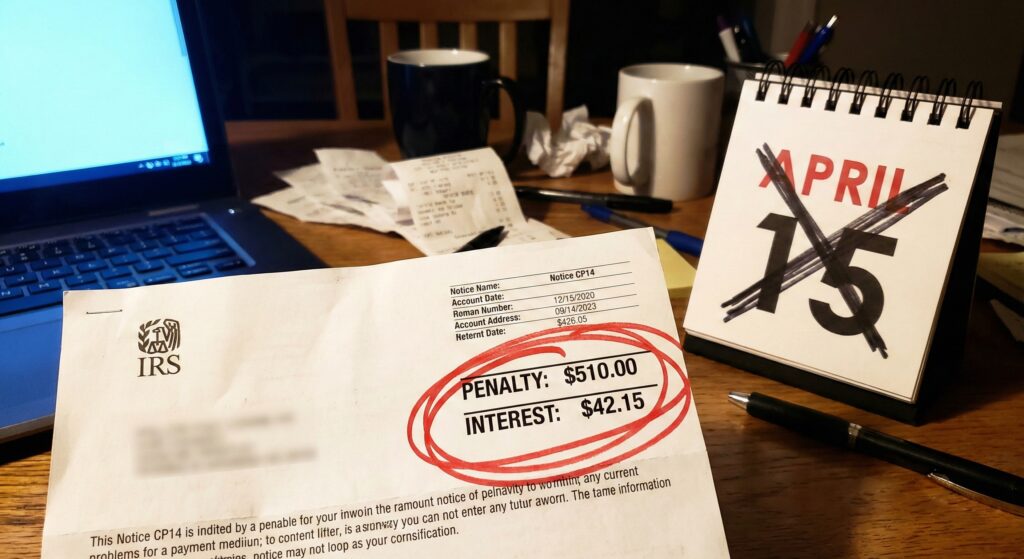
The Two Penalties That Stack
The IRS does not charge one late fee. It charges two, and they compound separately.
Failure to File (the expensive one). This penalty runs at 5% of your unpaid taxes for every month, or partial month, your return goes unfiled. It caps at 25% of your unpaid balance. If your return is more than 60 days late, a minimum penalty kicks in: $525 for 2025 returns, or 100% of the tax owed, whichever is smaller. Small balances take the hardest hit here.
Failure to Pay (the cheaper one). Filing on time but not paying triggers a separate 0.5% monthly penalty on the unpaid balance, also capped at 25%. When both penalties apply in the same month, the IRS reduces the Failure to File rate to 4.5%, keeping the combined monthly charge at a ceiling of 5%.
The gap between those two rates is the entire case for filing immediately, even with an empty bank account.
The Silent Drain: Interest
Penalties can be negotiated. Interest almost never can.
The IRS applies 7% annual interest, compounded daily, on any unpaid tax balance. This rate is set quarterly; it held at 7% through Q1 2026 and is subject to change each quarter thereafter. Interest accrues on top of both the original tax and on accrued penalties, which means delays do not just cost more in percentage terms. They cost more in absolute dollars every single day.
Three Moves to Make Immediately
1. File now, even if you cannot pay.
This is the highest-leverage action available to a late filer. Filing immediately stops the 5% Failure to File penalty. What remains is only the 0.5% Failure to Pay rate, which is one-tenth the cost. You are not required to send payment with the return.
2. Pay something, anything.
Every dollar paid reduces the principal on which both interest and penalties calculate. IRS Direct Pay at IRS.gov allows same-day payments; select “Balance Due” for Tax Year 2025. There is no minimum payment requirement.
3. Request a payment plan.
An approved Installment Agreement locks in monthly payments for up to 72 months. Once active, the Failure to Pay penalty drops from 0.5% to 0.25% per month, but only for taxpayers who also filed their return on time. A Short-Term Payment Agreement covers balances paid in full within 180 days and carries no user fee, but it does not reduce the penalty rate.
First-Time Penalty Abatement: The Option Most Filers Never Use
Neither the IRS website homepage nor most tax software walkthroughs prominently advertises this, but it is real: the First-Time Abatement (FTA) waiver can eliminate both the Failure to File and Failure to Pay penalties entirely.
To qualify, a taxpayer must have filed all required returns, have no prior penalty assessed in the preceding three tax years, and have paid, or arranged to pay, any tax currently owed. The IRS grants FTA requests routinely for first-time offenders. The request can be made by phone or by filing Form 843. Interest on abated penalties is also removed when the underlying penalty disappears, though interest on the original tax balance remains.
Penalty Cost Calculator: Filing Late vs. Paying Late
Assume you owe $2,000 and resolve it three months after the April 15 deadline.
The $270 difference in that example is not a rounding error. At scale, with a $10,000 balance, the same comparison produces a $2,700 gap. Filing immediately is the single most impactful tax decision a late filer can make.
Penalty abatement, installment agreements, and interest calculations are fact-specific. The IRS adjusts interest rates quarterly and applies penalty relief on a case-by-case basis. For any balance exceeding a few thousand dollars, a licensed tax professional can often recover far more than their fee through abatement requests alone.
Disclaimer: This article is for informational purposes only and does not constitute tax, financial, or legal advice. Verify all figures directly at IRS.gov before filing.

Evan Cole Editor-in-Chief | Breaking News & Public Policy
“From Washington to Wall Street, and Main Street to Hollywood—Evan Cole connects the dots.”
As the Editor-in-Chief at Newskilo, Evan leads a dynamic team of journalists dedicated to uncovering the truth behind the headlines. With over 15 years in digital media, Evan has a reputation for cutting through the noise.
While he is widely recognized for his deep analysis of U.S. fiscal policy (IRS & Stimulus), Evan’s expertise extends to global current events, corporate accountability, and cultural trends. Whether he is breaking down a complex government bill, exposing a tech giant’s failure, or analyzing the societal impact of a viral celebrity moment, Evan’s goal is simple: To tell the stories that shape our world with clarity, accuracy, and integrity.