
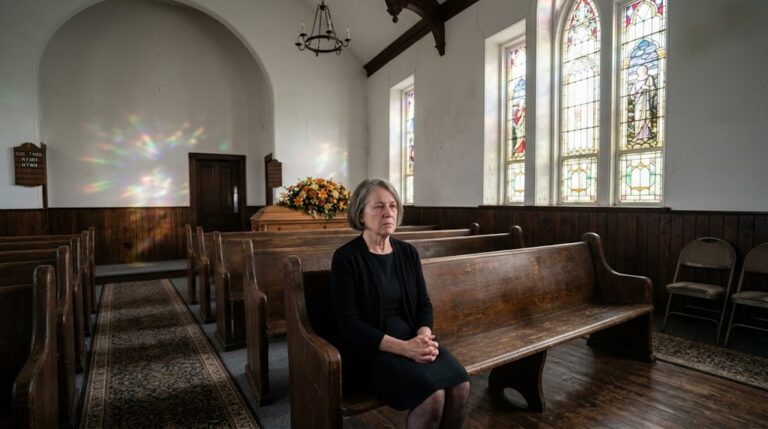
I buried my daughter on a Thursday morning in October.
The leaves outside Saint Michael’s were turning amber and red — the kind of fall day Emily always said was her favorite. She used to drive thirty minutes just to walk through Waveny Park when the colors peaked. She said it made her feel like the world was showing off.
She never got to see this one.
The church was full. Neighbors. Colleagues. Friends from her book club. People who actually loved her. The kind of silence that fills a room when grief is real — heavy and still, like the air before a storm.
Then the doors opened.
The click of heels on marble echoed through the entire sanctuary.
I turned around like everyone else. And there was Ethan Caldwell — my son-in-law — walking down the center aisle with his chin up and a smirk on his face. Not rushing. Not apologizing. Just strolling in like he’d shown up late to a Sunday brunch in Greenwich.
His suit was pressed. Not a hair out of place.
And on his arm — a woman in a red dress. Not dark red. Not burgundy. Bright, bold, look-at-me red. At a funeral. At my daughter’s funeral.
“Traffic on 95 was a nightmare,” he announced to no one in particular.
The priest stopped mid-sentence.
I watched Ethan drop into the front pew — Emily’s pew — and drape his arm around this woman like they were settling in for a show.
As she passed me, she slowed. I thought, for one second, she was going to offer condolences.
Instead, she leaned in close, close enough that I could smell her perfume, and she whispered three words directly into my ear.
“Looks like I won.”
I said nothing. I gripped the edge of the pew, fixed my eyes on my daughter’s casket, and I breathed. Because I had decided — weeks before that moment — that I was not going to be the one who lost control.
I was going to let something else do that for me.
Near the side aisle, I saw Michael Reeves stand up. Emily’s attorney. He was holding a sealed envelope.
He walked to the front of the church, cleared his throat, and said four words that made Ethan’s smirk go completely still for the first time all morning.
Part 2 — Long Sleeves In July
I need to go back. Because the story didn’t start in that church.
It started on a Saturday in late July, when Emily came to visit me at the house in Darien — my little cape cod off Leroy Avenue that I’ve had for thirty years, the one she grew up in, the one where she used to sit on the kitchen counter and eat cereal straight from the box.
She was wearing a long-sleeved cardigan.
It was ninety-one degrees outside.
“I’m just always cold now,” she said before I could ask. Her hand went to her sleeve instinctively, tugging it down.
I let it go. I hate that I let it go.
She sat at my kitchen table and drank iced tea and told me things were fine, that Ethan was just under pressure from work, that the Caldwell Group’s third-quarter numbers were looking bad and it was stressing him out. She smiled the whole time. But her eyes were somewhere else. Like she’d pre-loaded the smile and then checked out.
“Come home,” I told her. “Even just for a few weeks. You and the baby can stay in your old room.”
She was five months pregnant at that point.
“Mom.” She covered my hand with hers. “It’s going to get better. When the baby comes, everything changes. He’ll come around.”
I wanted to believe her.
I should have pushed harder.
Six weeks later, Emily collapsed at home. The paramedics came. By the time I reached the hospital, the baby was gone. And three days after that — so was Emily.
The official report said complications. Heart failure accelerated by trauma.
Trauma.
I’ve been living with that word ever since.
And Ethan — Ethan posted a black-and-white photo on Instagram that night with the caption: “Heaven gained an angel.” Fourteen hundred likes. A blue heart emoji from the woman in the red dress.
He was photographed having dinner in the Meatpacking District the following Friday.
Part 3 — What Emily Left Behind
What no one knew — what Ethan absolutely did not know — was that Emily had spent the last four months of her life meeting quietly with Michael Reeves.
Michael had been her family’s attorney for twenty years. He handled my late husband’s estate. He drew up Emily’s first will when she and Ethan got married, standard stuff, everything to the spouse.
But sometime in late spring, Emily called him on her personal cell — not the landline Ethan monitored, not the email on their shared account. Her personal cell.
She asked him to draw up a new document.
She didn’t tell me. She didn’t tell her friends. She came to see Michael alone, twice, at his office in Stamford, and she was meticulous. Deliberate. Calm in a way that apparently shook him, because he told me later: “She knew exactly what she wanted. She’d clearly been thinking about it for a long time.”
What she wanted was to make sure Ethan got nothing.
The house on Long Ridge Road — purchased before the marriage, with a down payment from my late husband’s life insurance, in Emily’s name alone — she left to me in its entirety.
The investment account she’d built over twelve years as a graphic designer, the one Ethan didn’t know the full balance of because she kept it under her maiden name, Carter — she left to a domestic violence nonprofit in Stamford.
Her jewelry. Her car. Her photography equipment. Her vintage book collection.
All of it itemized. All of it directed away from Ethan with surgical precision.
And there was a letter. Sealed separately. Addressed to me.
Michael told me about all of this the week before the funeral. I sat in his office and he walked me through every page. By the end, I was holding my daughter’s handwriting in my hands and trying to breathe.
She had known.
She had known she was in danger. Maybe not the exact shape of it — but she’d felt it coming, the way you feel a change in weather before the sky shifts. And instead of running, instead of fighting in a way that could have gotten her hurt sooner, she got quiet and she got smart.
She protected everything she could from the man who was hurting her.
And she trusted me to be there when the moment arrived.
Part 4 — What Happened When Michael Started Reading
The room went absolutely silent when Michael cleared his throat.
“Before the burial,” he said — and his voice was steady in a way I have never forgotten — “I am required by direct legal instruction from the deceased to read the last will and testament of Emily Anne Carter. Her explicit directive was that this be done in the presence of all named parties. Today. Here.”
Ethan shifted in the pew.
“A will?” He said it with that half-laugh he uses when he wants to make someone feel small. “My wife didn’t have anything worth — I mean, we filed jointly, the assets are—”
“Mr. Caldwell.” Michael didn’t raise his voice. He didn’t need to. “You are not named as a beneficiary in this document. You are named once, in a separate addendum. I’ll get to that.”
The woman in red stopped smiling.
Ethan’s jaw tightened.
Michael opened the envelope and read it straight through. Every line. Every instruction. The house. The accounts. The letter to me, which he did not read aloud — just noted its existence and handed it directly to me across the aisle.
I held it against my chest without opening it.
When he reached the addendum — the one section that named Ethan — Michael paused. Just for a moment. Then he read it.
Emily had left her husband one item.
A single journal.
With a note attached that said: “So you remember exactly what you did.”
I don’t know what was in that journal. I don’t want to know.
But I watched Ethan’s face go from smug to pale to something I can only describe as cornered. He stood up. Knocked the knee of the woman in red. Said something under his breath.
He walked out before Michael finished speaking.
The woman in red sat there alone for another thirty seconds, looked around at a church full of people staring at her, and then quietly collected her bag and followed him.
The doors closed behind them.
Nobody said anything.
Then someone started clapping.
I don’t know who started it. But within ten seconds, the entire church was clapping — not loudly, not the way you do at a celebration — but the slow, deliberate kind. Like a collective exhale. Like a room full of people letting go of something they’d been holding for too long.
I pressed my daughter’s letter to my chest and I finally — finally — let myself cry.
The Aftermath
Ethan’s attorney contacted Michael within forty-eight hours, contesting the will.
They lost. Emily had been thorough. Every document notarized, every instruction airtight. Michael told me he’d never seen a private individual prepare with such precision.
“She was protecting you,” he told me. “Even at the end. Especially at the end.”
The house sold last spring. I used part of the proceeds to fund an endowment at the Stamford domestic violence shelter in Emily’s name. The rest is in a trust — untouchable, documented, exactly the way she wanted it.
I opened her letter the night of the funeral, sitting in my kitchen with the lights low and a cup of chamomile going cold in front of me.
I’m not going to share what she wrote.
Some things belong only to the people they were meant for.
But I’ll tell you the last line, because I think she’d want someone else to hear it.
She wrote: “Don’t be sad for me, Mom. I spent years being afraid of the wrong things. By the time I figured out what actually mattered — it was you. It was always you. Make sure they remember I was brave.”
I folded that letter and I held it for a long time.
She was brave.
She was the bravest person I have ever known.
And she won. Long before that lawyer ever opened that envelope — she had already won.

Evan Cole Editor-in-Chief | Breaking News & Public Policy
“From Washington to Wall Street, and Main Street to Hollywood—Evan Cole connects the dots.”
As the Editor-in-Chief at Newskilo, Evan leads a dynamic team of journalists dedicated to uncovering the truth behind the headlines. With over 15 years in digital media, Evan has a reputation for cutting through the noise.
While he is widely recognized for his deep analysis of U.S. fiscal policy (IRS & Stimulus), Evan’s expertise extends to global current events, corporate accountability, and cultural trends. Whether he is breaking down a complex government bill, exposing a tech giant’s failure, or analyzing the societal impact of a viral celebrity moment, Evan’s goal is simple: To tell the stories that shape our world with clarity, accuracy, and integrity.
Leave a Reply