
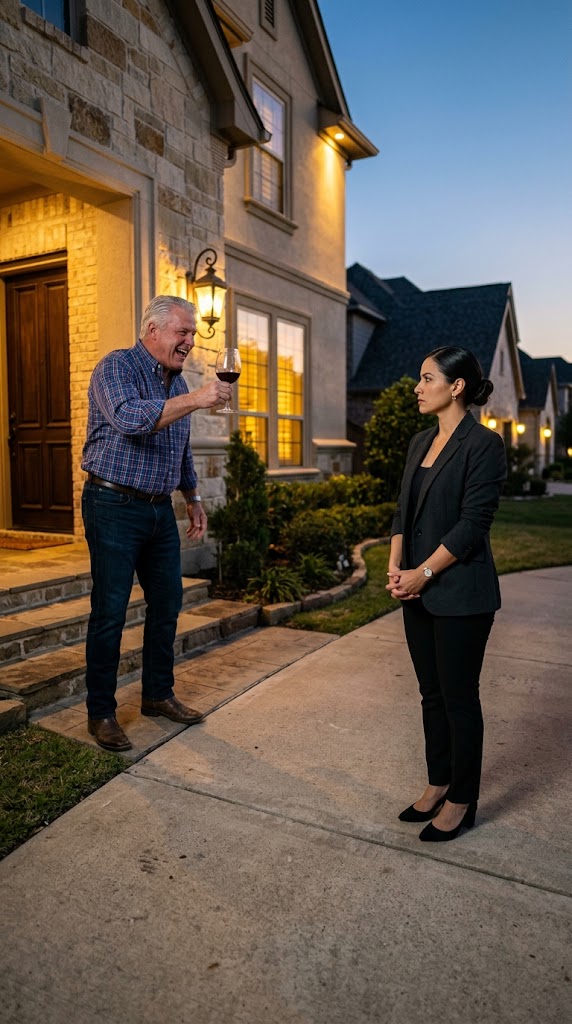
I was already halfway to the door when I heard my brother laugh.
Not a polite laugh. A real one. The kind that tells you the joke landed exactly the way it was meant to.
My father had just stood up at his own birthday dinner — the one I paid for, at the house I helped renovate, at the long walnut table surrounded by people who had watched me work my entire adult life to become something he couldn’t dismiss — and raised his glass.
“To my idiot daughter,” he said.
The room froze. Then broke apart.
“Trying to buy love with money.”
I’d bought him a truck. Not a cheap one. A black King Ranch F-250. Custom wheels. Towing package. The exact engine he’d hinted about for three Thanksgivings straight while claiming he never asked for anything.
I paid cash. Had the title held for the birthday reveal. Drove two hours in traffic to be there on time.
When he opened the key box at the table, the whole room went quiet. He walked around the truck in the driveway, one hand trailing the paint. For thirty seconds, I thought I’d finally gotten something right.
I should have left then. Instead I stayed for dessert.
Now I was standing there while my aunt Cheryl covered her smile with her hand and my mother studied her plate — not in shame, just calculating which version of tonight to support.
I folded my napkin. I smiled at my father like he’d just confirmed something I’d suspected for years. And I walked out without a single word.
Nobody followed.
That was Saturday night. Sunday morning, his driveway was empty. By 8:12 AM, my phone had 108 missed calls.
Part 2: The Truck Was Never Really About the Truck
I want to be honest about something: I knew buying that truck was a risk.
Not financially. I’m thirty-six. I run a supply chain consulting firm I built from nothing, and I’ve been financially independent since I was twenty-four. The cost wasn’t the problem. The cost was the point — or at least, that’s what my father would have said if he’d ever been asked to explain his own behavior out loud, which he never was, because in our family the unspoken rule was that Dad’s opinions were weather. You didn’t argue with weather. You just dressed for it.
My father, Robert, grew up in West Texas with two pairs of jeans and a father who communicated entirely through silence and occasional approval of livestock. He built a modest career in commercial real estate, bought a nice house outside Fort Worth, raised three kids, and somewhere along the way decided that the highest form of love was withholding praise until the recipient stopped needing it.
He wasn’t cruel in the dramatic way. He didn’t hit anyone. He didn’t drink himself into blackouts. He was worse than that, actually — he was charming. Funny at parties. Generous with strangers. He just had a very specific way of making the people closest to him feel like they were perpetually auditioning for a role he’d already decided to give someone else.
My brother Dean was the favorite. Not because Dean was better — Dean peaked in high school and had been coasting on my father’s goodwill and his own confidence ever since — but because Dean was a man, and my father was the kind of man who found women useful but never fully serious. My sister Mara had opted out entirely in her late twenties, married a quiet man from Colorado, and now communicated with the family mainly through Christmas cards and strategic unavailability.
That left me.
The achiever. The responsible one. The one who had put herself through college, built something real, and still showed up to every birthday dinner, every Thanksgiving, every Easter, carrying the hope that this time the metrics would be enough.
The truck was not about buying love. I want to be clear about that, even now.
The truck was about one evening. One single moment where I handed my father something undeniable and he responded like a father instead of a judge.
I had genuinely believed it was possible.
That’s the part that still stings.
Part 3: The Dinner That Changed Everything
The dinner was at my parents’ house — a large colonial-style home in the suburbs of Fort Worth that my father had bought in 1998 and my mother had spent the next twenty-five years furnishing to a standard she referred to as “understated elegance” and everyone else referred to as “a lot.”
Long walnut table. Expensive steaks. Too much red wine. My brother Dean was already bragging about his quarterly bonus before the salad plates were cleared — he’d gotten a 12% raise at the commercial lending firm where he worked, which he mentioned four times in the first forty minutes, each time with slightly different emphasis, like he was testing which version impressed people most.
My mother was wearing emerald silk and the expression she wore when she expected other people to admire her family more than they actually did.
My aunts and uncles had come in from Plano and Arlington. My cousins were filming pieces of the night for their Instagram stories. There were balloons in the den and a giant gold foil “60” propped against the fireplace.
When I slid the key box across the table, the room actually went quiet.
Not politely quiet. Genuinely, unexpectedly quiet.
My father opened it slowly. Saw the Ford logo on the fob. Looked up at me with an expression I had never seen on his face before — something unguarded, almost startled, stripped of the usual performance. Real.
Then everyone went outside.
The truck sat in the driveway under the motion lights with a red bow across the hood. My uncle whistled. Dean let out a low curse he was pretending was a compliment. Even my mother looked impressed, which for her was the emotional equivalent of a standing ovation.
My father walked around the truck slowly, one hand trailing over the paint, the way he used to walk around cars on dealer lots when I was a kid, like he was assessing it, like the truck had to earn something from him too.
“This is mine?”
“Happy birthday, Dad.”
He stood there for a long moment. Said nothing. Then he nodded once — tight, almost reluctant — and said: “Well.”
It wasn’t much. But from him, it was something.
We went back inside. More wine. Louder voices. Dean pivoted seamlessly from his bonus to a story about a golf trip that somehow also involved his bonus. My aunt Cheryl started a side conversation about whether the Cowboys would ever recover their offensive line.
I was sitting at the end of the table, watching my father laugh at something my uncle said, and I remember thinking: just leave now. You got the moment. Don’t push it.
But I stayed for dessert.
My mother brought out the cake — towering, three-tier, caramel and pecan because those were my father’s actual favorites, even though he always claimed he didn’t care about cake. Everyone sang. He blew out the candles. Someone clinked their glass.
And then my father stood up.
Room went quiet again. He was smiling — that familiar tight, amused smile that I had never fully been able to read, the one that could mean he was charmed or the one that meant he was about to perform for an audience.
He lifted his glass.
“Well,” he said, looking around the table. “Here’s to sixty years.” Pause. “And here’s to my idiot daughter.”
I heard the word before my brain had time to soften it.
The room went still for exactly half a second. Then it cracked open with laughter.
“Trying to buy love with money.”
My brother laughed the loudest. My aunt Cheryl covered her mouth, still smiling, eyebrows raised in the amused “oh wow” expression of someone watching a mildly risky bet pay off. My uncle was already nodding like this was the punchline to a joke he’d been waiting for.
My father looked directly at me, glass still raised, smile unchanged.
I felt every eye in the room shift.
And in that moment something clicked — not emotionally, but mechanically, like a lock turning.
I understood. Not just the toast. Everything.
The dinner. The truck. The setup. The thirty seconds of genuine surprise in the driveway, which I now realized had been real but brief — not because the gift was moving, but because the gift had been better than expected, which made it better material.
I had handed my father the best prop he’d ever had.
I stood up slowly. Folded my napkin the way my mother had taught me in the fourth grade. Looked at my father. Smiled. Not a hurt smile. Not a tight smile. A clear one — the kind that tells someone: I see you exactly as you are now, and I will not forget this.
Then I left.
Nobody called out after me. Not even my mother.
I heard the laughter resume before I reached the front door.
Part 4: The Morning After — And What I Actually Did
I drove home that night on I-35 with the radio off and the windows cracked, and I didn’t cry. That surprised me. I thought I would. I had cried over smaller things before — a sharp comment at Thanksgiving, a missed acknowledgment at graduation, the time my father told Dean he was proud of him at Christmas and turned to me and said, “You look tired.”
But that night I didn’t cry. I just drove. And somewhere around Hillsboro, I made a phone call.
To my broker.
My company had purchased the truck through a preferred auto broker who handled fleet and specialty acquisitions for my clients and, occasionally, for me. The title transfer had never been completed — I had specifically held the paperwork, intending to present it formally after the dinner. The truck was still, legally, mine.
I explained what I needed. He said he could have someone at the house by 7 AM.
“Make it quiet,” I said. “No drama. Just come, take the truck, leave.”
“And the bow?”
“Leave the bow.”
I went to sleep at midnight. My phone was already showing three missed calls from my mother and one from Dean. I turned it face-down and didn’t look at it until morning.
At 6:47 AM, I received a text from my broker: En route.
At 7:14 AM: Done. No issues. Title is clean.
At 8:12 AM, I looked at my phone for the first time since I’d woken up.
108 missed calls.
Not 10. Not 40. 108. From my father, my mother, Dean, my aunt Cheryl, my cousin Tyler, two numbers I didn’t recognize, and one from a Fort Worth area code I eventually traced to my father’s neighbor, a retired contractor named Gary who I had met exactly twice at family barbecues.
My father had called Gary.
I sat with that for a while.
The voicemails were exactly what you’d expect. The first wave — calls placed between 7:15 and 7:45 AM — were from my mother and Dean, confused and escalating. “The truck is gone.” “Did you have it towed?” “Call me back right now.” The second wave, from roughly 7:45 to 8:00 AM, shifted in tone. Dean’s messages got louder. My mother’s got quieter, which was worse. And my father’s — I’m not going to transcribe all of them, but I’ll tell you what they had in common: not a single one of them started with an apology. Not one began with “I shouldn’t have said that.” Not one contained the word “sorry.”
They all started with versions of the same thing.
“Where is my truck.”
Not the truck. Not your truck. My truck.
It had been in his driveway for eleven hours, and he had already revised the history of its ownership.
I let my phone ring through to voicemail until 9:30 AM. Then I called my mother back.
She answered on the first ring.
“You need to explain yourself,” she said.
“He called me an idiot at his birthday dinner in front of thirty people.”
Silence.
“He was joking, sweetheart.”
“I know,” I said. “That’s actually the problem.”
Another silence, longer this time.
“Your father is very upset.”
“Mom.” I took a breath. “I love you. But I’m not going to spend today managing Dad’s feelings about consequences. Tell him the truck is at my broker’s lot. If he wants to talk — a real conversation — he knows my number.”
I hung up.
Conclusion: What Happened Next — The Twist Nobody Saw Coming
Here is what I did not expect: my father showed up at my door.
Not with lawyers. Not with a complaint. He drove himself, alone, in my mother’s car, and rang my doorbell at 2:30 on a Sunday afternoon.
I almost didn’t answer.
I watched him through the ring camera for a long moment — this silver-haired man standing on my porch in jeans and a flannel shirt, no performance, no audience, hands at his sides. Looking older than he’d seemed last night. Looking, for the first time in my memory, actually uncertain.
I opened the door.
He didn’t speak right away. He looked at me the way he’d looked at the truck in the driveway — like he was assessing something he hadn’t fully expected.
Then he said: “I didn’t know that would land the way it did.”
I waited.
“Dean laughed, and then everyone laughed, and I—” He stopped. Started again. “I thought it was a joke about how much you always try. How hard you work. I didn’t mean—”
“You called me an idiot in front of your whole family,” I said. “And then you called me thirty-seven times demanding your truck back without once saying that.”
He looked at the porch floor. “I know.”
“How many years have I been trying?” I asked. “How many dinners, how many calls, how many things?”
He didn’t answer.
“I’m not asking you to be a different person, Dad. I’m not asking you to cry or make a speech. I’m asking you to tell me, right now, without anyone watching — was it worth it? The joke. Was it worth it?”
A long pause.
“No,” he said quietly. “It wasn’t funny.”
It wasn’t an apology, exactly. My father doesn’t do those. But from him, it was the closest thing.
I got the truck back from the broker the following week.
I did not give it to my father. I kept it parked in my company lot for four months while we had what I can only describe as the most direct conversations we had ever had in my life — conversations without audience, without performance, without my mother or Dean triangulating in the background.
I gave him the truck again on a Tuesday afternoon in October. No dinner. No bow. Just the title, slid across my kitchen table with a cup of coffee.
He took it without a toast.
That was the best birthday gift I have ever given him.
Some people asked me later if I regretted doing it — taking the truck back, making the scene, all of it.
Here is what I tell them: I didn’t make a scene. I made a boundary. Those are very different things.
A scene is for an audience. What I did was for myself — and, eventually, whether he would admit it or not, it was for him too.
Because thirty-six years of trying to hand my father something undeniable had finally worked.
Just not in the way I expected.
The truck wasn’t what changed his mind.
The empty driveway was.

Evan Cole Editor-in-Chief | Breaking News & Public Policy
“From Washington to Wall Street, and Main Street to Hollywood—Evan Cole connects the dots.”
As the Editor-in-Chief at Newskilo, Evan leads a dynamic team of journalists dedicated to uncovering the truth behind the headlines. With over 15 years in digital media, Evan has a reputation for cutting through the noise.
While he is widely recognized for his deep analysis of U.S. fiscal policy (IRS & Stimulus), Evan’s expertise extends to global current events, corporate accountability, and cultural trends. Whether he is breaking down a complex government bill, exposing a tech giant’s failure, or analyzing the societal impact of a viral celebrity moment, Evan’s goal is simple: To tell the stories that shape our world with clarity, accuracy, and integrity.
Leave a Reply