
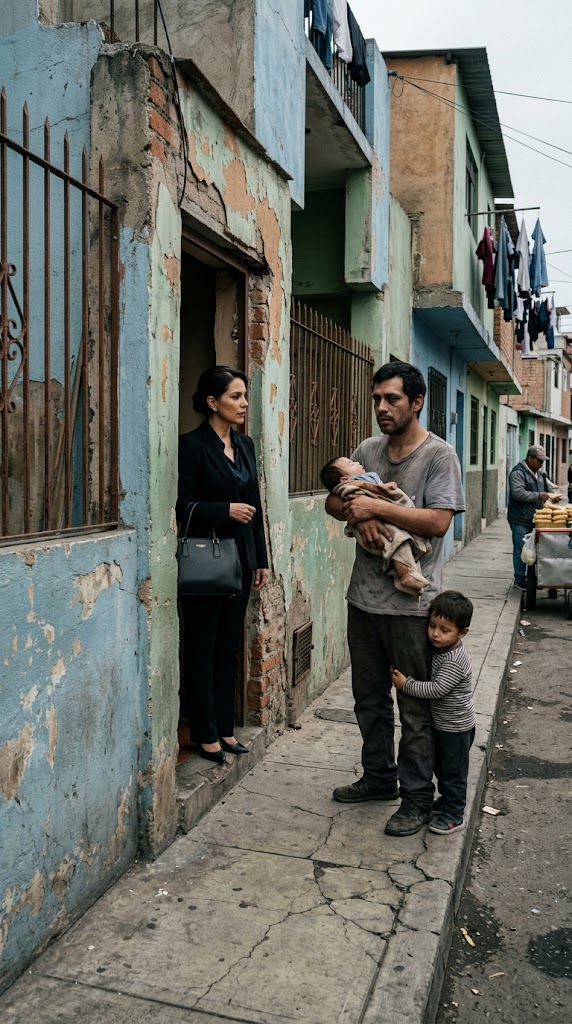
I drove to his house to fire him. I never expected to carry his daughter to the hospital myself.
Three absences. Same excuse every time — “family problems.” I’d heard it a hundred times from a hundred people. I was done being soft about it.
My assistant Patricia kept saying, “He’s never been irresponsible, Laura.” I told her people lie better when they know how to play the victim. I wrote down his address — 118 Jacarandas Street, San Gabriel — and drove to the other side of the city. Past tamale stands, broken sidewalks, dangling wires, children kicking a crushed bottle around like it was a soccer ball.
I sat in my black SUV and watched it all slide past the window. I’m not proud of how I felt in those minutes. But that’s the truth.
His door was wooden. Poorly patched. Paint peeling off in strips.
When he opened it, I almost didn’t recognize him. Not the quiet, efficient man who mopped my office floors before dawn. This man had dark circles so deep they looked bruised. A baby on one arm. A small child wrapped around his leg. He said, “Yes, ma’am,” to my cold opening line, and somehow managed to say it with dignity.
And then I looked past him. A tiny room. Medicine bottles. Notebooks. And on a sagging sofa — a girl of about eight, buried under a blanket, face blazing red, breathing in short, labored pulls.
“She died six months ago,” he said, when I asked about her mother. He said it the way people say things that still wound them every single time.
I didn’t have words. Then a voice from the back — a woman’s voice, sharp with resentment: “Stop playing the victim, Carlos. Those children aren’t my problem.”
I touched the girl’s forehead.
The heat made my hand go cold.
“We’re getting her to a hospital. Now.“
Part 2: The Diagnosis That Made My Legs Go Weak
The private emergency bay of the best hospital in the district — I’d been a donor there for four years. I’d never walked through the actual emergency entrance. I’d attended the charity galas on the upper floors. I knew the hospital’s chairman by his first name over cocktails.
I did not know what bacterial sepsis looked like in a child’s face until that night.
The triage nurses hesitated when they saw Carlos — his worn clothes, his red eyes, the infant against his chest. I set my platinum card on the admissions desk before they could form the question.
“She is under my account. Get a pediatrician out here immediately.”
There’s a specific kind of efficiency that money buys in a hospital that shouldn’t exist but does. Within four minutes, a pediatric specialist was doing an assessment. Within twenty, the girl — her name, I learned, was Sofia — had an IV line, cooling blankets, and three nurses rotating around her.
The doctor pulled me aside while Carlos was with the children.
“Another twelve to eighteen hours and this becomes a very different conversation,” he said.
I looked through the glass partition at Carlos — sitting with the infant on his knee, one hand over his face, his young son pressed against his side asleep — and I thought about the meeting I’d been planning in my head during the drive over. The prepared language. The HR paperwork already drafted on my desk. The way I’d planned to be precise and unemotional about it.
Three absences.
I had almost let a man get fired for the crime of watching his daughter almost die without enough money to do anything about it.
The pediatrician was still talking. I was only half-hearing him. I was doing a different kind of calculation — not the kind I did with quarterly reports, but the kind that tells you exactly how wrong you have been.
Part 3: What He Told Me in the Waiting Room — and What I’d Never Bothered to Ask
The private waiting room on the pediatric floor had a coffee machine, soft lighting, and chairs that didn’t hurt your back. I handed Carlos a cup. He held it with both hands like it was a life raft.
The infant was asleep in a hospital bassinet. The young son had been taken by a kind nurse to a small children’s area down the hall, where he was watching cartoons with a blanket over his shoulders.
For the first time in hours, it was almost quiet.
“I was going to come in tonight,” Carlos said. “I just didn’t have anyone to watch them.”
“Tell me about the mother-in-law,” I said.
He exhaled. “She only comes to the house to collect rent. The house technically belonged to her husband — my wife’s father. When he died, she kept the deed. She lets us stay there, but she makes sure we know we can leave any time.” His jaw tightened. “She told my wife that getting sick was a choice.”
“Your wife was sick before she died?”
“Fourteen months,” he said. “We spent everything we had on partial treatments. Borrowed from everyone we knew. When she passed, I had three children, a rented house I couldn’t be sure I’d keep, and approximately six hundred dollars.”
He said it flatly. Not looking for sympathy. Just accounting.
“And you kept showing up to work,” I said.
“I needed the job,” he said simply.
I thought about Patricia again. He’s never been irresponsible. She had tried to tell me. I had been so confident in my ability to read people that I had not actually looked at one.
“Patricia told me you were studying accounting,” I said.
He almost smiled. The first time I’d seen anything like it on his face that night. “One semester from finishing. I had to drop out when my wife got her diagnosis. The night classes stopped making sense when I was working double shifts and sitting in hospital waiting rooms.”
He looked around at the private waiting room — the soft chairs, the good lighting — with an expression I recognized. It was the expression of someone who has spent a long time in the other kind of waiting room. The ones with plastic chairs and flickering fluorescent lights and a number ticket you pull from a dispenser.
“One semester,” I said.
“Yes, ma’am.”
Part 4: The Decision I Made at 11:47 PM — and Why I’ve Never Regretted It
Sofia’s fever broke at 11:31 PM. The doctor came out to tell us personally. Carlos covered his face again, but this time his shoulders weren’t shaking with despair. They were shaking with relief — a different thing entirely, though it looks the same from the outside.
I waited until he’d collected himself.
“Carlos,” I said. “You aren’t fired.”
He looked up.
“Starting Monday, you are on paid administrative leave for four weeks. Full salary. You will use that time to find a proper apartment — the company will advance you three months’ deposit, interest-free — and to be with your children while Sofia recovers.”
He opened his mouth. I kept going.
“When you return, you will not be returning to the maintenance crew. You’ll be joining the junior accounting department. We will cover the remaining semester of your tuition. Your children are enrolled in our corporate childcare program, effective immediately.”
The silence lasted long enough that I started to wonder if I’d said it unclearly.
“I don’t understand,” he said finally. His voice was almost a whisper.
“You’ve been taking care of my company for three years,” I told him. “It’s past time the company took care of you.”
He tried to say something and couldn’t. The infant shifted in the bassinet. Down the hall, his son laughed at something on the cartoon he was watching — a bright, unguarded child’s laugh that carried all the way to where we were sitting.
I drove home at 1 a.m. through the empty city.
My penthouse was exactly as I’d left it — immaculate, silent, expensive. I stood in the kitchen in my ruined designer suit — there was a faint smudge of children’s grime on the lapel and a small dried handprint on the shoulder where Sofia had gripped me in the car — and I did not change immediately.
I stood there for a while.
The Twist Payoff: What Happened Six Months Later
Four months after that night, Carlos submitted his first independent accounting analysis to the department head — a quarterly variance report on our facilities vendor contracts. It was so thorough, and identified such a specific and previously overlooked billing discrepancy in our cleaning supply procurement, that the department head forwarded it to me with a single line: Where did you find this person?
The discrepancy Carlos identified recovered $34,000 in overcharges we had been absorbing for two years.
He finished his final accounting semester in the evenings while working his new role during the day, with the children in our corporate childcare three floors below his desk. He passed with the highest grade in his cohort.
The mother-in-law, I was told by Patricia — who by that point had taken a personal interest in monitoring the situation — vacated the house two weeks after our encounter, apparently deciding that whatever leverage she thought she had was no longer worth exercising against a man whose employer had just become visibly invested in his stability.
Sofia came to the office Christmas party that December. She walked in holding her father’s hand in a bright red dress, absolutely recovered — healthy, loud, curious, tugging at everything on the snack table. When Patricia introduced her to me, Sofia looked up and said very seriously, “Are you the lady who carried me in your good jacket?”
I told her yes.
She considered this. “Your jacket is prettier now,” she decided.
It was. I’d had the handprint dry-cleaned off, but I’d kept the suit. I wear it occasionally. On days when I feel the particular gravity of glass towers pulling me back toward the place where I’d been before that evening — the place where efficiency was the highest value and the floors below me existed to be shone.
The handprint is gone, but I know exactly where it was.
That, I think, is the point.

Evan Cole Editor-in-Chief | Breaking News & Public Policy
“From Washington to Wall Street, and Main Street to Hollywood—Evan Cole connects the dots.”
As the Editor-in-Chief at Newskilo, Evan leads a dynamic team of journalists dedicated to uncovering the truth behind the headlines. With over 15 years in digital media, Evan has a reputation for cutting through the noise.
While he is widely recognized for his deep analysis of U.S. fiscal policy (IRS & Stimulus), Evan’s expertise extends to global current events, corporate accountability, and cultural trends. Whether he is breaking down a complex government bill, exposing a tech giant’s failure, or analyzing the societal impact of a viral celebrity moment, Evan’s goal is simple: To tell the stories that shape our world with clarity, accuracy, and integrity.
Leave a Reply