
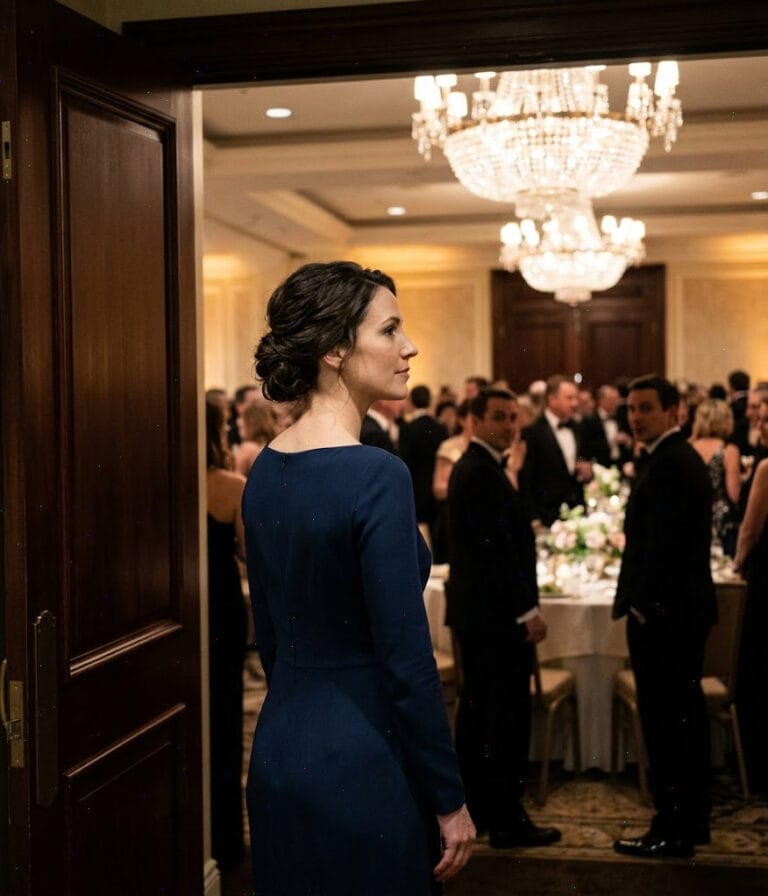
If someone had told me years ago that my ex-husband would one day invite me to a wedding just so a room full of people could quietly watch me struggle, I probably would have dismissed it as bitterness speaking louder than reality.
But by the time his message appeared on my phone that quiet afternoon, the way he treated me had already become so familiar that it no longer surprised me — lingering in my life like the heavy coastal air in Florida, sometimes light, sometimes overwhelming, but always present in the background of ordinary days.
The message came through while my four-year-old twins, Lucas and Adrian, were stretched out on the floor of our small Tampa apartment, completely absorbed in their world, pushing toy cars along a racetrack they had built from cardboard boxes and old books. I sat at the kitchen table surrounded by grocery receipts, trying to stretch a budget that never quite stretched far enough, pretending not to notice that the ceiling fan above me had stopped working weeks ago.
My phone vibrated against the table.
The name on the screen made my chest tighten immediately. Darren. My ex-husband. The father of my children. And the man who had spent years turning every hardship in my life into something that, in his mind, proved I deserved it.
His message was short, but the meaning was transparent. His cousin was getting married at a luxury hotel by the water. He thought it would be “nice” if I came. I could bring the boys, he added — as if they were props in a scene he had already staged and lit.
I didn’t need to read it twice.
He wanted an audience. He wanted people to look at him and see success, then look across the room at me and quietly draw conclusions without saying a word out loud. He wanted me standing there in simple clothes, managing two restless small children, while his relatives raised their glasses and smiled at each other behind polite eyes.
This wasn’t an invitation. It was a stage. And I was meant to be the evidence of a story he had been telling for years.
I tried to hold myself together. That lasted about four seconds.
Children notice the things adults wish they wouldn’t. Lucas looked up first, studying my face with that particular seriousness that four-year-olds carry when they sense something is wrong but can’t name it yet. Adrian followed, setting his toy car aside and tilting his head.
“Mom, why do you look sad?” Lucas asked.
Then Adrian asked the question that nearly undid me completely.
“Does Dad not want us anymore?”
I pulled them both into my arms and held them for a long moment, telling them that if someone couldn’t see how extraordinary they were, that was his loss — not theirs. Never theirs.
My phone vibrated again.
Unknown number.
I almost let it go to voicemail. But something made me answer.
“Please don’t hang up,” the voice said. Calm. Quiet. Careful. “I believe I just overheard your ex-husband explaining exactly how he plans to embarrass you tonight.”
I stared at the wall and said nothing.
He introduced himself as Victor Salgado and told me he had been sitting in the hotel restaurant two floors below when he overheard Darren on a phone call, speaking loudly, telling a friend that inviting me to the wedding would give everyone a chance to see “how poorly things had turned out.”
Victor didn’t sound entertained when he repeated those words. He sounded genuinely uncomfortable.
Then he mentioned the house. The home where Lucas and Adrian were born. The place Darren had told me he’d been forced to sell due to business pressure — a story I had accepted because I needed something to make sense of the loss.
According to Victor, that had never been the full truth.
Darren had been describing, quite openly, how he had managed certain personal debts by quietly liquidating the property while making it seem unavoidable.
My grip tightened around the phone.
“Your ex-husband believes tonight will be his moment,” Victor said. “He has already designed the stage. He expects a specific performance from you.”
He paused.
“If you’re willing — we can make sure that stage doesn’t belong to him.”
Part 2: The Man Who Listened Without Judging
Under any other circumstance, I would have ended that call immediately.
Life had already taught me that unexpected offers from strangers, especially wealthy ones, tended to arrive with strings attached that only became visible later. I didn’t have the bandwidth for more complications.
But then Victor said something that made me stop.
“Moments like that don’t just affect you,” he said, gently but directly. “Children remember them. For the rest of their lives.”
He told me he had seen Lucas and Adrian playing in the courtyard the day before.
“They looked like two little princes running through their own world,” he said, and there was a quiet warmth in his voice that didn’t sound performed. “Children like that shouldn’t grow up watching their father succeed by making their mother look small.”
He no longer sounded like a stranger.
He sounded like someone who understood exactly what was at stake — not just for me, but for two small boys who were still building their understanding of what love looked like and what their mother deserved.
Within the hour, Victor was sitting at my kitchen table.
He was the founder of Salgado Holdings, with businesses across the United States and Latin America, and he carried himself with the specific quietness of someone who had nothing left to prove. He didn’t fill silence unnecessarily. He didn’t perform.
He just listened.
I told him everything. He didn’t interrupt once. When I finished, he was quiet for a moment before he spoke.
“Darren expects you to walk in looking defeated,” he said. “He has prepared an audience for a version of you that you don’t have to be.”
He stood and walked to the window, looking out at the worn buildings and the laundry drifting in the evening air, then turned back toward me.
“He wants a performance,” Victor said. “So let’s give him one he didn’t write.”
Part 3: The Turning Point
I had two hours.
Victor made three calls while I put Lucas and Adrian down for a short rest, each conversation brief and precise, the way people speak when they’re used to things actually happening after they speak.
By 5:30 PM, a woman named Renata was at my door with a garment bag and a small kit. She worked, apparently, with Victor’s team regularly. She didn’t ask questions. She didn’t offer unnecessary opinions. She simply looked at me for a moment and got to work.
I sat at my kitchen table — the same table covered in grocery receipts an hour earlier — and let someone take care of me for the first time in longer than I could clearly remember.
While Renata worked, Victor sat across from me and told me the plan.
We weren’t going to confront Darren. We weren’t going to cause a scene. We weren’t going to do anything he could later reframe as instability or bitterness or the performance he had already written for me in his head.
We were simply going to arrive.
“The most disorienting thing you can do to someone who has spent months building a narrative about your decline,” Victor said carefully, “is show up looking like the narrative was never true.”
He was right.
I knew he was right before he finished the sentence.
Darren had constructed a version of me for that room — a version built from his own retelling of the past four years, polished and repeated until the people in that ballroom had already absorbed it without realizing it. My job tonight wasn’t to fight that version.
My job was to simply be too real for it to survive contact with me.
At 6:45 PM, I looked in the bathroom mirror.
I didn’t look like someone making an effort. I looked like someone who had simply never stopped.
Lucas came to the doorway, rubbing one eye. He looked up at me for a long moment.
“Mom,” he said. “You look like a queen.”
I almost cried. I didn’t.
Not tonight.
Part 4: The Final Confrontation
We arrived at 7:10 PM.
Victor walked beside me, relaxed and unhurried, in the quiet way of someone who knew that presence was its own language. Lucas held my left hand. Adrian held my right.
The hotel entrance opened into a long corridor lit with warm amber light, and at the end of it, the ballroom doors stood open.
I could hear the noise of the reception — glasses, laughter, the low current of a room full of people in expensive clothes performing enjoyment for each other.
I paused for exactly one breath at the threshold.
Then I walked in.
The shift in the room was subtle. Not dramatic. Not cinematic. Just — real. The kind of thing that happens when something enters a space that doesn’t match what people were prepared to see.
I watched it move through the room like a quiet ripple — a turned head here, a double glance there, someone mid-sentence who lost the thread of what they were saying.
And then Darren turned around.
I don’t have the right words for what crossed his face in that moment. It wasn’t anger, not yet. It wasn’t embarrassment, though that was coming. It was the specific disorientation of someone whose plan has just made contact with a reality that didn’t cooperate.
He looked at me. Then at Victor. Then back at me.
The cousin whose wedding this was — a kind woman named Patricia who had always been quietly decent to me — broke away from a group near the bar and came toward me with genuine warmth.
“You came,” she said, pulling me into a hug. “I’m so glad you came.”
Behind her, I watched Darren’s posture shift.
He had prepared a role for me tonight. He had set a table for a specific version of events and invited an audience to watch. What he hadn’t prepared for was the possibility that I would simply refuse to play the part he’d written.
He approached us about twenty minutes later. Carefully. With the cautious smile of a man trying to recalibrate in real time.
“You look—” he started.
“Thank you for the invitation,” I said simply. Not cold. Not warm. Just complete.
He glanced at Victor.
“Who is—”
“A friend,” I said.
Lucas tugged my hand at that moment and pointed toward the dessert table, asking if they could have something with sprinkles, and I turned my full attention to him — completely, genuinely — and the conversation with Darren ended the way many things between us had needed to end years ago.
Not with an explosion.
Just with me choosing where to put my attention.
He stood there for a moment longer than was comfortable, then turned and walked back toward his group.
I didn’t watch him go.
There is something nobody tells you about the moments that are meant to break you — that they only work if you accept the role that was written for you.
Darren had spent months constructing a version of me for that room. He had told his story to cousins and old friends and anyone who would listen, painting careful strokes of a woman who had fallen apart without him.
He needed that story to be true because the alternative was harder to carry: that I had built something real, that I was still standing, and that the years he’d spent measuring his success against my difficulty had been measuring the wrong things all along.
I left the wedding at 9:30 PM.
Lucas fell asleep in the back seat before we reached the freeway. Adrian stayed awake for exactly two traffic lights, then went quiet.
Victor drove without speaking for a while.
“How do you feel?” he finally asked.
I thought about it honestly.
“Like myself,” I said.
That was the most accurate answer I had.
Not victorious. Not vindicated. Not even particularly triumphant. Just — like myself. Fully. Without apology and without performance.
The ceiling fan in my apartment still didn’t work when I got home. The grocery receipts were still on the table. Nothing had magically resolved.
But I had walked into a room someone built to diminish me, and I had walked back out still whole.
That’s the thing no one can engineer away from you once you understand it: the story only belongs to the person who refuses to let it be written for them.
I refused.
That night — for the first time in longer than I can honestly remember — I slept well.

Evan Cole Editor-in-Chief | Breaking News & Public Policy
“From Washington to Wall Street, and Main Street to Hollywood—Evan Cole connects the dots.”
As the Editor-in-Chief at Newskilo, Evan leads a dynamic team of journalists dedicated to uncovering the truth behind the headlines. With over 15 years in digital media, Evan has a reputation for cutting through the noise.
While he is widely recognized for his deep analysis of U.S. fiscal policy (IRS & Stimulus), Evan’s expertise extends to global current events, corporate accountability, and cultural trends. Whether he is breaking down a complex government bill, exposing a tech giant’s failure, or analyzing the societal impact of a viral celebrity moment, Evan’s goal is simple: To tell the stories that shape our world with clarity, accuracy, and integrity.
Leave a Reply