
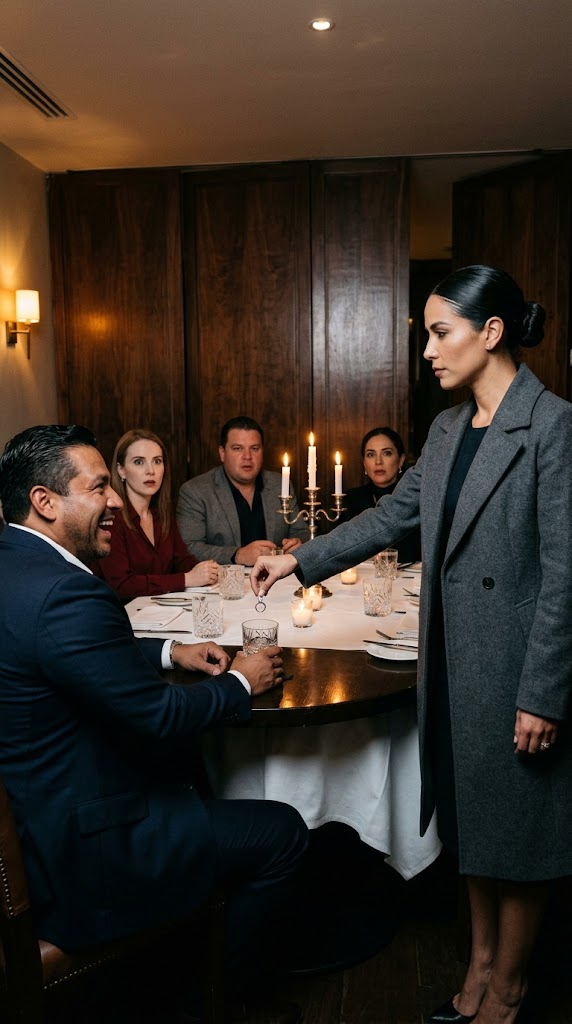
I walked in twelve minutes late.
Still in my coat. Phone still warm from a call that had ended thirty seconds earlier. My mind barely in the room yet.
And the first thing I heard was his voice — laughing.
“I don’t want to marry her anymore.”
I stopped cold behind the wooden divider near the private dining room. I knew that voice. I had been waking up next to it for two years.
Mauricio.
I didn’t move. I go still when something is about to get worse — it’s a reflex I built long before I became a corporate lawyer. I hold position. I let the truth finish arriving.
“She’s… pathetic,” he said.
And the table laughed.
Not an uncomfortable laugh. Not a nervous one.
A real one.
I recognized Rodrigo’s. Sofía’s. People I had spent weekends with — birthdays, spontaneous trips, long dinners where I showed up half-dead from work and still smiled just enough.
People I had trusted.
I stood there for a moment that felt impossibly long.
I’m thirty-four. A partner at a restructuring firm. My job is walking into businesses that are quietly dying — beautiful from the outside, rotting underneath — and figuring out exactly what is worth saving and what needs to be cut.
I know how to read a room that is pretending everything is fine.
And standing behind that divider, I understood something I had been too busy — too invisible — to see clearly.
He never looked at me and saw a partner.
He saw a convenience.
So I walked to the table.
Daniela saw me first. The color left her face completely. She opened her mouth — and closed it.
Mauricio turned. I watched it all move across his face in real time — shock, then fast calculation, then that practiced charm rising like a mask he’d worn for so long he’d forgotten it was one.
I didn’t give him time to put it on.
I reached down slowly. No trembling. No scene.
I slid the ring off my finger — that enormous solitaire he had picked specifically to impress people at tables exactly like this one — and set it softly beside his whiskey glass.
The sound it made was almost nothing.
But every single person at that table went completely still.
“It’s fine,” I said. “You don’t have to marry me.”
And that’s when I saw it.
Relief.
Just a flicker. Half a second.
He covered it fast — replaced it with manufactured concern — but I caught it. And I wasn’t the only one.
I recognized that expression. I’ve seen it hundreds of times across conference tables — on the faces of businessmen who believe they’ve just escaped disaster.
Right before they realize how much worse it’s about to get.
Part 2: What The Laughter Cost Him
I need to go back.
Not because the ending needs context — but because what happened that night didn’t start in that restaurant. It started fourteen months earlier, in a glass-walled conference room on the twenty-second floor of a building in Santa Fe, when a man named Mauricio Valdés Reyes walked in with a company that was six weeks away from insolvency and sat across from me like he was doing me a favor by being there.
He was handsome. He knew it. He leaned back in the chair like a man who had always been told that charm was a substitute for preparation.
His company — a mid-sized real estate development firm, highly leveraged, badly structured — had missed two consecutive debt service payments and was hemorrhaging key executives. His CFO had quietly resigned the month before. He had two creditors circling and a board that was starting to ask questions he couldn’t answer.
I had seen it a hundred times.
He needed a restructuring agreement. A clean, legally airtight arrangement that would satisfy his creditors, stabilize the firm’s obligations, and give him time to recapitalize. Without it, his company was finished — not next year, not in six months. In six weeks.
I drew up the agreement personally.
My name was on line thirty-one.
Thirty-eight pages of precise, protective legal architecture — every clause designed to hold his world together while he found his footing. I negotiated with his creditors directly. I sat in rooms with lawyers who were paid more than I was to tear the arrangement apart, and I held every line.
And somewhere in the middle of those late nights and high-pressure calls and the slow, grinding work of saving a company that didn’t deserve saving as much as its owner believed it did — I made a mistake I had never made before in my professional life.
I let it become personal.
The dinners started as follow-up meetings. Then they became something else. He was attentive in a way that felt rare. He asked questions about my work like he actually wanted to understand it. He laughed at the right moments and went quiet at the right ones.
He was performing. I know that now.
But at thirty-four, after years of being the smartest person in every room and the least noticed woman in every social one, being chosen — being seen, or so I believed — felt like something I hadn’t known I was waiting for.
We had been together eleven months when he proposed.
The ring was magnificent. Large, precisely chosen, absolutely spectacular in candlelight.
It was designed to be photographed. I understand that now too.
The restructuring agreement, meanwhile, was renewed at the twelve-month mark with my signature and remained, quietly, the legal backbone of everything his company stood on. His creditors had accepted its terms. His board had stabilized. His public valuation had recovered.
He had not once, in fourteen months, mentioned it at a dinner party.
Why would he? To him, it was paperwork. Details. Something his lawyers handled.
He didn’t understand — had never bothered to understand — that I was the lawyer.
That the agreement was mine.
That without my firm’s continued backing, it expired in eleven days from that November evening in Polanco.
And I was the only person at that table who knew it.
Part 3: The Night I Chose Not To Perform
I have a rule I developed in my first years of practice.
Never let the room know what you know until you’re ready to use it.
I had sat through bad-faith negotiations. I had listened to men explain my own legal filings back to me incorrectly and waited until the exact moment to correct them so calmly that the air left the room. I had learned that the most powerful position in any confrontation is the one where you are the only person who fully understands what is happening.
That night at the restaurant, Mauricio thought he was the one in control.
He was wrong about that the moment I walked in.
After I set the ring down, after I said what I said, after his face did everything it did — I didn’t leave. That was the part no one expected.
I pulled out the chair across from him and I sat down.
Rodrigo looked at Sofía. Sofía looked at Daniela. Nobody spoke.
Mauricio reached for his whiskey.
“You didn’t have to come out here to do this,” he said quietly. He had already recalibrated. He was already managing the situation, controlling the narrative, preparing the version of this story he would tell at the next dinner.
“I didn’t come here to do this,” I said.
“Then what are you doing?”
I looked at him for a long moment. This man who had chosen that ring for the photograph it would take. This man who had called me pathetic to people who ate at our table. This man who had felt relief — pure, unguarded relief — when I gave it back.
“I came for dinner,” I said. “You’ve been the one doing things.”
Sofía laughed — once, nervously — and immediately covered her mouth.
Mauricio’s jaw tightened.
He leaned forward.
“Look,” he said. The charm was fully gone now. What replaced it was something colder. “I’ve been honest with you. We’re at different stages. I didn’t handle this the right way, I know that—”
“Mauricio,” I said.
He stopped.
“I’m not here to have that conversation.”
“Then what do you want?”
I reached into my coat.
The document was folded in thirds — I had been carrying it for two days, not because I had planned this, but because I had been reviewing it for an unrelated reason and had simply not yet removed it from my coat.
In that moment, I was grateful for my own disorganization.
I unfolded it slowly. Set it on the table between us.
He glanced at it. Then looked more carefully.
His color changed.
“That’s—”
“Yes,” I said.
Rodrigo leaned sideways to look at the document. I watched him read the header. I watched his expression shift.
“What is that?” Sofía asked.
Nobody answered her.
Mauricio was staring at the paper. At the date printed at the top. At the expiry clause on the third page — which I had turned to before folding it, specifically, two days earlier, for no reason I could have explained then.
“This expires in eleven days,” he said slowly.
“Yes.”
“And your firm—”
“Withdraws backing. Yes.”
The table was absolutely silent.
Mauricio sat very still. Something was happening behind his eyes — the fast, cold arithmetic of a man calculating damage in real time. The creditors. The board. The timeline. What eleven days meant versus what sixty days would have meant. What my signature meant. What its absence meant.
I watched him arrive at the number.
“You can’t do that,” he said quietly. Not angry. Careful.
“I haven’t done anything,” I said. “The agreement has standard terms. I’ve simply made no decision about renewal.”
“That’s the same thing.”
I tilted my head slightly.
“Is it?”
Part 4: The Final Confrontation
He asked the others to leave.
Rodrigo went immediately — stood up, jacket in hand, out the door in under thirty seconds. Sofía followed without speaking. Daniela touched my arm as she passed — a light, uncertain pressure, like she wanted to say something she hadn’t earned the right to say yet.
And then it was just us.
The waiter appeared. Mauricio waved him off without looking up.
For a long moment, neither of us spoke. The restaurant moved around us — muffled laughter from another table, the soft collision of cutlery, someone ordering wine — and we sat inside a bubble of absolute stillness.
“How long have you known?” he asked finally.
I didn’t answer immediately.
“About what you said tonight — or about the way you’ve seen me for the past year?”
He looked up.
“Both.”
“Tonight — about four minutes before I sat down.”
“And the other.”
I looked at him.
“Long enough to recognize it for what it is.”
He sat back. The mask was completely gone now. What was underneath it was not the charming, handsome man from the conference room three years ago or the attentive dinner companion from two years ago. What was underneath it was just a man — tired, scared, and suddenly very aware that he had profoundly misunderstood the nature of the situation he was in.
“What do you want?” he asked.
And I realized something, sitting across from him in that candlelit room, with his ring still on the tablecloth between us and his company’s future sitting in my coat pocket:
I didn’t want anything from him.
That was the truest, most clarifying thing I had felt in two years.
I wasn’t there for leverage. I wasn’t there to negotiate. I wasn’t there to watch him beg or panic or perform remorse. I hadn’t walked to that table planning any of this — I had simply walked to the table because I was no longer willing to stand behind a divider and listen.
The document was coincidence. My signature on line thirty-one was a consequence of my work — not a weapon I had crafted for this moment.
But I understood something now that I had needed to understand.
He had known, for some time, what that agreement meant. He had simply believed — as men like him often do — that the person holding it would never use it. That I was too professional. Too measured. Too committed to reputation and process and keeping things clean to ever simply choose myself over the structure.
He thought my reliability was his safety.
He thought my competence was his guarantee.
“I don’t want anything from you,” I said.
The relief that crossed his face was extraordinary.
And then I kept going.
“But I want you to understand something clearly, because you are going to spend a significant amount of time — starting in approximately eleven days — trying to understand what happened here.”
He waited.
“You made a decision tonight about who I was to you. That decision wasn’t made tonight — it was just spoken out loud tonight, which is the only reason I’m grateful I was late.”
“Valentina—”
“I’m not finished.”
He closed his mouth.
“You built your company’s recovery on work I did. You wore the stability that my firm provided as if it were something you had created. You introduced me to those people as your fiancée while telling them I was pathetic. And you felt relieved — genuinely relieved — when I gave the ring back.”
I folded the document and placed it in my inner pocket.
“So no. I don’t want anything from you.”
I stood.
“I want you to understand that the two things you underestimated most — my work and my patience — were the only things keeping your life exactly as you wanted it.”
I picked up my bag.
“And I genuinely hope the next eleven days teach you something that the last three years clearly couldn’t.”
I walked out.
The November air in Polanco was cold and clean and absolutely perfect.
I stood on the sidewalk for exactly one minute. Traffic moved past. A couple laughed somewhere behind me. The city was completely indifferent to what had just happened inside that restaurant, which was exactly right.
Then I took out my phone and called my associate.
“Hey — get me the renewal file on the Valdés restructuring,” I said. “I want to look at our options.”
The Aftermath: What Real Power Looks Like
Mauricio called three times that night. Once from his personal line, twice from a number I didn’t recognize — probably his lawyer, already on a call before midnight.
I didn’t answer any of them.
In the morning, I had a formal letter from his legal team requesting an emergency meeting regarding the restructuring timeline. Professional. Careful. Exactly the tone you use when you are terrified and trying very hard not to show it.
I forwarded it to my associate with two words: “Schedule it.”
The meeting happened four days later. Mauricio arrived with two lawyers and a revised proposal that was, frankly, significantly more favorable to our firm than the original agreement had been. He was perfectly composed in the conference room — professional, measured, the full charm restored for business purposes.
He never mentioned the restaurant.
Neither did I.
We renegotiated the restructuring agreement over three sessions. Every clause was reviewed. The new terms protected our firm more aggressively, extended the liability window, and gave us considerably more oversight authority over the company’s restructuring decisions.
He signed everything.
Three weeks after that dinner in Polanco, his company had a new agreement — stronger than the one before, entirely on our terms — and I had submitted the paperwork dissolving our engagement to the jeweler who had designed the ring.
Rodrigo texted me once. An apology that was too carefully worded to be genuine and too short to mean anything. I read it once and put my phone down.
Daniela came to my office.
She stood in my doorway on a Tuesday morning and she looked like she hadn’t slept well in a week.
“I should have said something,” she told me.
“Yes,” I said. “You should have.”
“I’m sorry.”
I looked at her for a moment.
“I know you are,” I said. “Honestly. But I need you to understand — the hardest part of that night wasn’t what Mauricio said.”
She waited.
“It was realizing how long I’d been performing contentment for a table full of people who were comfortable watching me disappear.”
She nodded slowly. Her eyes were wet.
“I don’t know if I can forgive that yet,” I told her honestly. “But I’m not angry. I’m just clear now in a way I wasn’t before.”
She left. I don’t know where things stand with us. I find I’m not urgently trying to figure it out.
What I Know Now
People ask me — colleagues, sometimes, when pieces of what happened that night have filtered through professional circles the way things do — whether I planned it. Whether the document in my coat was calculated. Whether I had been waiting for a moment like that.
The honest answer is no.
The honest answer is that I was twelve minutes late because a client in Guadalajara had a crisis at 6:47 PM and I stayed on the phone because that is what I do. The document was in my coat because I had been reviewing it two days earlier and had simply not taken it out. I had not rehearsed what I said at that table. I had not known I was going to sit down.
What I had — what I have always had, and what that night made visible to me in a new way — was the capacity to stay composed when everything is collapsing. To read a room with clarity when every emotion in my body is screaming. To speak precisely when imprecision would cost me more than silence.
Those are not traits I developed in law school.
They are traits I developed in thirty-four years of being the woman in the room who worked twice as hard to be taken half as seriously.
Mauricio thought he was calling me pathetic.
He was, without knowing it, describing the version of me he needed me to be for his life to work the way he wanted it to.
I was never that version.
I was the one on line thirty-one.
And the moment I stopped pretending otherwise — stopped making myself small enough to fit in the story he was telling about me — was the moment everything became very, very clear.
The ring is gone.
The agreement has been renewed — on my terms.
And I had dinner alone last Tuesday at a small restaurant in Condesa. No performance. No audience. No wooden divider hiding anything.
Just me, a glass of very good wine, and the particular quiet of a person who finally stopped waiting to be seen by someone who was never really looking.
It was the best dinner I’d had in two years.

Evan Cole Editor-in-Chief | Breaking News & Public Policy
“From Washington to Wall Street, and Main Street to Hollywood—Evan Cole connects the dots.”
As the Editor-in-Chief at Newskilo, Evan leads a dynamic team of journalists dedicated to uncovering the truth behind the headlines. With over 15 years in digital media, Evan has a reputation for cutting through the noise.
While he is widely recognized for his deep analysis of U.S. fiscal policy (IRS & Stimulus), Evan’s expertise extends to global current events, corporate accountability, and cultural trends. Whether he is breaking down a complex government bill, exposing a tech giant’s failure, or analyzing the societal impact of a viral celebrity moment, Evan’s goal is simple: To tell the stories that shape our world with clarity, accuracy, and integrity.
Leave a Reply