
His voice was shaking with rage on the other end of the line.
Mine wasn’t.
“Reactivate the card RIGHT NOW, Rebeca! Or I swear I will cut you out of my life completely!”
I was sitting at the kitchen island in our house in Coyoacán. My coffee was still warm. Through the window, purple jacaranda petals drifted slowly down from the trees and onto the sidewalk — as if they had absolutely nowhere urgent to be.
I stirred my coffee slowly. Let the silence stretch.
“Are you even listening?!” Mauro’s voice cracked. “My mother is here, my sister is crying — you’re leaving us standing in an airport like criminals!”
I wasn’t leaving anyone anywhere.
Three hours earlier, I had called the bank and reported my platinum card stolen. Because it was. I hadn’t given anyone permission to take it from my office drawer and charge first-class flights to Vail on it. I found out the same way I found out most things in this marriage — after the fact, with a note on the kitchen counter as the only courtesy extended to me.
“We went to Vail with my parents and Jimena for a week. You’re paying for everything. After all the stress you cause us, we deserve it.”
No question. No phone call. No conversation.
Just a note. Like I was a bank with a name.
Then Patricia’s voice came on — it always did, precisely when she decided her son needed reinforcement.
“Don’t be ridiculous,” she said. “You are Mauro’s wife. What’s his is yours and what’s yours is his. That’s how a real family works.”
I let out a quiet laugh.
“That’s a fascinating definition of family, Patricia.”
“Watch your tone,” she snapped back. “Fix this now. Because when we get back, you will be the one leaving this house.”
This house. She had said those two words to me for three years — every argument, every holiday, every passive-aggressive dinner where I sat at a table that she acted like I was a guest at. Jimena never bothered to pretend. She treated me like a stranger who had moved in without being invited. And Mauro stood between all of it and said, every single time, “That’s just how they are. Don’t take it personally.”
I took it personally.
“Mauro,” I said, before he could start again. “Don’t worry. Soon, you won’t need to speak to me as your wife.”
Patricia gasped.
“Is that a threat?!”
“No,” I said. “It’s a fact. It’s over.”
I hung up.
Part 2: The Vacation That Sealed Everything
They didn’t come back in three days.
They came back in four — because Jimena wanted a final spa afternoon.
Mauro texted me from the resort pool terrace to let me know. Not to apologize, not to explain, not to acknowledge any of it. To tell me the snow had been perfect and that I needed to “stop being so dramatic.” The lounge chairs were visible behind him in the photo he attached, which he seemed to have sent without realizing was worse than not sending anything at all.
Patricia spent those four days doing what Patricia did in every conflict — she went to the family.
Audio messages, one after another, to aunts, cousins, Mauro’s godmother, an uncle I had met exactly once. She described how I had “humiliated her son” in front of an airport full of people. How I had “always been cold.” How I had “never really understood what it meant to be part of a family like theirs.”
I received four separate calls from relatives asking me, gently and uncomfortably, to please fix things and consider everyone’s feelings.
I forwarded every message to Verónica Saldaña, my attorney.
Jimena posted the vacation photos on Instagram. Vail powder snow, glasses of wine by a fireplace, matching robes, a group photo with wide smiles and arms around each other. She captioned one: “Family always comes first.”
It got forty-seven thousand likes.
She had no idea those photos — every geotag, every timestamp — would be sitting inside a legal document by the end of the week.
Meanwhile, I was not sitting still.
I met with Verónica for three hours the first night. I gave my finance director a list of transactions I had been quietly tracking for months — small amounts, irregular, disguised as business expenses inside our household accounts. She confirmed what I had already suspected.
The numbers didn’t lie. They never did.
Mauro had been financially bleeding from me in slow, careful increments for a long time. Long enough to have learned which amounts wouldn’t trigger scrutiny. Long enough to have convinced himself that this was just how things worked between married people.
He had confused access with permission.
He had confused proximity with ownership.
And for five years, I had let him.
Not anymore.
Part 3: The Turning Point
Here is what Mauro never knew about the house in Coyoacán.
He thought of it as ours — the way people think of things as theirs simply because they live inside them, sleep in them, eat in them every day. He spoke about it to friends with the casual ease of a man who believes he is the natural center of any space he inhabits.
He had never once read the property documents.
The house was held in a trust.
The trust was in my name.
My father, a methodical and quietly brilliant man who had built his business from nothing in Guadalajara, had set it up four years before Mauro and I ever met. He had seen things in his lifetime that taught him a particular lesson about mixing love and legal vulnerability. When I married, he said nothing about it — just squeezed my shoulder once and told me the paperwork was in order.
I had never told Mauro.
Not out of secrecy, but because it simply never came up. He never asked. He assumed. And his assumptions were comfortable for him, so he protected them the way people protect comfortable things — by never looking too closely.
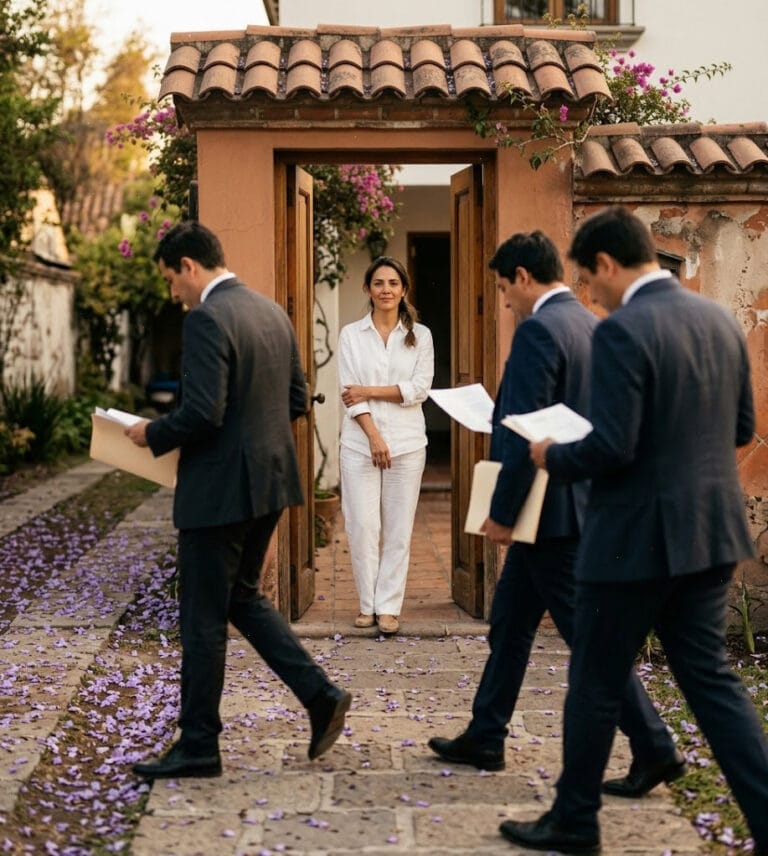
The night they returned from Vail, I dressed carefully.
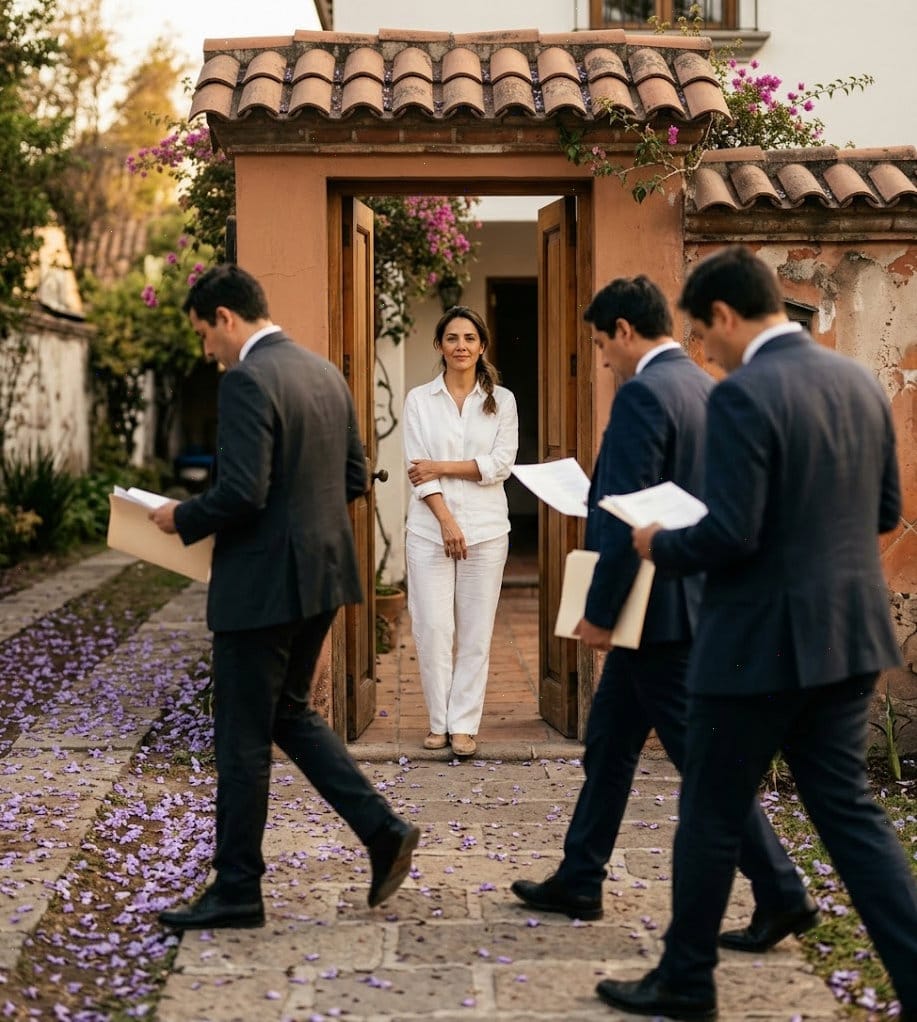
White linen top. Dark trousers. Simple earrings. I was not going to give anyone the satisfaction of seeing me disheveled, or crying, or diminished in any visible way.
Verónica arrived at 6:45 p.m. with two attorneys and a court officer.
We stood in the entrance — on my side of the door — and we waited.
The car pulled up at 7:10.
Part 4: The Final Confrontation
Mauro got out first.
He had rehearsed something. I could see it the same way you can see a rehearsed expression on someone’s face — slightly too composed, slightly too ready. He had spent four days in a luxury resort being surrounded by people who told him he was right, and he had arrived home prepared to be the wronged party with dignity.
Patricia stepped out behind him, new sunglasses still on at 7 p.m. She scanned the entrance with the expression of a woman who has already decided what she is walking into.
Jimena didn’t look up from her phone until she was halfway up the stone path.
Then she saw Verónica.
Then the attorneys.
Then the court officer.
She stopped.
Mauro’s rehearsed expression lasted approximately four seconds.
“What is this?” His voice was lower now. Not angry yet. Confused in a way that was much more satisfying than anger would have been.
Verónica stepped forward and held out the folder with both hands — the way she always did, cleanly, with no drama at all.
“Mr. Mauro Beltrán. You are hereby notified of formal divorce proceedings, exclusive property claims under the trust designation, and a complaint for unauthorized use of financial instruments.”
Patricia laughed. A sharp, reflexive laugh — the kind that is really just shock wearing a different mask.
“You cannot do this here,” she said. “Not in our house.”
Verónica looked at her calmly.
“That’s precisely why we can.”
The silence that followed was the kind that fills a space completely.
Even the street was quiet. A few jacaranda petals drifted down from the tree at the edge of the property and settled on the stone path between us and them.
Mauro looked at the folder in his hands without opening it.
Then he looked at me.
For five years, when Mauro looked at me, there was always something proprietary in it — the particular gaze of someone who sees what they own rather than who they love. I had noticed it early and told myself I was imagining it. I had noticed it later and told myself it didn’t matter. And then one morning I woke up and understood that some things matter precisely because you spent so long pretending they didn’t.
He was not looking at me that way now.
“Rebeca,” he said. Quieter. “We can talk about this.”
“We could have talked about it before you took my card out of my desk and left without telling me,” I said. “We could have talked about it three years ago, the first time your mother told me I’d be leaving this house. We could have talked about it any one of the hundreds of times I asked you to.”
He said nothing.
“You always told me not to take it personally,” I said. “I took it personally, Mauro. I was right to.”
Jimena had gone completely still. Her phone was in her hand but her eyes were up, and behind her sunglasses she was doing a rapid, private calculation.
Patricia stood at the edge of the path, and for the first time in three years, she had nothing to say.
I turned and walked back inside.
Verónica would handle everything that came next. That was what I had paid her for, and she was very, very good at her job.
I went to the kitchen. I poured the rest of my cold coffee down the sink and made a fresh cup.
Outside, the jacarandas were losing their petals in the evening breeze — whole sheets of purple falling gently, covering the ground, covering the path, covering the stone.
I watched them through the window and felt, for the first time in years, like I could breathe all the way down to the bottom of my lungs.
The Space That’s Left
Freedom does not arrive with fireworks.
It arrives in small, quiet moments — the first night you sleep without bracing for a sound, the first morning you drink your coffee without calculating someone else’s mood, the first week you look at your own bank account and feel only clarity instead of that low, constant anxiety of watching it disappear into someone else’s appetite.
Mauro’s legal team contacted Verónica within forty-eight hours, as expected.
They came in confident. They left with a significantly more accurate picture of the situation.
The house proceeded through the trust without contest. The financial complaint resulted in a formal settlement agreement. The marriage was dissolved in five months — efficiently and without screaming, because by the time we reached the final documents, there was nothing left to fight about. Every fight Mauro thought he might have had, he had already lost before it started.
Patricia called me once, early on — a different tone than I had ever heard from her. Not apologetic, exactly. But something in the register below outrage that I recognized as the beginning of understanding.
I listened for a moment.
Then I wished her well and ended the call.
Jimena deleted the Instagram post.
Some things — not all things, but some — simply cannot be undone.
Here is what I know now, that I wish I had understood sooner: the people in your life who tell you that disrespect is just personality, that entitlement is just habit, that what’s yours is simply ours without any conversation about it — those people are not describing reality. They are describing the reality they prefer, and hoping you will stop seeing the difference.
I stopped.
The jacarandas in Coyoacán bloom every spring without fail — those same purple trees, the same petals on the same sidewalks. They were blooming the day I made the calls that changed everything.
I think about that sometimes.
How the most important decisions of a life often happen in ordinary kitchens, in ordinary light, with a cup of coffee going cold beside you.
And how the only difference between a woman who stays and a woman who doesn’t — is the moment she decides that she already knows everything she needs to know.
I had known for a long time.
I was finally ready to act like it.

Evan Cole Editor-in-Chief | Breaking News & Public Policy
“From Washington to Wall Street, and Main Street to Hollywood—Evan Cole connects the dots.”
As the Editor-in-Chief at Newskilo, Evan leads a dynamic team of journalists dedicated to uncovering the truth behind the headlines. With over 15 years in digital media, Evan has a reputation for cutting through the noise.
While he is widely recognized for his deep analysis of U.S. fiscal policy (IRS & Stimulus), Evan’s expertise extends to global current events, corporate accountability, and cultural trends. Whether he is breaking down a complex government bill, exposing a tech giant’s failure, or analyzing the societal impact of a viral celebrity moment, Evan’s goal is simple: To tell the stories that shape our world with clarity, accuracy, and integrity.
Leave a Reply