
My mother looked directly at me in front of the entire family and said it out loud.
“You were always her least favorite. She knew you’d waste everything.”
No hesitation. No shame. Like she had been holding that sentence for years and was finally, finally allowed to use it.
My grandmother had just been buried four days earlier.
My name is Thea. I’m thirty-one. I teach third grade in Hartford, Connecticut — and in my family, that has always been treated like a mild embarrassment rather than a career.
My older brother Brandon? Investment banker. Every holiday was basically a tribute to him. My parents bought him a Rolex last Christmas to celebrate a promotion.
My gift that year was a Costco gift card.
I’m not being dramatic. That actually happened.
The only person in my family who ever looked at me like I mattered was my grandmother, Eleanor.
She called me on my thirtieth birthday, off-key singing and laughing, and told me I was “the best thing this family ever created.” She baked me cookies and wrote little notes and kept a framed photo of the two of us on her nightstand until the day she died.
So when my dad called at midnight three weeks ago to say she was gone, I drove straight to Westport.
Not a single person hugged me when I walked in.
My mother told me the funeral arrangements were already handled. Brandon was giving the eulogy — because, as my mother explained with zero irony, he was “better with public speaking.”
I asked my father point-blank: am I in the will?
He went quiet for so long I understood the answer before he said a word.
That night I started reading everything I could find about probate law.
Then a thick envelope arrived from a law firm I had never heard of. Inside was an invitation to the will reading, formal and professional — and at the bottom, two words that made my stomach drop:
Separate matter.
I wore the blazer my grandmother always loved. I barely slept.
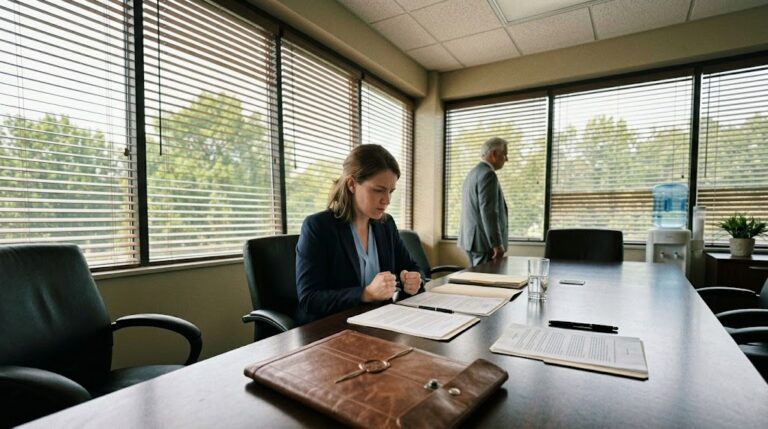
The reading happened in a conference room flooded with morning light. My parents at the head of the table. Brandon next to his wife. Everyone composed.
And in the corner — a silver-haired man I had never seen before, holding a leather envelope, completely still, watching the room like he had been waiting a long time for this moment.
The will was read.
House to my father. Investments to Brandon. Everything else to my mother.
My name — not once.
Then my mother turned to me and delivered the line she had clearly rehearsed.
The room stayed silent. My brother looked at the table. My father almost smiled.
And then the man in the corner stood up.
And nothing in that room — or in my life — was ever the same again.
Part 2: What They Thought Was Already Settled
Growing up in Westport, appearances were everything.
My father sold real estate to people with generational money. My mother ran the family’s social calendar like a military operation — the right club memberships, the right dinner parties, the right Christmas card photo every single year.
Brandon fit that world effortlessly. He was sharp, athletic, easy in rooms full of important people.
I was the one who cried at sad commercials and brought stray cats home and became a teacher because I genuinely loved it.
That was the divide in our family. Not income. Not achievement. Fit.
Brandon fit.
I didn’t.
My grandmother Eleanor was the only one who never made that distinction.
She lived twenty minutes away in a house that always smelled like coffee and old books. When I was in college and struggling, she was the one who called every Sunday. When I got my first classroom, she drove forty-five minutes to bring me a handmade banner that said Miss Lawson’s Room in her careful cursive.
She came to my classroom Christmas pageant three years running.
My parents made one, briefly, five years ago — and spent most of it checking their phones.
When she passed — quietly, in her sleep, which everyone agreed was peaceful — I felt the loss in a way that was hard to describe to people who hadn’t experienced it. Like a room in your house suddenly going dark.
I drove to Westport that night in the rain.
The house was fully lit. Cars in the driveway. People moving around inside like the logistics of death required immediate management.
No one came to the door when I knocked. I let myself in.
My mother was on the phone in the kitchen, voice low and efficient. My father was at the dining room table with a yellow legal pad in front of him.
I stood in the entry for almost a full minute before my mother looked up and said, without warmth, “Oh. You made it.”
That was it.
That was the greeting.
I went upstairs alone. Her lamp was still on. The blanket folded at the foot of the bed. The photo of the two of us — taken at my college graduation — sitting on the nightstand exactly where it always had.
I sat down beside the empty bed.
I put my hand where hers would have been.
And downstairs, I could hear my parents talking in tight, clipped tones that sounded nothing like grief.
They sounded like people finalizing a transaction.
Part 3: The Envelope With Two Words
The letter arrived four days later.
Thick cream paper. A return address I didn’t recognize — Kesler & Associates, a small firm in New Haven. My full legal name printed carefully on the front. No “Mrs.” No “Ms.” Just: Thea Marguerite Lawson.
My grandmother used my middle name.
Nobody else ever did.
Inside was a formal letter, two paragraphs, inviting me to the will reading at the family attorney’s office. Professional. Standard.
Except at the bottom, below the address and the date and the RSVP instructions, were two words typed in a separate line:
Separate matter.
I read it standing in my apartment doorway still in my coat.
Then I read it again.
I called the number on the letterhead. A woman answered, polite but firm. She confirmed my attendance was requested. She confirmed the date. When I asked what “separate matter” meant, she said, “Mr. Kesler will explain at the reading.”
That was it.
I spent the next three days barely sleeping.
I reread every card my grandmother had ever sent me. I went through old voicemails I’d saved — her voice, always warm, always unhurried, always finding ways to say you matter without using those exact words.
The last time I had seen her, six weeks before she passed, she had held both of my hands in hers and looked at me with an expression I couldn’t fully read at the time.
“No matter what happens,” she said, “you’ll be taken care of.”
I thought she was talking about life in general. About resilience. About the kind of reassurance grandmothers give because they love you.
I didn’t understand she was being specific.
The night before the reading, I laid out the navy blazer she always complimented — you look like a woman who knows her worth in that thing — and I set my alarm for six a.m.
I barely needed it.
I was awake by four.
Part 4: The Room Where It All Broke Open
The conference room at my family’s attorney’s office was bright and corporate — round table, leather chairs, a water pitcher nobody touched.
My father sat at the head of the table. My mother to his left, pearls on, posture perfect. Brandon beside his wife, already scrolling his phone when I walked in.
No one acknowledged me immediately.
I sat across from my mother and placed my hands flat on the table so she could see they weren’t shaking.
In the far corner, the silver-haired man sat alone. He hadn’t brought coffee. He hadn’t brought an associate. Just himself and that leather envelope resting on the table in front of him, unsealed but closed.
He caught my eye once and gave the smallest nod.
The family attorney — a man named Gerald who had worked with my grandparents for thirty years — cleared his throat and began.
The house in Westport: my father.
The investment portfolio: Brandon, outright.
The furniture, the jewelry, the personal effects: my mother, to distribute as she saw fit.
Gerald paused.
My name had not been spoken.
My mother’s shoulders relaxed by a fraction. My father uncapped his pen.
Then my mother turned toward me.
She had the look of someone setting down something they had been carrying for years — not with guilt, but with relief.
“You were always her least favorite,” she said, loud enough for the whole room. “She knew you’d waste everything. She told me herself.”
No one objected.
My brother’s jaw tightened, but he looked at the table.
My father said nothing.
The only sound was the ventilation system and the distant muffled noise of traffic outside.
I kept my hands flat on the table. I did not respond.
Then Maggie spoke.
Maggie was Eleanor’s neighbor of seventeen years — a retired school librarian who my grandmother had once described as “the most honest person I’ve ever met.” She had been invited at the family attorney’s request, for reasons none of us understood at the time.
“That’s not true,” Maggie said, directly and without any drama. “Eleanor talked about Thea constantly. She was proud of her.”
My mother’s head turned sharply.
“This isn’t a conversation—”
“Actually,” the silver-haired man said from the corner, “it is.”
He stood.
He was taller than I expected. Unhurried. The kind of stillness that comes from never being intimidated by a room.
“My name is Harold Kesler,” he said. “I’m an attorney. Eleanor Lawson retained me approximately four years ago for a matter she kept entirely separate from her estate planning.”
My father’s face went rigid. “I’ve never heard of you.”
“That was intentional,” Kesler said.
My mother stood. “This is completely inappropriate. Gerald, what is—”
“I was instructed,” Gerald said, quietly but firmly, “to allow Mr. Kesler to speak after the primary reading. Eleanor made that arrangement explicit.”
Primary reading.
I felt it in my chest before I understood it in my head.
Kesler stepped to the table and placed the leather envelope in the center.
He looked directly at me.
“Miss Lawson,” he said, “your grandmother asked me to be here specifically for you.”
My father gripped the armrests of his chair.
My mother went a shade paler than I had ever seen her.
Kesler slid his finger under the seal.
Inside was a document I later learned had been drafted, reviewed, and notarized in three separate sessions over four years. My grandmother had been meticulous. She had anticipated every objection, every challenge, every procedural avenue my parents might pursue to contest it.
Eleanor Lawson had spent four years quietly building a secondary trust.
A trust that could not be touched, contested, or restructured by anyone named in her primary estate.
A trust funded by the liquidation of a private investment portfolio she had maintained — separately, in her own name, with Kesler’s firm as trustee — since my grandfather passed.
The total value of the trust: $2.3 million.
Sole beneficiary: Thea Marguerite Lawson.
My mother sat back down.
My father’s pen hit the table.
Brandon finally looked up — and stayed looking up, his expression cycling through confusion and something I think might have been shame.
Kesler read the accompanying letter aloud. My grandmother’s words, in her exact voice, written eighteen months before she passed:
“To Thea — you taught children to read when their own parents couldn’t be bothered to listen. You showed up to her funeral even though this family never showed up for you. You are not the least favorite. You were always the truest. I knew what they would say the moment I was gone. I planned for it. The money is yours to use however you choose — but I hope some of it goes toward something that makes you laugh. You deserve to laugh more. All my love, always — Gran.”
What Happened After
I didn’t speak much for the rest of that meeting.
There wasn’t much to say.
My mother asked twice whether the trust was contestable. Kesler answered both times with the same polite, immovable calm: it was not.
My father left without speaking to me.
Brandon lingered in the hallway when I came out. He stood there with his hands in his jacket pockets and said, “I didn’t know about any of this.”
I believed him, actually.
“I know,” I said.
“Mom shouldn’t have said that.”
“No,” I said. “She shouldn’t have.”
We didn’t hug. We didn’t have a breakthrough conversation. But he held the door open for me when we walked out, and that felt like something.
The trust funds were released to me six weeks later, after probate cleared and Kesler’s team completed the final paperwork. I sat in my Hartford apartment on a Tuesday night and stared at the account balance on my laptop screen until it stopped looking real.
I cried for about an hour.
Not because of the money — though the money changed things, genuinely and practically changed the next twenty years of my life.
I cried because of the letter.
Because she had known.
She had known exactly what they would do, exactly what they would say, and she had quietly, patiently, lovingly built a wall around me years in advance.
She hadn’t been able to stop them from saying the words.
But she had made absolutely sure the words didn’t win.
I’m still teaching third grade. That part hasn’t changed and honestly, I don’t want it to. I bought a house — a small one, on a street with old maple trees — and I set aside a portion of the trust for a scholarship fund in Eleanor’s name at the Hartford school district.
Maggie came to the house-warming dinner.
She brought the same kind of cookies my grandmother used to make.
She said Eleanor had been planning the trust since the Christmas she watched my parents give Brandon the Rolex.
“She saw everything,” Maggie told me. “She just never let them know she did.”
On my nightstand now, I keep the framed photo from her room — the one from my college graduation, both of us laughing at something just outside the frame.
And next to it, the note she tucked into those last cookies.
Keep being yourself. The world needs more you.
It does.
And so did she.
Names and some identifying details have been changed to protect privacy. All legal scenarios described are for storytelling purposes.

Evan Cole Editor-in-Chief | Breaking News & Public Policy
“From Washington to Wall Street, and Main Street to Hollywood—Evan Cole connects the dots.”
As the Editor-in-Chief at Newskilo, Evan leads a dynamic team of journalists dedicated to uncovering the truth behind the headlines. With over 15 years in digital media, Evan has a reputation for cutting through the noise.
While he is widely recognized for his deep analysis of U.S. fiscal policy (IRS & Stimulus), Evan’s expertise extends to global current events, corporate accountability, and cultural trends. Whether he is breaking down a complex government bill, exposing a tech giant’s failure, or analyzing the societal impact of a viral celebrity moment, Evan’s goal is simple: To tell the stories that shape our world with clarity, accuracy, and integrity.
Leave a Reply