
I was standing between gates at O’Hare, shoes still damp from running across two terminals, when my phone buzzed.
It was Lily. My 14-year-old daughter. The one I trusted my parents to watch while I was on a work trip in Denver.
Lily: Mom… I woke up and Grandma left a note on my pillow. It says I have to move out.
I actually laughed. One short, confused sound. Because that couldn’t be right.
I called her. She answered on the first ring, whispering so low I had to press the phone hard against my ear just to hear her.
“Read it to me,” I said.
Paper rustled. Her voice cracked. “It says… ‘Pack your things and move out. We need to make space for your cousin. You’re not welcome.’ It’s signed by Grandpa and Grandma.”
I stepped all the way out of the boarding line. My backpack slid off one shoulder.
They had left a note. On her pillow. While she slept. Telling a 14-year-old girl she wasn’t welcome in her own home.
“Where are you right now?” I asked.
“In my room. The door’s locked. They said Aunt Rachel is bringing Mason today and I need to be ‘mature’ and go stay with a friend.”
A friend. Like my daughter was a hotel room you checked out of when someone else needed the bed.
I had a contract meeting in Denver the next morning. A hotel already paid for.
I walked straight to the airline counter and bought the next flight to Richmond, Virginia. Texted my attorney from the terminal: Emergency. Need papers ready. She didn’t ask questions.
Three hours later I was in my driveway. Everything looked normal. Everything looked quiet.
It wasn’t.
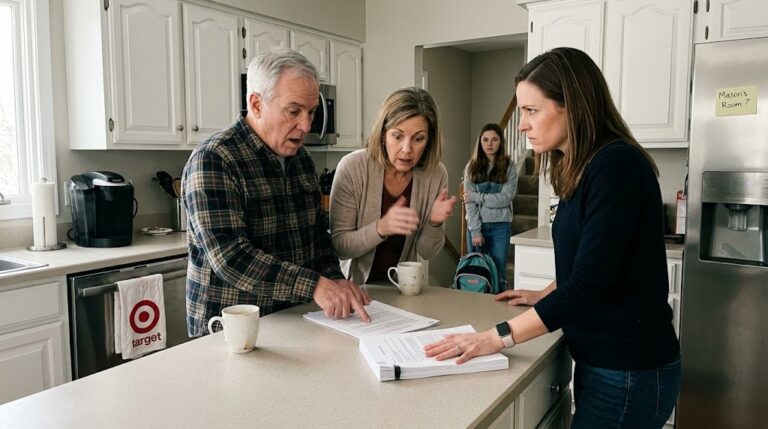
When I opened the front door, the coffee smell hit me first. Then my mother’s voice — cheerful — coming from the kitchen.
“We’re doing what’s best for the family.”
I reached into my tote bag, pulled out an envelope. Thick. Freshly printed. Stapled.
I slid it across the kitchen counter to my father. “Read it,” I said.
He opened it. My mother leaned in. Slowly, like a candle running out of wax, they both went pale.
“Nora… this can’t be real.”
Part 2: What They Forgot — And What I Never Did
Here’s the thing my parents seemed to have completely forgotten in their excitement to redecorate for Mason.
The house — the one with the blue shutters, the HOA dues I paid every single quarter, the mortgage that came out of my checking account every first of the month — was mine.
Not theirs.
Mine.
I had bought it four years earlier after my divorce. A three-bedroom colonial in a quiet Richmond suburb. I put my parents up in the guest room because my father had some health problems that year and my mom didn’t want to be alone. It was supposed to be temporary. Six months, maybe eight.
Then six months became a year. A year became two. And somewhere in those two years, my parents started acting like the house belonged to them. Hosting dinners I wasn’t invited to. Rearranging the living room without asking. Signing up for the HOA newsletter as if they were the homeowners.
I let it go. I was working seventy hours a week and raising Lily mostly solo. I didn’t have the bandwidth to fight about throw pillows and mailing lists.
But this? This was different.
When I called my sister Rachel that evening, she answered on the third ring, voice tight.
“Mom said you were being dramatic,” she said.
“Rachel. They told a fourteen-year-old to pack her bags and go stay with a friend.”
Silence.
“Mason needs stability right now,” she said finally. “His dad just left. He’s struggling.”
“I understand that. I’m sorry for Mason. But the answer to Mason’s problems is not to displace my child from my house.“
More silence.
Then: “Mom said the house is basically theirs since they’ve been maintaining it.”
I had to set the phone down for a second.
Maintaining it. They had lived there rent-free for over two years. I paid the mortgage, the utilities, the HOA, the property taxes. My mother planted some mums by the mailbox in October. That was the extent of the maintenance.
I picked the phone back up. “Tell Mom to read the paperwork Dad is holding.”
I hung up.
Part 3: The Envelope — What I’d Already Put in Motion
Here’s what nobody knew. Not my parents. Not Rachel. Not even Lily.
About eight months earlier, when the tension in the house had started quietly escalating — my mother making comments about “her kitchen,” my father cc’ing himself on HOA emails — I’d had a conversation with my attorney, Dana.
Not aggressive. Just protective. The kind of thing you do when something feels slightly off and you don’t want to be caught flat-footed later.
Dana had walked me through my options. We updated the formal housing agreement — nothing aggressive, just clean documentation of the legal arrangement. Guest occupancy. My name and Lily’s name as sole residents. A formal 30-day notice clause required for any changes to the arrangement.
I signed it. Dana filed it. I put a copy in a locked drawer in my home office and forgot about it for eight months.
Until Lily texted me from O’Hare.
I’d called Dana from the airport terminal. Told her what happened. She had the paperwork printed, organized, and ready by the time my Uber was pulling out of Richmond International.
The envelope I slid across that kitchen counter wasn’t a threat. It wasn’t dramatic.
It was eight months of quiet preparation colliding with one morning of cruelty.
It said, in plain legal language: This is my home. These are my terms. You are guests. And guests do not evict children.
Part 4: The Kitchen. The Silence. The Reckoning.
My father read slowly. He always did. My mother read over his shoulder, her finger moving line by line like she was looking for the exit.
There wasn’t one.
“This isn’t—you can’t just—” My father stopped. Started again. “We’ve been here two years, Nora. We’ve maintained this place.”
“You’ve lived here,” I said. “Rent-free. I’ve maintained it.”
My mother dropped the warm act entirely. “You’re seriously going to pull out paperwork right now? Because of this? Mason is family.“
“So is Lily.”
“That’s not the same—”
“Say that again,” I said. Quietly. “Say my daughter is not the same as Rachel’s son. I want to hear you say it out loud.”
She didn’t.
My father set the envelope on the counter like it had burned him. “What do you want, Nora.”
“I want you to look at my daughter,” I said, “who came down those stairs this morning with a packed backpack because her grandparents left a note on her pillow telling her she wasn’t welcome. And I want you to understand what you did.”
Lily was still standing at the base of the stairs. She hadn’t moved. She was watching all of this the way kids watch things that they know will matter to them later — taking it in, cataloging it, trying to figure out what it means about who loves them.
That image right there — my kid standing in her own house, backpack at her feet like a refugee — that’s the thing I will never fully forgive.
“The paperwork outlines a 30-day formal notice requirement for any changes to occupancy,” I said. “That means you cannot put Mason in Lily’s room. You cannot ask Lily to leave. And going forward, if you want to remain here, we’re putting a formal rental agreement in place.”
My mother made a sound.
“A rental—“
“Or,” I said, “you’re welcome to make other arrangements. I’ll give you thirty days. Per the agreement.”
My father looked at my mother. My mother looked at my father. Something passed between them — some unspoken negotiation, the way couples communicate thirty years of history in a single glance.
Then my mother turned to Lily.
And for one breathless second I thought she might actually apologize.
“We were only trying to help Rachel,” she said instead.
Lily nodded once. Picked up her backpack. Walked past them both to the kitchen, opened the refrigerator, and made herself a sandwich.
She didn’t say a word.
She didn’t need to.
The Aftermath: What They Lost
My parents moved out twenty-two days later. They’re renting a two-bedroom apartment on the north side of Richmond, closer to Rachel.
Mason, I heard, ended up staying with a family friend while Rachel got back on her feet. Perfectly good outcome, achieved without traumatizing any fourteen-year-olds.
My mother called me three weeks after they moved out. She wanted to know if I’d reconsider for the holidays. Thanksgiving was coming up. She was already thinking about the menu.
I told her I needed more time.
That was honest.
Lily and I had Thanksgiving with my college roommate’s family in Northern Virginia. We ate too much green bean casserole. We drove home that Sunday night with leftover pie and Christmas music playing low on the radio.
When we pulled into the driveway, Lily looked at the house — the blue shutters, the little wreath she’d made in art class still hanging on the door — and said, “It feels like ours again.”
She was right.
It always was.

Evan Cole Editor-in-Chief | Breaking News & Public Policy
“From Washington to Wall Street, and Main Street to Hollywood—Evan Cole connects the dots.”
As the Editor-in-Chief at Newskilo, Evan leads a dynamic team of journalists dedicated to uncovering the truth behind the headlines. With over 15 years in digital media, Evan has a reputation for cutting through the noise.
While he is widely recognized for his deep analysis of U.S. fiscal policy (IRS & Stimulus), Evan’s expertise extends to global current events, corporate accountability, and cultural trends. Whether he is breaking down a complex government bill, exposing a tech giant’s failure, or analyzing the societal impact of a viral celebrity moment, Evan’s goal is simple: To tell the stories that shape our world with clarity, accuracy, and integrity.
Leave a Reply