
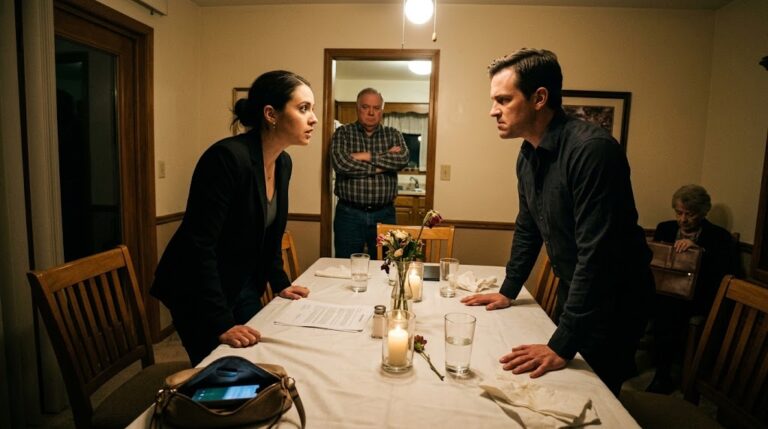
I thought it was just a weird dinner.
My mom texted me that afternoon — “Come over tonight, family dinner, don’t be late” — and something about the way she worded it made me sit in my apartment parking lot for a full two minutes before I started the car.
I should’ve trusted that two minutes.
When I walked in, there were candles lit in the living room. A white tablecloth ironed flat like someone had pressed every crease out by hand. Fresh flowers. No smell of food. No pots on the stove.
Just a chair pointed toward a stranger in a dark jacket, a pen sitting next to a neat stack of papers, and a small quiet man in the corner with a leather folder on his lap.
My stomach dropped.
My mother came out of the kitchen smiling like it was Christmas morning.
“There she is,” she said. “Come sit, sweetheart. Everyone’s been waiting on you.”
I turned for the door. That’s when I heard the deadbolt click.
My father was standing at the front door. Not near it. At it. Arms folded, shoulders filling the frame the exact same way they had three years ago when he told me if I walked out, I shouldn’t bother coming back.
I walked to the table. My mother slid a contract toward me like she was passing the dinner rolls.
My full name was already typed into every single blank. Jessica Marie Archer. Bride. My address. My employer. A sixty-day clause that meant I’d have to quit my job. A piece of property off Route 80 I had never heard of in my life.
And then I saw it. My exact savings balance. A number I had never told one single person in that house.
I looked across the table at the man they had brought to collect me. Victor Hail. Early forties. Clean shirt. Eyes like a deed transfer. He stuck out his hand.
“I believe you’ll find the terms reasonable,” he said.
My mother brought out the tears right on schedule — perfectly timed, perfectly placed — and started talking about sacrifice and nine months and everything she’d ever given me.
I watched them fall and felt nothing but one single, ice-cold thought. How much do you owe him?
I asked it out loud. My father looked at the floor. There was my answer.
I reached into my purse, felt my phone, saw the text I’d been waiting on since yesterday, and looked back up at all three of them.
Then I smiled. A real one. A calm one.
“You really should have read what I filed yesterday.”
Part 2: The Number That Told Me Everything
Nobody becomes that specific by accident.
Not the savings balance. Not the address. Not the employer. You don’t type $34,817 into a legal contract unless someone handed you a bank statement, and the only people in my life with access to that account number were sitting in this room.
I turned back to the contract and read every line out loud.
Page one: the marriage terms, Victor’s full legal name, his family’s LLC, and a clause that made me the primary signatory on a piece of commercial property off Route 80 — a building I later learned was tied up in a code violation dispute with the county.
Page two: the employment clause. Sixty days post-marriage, I would “voluntarily” relinquish independent employment. Victor’s family “does not require a working wife.” My mother had underlined that sentence in pencil.
Page three: a transfer of beneficial interest in my savings account to a joint marital fund, controlled by the husband’s estate.
I read it out loud in that flat, even voice you use when you’re too far past shocked to perform emotion anymore.
Victor’s jaw tightened. The officiant had stopped smiling about four minutes ago. My father was staring at the wall.
“How much?” I asked again.
My mother slammed her palm on the table. “Don’t you dare accuse your father of—”
“How. Much. Does he owe Victor’s family.”
The silence that followed was the loudest thing I had ever heard in that house.
My father sat down. He looked ten years older in about four seconds. His voice came out smaller than I’d ever heard it. He said a number.
Forty-three thousand dollars.
Borrowed eighteen months ago. Interest-compounded. Now closer to sixty. Victor’s family had been patient, he said. They had offered an arrangement. A solution that didn’t require lawyers or courts.
Just me.
I looked at my father and felt something I had never expected to feel in that moment — not rage, not grief. Something quieter and heavier. The specific sadness of understanding exactly who raised you.
“You told them my bank balance,” I said.
He didn’t answer.
He didn’t have to.
Part 3: What I Did The Day Before
My aunt Renata had called me the previous morning.
She is my mother’s older sister, and they haven’t spoken properly since my grandmother’s funeral. She got my number from a cousin, called from a blocked line, and spoke fast like she was worried someone would walk in.
“They’re planning something for tomorrow night,” she said. “I heard your mother on the phone. Jessica, I need you to listen to me. Do not go alone.”
I sat on my apartment floor after that call for a long time.
Then I called my attorney.
His name is Daniel Foss. He’s thirty-eight, talks fast, and has handled three restraining orders and one wrongful termination case for people in my office building. I had his number in my phone from a lease dispute two years ago. I had never been so grateful for a saved contact in my life.
I told him everything my aunt said. I told him about Victor. About what my mother had been pressuring me about for months — the comments about my apartment being too expensive, the hints about a “good family” that had “expressed interest,” the way she’d twice asked me how much I had saved up “just to know you’re okay.”
Daniel listened without interrupting.
Then he said, “Okay. Here’s what we’re going to do.”
That afternoon, I filed an emergency civil protective order citing financial coercion and attempted forced marriage under Ohio Revised Code § 2905.32. I filed a fraud report with my bank and added a security hold and third-party transaction freeze on my savings account — effective immediately. I wrote a sworn affidavit documenting every conversation, every pressure tactic, every detail my aunt had given me, and had it notarized at the FedEx on Chambers Street at 4:47 PM.
And then Daniel sent a letter — certified, time-stamped, delivered that morning to my parents’ address — notifying all parties of the protective filing and the financial freeze, and advising that any attempt to compel a signature under duress would constitute a criminal act under state law.
I hadn’t told a soul.
I went to that dinner knowing exactly what I was walking into.
I walked into it anyway.
Because I needed them to show me every card they were holding.
And they did.
Part 4: The Room Goes Silent
I set my phone face-up on the table.
The text from Daniel read: “Confirmed delivered 9:14 AM. Order is active. You’re covered. Call me when you’re out.”
I slid the phone across the white tablecloth so Victor could read it.
He picked it up. Read it once. Read it again. Set it down very carefully, like it had a temperature.
“What is this,” he said. Not a question. A stall.
“That’s a civil protective order filed in Franklin County yesterday morning,” I said. “It names you, your family’s LLC, and both of my parents. It also includes a certified fraud hold on every account in my name. Which means that contract” — I tapped the stack of papers — “is not only unenforceable, it’s evidence.”
My mother’s face did something I had never seen it do.
It cracked.
Not into tears. Not into anger. Into something rawer — the expression of a person who has just watched the architecture of a carefully built plan collapse in real time.
“You don’t understand what you’ve done,” she said.
“I understand exactly what I’ve done,” I said. “I filed before you could lock the door.”
Victor stood up. He straightened his jacket with both hands — that specific gesture men use when they need a second to recalibrate — and looked at my father.
My father was still looking at the floor.
“We’ll need to revisit the terms,” Victor said, to no one in particular.
“There are no terms,” I said. “There is no arrangement. There is no tonight.”
The officiant in the corner quietly closed his leather folder, stood up without making eye contact with anyone, and let himself out the side door. I heard his car start in the driveway thirty seconds later.
I stood up, picked up my purse, and walked to the front door.
My father was still standing there.
I looked at him for a long moment.
“Move, Dad.”
He moved.
The Aftermath
Victor Hail left without another word. His family’s attorney contacted Daniel the following week and — upon being informed of the full scope of the protective filing and the notarized affidavit — quietly withdrew any claim of informal debt agreement. There was nothing in writing. There had never been anything in writing. Because men like Victor’s father prefer arrangements that leave no paper trail.
They hadn’t counted on me leaving one.
My parents did not call for eleven days.
When my mother finally texted, it was four words: “We need to talk.”
I didn’t respond that day.
I went to Target, bought a new set of dish towels, made coffee in my own apartment, and sat by my window for a while.
That savings balance they had typed into a contract? Still mine. Still exactly where I left it. With a security flag on it that requires my voice confirmation and a callback number to release.
Three months later, I met with a family attorney about formally documenting the coercion attempt for future legal protection. I’m not angry anymore — not in the hot, chaotic way I was that night. What I feel now is something closer to clarity.
You cannot sell a person who already knows her own worth.
And you cannot trap a woman who started building her exit the day before you locked the door.

Evan Cole Editor-in-Chief | Breaking News & Public Policy
“From Washington to Wall Street, and Main Street to Hollywood—Evan Cole connects the dots.”
As the Editor-in-Chief at Newskilo, Evan leads a dynamic team of journalists dedicated to uncovering the truth behind the headlines. With over 15 years in digital media, Evan has a reputation for cutting through the noise.
While he is widely recognized for his deep analysis of U.S. fiscal policy (IRS & Stimulus), Evan’s expertise extends to global current events, corporate accountability, and cultural trends. Whether he is breaking down a complex government bill, exposing a tech giant’s failure, or analyzing the societal impact of a viral celebrity moment, Evan’s goal is simple: To tell the stories that shape our world with clarity, accuracy, and integrity.
Leave a Reply