
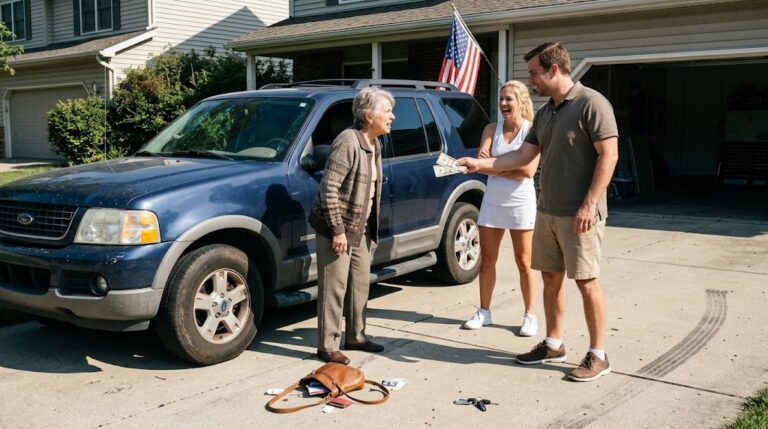
First my credit card declined.
Then my debit.
Then my emergency Amex—the one I hadn’t maxed out in twenty-eight years of marriage or the five since my husband, Warren, passed.
I was standing at the Whole Foods checkout. The cashier gave me that careful, sympathetic smile people reserve for quiet disasters.
“Do you have another way to pay?” she asked, holding my cards like they might stain her hands.
Someone behind me cleared their throat loudly. A shopping cart nudged against mine. I could feel the impatient eyes burning into my back.
“Please try the debit again,” I said. My voice sounded smaller than I felt.
She did. Declined. Again.
I left the cart right there—organic chicken, ripe tomatoes, the good olive oil Warren always loved—and walked out. I kept my chin up, but my hands were shaking so hard I nearly dropped my purse on the pavement.
In the baking heat of my Ford Explorer, I opened my wallet. No cash. Just a faded photo of Warren from our twentieth anniversary.
He was the man who started as a mechanic with grease permanently stained under his fingernails. Together, we built Morrison Auto Group from absolutely nothing.
Twelve dealerships. Three states. Forty-two million dollars in assets.
And that morning, I couldn’t even buy my own groceries.
I called the bank immediately. I sat through the automated menu and the awful, tinny hold music until a human finally answered the phone.
“All of your accounts are currently frozen, Mrs. Morrison,” the representative said, his tone entirely too clinical. “I can’t provide details over the phone. You’ll need to come into a branch.”
I didn’t need details. I knew exactly who had done it.
My son. Desmond.
He was my miracle baby after three devastating miscarriages. He was the child I nursed through midnight fevers, the teenager I gave his first job sweeping the showroom floor.
He was the man I made co-signer and granted power of attorney—because I trusted him. Because he was my only child. Because I thought blood still meant something in this world.
I threw the car into drive and headed straight to his house. It was the house I helped him buy in a pristine HOA suburb, complete with manicured lawns and top-tier school districts.
His new Range Rover sat gleaming in the driveway. His wife Karen’s Mercedes was parked right beside it. Both were financed through my dealerships at zero percent interest.
I pounded on the front door. Karen answered in crisp white tennis gear. Her manicure was flawless, her smile sharp as glass.
“Oh, Nora. What a surprise,” she drawled, acting like she had no idea why I was standing sweating on her welcome mat.
“My cards aren’t working,” I said, pushing past her into the foyer. “The bank says my accounts are frozen. Where is my son?”
“You should’ve called first,” she replied, casually inspecting her acrylic nails. “He blocked your number this morning. He said it was time to establish boundaries.”
Boundaries.
This was coming from the woman who paid her mortgage, her luxury cars, and her children’s private school tuition with my money.
Desmond appeared at the top of the stairs. He had Warren’s strong jaw and Warren’s broad shoulders, but absolutely none of his kindness.
“Yes, I froze the accounts,” he said calmly, walking down the steps. “We need to discuss your spending. Someone has to safeguard the family assets.”
“The family assets?” I echoed, my chest tightening. “Your father and I built that money. Every single cent of it.”
Karen sighed loudly, crossing her arms. “Here we go again. Every Thanksgiving dinner it’s the exact same story—how hard you and Warren worked. Frankly, we’re tired of the guilt trips.”
Then, standing in the marble entryway I paid for, they laid out their plan. They spoke like it was already a finalized business transaction.
They were selling the dealerships to a private equity firm. Thirty-eight million dollars in liquid cash.
Desmond mentioned documents I’d supposedly signed while groggy after my gallbladder surgery last year. Full power of attorney. My complete removal from every executive role.
No access. No voice. No income.
Desmond reached into his designer leather wallet. He pulled out two crisp twenty-dollar bills and held them out to me like I was a beggar on the street.
“Here, Mom. For groceries,” he said, a sickening smirk on his face. “Since your cards don’t work.”
Forty dollars.
For the woman who built the empire he was currently dismantling.
I didn’t take it. I looked my only child dead in the eyes.
“I’d rather go hungry,” I said, my voice trembling with rage, “than beg my own son for money that exists only because of my sweat.”
Karen laughed. A cold, awful sound. “You’ll be back. Hunger makes women very cooperative. When you’re ready to apologize and be reasonable, we’ll discuss a monthly allowance. Something appropriate for a woman your age.”
They talked about putting me in assisted living. About me selling my own home. About staying out of their way while they finished selling everything Warren and I bled for.
And when I didn’t immediately agree, Desmond used the one threat he knew would destroy me.
“If you fight us,” he said softly, leaning in close, “you won’t ever see your grandchildren again.”
I turned around. I walked back to my car on legs that felt like lead. I shut the door, locked it, and sat there in total silence.
In one single morning, my son had frozen my money, stolen my life’s work, and threatened to take away my grandchildren.
Then, my cell phone rang. It was an unknown number.
I wiped a tear from my cheek and answered. “Hello?”
“Mrs. Morrison?” a deep voice said. “This is Frederick Peton, senior vice president of private wealth at First National. We’ve been trying to reach you about highly unusual activity on your accounts.”
My heart skipped a beat. “Unusual activity?” I whispered.
“There were multiple large transfer attempts this morning using your credentials,” the banker said. “We’re seeing movements totaling roughly twenty-three million dollars.”
The world tilted on its axis. I looked out the windshield at my son’s house.
“Several of the accounts your son attempted to access,” he continued, his voice dropping lower, “are protected by security measures you and your late husband put in place a decade ago. He couldn’t reach them. No one can—except you.”
And sitting there in my hot car, parked outside my son’s house, with forty dollars still burning in my memory and my cards still frozen, I finally understood something terrifying.
Desmond thought he had taken everything from me.
He had absolutely no idea what I was about to do next.
Part 2: The Ghost In The Machine
I didn’t drive home. I drove straight to the massive steel-and-glass skyscraper downtown that housed First National’s private wealth division.
I marched into the air-conditioned lobby in my sensible shoes and grocery-store slacks. I didn’t care how I looked. I was a woman running on pure adrenaline and betrayal.
Frederick Peton was waiting for me in a mahogany conference room on the 40th floor. He slid a thick manila folder across the polished table.
“Your son presented a comprehensive Power of Attorney document this morning,” Frederick explained, his hands folded neatly. “It effectively grants him total control over the Morrison Auto Group operating accounts, your personal checking, and the primary investment portfolios.”
I stared at the black-and-white photocopy of my signature. It was shaky. Weak.
I remembered the day I signed it. I was in a hospital bed, hooked up to an IV drip, fresh out of surgery. Desmond had come in with a “routine tax extension” he claimed needed my immediate sign-off.
My own son had weaponized my illness to steal my life’s work.
“He drained the operating capital?” I asked, my voice barely a whisper.
“Yes,” Frederick nodded gravely. “He moved four million into a holding company controlled entirely by his wife, Karen. He then initiated a freeze on your personal debit and credit lines, citing ‘elder vulnerability’ and ‘cognitive decline.’”
Cognitive decline. The room spun. They were trying to paint me as senile.
“But,” Frederick said, leaning forward, a sharp glint in his eye. “He made a catastrophic miscalculation. He doesn’t know about the Vanguard Trust.”
My breath caught in my throat. The Vanguard Trust.
Years ago, before Warren got sick, we sat at our kitchen table drinking cheap coffee. Warren was a mechanic first, a businessman second. He didn’t trust suits, and he didn’t trust the stock market.
“Nora,” Warren had told me, his rough hands covering mine. “Dealerships go bust. Markets crash. The only thing that lasts is dirt.”
So, quietly, without telling a single soul—not our accountants, not our managers, and certainly not our teenage son—Warren and I set up a separate corporate entity.
We called it Ironwood Holdings.
Every time a dealership had a record month, we took a percentage of the profits and funneled it into Ironwood. Then, Ironwood did something brilliant. It bought the actual physical land that the Morrison Auto Group dealerships sat on.
All twelve locations. Prime commercial real estate across three states.
Morrison Auto Group didn’t own the land. Morrison Auto Group rented the land from Ironwood Holdings. And I was the sole, unchallengeable owner of Ironwood.
“Desmond tried to access the Ironwood accounts,” Frederick continued, tapping the file. “But Warren set it up with a dual-authentication biometric lock that requires your physical presence and a secondary passcode. Desmond got locked out. And because he triggered the security protocol, the entire $23 million cash reserve in Ironwood is now completely sealed off to anyone but you.”
I looked out the massive window at the city skyline. Desmond thought he was selling the auto group.
He didn’t realize he was trying to sell a business that was about to be evicted.
“Frederick,” I said, sitting up perfectly straight. “I need you to recommend the most vicious corporate litigator in this city. I don’t want a negotiator. I want a butcher.”
Frederick smiled. “I know just the man.”
Part 3: The Art of War
His name was Marcus Vance. He wore suits that cost more than my first car and looked at corporate law the way a great white shark looks at a wounded seal.
When I sat in his office and laid out Desmond’s plan, Marcus didn’t offer sympathy. He offered a strategy.
“Your son is currently in negotiations with Apex Equity,” Marcus said, pulling up files on his massive monitor. “They’re a ruthless firm. They buy businesses, strip them for parts, and fire everyone. Desmond is likely promising them the physical real estate as part of the $38 million valuation.”
“He doesn’t own the real estate,” I said. “I do.”
“Exactly,” Marcus grinned. “Apex Equity hasn’t done their deep-dive due diligence yet. When they find out the business they are buying is merely a tenant on land owned by a hostile landlord, the deal will implode.”
“I don’t just want the deal to implode,” I said, my voice cold as ice. “I want him ruined. He threatened to take my grandchildren.”
Marcus paused. He looked at me, really looked at me, and nodded.
“Then we don’t just kill the deal,” Marcus said softly. “We let him sign the preliminary paperwork. We let him spend the money in his head. We let him leverage himself to the hilt. And then, we drop the anvil.”
For the next three weeks, I played the part of the broken, defeated old woman.
I didn’t call Desmond. I didn’t text Karen. I lived off a tiny line of credit Marcus opened for me. I shopped at a discount grocer on the edge of town, paying in cash, making sure one of Karen’s gossiping tennis friends saw me looking ragged.
The report made it back to my son. He texted me exactly once: “Ready to talk about assisted living yet, Mom?”
I didn’t reply. I just forwarded the text to Marcus.
Behind the scenes, we were moving with lethal precision. As the sole director of Ironwood Holdings, I drafted new lease agreements for all twelve Morrison Auto Group locations.
The previous leases, signed by Warren, were comically generous to the dealerships. One dollar a year.
I drafted new commercial leases reflecting current, exorbitant market rates. I added immediate eviction clauses for non-payment. I backdated the notice of rent increase to the exact day Desmond assumed his fraudulent Power of Attorney.
Meanwhile, Desmond was getting reckless. Anticipating his $38 million payout from the private equity firm, he took out massive bridge loans.
He bought Karen a vacation home in Aspen. He ordered a custom Porsche. He leveraged his own house—the one I helped him buy—to the absolute maximum.
He was building a castle on quicksand, and he had no idea I was holding the dynamite.
The closing date for the sale of Morrison Auto Group was set for a Tuesday. At 10:00 AM.
At 9:00 AM, Marcus and I walked into the lobby of Apex Equity.
Part 4: The Boardroom Bloodbath
The boardroom was all glass and arrogance.
Desmond sat at the head of the long oak table, wearing a custom-tailored Italian suit. Karen sat next to him, looking like she had already mentally spent the millions. Across from them sat three severe-looking men in grey suits—the buyers from Apex Equity.
A massive stack of closing documents sat in the middle of the table, pristine and ready for signatures.
The door clicked open. Marcus walked in first. I walked in right behind him.
The blood instantly drained from Desmond’s face. He looked like he’d seen a ghost.
“Mom?” he stammered, standing up. “What are you doing here? Security is supposed to keep unauthorized people out.”
“Sit down, Desmond,” I said. My voice didn’t shake. I wasn’t the scared woman in the Whole Foods parking lot anymore. I was Warren Morrison’s widow, and I was here to collect.
Karen sneered. “Nora, this is a closed business meeting. Go home. We’ll send you your allowance on the first of the month.”
The lead buyer from Apex Equity frowned. “Desmond, who is this?”
“She’s nobody,” Desmond said quickly, sweating now. “She’s my mother. She’s… unwell. Cognitively declining. I have full Power of Attorney.”
Marcus stepped forward and dropped a thick, leather-bound folder onto the center of the table. It landed with a loud, heavy thud.
“Gentlemen,” Marcus said, addressing the Apex buyers. “My name is Marcus Vance. I represent Mrs. Nora Morrison, the sole owner and acting CEO of Ironwood Holdings.”
The buyers looked confused. “Ironwood Holdings? We’re here to purchase Morrison Auto Group.”
“I’m aware,” Marcus smiled smoothly. “But before you sign a check for thirty-eight million dollars, I felt obligated to inform you of a slight complication regarding your new assets.”
Desmond lunged forward. “Don’t listen to him! She’s crazy! Sign the papers!”
I looked dead at the lead buyer. “Morrison Auto Group does not own the land beneath its twelve dealerships. Ironwood Holdings does. I own Ironwood Holdings. And as of midnight last night, Morrison Auto Group is in default on its leases.”
Silence fell over the room. It was absolute, crushing silence.
The lead buyer slowly opened the folder Marcus had dropped. He flipped through the deeds. The property titles. The aggressively restructured commercial leases.
“What is this?” the buyer hissed, turning violently toward Desmond. “You swore the real estate was included in the valuation. You signed disclosures stating the company owned the dirt!”
“I… I thought we did!” Desmond panicked, his voice cracking like a teenager’s. “My dad built the company! It’s all one entity!”
“It’s not,” I said quietly. “Your father knew you were weak, Desmond. He knew you liked the flash of the cars but hated the grease of the garage. He protected the land. He protected me.”
Marcus pulled out a secondary document and slid it toward Desmond.
“This is a formal notice of immediate eviction for all twelve locations,” Marcus stated clearly. “Morrison Auto Group owes Ironwood Holdings roughly four million dollars in back-rent and penalties. Furthermore, we are filing an injunction against the sale of the business, pending a criminal investigation into the forged Power of Attorney documents used to seize control of Mrs. Morrison’s personal accounts.”
Karen let out a sharp, hysterical gasp. “Criminal investigation?”
The Apex buyers didn’t hesitate. They stood up in unison.
“The deal is dead,” the lead buyer said, throwing his pen onto the table. “You lied on federal financial disclosures, Morrison. You’re lucky we don’t sue you for fraud ourselves.”
They walked out. The heavy glass door slammed shut behind them.
The silence that followed was deafening.
Desmond collapsed into his chair. His custom suit suddenly looked two sizes too big. He stared at the unsigned closing documents, his hands trembling.
“Mom,” he whispered, his eyes wide with genuine terror. “Mom, the bridge loans. I borrowed millions against the payout. I put the house up. I put everything up.”
“I know,” I said.
Karen stood up, her face twisted in absolute fury. She pointed a manicured finger at me. “You vicious, evil old witch! You ruined us! We’re going to lose the house! We’re going to lose everything!”
I walked slowly around the table until I was standing inches from the woman who had laughed at me.
“You told me hunger makes women cooperative, Karen,” I said softly. “Let’s see how cooperative you are when you’re buying your groceries on food stamps.”
Desmond reached out, trying to grab my hand. He was crying now. Actual, desperate tears.
“Mom, please. Please. I’m your son. I’m your only child. Don’t do this to me.”
I looked down at the boy I had raised. The boy who had handed me forty dollars and threatened to keep my grandchildren away from me.
“You established boundaries, Desmond,” I said, my voice steady and completely void of emotion. “I am simply respecting them.”
I turned on my heel and walked out of the boardroom. Marcus followed right behind me.
Conclusion: The Karma of a Forty-Dollar Insult
The fallout was swift, brutal, and absolute.
Without the private equity buyout, Desmond couldn’t cover the massive, high-interest bridge loans he had taken out to fund his new luxury lifestyle. The banks called in the debts within thirty days.
He was forced into Chapter 7 bankruptcy.
The pristine house in the HOA neighborhood was foreclosed on. The zero-percent interest cars were repossessed right out of the driveway.
I know, because I drove by and watched the tow trucks haul Karen’s Mercedes away.
Karen filed for divorce three weeks later. She tried to claim half of the nonexistent assets, only to find out she was legally on the hook for half of the crushing debt. She moved into a cramped two-bedroom apartment across town.
Desmond faced felony fraud charges for the forged Power of Attorney. Thanks to Marcus’s relentless pressure, the district attorney took the case seriously. Desmond avoided jail time by taking a plea deal, but he is now a convicted felon. Good luck getting a job in corporate finance ever again.
As for me?
I assumed total, undisputed control of Morrison Auto Group. I fired the sycophants Desmond had hired and promoted the loyal general managers who actually knew how to sell cars. Under my direct supervision, we had our most profitable quarter in six years.
And my grandchildren?
With Desmond broke and Karen working double shifts at a mid-tier retail store just to make rent, they suddenly needed help. A lot of help.
I pay for the kids’ tuition. I buy their clothes. I have them over at my massive, quiet house every single weekend. They love baking cookies with their grandmother.
Every Sunday evening, Desmond drives his beat-up, ten-year-old Honda Civic up my long, winding driveway to pick them up.
He doesn’t come inside. He waits on the porch.
Last week, as I was walking the kids out to his car, Desmond looked at me. He looked older, exhausted, totally broken. His designer clothes were gone, replaced by faded jeans and a cheap jacket.
“Mom,” he said, his voice quiet and defeated. “I’m short on rent this month. I just need a little help. Just a loan.”
I stopped. I reached into my purse. I opened my wallet.
I pulled out two crisp twenty-dollar bills.
I held them out to him, watching the humiliation burn hot and red across his face.
“Here, Desmond,” I said.
He took the money. He had to.
He put it in his pocket, put his head down, and drove away.
I locked my heavy front door, walked into my beautiful kitchen, and poured myself a glass of the very best wine money could buy.

Evan Cole Editor-in-Chief | Breaking News & Public Policy
“From Washington to Wall Street, and Main Street to Hollywood—Evan Cole connects the dots.”
As the Editor-in-Chief at Newskilo, Evan leads a dynamic team of journalists dedicated to uncovering the truth behind the headlines. With over 15 years in digital media, Evan has a reputation for cutting through the noise.
While he is widely recognized for his deep analysis of U.S. fiscal policy (IRS & Stimulus), Evan’s expertise extends to global current events, corporate accountability, and cultural trends. Whether he is breaking down a complex government bill, exposing a tech giant’s failure, or analyzing the societal impact of a viral celebrity moment, Evan’s goal is simple: To tell the stories that shape our world with clarity, accuracy, and integrity.
Leave a Reply