
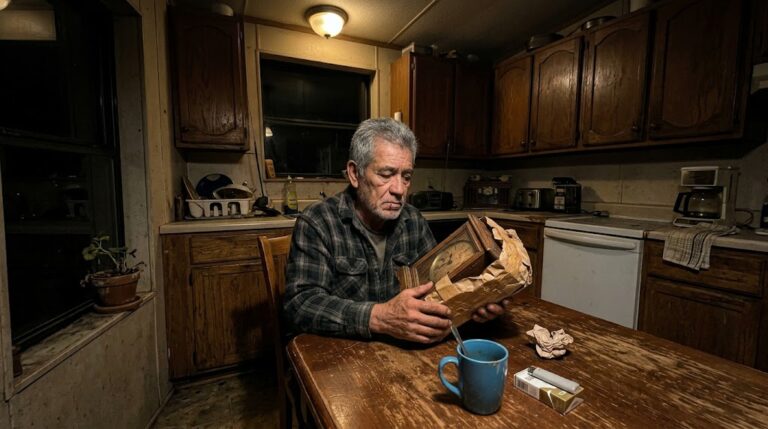
My son hit me thirty times while his wife watched and smiled.
I counted every single one.
Not because I was too weak to stop him. Because something inside me just… went quiet. Like a switch flipped off that I didn’t know could flip.
My name is Arthur Vega. I’m 68 years old. I spent forty years pouring concrete in the Texas heat, negotiating with union bosses, surviving recessions that wiped out men half my age. I buried friends. I built bridges that are still standing.
And last February, I drove my old sedan two blocks away from my son’s birthday party because his circular driveway was already packed with rental luxury cars.
I was carrying a small gift wrapped in brown paper.
He threw it on the table like it was a Target clearance item he didn’t ask for.
Then he told his guests — out loud, in front of everyone — that he was sick of me showing up expecting gratitude in a house that had “nothing to do with me anymore.”
I told him, calm as a Tuesday morning, to be careful about forgetting who laid his foundation.
That was enough for him.
He stood up. He pushed me first.
And then his hand came across my face.
I counted. One. Two. Three.
By the time I hit thirty, my lip was split, blood was pooling in the back of my throat, and his wife Sofia was sitting on the couch with this little half-smile. The kind you see on someone who’s enjoying the show.
My own son. Thirty years old that night. The man I handed everything to.
I didn’t yell. I didn’t call the police. I didn’t threaten him.
I just picked up the gift box from the floor, looked at him for a long moment, and walked out.
Here’s what nobody talks about: sometimes you don’t raise a grateful child. Sometimes you just spend decades keeping an ungrateful man comfortable.
What Daniel didn’t know — what he couldn’t have known — is that the house he’d been living in for five years was never his.
Not legally. Not on any document. Not anywhere.
Part 2: The House That Was Never Theirs
Five years before that birthday dinner, I closed the best real estate deal of my career.
After forty years in Texas construction, I knew Highland Park property the way a surgeon knows anatomy. When a private off-market listing came across my desk — a 4,800 square-foot house on a quiet street, seller motivated, priced under market — I moved fast.
I paid cash. Every dollar.
I let Daniel and Sofia move in. I told them it was their home. I meant it as a gift in spirit. But I’m a builder. I think in load-bearing walls and fine print. And the fine print said the deed was held by a limited liability company called Mastiff Holdings LLC.
I was the sole member.
It wasn’t a trap. Not then. It was caution. It was the habit of a man who had watched too many handshake deals fall apart to ever skip the paperwork.
But over the years, that LLC became something different.
It became a test.
The warning signs had started small. Daniel stopped calling me Dad and started treating my phone calls like interruptions. Sofia began sending me text messages asking me to “call ahead before dropping by” — as if I needed an appointment to visit property I owned outright.
At their dinner parties, I was introduced as “Arthur, Daniel’s father, the old builder.” Said with a smile that was designed to be polite and managed to be dismissive at the same time.
They were ashamed of my 2009 Ford F-150. Ashamed of my work boots. Ashamed of my hands, which looked like what forty years of honest work actually looks like.
That always amused me.
Because every square foot of the floor they were standing on? I paid for it.
The night of Daniel’s thirtieth birthday dinner, I walked into that house carrying a restored antique clock. The same model his grandfather had kept on his desk for thirty years in a small house in San Antonio. I’d tracked it down through three different estate sales in Austin. It took me six months.
Daniel opened the brown paper, glanced at it, and set it down on the table without a word.
Then, about an hour later, after a few drinks loosened something mean in him, he stood up and said what he’d apparently been building toward for years.
He said he was tired of me acting like he owed me something. Tired of me showing up to “his home” like I had some kind of claim to it. Tired of the silent judgment he swore he felt every time I looked at him.
I said, calmly, that he should be careful about forgetting who built the foundation under him.
He heard it as an insult.
He walked toward me.
And then he started.
Thirty times. I counted because I needed something to hold onto. The numbers were cleaner than the reality. Easier than looking at my son’s face twisted into something I didn’t recognize.
Sofia sat on the couch and watched.
When it was over, he was breathing hard, like he’d just finished a workout. Like he’d accomplished something.
I wiped my mouth with the back of my hand. I looked at him. I picked up the clock box from the floor. And I left.
Part 3: 8:06 AM
I didn’t sleep that night.
Not because I was in pain, though I was. Not because I was angry, though I was that too.
I didn’t sleep because I was working.
My desk at home looks nothing like Daniel’s office. No standing desk, no dual monitors, no $400 ergonomic chair. Just a wooden table I built myself in 1987, a legal pad, and a lamp that’s been running since the Clinton administration.
I sat down at that table at 2 AM with a yellow legal pad and started writing.
I listed every asset tied to Mastiff Holdings. The Highland Park property. Two other small parcels I’d acquired in Collin County that I’d been holding as long-term investments. I listed the current market comps in the neighborhood. I wrote down the name of the buyer — a developer I’d done business with twice before — who had called me eight months earlier asking if I knew of any off-market properties in that zip code.
I had told him I’d keep my ears open.
I circled his name on the legal pad.
Then I made a second list. It was shorter.
It had one item on it: What Daniel believes is true.
He believed the house was his. He believed the deed was in his name. He had never asked, never checked, never looked at a single document. He had accepted comfort the way people who’ve never gone without tend to do — completely, without question, and with total confidence that it would always be there.
That confidence was about to meet forty years of Texas contract law.
At 6 AM, I showered, made coffee, and put on the same kind of clothes I’ve worn my whole life. Work pants, a clean button-down, boots.
At 8:06, I called my attorney, a man named Gerald who has handled my business affairs since 1998. I told him what happened the night before. There was a long silence on his end.
Then he said, “Arthur. You sure?”
I said, “Call the buyer. Get me a number by nine.”
At 8:23, I called the listing manager connected to Mastiff Holdings and initiated the private expedited sale process we had discussed in the abstract eight months earlier when that developer had first come calling.
At 9:10, the property was effectively listed through a private channel to a pre-qualified buyer. No MLS. No Zillow. No open houses. This was how Texas money moved when it didn’t want to make noise.
I drove to Gerald’s office.
I had a second cup of coffee in his waiting room.
His assistant brought me a copy of the deed and all associated Mastiff Holdings documents. I read every page. Not because I needed to. Because I wanted to feel the weight of what I was holding.
At 11:49 AM, I signed the papers.
The house was sold.
Part 4: The Knock at the Door
I was still at Gerald’s office, finishing the paperwork on the Collin County parcels, when my phone buzzed.
Sofia.
I looked at that name on the screen for about four seconds.
Then I answered.
She wasn’t yelling, not at first. She was using the voice she used at dinner parties — controlled, polished, each word like it had been ironed. She said there were two men at the door. Said they had documents. Said they were asking her to confirm her name.
I said, “Sofia, what’s on those documents?”
The polish cracked.
She said there was something about a property transfer. Something about Mastiff Holdings. Something about a thirty-day notice to vacate a property that had been sold as of that morning.
Then the voice broke completely.
She started screaming.
She used words I won’t repeat here. She said I had lost my mind. She said Daniel was going to sue me, have me declared incompetent, take everything. She said I was a bitter, jealous old man who couldn’t stand watching his son be more successful than him.
I let her finish.
Then I said, “Sofia, the deed was never in Daniel’s name. The property has always belonged to Mastiff Holdings LLC. I am the sole owner of that LLC. I sold my property this morning through a completely legal private transaction. Gerald Marsh’s office handled the paperwork. You’re welcome to have your attorney call him.”
Silence.
“The thirty-day notice is generous,” I added. “Under Texas law, I wasn’t required to give you that much time.”
She hung up.
Daniel called eleven minutes later. I didn’t answer.
He called six more times before 2 PM.
I let every one go to voicemail.
Conclusion: What Gets Left Behind
Daniel did contact an attorney. The attorney reviewed the Mastiff Holdings LLC documents, the original deed, and the transaction record from that morning.
He called Gerald’s office and spoke for about twenty minutes.
Then he called Daniel back.
I don’t know exactly what was said in that conversation. But I know Daniel stopped calling me after that.
The house sold for $2.3 million. The buyer closed in nineteen days. He’s already broken ground on a renovation.
I donated $150,000 from the proceeds to a trades apprenticeship program at a community college in San Antonio — the kind of program that teaches young people how to build things with their hands. Real things. Things that last.
The antique clock is on my desk now. The same model his grandfather kept for thirty years.
I think about that night sometimes. About counting. About what it means when you count instead of fighting back.
I think it means you’ve already decided something.
Some people will read this and say I went too far. That a father shouldn’t do that to a son, no matter what.
Maybe. I’ve sat with that.
But I also think about what it felt like to walk into that house carrying a six-month project wrapped in brown paper and watch it get tossed aside. I think about Sofia’s smile. I think about thirty.
I built things my whole life. Roads. Bridges. A business. A family.
Some things you build are worth keeping.
Some things you built for someone else, and when that someone shows you clearly they don’t deserve it, the only honest move left is to stop pretending otherwise.
Daniel knows where I live. My number hasn’t changed.
I’m not holding my breath.
But if he ever decides to pick up that phone — really pick it up, not to threaten or negotiate, but to say the one word that might actually mean something — I’ll answer.
I’m his father.
That part, unlike the deed, was always in his name.

Evan Cole Editor-in-Chief | Breaking News & Public Policy
“From Washington to Wall Street, and Main Street to Hollywood—Evan Cole connects the dots.”
As the Editor-in-Chief at Newskilo, Evan leads a dynamic team of journalists dedicated to uncovering the truth behind the headlines. With over 15 years in digital media, Evan has a reputation for cutting through the noise.
While he is widely recognized for his deep analysis of U.S. fiscal policy (IRS & Stimulus), Evan’s expertise extends to global current events, corporate accountability, and cultural trends. Whether he is breaking down a complex government bill, exposing a tech giant’s failure, or analyzing the societal impact of a viral celebrity moment, Evan’s goal is simple: To tell the stories that shape our world with clarity, accuracy, and integrity.
Leave a Reply