
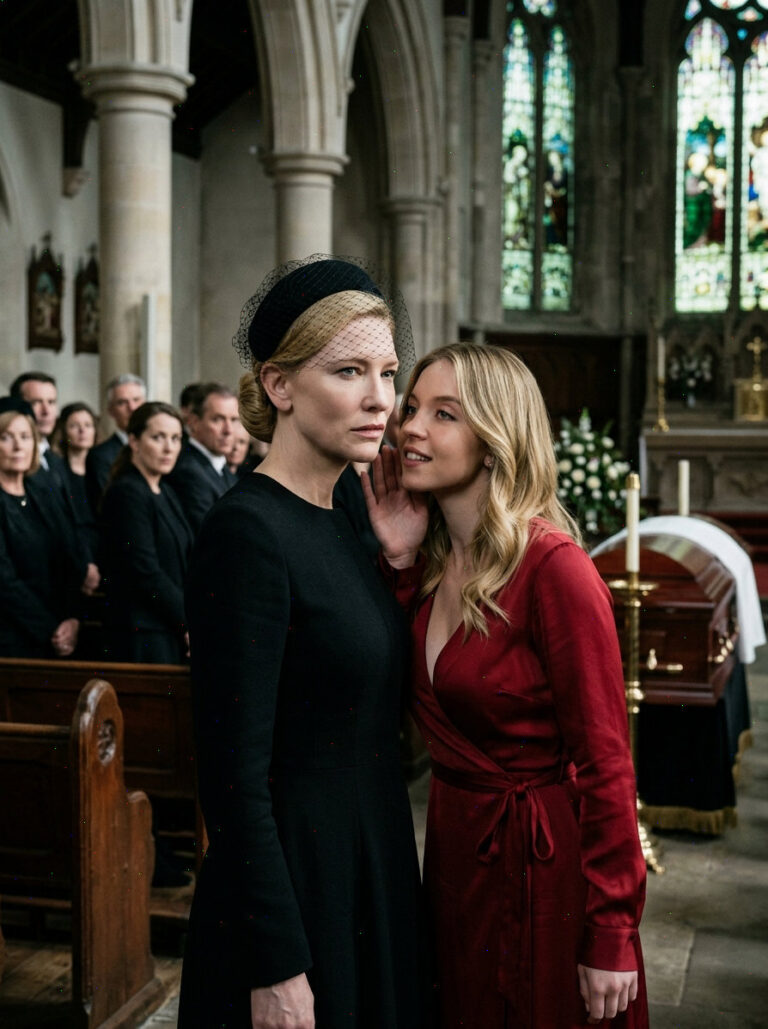
My pregnant daughter was in a coffin—and her husband showed up like it was a celebration.
Not quietly. Not with shame.
He walked in laughing.
The sound split through the organ hymn like a blade through water. Every head turned. Black suits went rigid. The white lilies on their stands seemed to tremble. And there he was—Evan Vale, my son-in-law, shoes polished to a mirror shine, gold watch catching the light, one hand resting casually on the waist of the woman who had spent two years dismantling my daughter’s life.
Her name was Celeste.
Her heels clicked against the old stone church floor. Sharp. Rhythmic. Like applause at a show that had just ended exactly the way she wanted.
I stood beside Emma’s coffin with my hands folded in front of me like I was praying. The neighborhood women murmured behind their black gloves. My sister grabbed my elbow and squeezed hard enough to bruise. I did not move.
Inside that coffin, my Emma looked like porcelain. Too pale. Too still. One hand rested over the soft curve of her belly—where my unborn grandson had stopped breathing with her, three days before Christmas.
Evan’s eyes found mine across the room.
“Margaret,” he said, warmly, like we had just bumped into each other at a grocery store. “Terrible day.”
I said nothing.
Celeste leaned forward. Her perfume reached me first—something expensive and floral, obscene in a room that smelled of grief and old wood. Her red lips barely moved.
“Looks like I win,” she murmured.
My throat filled with fire.
So I swallowed the scream. I pressed it deep, down past my ribs, past the grief that had been cracking me open since the phone rang at 2 a.m. four days ago.
At the front of the church, Mr. Halden stepped out from the shadow of the pulpit. He held a sealed envelope. Emma’s name was written across the front in her own handwriting.
“Before the burial,” he announced, “the will must be read.”
Mr. Halden broke the seal, unfolded the paper, cleared his throat.
And read the first name.
“My mother, Margaret Ellis.”
The smile slid off Evan’s face.
Part 2: What Emma Knew
What Evan never understood about my daughter was that she observed everything and said very little.
Emma had been like that since she was seven years old. She would sit at the kitchen table while the adults talked, her eyes moving quietly from face to face, absorbing everything, filing it away. I used to joke that she should have been a spy. She had her father’s patience and my stubbornness, and she had grown up in a house where we did not make decisions in anger.
She made decisions when the time was right. When all the pieces were in place.
Evan had met Emma at a conference in Chicago six years ago. He was charming in the way that certain men are charming—reflexively, effortlessly, like breathing. He knew how to fill a room. He knew how to make a woman feel like the only person in it. Emma had called me after their second date, voice lit up in a way I had not heard since she was a teenager. She said, “Mom, he’s different.”
I had smiled and said the things a mother says.
But I had watched him at Sunday dinners. I had watched the way his eyes moved around a room even when he was speaking directly to you. I had noticed the way he spoke about money—not with worry, the way ordinary people do, but with a particular hunger, like it was something he was owed.
I said nothing. Emma was an adult. Emma was happy.
For a while, she was.
The cracks started showing in year three. Small things. Evan working late. Evan’s phone face-down on every surface. Emma growing quieter at family dinners, the light behind her eyes dimming like a lamp on a slow dial. She lost weight. She stopped mentioning his name with warmth.
Then last spring, she called me on a Tuesday afternoon, her voice very steady and very controlled in the way voices get when a person has been crying for hours and has finally run completely dry.
“Celeste,” she said. “He’s been with her for almost two years.”
I drove to her house that night. I sat with her until 3 a.m. I wanted to call Evan. I wanted to say things I cannot repeat here. But Emma held up one hand and said:
“Don’t. Please. Let me handle it.”
I should have known then. I should have recognized it—that quiet, that stillness. It was the same look she had at seven years old when a classmate had stolen her book report and she had simply smiled and said nothing. Three weeks later, that classmate had been caught in a lie about something else entirely, and Emma’s teacher had come to understand exactly what kind of child she was dealing with.
Emma did not react. Emma prepared.
What I did not know—what none of us knew—was that she had already been to see Mr. Halden. She had already begun restructuring everything. The house, which had been a wedding gift from my late husband and me, was titled only in Emma’s name. Evan had never noticed. The investment accounts her father had left her—accounts Evan had spent years casually referencing as “our future”—had never included his name on a single document.
Emma had been a meticulous woman.
And in those final months, while Evan spent his evenings with Celeste and his weekends pretending, Emma had spent her quiet hours building something that her husband would never see coming.
Part 3: The Envelope
The morning of the funeral, I arrived at the church two hours early.
Mr. Halden was already there, seated in the first pew with his briefcase on his lap. He stood when he saw me. He did not offer the usual condolences—he had already said everything there was to say at our meeting four days earlier, the morning after Emma died, when he had called me and asked me to come to his office alone.
That meeting had lasted two hours.
I had walked in a grieving mother and walked out something else. Something harder. Something with a purpose.
Emma had written me a letter. Four pages, handwritten, on the cream stationery she had used since college. I will not share all of it. Some of it is too private, too raw, too much mine to give to anyone else. But there are things she wrote that I can tell you, because she wrote them for exactly this reason—because she wanted them to be known.
“Mom, I know you’re going to want to scream at the funeral. I need you not to. I need you to be still. I need you to let Mr. Halden do his job. Because I have done mine.”
She had done her job in exhaustive detail.
The house—our family home, the one her father and I had given her as a wedding gift—had been quietly placed into a trust three months before she died. The trust’s beneficiary was her unborn child. In the event the child did not survive, the secondary beneficiary was me, her mother, Margaret Ellis.
The investment portfolio—nearly $340,000, accumulated over a decade of careful saving—was held in an account that had been a college graduation gift from her late father, opened in her name alone. It had never been a marital asset. Emma had confirmed this twice with two separate attorneys.
The life insurance policy. This was the one Evan had spoken to the insurance company about four days after her death—we knew this because Mr. Halden had anticipated it and had already spoken to them first. Emma had changed the beneficiary eleven weeks before she died. She had removed Evan Vale’s name entirely.
The new beneficiary: her unborn child. Secondary: me.
Every door Evan had been mentally walking through, planning his future in, calculating his windfall in—Emma had quietly bricked them closed, one by one, in the final weeks of her life.
She had known she was running out of time. The pregnancy had been complicated. The doctors had been careful in their language, but Emma had always been good at reading between the lines.
She had not told me how serious it was.
She had used the time she had left to make sure that the people who had hurt her would find nothing waiting for them.
Part 4: The Reading
When Mr. Halden read my name, the church went from a murmur to silence.
Evan’s face did not go angry. Not immediately. It went blank—the specific blankness of a man whose mental calculation has just returned an error, who is rapidly running the numbers again, certain he must have misunderstood.
Celeste’s hand tightened on his arm.
Mr. Halden continued reading. Each asset. Each account. Each property. My name, or the trust for the child who had not survived, appeared on every single line.
Evan’s name appeared once.
His personal vehicle, a 2021 BMW, which was registered in his name and had therefore never been Emma’s to give or take.
That was it.
That was everything Evan Vale walked away from that marriage with: a car.
When Mr. Halden finished, he folded the document precisely, returned it to the envelope, and looked up.
The room was absolutely silent except for the sound of someone weeping softly in the third row—Emma’s college roommate, who had driven six hours to be there, who had known Emma better than almost anyone, and who was now crying not from grief alone but from something that looked, unmistakably, like relief.
Evan said, “This is a mistake.”
Mr. Halden looked at him. “It is not.”
“She wouldn’t have—we were married. There are laws—”
“Mr. Vale.” Mr. Halden’s voice was the quietest it had been all morning. “Your wife was a meticulous woman. I met with her nine times in the final three months of her life. Everything has been reviewed, confirmed, and legally filed. There are no mistakes.”
Celeste took a step backward. Her heel caught on the uneven stone floor—the same heels that had clicked in like applause—and she stumbled slightly, grabbing the back of a pew.
No one helped her.
Evan looked at me.
I looked back.
I thought of Emma on the phone that night, voice low and careful, telling me to trust her. I thought of her hands in the coffin, still and pale and folded over the place where my grandson had been. I thought of seven years of Sunday dinners, and the way Evan had always looked at our house like he was estimating its value.
I did not say a word.
I did not need to.
Emma had already said everything.
Conclusion: What She Left Behind
We buried Emma on a Thursday, under a sky so gray it looked like the world was holding its breath.
Evan did not stay for the burial. He left after the reading, Celeste two steps behind him, both of them moving quickly, heads down, past the journalists outside who had come for a grief story and gotten something else entirely.
I stood at the graveside with my sister, and Mr. Halden, and Emma’s college roommate, and the old women from the neighborhood who had known my daughter since she was small.
We said our goodbyes.
In the weeks that followed, I received the documentation for the house. I walked through every room. I sat in the kitchen where Emma had learned to make her grandmother’s recipes. I stood in the nursery she had painted pale yellow, with the small crib she had assembled herself, the tiny folded blankets still stacked on the shelf.
I sat down on the nursery floor and I let myself cry—really cry, the way I had not been able to at the funeral, the way I had swallowed in that church because Emma had asked me to be still.
But even in the grief, something was different than I had expected.
There was no helplessness in it. No feeling of having been left with nothing.
Emma had made sure of that.
She had been gone, but she had left something behind—not just the house or the accounts or the legal documents, but the knowledge that she had seen everything clearly, and she had acted, and she had not let the people who had hurt her simply win by default.
Evan had walked into that church believing that death would do for him what marriage had not—deliver him a windfall, a clean exit, a fresh start funded by the woman he had betrayed.
He had walked out with a car.
My daughter, gone too young, too soon, had reached forward from the hardest weeks of her life and taken care of me. Had made sure that the house her father and I built would stay in the family. Had made sure that the money her father left her would not line the pockets of a man who had spent years treating her like a stepping stone.
She was meticulous until the end.
She was her father’s patience and my stubbornness, all the way to the last page.
I still talk to her. In the kitchen in the mornings. In the nursery sometimes, when I can stand to be in there. I tell her about small things—the weather, a recipe I tried, a show she would have liked.
And sometimes, in the particular quiet of an early morning, when the light comes in through the kitchen window at the angle it used to when she was small and sitting at the table watching everything, filing it all away—
I think I can hear her.
“I told you, Mom. I took care of everything.”
She did.
She really did.

Evan Cole Editor-in-Chief | Breaking News & Public Policy
“From Washington to Wall Street, and Main Street to Hollywood—Evan Cole connects the dots.”
As the Editor-in-Chief at Newskilo, Evan leads a dynamic team of journalists dedicated to uncovering the truth behind the headlines. With over 15 years in digital media, Evan has a reputation for cutting through the noise.
While he is widely recognized for his deep analysis of U.S. fiscal policy (IRS & Stimulus), Evan’s expertise extends to global current events, corporate accountability, and cultural trends. Whether he is breaking down a complex government bill, exposing a tech giant’s failure, or analyzing the societal impact of a viral celebrity moment, Evan’s goal is simple: To tell the stories that shape our world with clarity, accuracy, and integrity.
Leave a Reply