
My stepmother called me right as the sun was going down.
She sounded pleased. Not nervous. Not hesitant. Pleased.
“You are permanently banned from the beach house,” she said. “I changed the locks this afternoon. If you come anywhere near that property, I’ll have you removed.”
I was standing at my apartment window in Boston, my phone pressed so hard against my ear it left a mark. The sunset was smearing orange across the glass. My laptop was open behind me, an unfinished email still blinking on the screen.
None of that mattered anymore.
“You mean the house my mother left behind?” I asked.
She laughed. That laugh — the kind that twists something deep in your chest.
“I mean this family’s house,” she snapped. “And after what you pulled at Madeline’s graduation party, you don’t deserve to be anywhere near it.”
The graduation party I wasn’t even invited to.
I almost said it out loud. Instead I let her finish. She told me she’d already called the local police. That I was not welcome on the property. That if I showed up, I would be escorted away like a trespasser.
Then Madeline texted: “You were never really part of this family anyway.”
I didn’t respond to either of them.
I just walked to my home office, dropped to my knees, and pulled open the bottom drawer of my file cabinet. Behind old tax folders and expired insurance cards sat a thick envelope sealed with yellowing tape — untouched since the week after my mother’s funeral.
Five words on the front. Written in my mother’s careful handwriting.
“Rebecca. Beach house documents. Important.”
“Important” was underlined. Three times.
I sat there on the floor for a long moment, just holding it.
Part 2: What My Mother Had Quietly Done
My mother, Carol, had never been a dramatic person. She didn’t make speeches. She didn’t announce her decisions. She simply acted — quietly, deliberately, and almost always three steps ahead of everyone else in the room.
I didn’t fully understand that until I was sitting cross-legged on my office floor at nearly ten o’clock at night, spreading the contents of that envelope across the hardwood.
Inside were three documents.
The first was a copy of the property deed for the beach house in Harwich Port — the one my parents had bought the summer before I turned seven. The one with the white porch faded by salt air and the kitchen window my mother always left open while she cooked, letting in garlic and lemon and ocean breeze.
The second was a trust agreement, dated fourteen months before she passed, establishing the beach house as held in trust for my sole benefit — bypassing the estate entirely, bypassing my father, bypassing Diana.
The third was a letter. Handwritten. Two pages. Addressed to me.
I won’t quote it in full — some things are too private to put on the internet. But the second paragraph began with: “I know you think I don’t see what Diana is doing to this family. I see everything. That’s why I did this before things get worse.”
She had consulted an estate attorney named Evelyn Porter. She had done it on a Tuesday afternoon while I was at work, while my father thought she was at a doctor’s appointment, while Diana was likely redecorating my childhood bedroom.
My mother had looked at her own future and calmly arranged it so that even after she was gone, she’d still be standing between me and the woman who had been trying to push me out of this family for six years.
I traced her signature with my fingertip.
The ache was enormous and specific — the way grief gets when it suddenly has an object, a shape, a weight you can actually hold.
My phone buzzed again on the floor beside me.
Diana: “I already told the local police you are not authorized on that property. Don’t make this embarrassing for yourself.”
I pulled up Evelyn Porter’s contact in my phone. It was almost 10 PM, but she’d told me once — any time, Rebecca, for anything involving this trust — and I believed her.
She picked up on the second ring.
I read her Diana’s texts. I told her about the call. I described the new locks.
There was a pause, and then Evelyn said, quietly and with unmistakable satisfaction: “Forward me everything. Don’t respond to Diana. Book a car for tomorrow morning. I’ll meet you there.”
I barely slept. I lay in bed staring at the ceiling, the legal envelope on the nightstand, listening to Boston go quiet outside my window.
Before dawn, I was already on the road.
Part 3: The Drive Down and What I Was Preparing For
The drive from Boston to Harwich Port takes just under two hours in early morning traffic when the highway is still half-empty and the sky is still deciding between night and day.
I had the trust documents in a folder on the passenger seat. I had Evelyn’s number dialed as a favorite. I had every screenshot of every message Diana and Madeline had sent me the night before, backed up in three places — my phone, my email drafts, and a shared folder Evelyn had set up.
I had also, very quietly, made one additional call before I left.
I had called the locksmith company whose logo I’d spotted in the background of a photo Madeline had posted to her Instagram story the evening before — the one where she’d captioned it “glow up for the beach house ✨ new locks, new chapter.” The company was called Coastal Lock & Key, based in Hyannis.
I hadn’t told Diana I was coming.
I hadn’t told Madeline.
I hadn’t told my father, who had a habit of warning Diana whenever a conflict was about to arrive at her doorstep, giving her time to compose herself and her narrative.
I drove in silence, watching the highway flatten out into the familiar geography of the Cape — the scrub pines, the exit signs, the way the air changes when you get close enough to smell salt.
The beach house came into view at 7:14 AM.
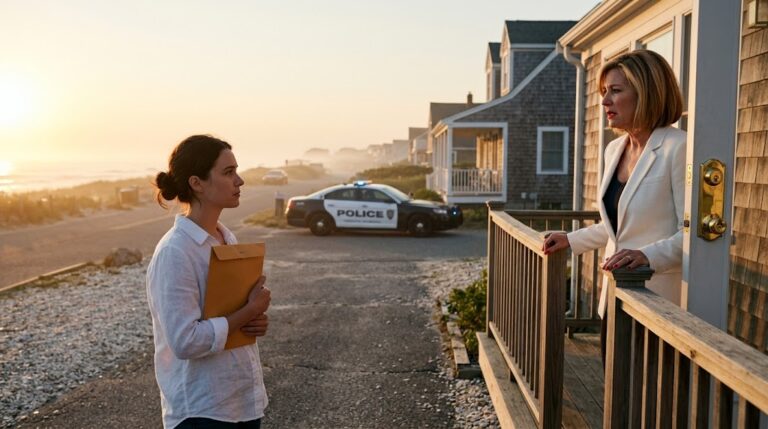
A police cruiser was already in the driveway.
Diana had followed through. Of course she had.
She was standing on the porch beside her brand-new brass door lock, arms crossed, wearing a pressed linen blazer in cream — deliberately elegant, deliberately composed. Like she’d dressed for this. Like she’d rehearsed it.
I parked on the street. I stepped out of the car. I held my folder against my chest and walked up the driveway slowly, the gravel crunching under my shoes.
Diana’s mouth curved into a smile the moment she recognized me.
“I warned you,” she said, loud enough for the officer to hear. “I told you not to come here.”
The officer — young, maybe twenty-six, looking deeply uncomfortable — stepped forward. “Ma’am, I’ve been informed that this is private property and you don’t have authorization to—”
“I’m Rebecca Harmon,” I said calmly. I held out the folder. “I’m the sole beneficiary of the Harmon-Coastal Trust, which holds title to this property. I have the deed and the trust documents if you’d like to review them.”
The officer blinked.
Diana’s smile didn’t falter — yet. “That’s not a valid document. The house belongs to this family, and I am the wife of the owner. She has no legal claim.”
“The trust was established before my mother’s death,” I said, still addressing the officer. “It transfers the property outside of the estate. My father’s name is not on the title. My stepmother’s name has never been on the title.”
A second vehicle turned into the driveway.
A white van. Coastal Lock & Key printed on the side in blue letters.
The man who had installed Diana’s brand-new brass lock stepped out, clipboard in hand. He looked between me and Diana with the particular expression of someone who suddenly realizes he has walked into something he wants no part of.
Diana turned.
And the smile left her face entirely.
Part 4: The Moment Everything Came Apart
Evelyn arrived four minutes later in a black SUV, already on the phone with someone, already striding across the gravel in low heels with the energy of a woman who has done this exact thing before and found it mildly entertaining.
She shook the officer’s hand. She introduced herself. She handed him a one-page legal summary — the trust document condensed into language designed for exactly this kind of moment.
The officer read it. Read it again. Looked at Diana.
Diana opened her mouth. Closed it. Looked at the locksmith, who was now explaining to Evelyn that he had installed a new deadbolt and two additional keyed locks — all of which, legally, had been installed without the property owner’s consent, on property he had no authorization to modify.
“So what does that mean?” Diana asked. Her voice had changed completely. The pleasedness was gone. What was underneath it was smaller and more brittle.
“It means,” Evelyn said, turning to face her with a patience that was almost surgical, “that every lock installed on this property in the last twenty-four hours needs to come out. And it means that you — and anyone you authorized to enter or modify this property — did so without the legal owner’s permission.”
Diana looked at my father, who had pulled up sometime in the last few minutes and was now standing at the edge of the driveway, hands in his pockets, not quite able to meet anyone’s eyes.
“James,” she said. “Tell them. Tell them this is our house.”
My father said nothing for a long moment.
Then, very quietly: “Carol set that trust up, Diana. I knew about it. I didn’t think it would ever — I didn’t think you would actually—”
He didn’t finish the sentence.
He didn’t need to.
Diana turned back to me. Her face had gone through three different expressions in the space of ten seconds — outrage, calculation, and finally something that looked almost like the beginning of understanding.
“Rebecca,” she said. “Let’s talk about this reasonably.”
“You’re welcome to contact my attorney,” I said. “Her card is in the folder.”
I walked up the porch steps for the first time in four years. I put my hand on the railing — the one worn smooth by my mother’s hands — and I felt the wood under my palm, salt-rough and warm in the morning sun.
The locksmith had already begun removing the new hardware.
Diana stood in the driveway with her phone in her hand and no one left to call.
Conclusion: What the Beach House Actually Meant
I’ve thought a lot about why my mother did it the way she did — quietly, without telling me, without making it a moment or a declaration.
I think she understood that the house was never really about the house.
It was about the last place where she had been fully herself — where she had cooked with the window open, where she had sat on that worn porch watching the water, where she had existed before Diana arrived and began slowly editing her out of her own family’s story.
She gave it to me because she knew I was the only one who would remember it that way.
The new locks came off by nine that morning. Evelyn filed the necessary paperwork by noon. Diana sent me three increasingly formal texts over the following week — first argumentative, then conciliatory, then something that only people who’ve suddenly lost leverage know how to write: vague, careful, leaving room for a door that wasn’t there anymore.
My father called me on a Thursday evening, two weeks later.
He said: “I should have said something sooner.”
I told him I knew.
I don’t know yet what happens with him. That’s a longer story — the kind that unfolds slowly, with a lot of silence in between the words.
But I know what happens with the beach house.
I went back the following weekend. I left the kitchen window open while I made dinner — garlic, lemon, the ocean breeze moving through the screen.
And for the first time in a very long time, the place felt like mine again.
Because it always was.

Evan Cole Editor-in-Chief | Breaking News & Public Policy
“From Washington to Wall Street, and Main Street to Hollywood—Evan Cole connects the dots.”
As the Editor-in-Chief at Newskilo, Evan leads a dynamic team of journalists dedicated to uncovering the truth behind the headlines. With over 15 years in digital media, Evan has a reputation for cutting through the noise.
While he is widely recognized for his deep analysis of U.S. fiscal policy (IRS & Stimulus), Evan’s expertise extends to global current events, corporate accountability, and cultural trends. Whether he is breaking down a complex government bill, exposing a tech giant’s failure, or analyzing the societal impact of a viral celebrity moment, Evan’s goal is simple: To tell the stories that shape our world with clarity, accuracy, and integrity.
Leave a Reply