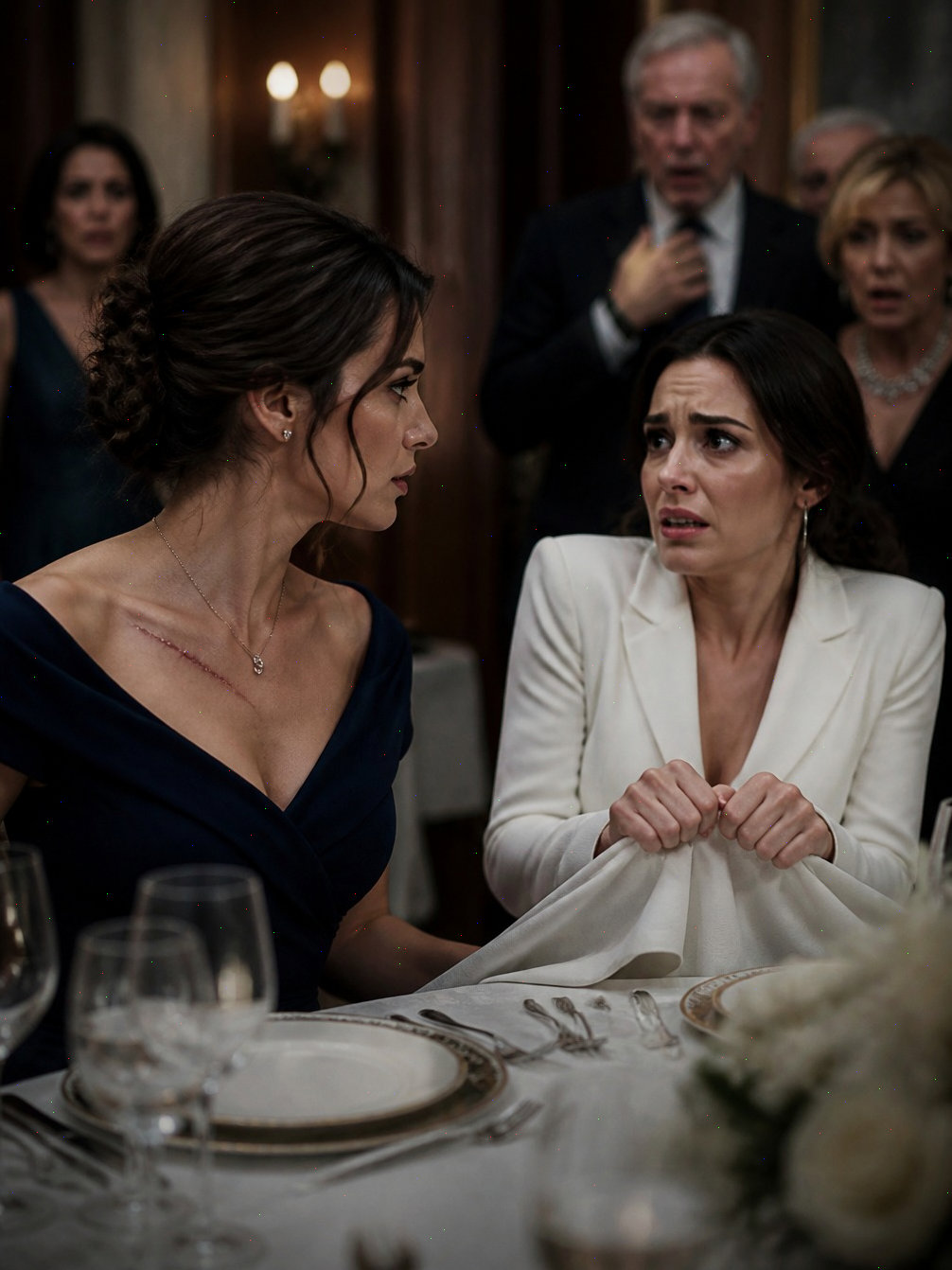
I was standing in the doorway of the dining room at Ashford Hall when I heard my mother say her name.
Not mine. Hers.
My hand was still pressed against the surgical scar beneath my navy dress — nine weeks old, still angry and red — when twenty-two glasses rose into the air for Natalie.
My name is Alice Jordan. I’m thirty-one. I work for a nonprofit that helps low-income families navigate medical systems. I make $41,000 a year. I live in a studio apartment where the radiator clanks all night. I own one nice dress — the navy one I wore that evening — because I bought it specifically so the neckline would sit just low enough to show the top of my scar.
I wanted them to see it. I needed at least one person in that room to look at my body and remember what I had done.
Nobody did. Not until the very end.
When Dad collapsed at the Jordan Medical Supply annual gala — an event I was not invited to — a cousin texted me from the parking lot of St. Marcus Hospital. I drove there with both hands shaking on the wheel, running two yellow lights.
The doctors told us his kidneys were failing. Stage four. He needed a transplant. Without one, they were talking about months, maybe less.
The next morning, while my mother was still in the family lounge accepting casseroles from company executives, I walked myself to the transplant coordinator’s office and asked to be tested. I didn’t tell anyone.
A week later, the coordinator called. Ninety-eight percent compatibility.
When I brought the results to my family, my mother looked at the printout the way you look at a piece of junk mail. Natalie said she had been “in the process of scheduling her own test.” I knew she hadn’t. She has a needle phobia so severe she once fainted getting a flu shot. Nobody said that out loud. Nobody said thank you, either.
My mother told my father, within earshot of me, that I had never finished anything hard in my life.
Dad accepted my kidney anyway.
The surgery was September 15th. I remember the ceiling tiles of the pre-op room. I remember the anesthesiologist asking if I had anyone waiting for me. I said yes. I lied.
I woke up at 6:40 in the evening with fire tearing through my left side and a nurse adjusting my IV drip. The chair beside my bed was empty. Down the hall, in the ICU, my mother and sister were holding vigil over my father, fielding calls from relatives, accepting flowers, posting updates. No one came to my room.
At 2:50 in the morning, I heard the squeak of wheels. Dad had convinced a night nurse to wheel him down the corridor in his hospital bed. He was hooked to three monitors. He gripped my fingers so hard I thought he might break them.
“I see you, Alice,” he whispered. His eyes were wet. “I am going to make this right.”
I thought he meant an apology was coming. Maybe a card.
While I recovered alone in my studio apartment — unable to lift anything heavier than a half-full coffee mug, surviving on soup I could barely heat — Natalie was transforming my father’s illness into her personal brand.
She organized a fundraiser. Not for Dad specifically, but for “kidney research and transplant advocacy.” She booked a venue downtown, sold sponsorships to Dad’s corporate contacts, and wore a white blazer to the press photos. She gave an interview to a local lifestyle magazine where she described watching her father fight for his life as “the moment I found my purpose.”
My name did not appear in the article.
The event raised $83,200. Jordan Medical Supply issued a press release calling Natalie a community champion. She got a segment on a regional morning show. She started using the phrase “healthcare advocate” in her Instagram bio.
I was still getting explanation-of-benefits statements in the mail. I had missed nine weeks of work. I had a post-surgical infection that required two additional prescriptions. I had a $6,400 gap between what the insurance covered and what the hospital billed. I was moving money between accounts to cover rent.
My mother called me once during that entire period. She said Dad’s kidney function numbers were excellent. She did not ask about mine.
The dinner was supposed to be a celebration. Twenty-two relatives in a private dining room at Ashford Hall. Round tables with white linen. A prix fixe menu. Dad had been discharged and cleared for light activity.
I was seated at the far end of the table. Natalie sat at Dad’s right side.
Before the first course, my mother stood with her wine glass. She said the last few months had shown her what real strength looked like. She said one of her daughters had demonstrated true leadership, real compassion, a willingness to sacrifice for family.
She turned to Natalie.
“To my incredible daughter,” my mother said. “The one who saved your father’s life.”
Twenty-two glasses went up.
I pushed back my chair. I was going to leave. I had already decided I would walk out, drive home, and figure out the rest of my life without any of these people in it.
That was the exact moment Dad grabbed my wrist.
His grip was weak — post-surgical, sixty-three years old — but it stopped me completely. He reached into his jacket pocket and slid a folded napkin across the tablecloth until it reached my fingers.
Under the table, I unfolded it. The handwriting was unsteady, post-op tremor, but the words were clear.
“We received a report from the forensic auditors. The fundraiser was a fraud. I’ve changed everything. Wait.”
Part 2: Dad Stood Up
The room was still applauding for my sister when my father pushed himself to his feet.
He was sixty-three years old, nine weeks post-transplant, and visibly thinner than he had been before the surgery. His suit jacket hung slightly loose at the shoulders. But when he stood, the dining room went quiet in the way rooms go quiet when a person of serious authority stops performing politeness.
“Thank you, Claire,” Dad said. His voice was raspy — the surgery had required intubation, and his vocal cords had never fully recovered their old resonance — but it carried. Every syllable landed. “It is true. This room is full of family. And the last nine weeks have given me a lot of time to think about what family actually means.”
Natalie beamed beside him. She reached over and patted his arm. “We love you, Daddy. We’d do anything for you.”
Dad looked down at her hand.
Then he slowly, deliberately pulled his arm away.
Natalie’s smile didn’t disappear immediately. It flickered first — a brief malfunction, like a light bulb about to go — before settling into something confused and uncertain.
“While I was lying in a hospital bed, relying on a machine to clean my blood,” Dad continued, his gaze sweeping the twenty-two faces at the table, “I asked my company’s auditing firm to look into our personal and corporate finances. I wanted to make sure Claire and the girls would be secure if my body rejected the transplant.”
My mother shifted in her seat. The woman who had given a toast thirty seconds earlier looked suddenly like she wanted to disappear through the floor.
“Gerald,” she said, her voice strained with warning, “this isn’t the time for business—”
“It’s exactly the time,” Dad said. His voice cracked like a whip — not in volume but in finality. He reached into his breast pocket and withdrew a folded sheet of paper.
I watched Natalie’s face as he unfolded it. I watched the exact moment she understood what it was.
“Natalie,” Dad said, looking directly at his older daughter, “would you like to tell everyone where the eighty-three thousand dollars from your kidney research fundraiser actually went?”
The air conditioner hummed. Somewhere outside, a car passed on the street. The private dining room of Ashford Hall was otherwise perfectly, completely silent.
Natalie’s face drained of color so quickly it was almost theatrical. She gripped the tablecloth with both hands.
“I… it went to the foundation, Dad. What are you talking about?”
“It went to a limited liability company registered to your husband,” Dad read from the paper, his voice devoid of warmth. “An LLC that immediately paid off your secondary mortgage and cleared seventy thousand dollars in credit card debt. You didn’t raise money for kidney research. You monetized my organ failure to bail out your reckless spending.”
Aunt Sarah made a sound — somewhere between a gasp and a word that never formed. Uncle David’s fork hit the floor with a sound like a gunshot in the silence.
My mother stood up. Her face was flushed. “Gerald, stop it! She made a mistake. They were under financial pressure, and she was going to pay it back. You cannot do this in front of the family!”
There was a pause. Dad looked at my mother for a long time.
“You knew?” he asked.
Three words. Completely flat. No inflection.
My mother’s mouth opened. Nothing came out.
“You knew she was defrauding our friends, our colleagues, and the press,” Dad said, “and you stood there and toasted her integrity.”
“She’s your daughter!” Mom cried, her voice cracking with something that sounded more like self-preservation than maternal love.
“So is Alice,” Dad said softly.
And the room shifted.
Part 3: Twenty-Two Pairs of Eyes
For the first time all evening, I felt the weight of attention.
Twenty-two pairs of eyes moved from my father to me. Slowly, like compass needles finding north. I was at the far end of the table in my navy dress, with tear tracks drying on my face and both hands flat on the tablecloth, and for the first time in my thirty-one years at Jordan family gatherings, I was not invisible.
I didn’t know what to do with it. I just sat still and let them look.
Dad turned to face me fully. His expression, which had been controlled and cold while addressing my mother and sister, changed completely. It became something exhausted and tender and deeply sorry.
He reached down and unbuttoned the bottom button of his suit jacket. Then he pulled the hem of his dress shirt up just enough to expose the skin beneath — the thick, raised, dark-red line of his surgical scar running along his abdomen.
“Natalie planned a party,” Dad said. His voice had gone thick with emotion — not performative emotion, but the voice of a man who had been lying in a hospital bed at 2:50 in the morning holding his daughter’s hand in the dark and understanding, for the first time, what his family actually was. “Alice gave me her flesh. Alice gave me her blood. She went into surgery alone, woke up alone, and has been drowning in medical debt because her own mother refused to help her while funding a fraudulent gala for the daughter who couldn’t even be bothered to take a blood test.”
Something broke open in my chest.
I had not cried from the physical pain of the surgery — and there had been real, serious pain, the kind that makes you understand the phrase “brought to your knees” as something literal. I had not cried from the isolation of those nine weeks, eating soup alone and watching the explanation-of-benefits statements stack up on my kitchen counter. I had not cried at the toast.
But being seen — truly, publicly seen — by the man whose life I had saved broke me open in a way that nothing else had.
Hot tears spilled over before I could stop them. I pressed my lips together and stared at the tablecloth and let them fall.
Dad reached into his jacket one more time.
A thick manila envelope came out. He didn’t hand it to me. He set it on the table and slid it, slowly and deliberately, the full length of the white linen tablecloth, past the water glasses and the bread plates and the stunned hands of our relatives, until it stopped directly in front of me.
“Inside that envelope,” Dad said, “is the deed to the suburban house Natalie currently lives in. I own it. As of this morning, it belongs to you. You can move in. You can evict them and sell it to pay off your medical bills. Whatever you want to do — it’s your choice.”
Natalie made a sound I had never heard from her before. A strangled, hysterical sob that seemed pulled out of her against her will.
“Dad, you can’t do that! Where are we going to live?!”
“You have a lot bigger problems than housing, Natalie,” Dad said. His voice had returned to that cold, final register. “I handed the auditor’s report to the state attorney general’s charity fraud division three hours ago. I also terminated your employment at Jordan Medical Supply, effective immediately.”
He looked at my mother, who had sunk back into her chair with her face buried in her hands.
“My lawyers will contact yours on Monday, Claire,” he added.
Part 4: Walking Out
He didn’t wait for a response.
Dad walked around the large round table — past Aunt Sarah, who was pressing both hands over her mouth; past Uncle David, who was staring at his empty wineglass; past cousin Marcus and his wife, who were holding each other’s forearms without realizing it — and stopped beside my chair.
He held out his hand.
“I’m tired, Alice,” he said. His eyes, when they met mine, were soft in the way eyes get when a person has finally stopped carrying something they have been carrying for too long. “Would you take me home?”
I wiped my face with the back of my hand. I stood up.
I did not look at my mother. I did not look at Natalie, who was now weeping loudly into her husband Marcus Jr.’s shoulder while he sat rigid and white-faced, calculating, I imagine, exactly how serious the words “state attorney general” were.
I smoothed the front of my navy dress. I made sure the neckline was sitting exactly where I had positioned it before I walked in — low enough, precise enough, to show the top of my scar.
I wanted it visible for the walk out.
I took my father’s arm, and we walked out of the private dining room together, through the main dining room of Ashford Hall, past the hostess stand, and out into the cold night air.
The valet brought Dad’s car around. I helped him into the passenger seat — he was still slow on stairs and uneven pavement — and I drove him home in silence for the first fifteen minutes.
Then he said: “I should have seen it sooner.”
I kept my eyes on the road.
“I think part of me did see it,” he said. “I think I just wanted one of my daughters to be the person your mother always insisted she was.”
I thought about that for the rest of the drive.
The Twist That Changed Everything
Three weeks after the dinner at Ashford Hall, I moved into the house.
It is a four-bedroom colonial in a suburb forty minutes from the city. It has a backyard with an actual oak tree, a kitchen with a gas stove, and a master bathroom with a bathtub I have used every single evening since I moved in. After eighteen months in a studio apartment with a shower where the pressure alternated between scalding and freezing, the bathtub alone felt like something I had invented in a dream.
The medical debt was $23,400 total. I paid it off in full using proceeds from a home equity line of credit I opened the week after the deed transferred to my name. The loan officer shook my hand when we finished.
I have not spoken to my mother since the dinner. I received a single text from her three days afterward that read: You always had to be the victim. I screenshot it and forwarded it to my father’s attorney.
Natalie and her husband Marcus Jr. are facing a civil suit from the donors and corporate sponsors of the fundraiser, in addition to the state-level charity fraud investigation. Their attorney’s preliminary motion to dismiss was rejected in February. The house they were evicted from — my house — appraised at $610,000.
My father and I have dinner every Thursday. He drives to the house, and I cook, because his post-surgical diet still requires attention and because the first time I made his mother’s chicken piccata from memory, he cried for the second time since September 15th.
At one of those dinners, about a month in, I asked him something that had been sitting at the back of my throat since the night at Ashford Hall.
“When you slid that napkin to me at the table,” I said, “did you already know exactly what you were going to do? The house, the auditor’s report, all of it?”
He picked up his water glass and considered it for a moment.
“I knew the morning I got the auditor’s report,” he said. “Which was the morning before the dinner.”
“And you still went,” I said.
“I needed them to hear it in front of each other,” he said. “I needed twenty-two witnesses. I needed Claire to hear it surrounded by the same people she had performed her pride for.” He set the glass down. “She would have explained it away privately. Managed it. You know how she manages things.”
I did know.
“I also needed you to receive it in front of them,” he said quietly. “You deserved to be seen publicly by the same people who ignored you publicly. I wanted the ledger balanced in the same room.”
I looked at him across the dinner table — this man whose left kidney I no longer have, whose life I saved alone in a pre-op room on a September morning while my mother was two floors above me accepting condolences — and I understood something I had not let myself understand in thirty-one years.
He had always seen me. He had just been too weak, for too long, to say it in the rooms that mattered.
He wasn’t weak anymore.
Neither was I.
I smoothed down the front of my shirt — a habit now, I think, a way of acknowledging the scar that is fading slowly from red to silver — and I went to the kitchen to check on the chicken piccata.
The scar will never fully disappear. The transplant coordinator told me that before the surgery. She said it would fade, flatten, and become part of my body’s permanent landscape — a ridge of stiffer skin that I would feel when I pressed my hand to my side.
I press my hand to my side often.
Not because it hurts anymore. Because it reminds me of exactly how much I am worth, and that for the first time in thirty-one years, the people who owed me that acknowledgment finally said it out loud.
In a room full of witnesses.
With twenty-two glasses frozen in the air.

Evan Cole Editor-in-Chief | Breaking News & Public Policy
“From Washington to Wall Street, and Main Street to Hollywood—Evan Cole connects the dots.”
As the Editor-in-Chief at Newskilo, Evan leads a dynamic team of journalists dedicated to uncovering the truth behind the headlines. With over 15 years in digital media, Evan has a reputation for cutting through the noise.
While he is widely recognized for his deep analysis of U.S. fiscal policy (IRS & Stimulus), Evan’s expertise extends to global current events, corporate accountability, and cultural trends. Whether he is breaking down a complex government bill, exposing a tech giant’s failure, or analyzing the societal impact of a viral celebrity moment, Evan’s goal is simple: To tell the stories that shape our world with clarity, accuracy, and integrity.