
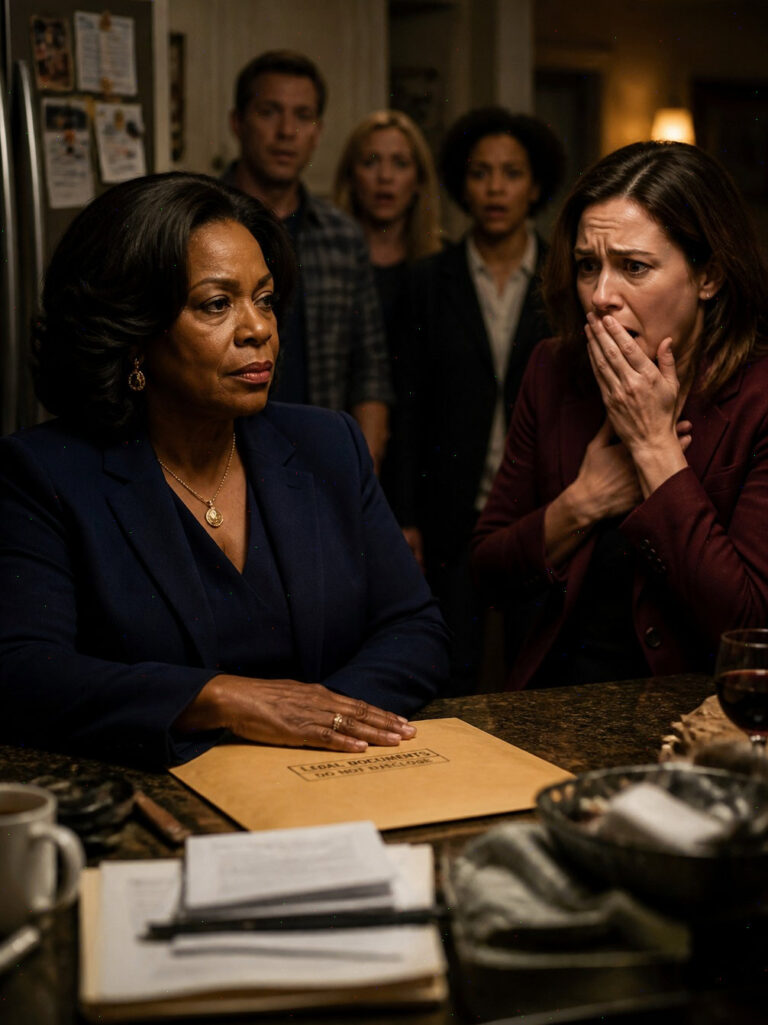
I’ve lived in this apartment for 38 years. Raised my son here. Buried my husband from here. Paid every single mortgage payment — alone — after George died.
And last Tuesday, while I was standing at my own kitchen sink, my daughter-in-law leaned in close and whispered, “You old witch. I only put up with you because of my husband.”
I didn’t turn around.
I finished drying my hands. Set the dish towel down. And I said, quietly, “Don’t worry. You won’t have to see me anymore.”
She laughed. She actually laughed.
I’m Adelaide. I’m 65. I spent 30 years as an ER nurse. I’ve held strangers’ hands while they took their last breath. I’ve made calls that saved lives in under 10 seconds.
But somehow, inside the home I own, I had become invisible.
Melinda rearranged my kitchen like it was hers. Corrected me in front of the grandkids. Acted like she ran the place. And Phillip — my son — just looked away. Every. Single. Time.
I kept telling myself: it’s for the family. For the grandchildren. Stay quiet. Keep the peace.
Then one night I came home from Rosie’s and heard them arguing behind the bedroom door.
“Twelve thousand dollars, Phillip. That’s ALL we had saved.”
He’d been gambling. Sports betting. The money for their future home — gone. The “overtime” he’d been working — a lie.
That’s when I understood why things had gotten so bad. Their plans collapsed. And now my home was the fallback they were trying to control.
A few nights later, Melinda had a friend over. Wine. Laughter. And she called me “the old burden.” Said they were only putting up with me until something better came along.
I sat on my bed that night and looked at my hands.
These hands saved lives. Now they scrubbed dishes for people who mocked me over wine.
The next morning, Melinda announced she wanted my bedroom for a home office. Had already picked paint colors. Suggested I move into the storage room since I “only slept there anyway.”
Phillip mumbled it would be “temporary.”
Something in me went completely still.
So the following morning, while they assumed I was running errands, I put on my navy pantsuit. Went to the bank. Then to a lawyer.
The bank told me: sole owner. Three payments left.
The lawyer reviewed everything, looked up, and said: “They’re there because you allowed it.”
Then he handed me a white envelope.
I didn’t open it at the table that day. I packed a bag. Stayed with Rosie for a week. Long enough to remember the woman I used to be.
When I came back, I asked everyone to sit down. Phillip sat. Melinda stood with her arms crossed. The kids watched.
I reached into my purse. Pulled out that white envelope. And placed it on the table.
Phillip went pale the second he saw it.
And in that moment, everything changed.
Part 2: The Week I Spent at Rosie’s — and What I Finally Let Myself Feel
Rosie has known me since nursing school. She was there when George and I got married in 1983. She was there at his funeral. She was one of the few people in my life who still spoke to me like I was a whole person — not a housekeeper with a grandmother title attached.
I arrived at her door with one bag, a box of George’s old records I refused to leave behind, and a face I hadn’t shown anyone in years.
I cried that first night. Not from sadness — from relief. The kind of relief that comes when you finally stop holding something in your chest that was never meant to live there.
Rosie made tea. She didn’t fill the silence with advice. She just sat with me. And after a while, she said the thing no one else had dared to say:
“Adelaide. You raised that boy. You built that home. When did you decide you didn’t deserve to live in it?”
I didn’t have an answer.
But that question followed me for the next seven days.
I slept in a real bed. I woke up without calculating what breakfast to make for five people. I walked to the corner store without checking if anyone needed anything. I sat on Rosie’s balcony in the mornings with coffee and watched the street move without feeling like I owed anyone anything.
And slowly, something that had been bent for years began to straighten.
I thought about George. He would have been furious — not loudly, but in that quiet, unmovable way he had. He once fired a contractor who spoke down to me during our kitchen renovation. Walked him out the door mid-sentence. “No man speaks to my wife like that in her own home.” He didn’t raise his voice once.
I had lost that standard for myself somewhere between grief and wanting my son to be okay.
I also thought about my grandchildren — Marcus, who was nine, and little Deja, who had just turned six. They had begun mimicking Melinda’s dismissiveness. The way Marcus would roll his eyes when I cooked. The way Deja once told me my room “smelled old.” Children absorb what they’re shown. I was showing them that the woman who loved them most could be spoken to like furniture.
That was not the lesson I was willing to leave behind.
By day five, I called the bank. The woman on the phone pulled up my account and read the information back to me in a flat, professional tone — but what she said made my breath catch.
Thirty-eight years of payments. One name on the deed. Three payments remaining.
“You are the sole titleholder, Ms. Adelaide,” she said. “No other party has any legal standing on this property.”
I sat with that for a long time.
On day six, I met with the attorney — a calm, methodical man named Mr. Hendricks who had a row of framed certificates behind his desk and reading glasses he kept sliding down his nose. I explained everything. The living arrangement. The agreement that was never formalized. The escalation. The insults. The bedroom demand.
He listened without interrupting. Then he asked a few precise questions. Then he was quiet for a moment.
“Mrs. Adelaide,” he said, “in the state of California, informal family arrangements of this kind carry no legal tenancy rights unless a formal lease agreement was signed or rent was formally collected and documented.”
He paused.
“They are there because you allowed it. And you can un-allow it.”
He slid a document across the desk. Cleanly drafted. Legal. Airtight.
A formal Notice to Vacate — 30 days, as required by California law even for informal occupants — along with a letter from his office establishing the terms clearly and without ambiguity.
I looked at it for a long time.
Then I picked up the pen.
Part 3: The Night I Came Home — and What the Apartment Told Me Without a Word
I came back on a Thursday evening.
I used my key — something I had started doing tentatively in my own home, as if I needed permission — and walked in to find dishes in the sink, backpacks on the floor, and Melinda on the couch, phone in hand, not looking up.
“You’re back,” she said. Not a greeting. An observation.
“I am,” I said.
I put my bag in my room and looked around. Melinda had moved two of my framed photos off the hallway shelf and replaced them with a decorative tray she’d bought. One of the photos — George and me at Niagara Falls, 1991 — was leaning against the wall on the floor.
I picked it up. Set it back on the shelf. Said nothing.
That night, I heard Melinda on the phone in the kitchen, voice low but carrying.
“She came back. I don’t know what she thinks has changed. We’ll just deal with it until we figure out the next move.”
The next move.
I went to bed early. Set my alarm for 6 AM. Slept better than I had in months.
The next morning, I made coffee for myself only — something I had never once done in that apartment. I sat at the kitchen table with George’s reading glasses that I still keep in my cardigan pocket sometimes, and I read through the documents one more time.
Marcus came in for breakfast and stood at the counter looking confused.
“Grandma, you didn’t make eggs.”
“I know,” I said. “Come sit with me for a minute.”
He sat down. I looked at this boy — George’s eyes, Phillip’s chin — and I thought about what he was learning in this home. About women. About ownership. About what respect looks like.
“Marcus,” I said, “when you grow up and have a home of your own — how do you want the people inside it to treat you?”
He thought for a second. “Good?”
“Good,” I repeated. “Good is the right answer.”
Phillip came home from work that afternoon looking tired. He glanced at me once, quickly, the way he’d been doing for months — that guilty, evasive look that told me he knew, on some level, how wrong things had gotten.
“Hey Mom,” he said. Quiet.
“We need to talk,” I said. “Tonight. Everyone at the table.”
Something in my voice must have told him this was not a conversation he could redirect, because he just nodded.
Part 4: The Table. The Envelope. The Silence That Changed Everything.
I waited until after dinner.
Melinda had cooked — something she did only on nights when she wanted to signal control. A gesture that said: see how much I do here. She moved around the kitchen with the energy of someone performing for an audience they resented.
After the children finished and were moved toward the living room, I asked everyone to sit.
Phillip sat immediately. He looked like a man waiting for a verdict he already knew was coming.
Melinda stood for a moment, arms crossed, the posture she used when she wanted to look unbothered. Then she pulled out the chair across from me and sat — slowly, deliberately, the way people do when they want to look like the action was entirely their idea.
The table was quiet.
I didn’t rush.
I’d learned in the ER that silence, deployed correctly, commands more attention than volume ever could. You don’t shout in a trauma bay. You speak clearly, you speak once, and people listen because they understand that what you say next matters.
“I want to talk about this home,” I said. “About how we’ve been living. And about what comes next.”
Melinda opened her mouth. I held up one finger — not aggressive, simply: I’m not finished.
She closed it.
I talked about respect. About the years I had spent making myself small in a space George and I had built with our hands, our overtime, our weekends. I talked about the night I overheard the gambling conversation. I talked about what it felt like to hear myself described as a burden by someone eating food I had bought, in a home I had paid for, while I was standing in the next room.
I did not raise my voice once.
Phillip’s jaw was tight. His eyes were wet. He was staring at the table.
Melinda’s arms had uncrossed. She was very still.
“I went to the bank last week,” I said. “And then I went to a lawyer.”
I reached into my purse.
I placed the white envelope on the table in the exact center — between all of us — and I left my hand on top of it for just a moment before I pulled it away.
Phillip looked at the envelope and went pale. He knew my handwriting on the outside. He knew what kind of envelope a lawyer sends.
“What is that?” Melinda asked. Her voice had changed. The certainty was gone.
“Open it,” I said.
She didn’t move at first. Then she reached across the table and picked it up. Tore the flap carefully. Pulled out the document.
I watched her eyes move across the first line.
Notice of Termination of Informal Occupancy — 30 Days.
The room went completely still.
Melinda set the paper down. Her hand was trembling slightly. She looked at Phillip — the look of someone expecting to be rescued.
Phillip did not look back at her. He looked at me.
“Mom—” he started.
“I love you,” I said. “I will always love you. But I spent 38 years in this home, and I am not leaving it. And I will not be managed inside it. Not by anyone.”
“Melinda.” I turned to her. “I don’t hate you. I don’t think you’re a bad person. I think you’re someone who got comfortable taking something that was never offered to you.”
She was quiet.
“You have 30 days. I’m not filing anything today. I’m giving you the chance to decide how you’d like to handle this — as adults, with dignity, for the sake of those children in the next room.”
Phillip put his face in his hands.
Melinda picked up the document again. Slowly this time. Reading every word.
And I sat back in my chair — in my home, at my table, in the apartment I had never once stopped paying for — and I let the silence do the rest of the work.
Conclusion: What Happened in the 30 Days That Followed
Within the first week, Phillip came to me alone.
He sat in the kitchen — the same kitchen where everything had begun — and he apologized. Not the quick, deflecting apologies he’d been offering for years. A real one. The kind that takes a minute to get out because the person saying it actually feels what they’re saying.
He told me he had started seeing a therapist for the gambling. That he’d known for months the situation at home had become something neither of them should have allowed. That he was ashamed — of the gambling, of the silence, of the years he had let his wife speak to his mother that way without correction.
I listened. I didn’t fill the silence with reassurance before he was done.
When he was finished, I told him the same thing I’d been telling him since he was a boy figuring out how to ride a bicycle on this street: “You fell. Now you get up. That’s all.”
Melinda and I did not have that kind of conversation. We were never close, and I had no interest in manufactured warmth. But three days later she came to me in the hallway — no audience, no performance — and said simply: “I was wrong to speak to you the way I did. I am sorry.”
It was six words and a pause. But it was real.
They began looking for an apartment within the second week. I helped them find a two-bedroom in a quieter part of Hayward — affordable, close enough that the grandchildren could still reach me easily, far enough that everyone could breathe.
On the last day, when the last box had been carried down to the van, Melinda paused at the door.
She looked around the apartment one final time. Then she looked at me.
“You were never the burden,” she said quietly. “I was.”
I nodded once. That was enough.
That night, I unpacked George’s records. I put Marvin Gaye on the turntable — his favorite — and I walked through every room of the apartment. I washed my own dishes. I made my own tea. I sat in the quiet of a home that had always been mine and finally felt like it again.
At 65, I had reclaimed something most people spend their whole lives bargaining away: the right to exist, fully, without apology, in the space you built.
My name is Adelaide.
I am a retired ER nurse. A widow. A grandmother.
And I am done making myself small in my own home.

Evan Cole Editor-in-Chief | Breaking News & Public Policy
“From Washington to Wall Street, and Main Street to Hollywood—Evan Cole connects the dots.”
As the Editor-in-Chief at Newskilo, Evan leads a dynamic team of journalists dedicated to uncovering the truth behind the headlines. With over 15 years in digital media, Evan has a reputation for cutting through the noise.
While he is widely recognized for his deep analysis of U.S. fiscal policy (IRS & Stimulus), Evan’s expertise extends to global current events, corporate accountability, and cultural trends. Whether he is breaking down a complex government bill, exposing a tech giant’s failure, or analyzing the societal impact of a viral celebrity moment, Evan’s goal is simple: To tell the stories that shape our world with clarity, accuracy, and integrity.
Leave a Reply