
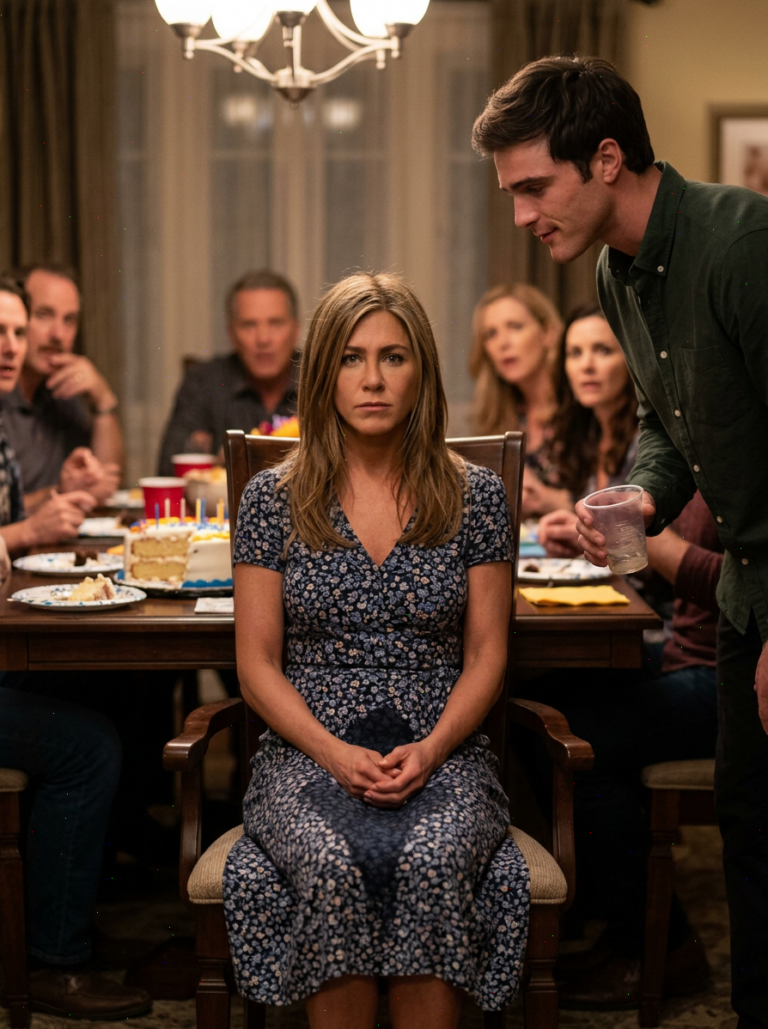
At my mother’s birthday dinner, my nephew dumped soda all over me and said, “Grandma says you don’t belong here.”
Everyone laughed.
I quietly wiped myself off, forced a smile, and stayed silent.
But that night, I removed my name from their loan.
By morning, his car was gone.
And at exactly 8 a.m., someone knocked on my door.
I had been sitting at that table for three hours before it happened — invisible the way you only get invisible inside your own family. Not ignored exactly. Just… categorized. Filed away under “present but not significant.” I had driven forty minutes to bring a gold-wrapped gift my mother hadn’t opened, wearing a dress I had bought specifically because I remembered she once said she liked that shade of blue.
My gift bag sat untouched on the sideboard. The gold tissue paper slowly sinking in on itself.
I told myself it didn’t matter. I had learned that the hard way — after losing my daughter, you understand very quickly that you can control what you give, not how it’s received. Camille had been gone three years by then. Three years of empty rooms and full grief and the particular silence of a family that had never quite known how to hold my pain, so they had quietly stopped trying.
“There’s going to be a car,” Tyler bragged across the table to a girl his age. “Grandma said when I turn sixteen, I’m getting a used Mustang.”
Mom laughed. “We’ll see, dear.”
My stomach tightened. I thought about the secondhand car my dad helped me find at seventeen. Mom had barely looked up from the sink. No excitement. No promises. No Mustangs.
That had always been the pattern.
Then Mom started talking about Tyler’s math teacher. “She said, ‘I don’t say this often, Mrs. Hart, but your grandson is different. He thinks on another level.’” She repeated it like something sacred. Genius-level, she said. A waste not to support him.
No one asked about my store.
No one mentioned the fundraiser.
No one said Camille’s name.
“Steph,” Mike said eventually, as if remembering I existed. “You still doing that candle thing?”
“The store? Yes. We’ve expanded—”
“That’s nice,” he said, already turning away. “You should talk to Tyler about business. He’s got the mind for it.”
Tyler scoffed. “I wouldn’t sell candles.”
“It’s not just candles,” I said quietly.
But they had already moved on.
Part 2: The Cup
I noticed Tyler stand up. He was holding a full plastic cup, condensation running down the sides, moving around the table casually, bumping shoulders, making people laugh. I didn’t think much of it at first. He was always performing — always working the room, reading who was watching and adjusting accordingly. I had watched him do it at every family gathering for three years, ever since he hit thirteen and realized the audience was always there if you played for it.
But at the last second, he turned.
And walked directly toward me.
“Tyler,” Mom called softly. “Don’t spill that, sweetheart.”
He stopped beside my chair. His eyes found mine. He was smiling — but underneath the smile was something practiced and cold, the same tone I had recognized months earlier when someone told me what he had said about Camille.
“She used to be a mom, but she failed.”
When that got back to me — through a cousin, then a second cousin, then a text I was never supposed to see — I had brought it to Mike quietly. I was told I was overreacting. That Tyler was a teenager. That I needed to understand teenage humor.
I understood it perfectly.
“Hey, Aunt Steph,” Tyler said.
He paused. Made sure everyone nearby was watching. A small performance, perfectly timed.
“Grandma says you don’t belong here.”
Then he tilted the cup.
The cold hit immediately — spreading across my lap, soaking through the blue dress, dripping off the chair onto the floor. I gasped. Someone at the far end of the table laughed. Then another person. Then a third. Mom said, “Tyler, honestly—” in the same tone she used when the dog jumped on the couch.
Mildly. Fondly.
I sat completely still.
I reached for a napkin. Blotted. Kept my face smooth. Forced a smile at no one in particular. Said nothing. I could feel the wet fabric against my legs. I could feel the room deciding what this moment meant — and I could feel them deciding it didn’t mean much.
Inside, something went very quiet.
Not broken. Broken was the hospital room, the tiny hand going still, the world tilting off its axis at 4:17 a.m. on a Tuesday in March three years ago. This was different from broken. This was more like a door closing. Quietly. With finality.
I stayed for forty more minutes. Said goodbye politely. Hugged Mom. Told Mike it was a lovely dinner.
I drove home in a wet dress with the windows down.
Part 3: 11:47 P.M.
I did not cry when I got home.
I changed my clothes. Made tea. Sat at the kitchen table for a long time looking at nothing in particular — at the wall, at the refrigerator with Camille’s drawing still held on with a butterfly magnet, at the middle distance where thoughts go when you are finally done arguing with reality.
Then I opened my laptop.
Eighteen months earlier, I had co-signed a loan for Mike and his family. It was framed as a quiet favor — the kind of favor that doesn’t get thanked because it gets absorbed into the general assumption of what you owe your family for including you. My credit score was the reason it was approved at a favorable rate. My name was the structural anchor of the entire arrangement.
I had never once been thanked for it.
I had never once been asked if I was comfortable continuing it.
I called my financial advisor at 11:47 p.m. She picked up on the third ring — she had worked with me for nine years and understood, without me having to explain much, that when I called at midnight it was not a small thing.
I told her what I needed.
She walked me through the steps.
It took eleven minutes to complete the modification request. I removed my name as co-signer. The lender would process it overnight. The terms would reset by morning — because without my credit profile anchoring the account, the loan restructured into a significantly higher risk tier. The automatic review process would flag it before business hours.
Tyler’s Mustang had been purchased three weeks earlier. Mike had put it on a secondary line tied to the same account — a detail he had mentioned at Thanksgiving, casually, the way people mention things they assume will never matter.
I closed the laptop.
I went to bed.
I slept better than I had in months.
Part 4: 8 A.M.
I was up before six. Made coffee. Went for a walk in the early light, the neighborhood still quiet, dew on the grass and the particular stillness of a morning before the world has fully started. I thought about Camille on walks like this — not the hospital end of her, but the beginning. The way she smelled. The weight of her on my shoulder. The way she laughed at the dog across the street.
I thought about the last three years — the store I had built from a grief project into something that actually sustained me, the fundraiser for the shelter, the quiet life I had constructed out of loss and stubbornness and love. I thought about the dinner table last night. The wet dress. The room laughing.
I thought about the moment the door had closed inside me.
At 7:30, I showered and changed.
At 8:00 exactly, someone knocked on my door.
I opened it.
It was Mike.
He was wearing the same shirt he had worn to the dinner the night before, which told me he hadn’t slept. His face was doing something complicated — cycling between anger and calculation and something that might have been, underneath all of it, the first flicker of genuine accountability I had seen from him in years.
He had the car keys in his hand. He was holding them loosely, the way you hold something you no longer know the value of.
“The bank called this morning,” he said.
“I know,” I said.
“Steph—”
“I’m going to stop you,” I said quietly. “Before you say something you’ve already decided.”
He looked at me — really looked, the way Daniel at that other table had failed to look at Mara, the way families fail to look at the people they have categorized as safe to overlook.
“I have been co-signing your security for a year and a half,” I said. “While sitting at your table as a joke. While watching your son speak about my dead daughter like she was a punchline. While bringing gifts that don’t get opened and funding shelters that don’t get mentioned and building a business that gets dismissed as a candle thing.”
Mike said nothing.
“I’m not angry,” I said. And that was the truth — the anger had burned clean overnight, leaving something cooler and more permanent behind. “I’m just done being the infrastructure for a house that doesn’t have a room for me.”
He held out the keys.
“The bank is requiring immediate resolution,” he said. “If you don’t re-sign—”
“I know what happens if I don’t re-sign,” I said.
A long pause.
“Tyler should come here,” I said finally. “Not to apologize. Not to perform an apology for your comfort. He should come here because what he said about Camille — and what he did last night — deserves a real conversation. An honest one. Not managed. Not minimized.”
Mike’s jaw tightened.
“And if that happens,” I continued, “we can talk about the loan. About what a co-signing arrangement looks like when it’s mutual — when it’s a relationship instead of a subsidy.”
He looked at the keys in his hand.
He looked at me.
And for the first time in as long as I could remember, I did not fill the silence.
I let it sit between us, heavy and clean, and I waited.
Conclusion: What Belonging Actually Costs
The hardest thing about being the invisible member of a family is not the invisibility itself. It is the energy you spend maintaining the performance of not minding it — the forced smiles, the quiet exits, the way you manage your own pain to avoid inconveniencing people who have already decided your pain is an overreaction.
I had spent years at that table.
Years of being the candle-thing aunt. The one who lost a child and was expected to be over it by now. The one whose name anchored a loan but whose voice didn’t anchor a conversation.
What changed was not that I stopped loving my family.
What changed was that I stopped subsidizing their comfort at the cost of my own dignity.
Tyler did come to my house. It took two weeks and a mediated conversation that Mike’s wife, Sandra, ultimately pushed for — because Sandra, it turned out, had been watching the pattern longer than I had and was tired of it in her own way. Tyler was fifteen, not a villain, just a boy who had been handed a script by adults who should have known better. The conversation was hard. He cried in a way that was clearly not performance. I told him about Camille — really told him, not the managed version, but the full weight of it. He sat with it.
That mattered.
The loan was restructured. I re-signed under new terms — documented, mutual, acknowledged. The Mustang stayed, because Tyler’s car was not my target, and punishing a fifteen-year-old financially was never the point.
The point was the door that had closed inside me that night.
The point was opening a different one.
My gift bag, I found out later, had been opened after I left. Mom had put on the necklace the following morning and worn it to church. She hadn’t called to say so. But Sandra texted me a photo.
Mom standing in the Sunday light, gold at her throat, looking like herself.
I saved it.
Not because it fixed anything.
But because it was true.
And after years of performing at a table where truth was the one thing no one wanted to bring, truth — even quiet, even late — felt like the only gift worth giving.
The end.

Evan Cole Editor-in-Chief | Breaking News & Public Policy
“From Washington to Wall Street, and Main Street to Hollywood—Evan Cole connects the dots.”
As the Editor-in-Chief at Newskilo, Evan leads a dynamic team of journalists dedicated to uncovering the truth behind the headlines. With over 15 years in digital media, Evan has a reputation for cutting through the noise.
While he is widely recognized for his deep analysis of U.S. fiscal policy (IRS & Stimulus), Evan’s expertise extends to global current events, corporate accountability, and cultural trends. Whether he is breaking down a complex government bill, exposing a tech giant’s failure, or analyzing the societal impact of a viral celebrity moment, Evan’s goal is simple: To tell the stories that shape our world with clarity, accuracy, and integrity.
Leave a Reply