
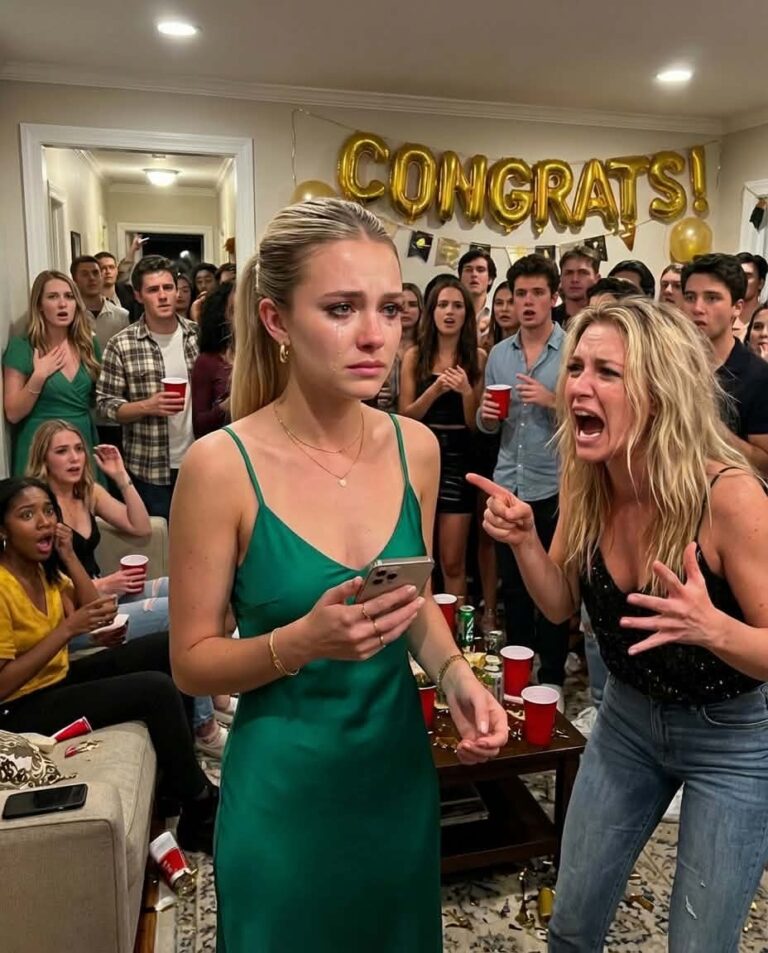
My doorbell camera started screaming at me from inside my Seattle hotel room at 8:47 p.m.
I was sitting on the bed in my conference clothes, shoes still on, reviewing notes from the afternoon session. I assumed it was a delivery. Maybe a neighbor. I almost ignored it.
I didn’t ignore it.
When I opened the live feed, I saw cars lining both sides of my street in Austin. Women in cocktail dresses stepping through my front door. Men in button-downs carrying ice buckets up my porch steps. A bartender — an actual hired bartender — setting up a station under the oak tree in my backyard.
I stared at the screen for a full ten seconds trying to understand why my house looked like a catering hall.
Then my sister Madison appeared on the camera in a silver dress, champagne glass raised, laughing at something someone behind her said.
And behind her, filling the frame of my front doorway, was a balloon arch.
Congratulations, Madison — Regional Director.
My stomach went cold.
I called her immediately. She answered on the fourth ring, her voice bright and warm and wrapped in music I could hear from two thousand miles away.
“Ava, hey. I was going to tell you.”
“Tell me you broke into my house and threw a party?”
She exhaled — that particular exhale she does when she’s decided I’m being unreasonable. “Don’t be dramatic. I used the spare key Mom has. Your place is bigger than mine, and this is a huge night for me.”
“My house is not available,” I said.
“This night isn’t about you,” Madison said. “I’m not stopping for anyone.”
In the background, someone shouted: Speech! Speech!
And I watched on my phone screen as a man I had never seen in my life leaned his full weight against the antique cabinet that Marcus had spent four months restoring by hand. I watched another guest carry a red drink through my living room and stop directly beside the white rug.
“Shut it down,” I said. “Now.”
“No.”
That word — flat, final, entirely unbothered — settled something inside me.
I had spent years watching Madison move through the world the way people move through spaces that belong to someone else. Every time I pushed back, my mother told me the same thing: successful people need support. Sensitive people need perspective.
So I stopped arguing.
I called Graham Patel — the off-duty Austin police sergeant who lived next door, who had my emergency contact saved in his phone, and who had been watching the commotion on my street for the last forty-five minutes waiting for me to say something.
“Graham,” I said quietly. “There are trespassers in my house.”
I muted my phone and watched the screen.
Part 2: What She Didn’t Know About the Spare Key
There’s something my family has always believed about me, and it is this: that I am the quiet one. That quiet means passive. That because I don’t shout, I don’t act.
It has been, over the course of my life, a genuinely useful misunderstanding.
Madison was fourteen months younger than me and had been rewriting the story of our family since she was old enough to understand that narratives are power. In her version, I was the cautious older sister who played it safe while she took the risks. I stayed local for college while she went to the University of Texas with scholarship money and an allowance my mother cut quietly from her retirement account. I married Marcus, who was a carpenter and a good man, while Madison married Derek, who was in finance and had opinions about wine vintages. I kept my head down at my accounting firm for nine years. Madison climbed fast and loud and left a trail of borrowed things and unreturned favors in her wake.
None of which would have been my business if she had not just put ninety-four strangers in my house.
My house, specifically — and I want to be clear about what that word means to me. Marcus and I had bought it together six years before he was diagnosed. We had spent weekends repainting the baseboards and refinishing the floors. He had built the shelving in the study by hand. He had spent four months on that cabinet alone, sanding it in the garage on Sunday mornings while I brought him coffee, and when he died, I kept everything exactly as he had left it because it was the only place in the world that still held the shape of him.
Madison knew that.
She had been to the house dozens of times. She had cried in my kitchen after her first pregnancy loss. She had slept in the guest room when she and Derek had their worst fight. She knew what the house was to me, and she had chosen it anyway because it was bigger than hers and had the backyard with the oak tree and photographed well.
I want you to understand that before I tell you what I did next.
Because what I did was not impulsive. It was not emotional. It was the decision of someone who had been patient for a very long time and had simply run out of reasons to keep being patient.
The spare key had been with my mother for two years — left there after Marcus passed, in case of an emergency, which I now understood my mother had interpreted very loosely.
I sent my mother one text while I watched the party on the live feed.
Mom. Did you give Madison a key to my house?
She replied in forty seconds. She said it was important sweetie. She just needed it for one night.
I looked at that message for a moment.
Then I put my phone face-down on the hotel duvet and called Graham back on my other line.
Part 3: The Fifteen Minutes That Followed
Graham Patel had been a police sergeant for eleven years and my neighbor for three. He was not a man who required extensive explanation.
When I told him there were trespassers in my house — people present without my knowledge or permission, entering via a key I had not authorized Madison to have access to — he was quiet for approximately four seconds.
“Are you filing a report?” he asked.
“I am.”
“I’ll start a non-emergency response and document the scene,” he said. “Give me ten minutes.”
“Take your time,” I said. “I want Madison to be in the middle of her toast.”
Another short pause. “Understood,” he said.
I watched the live feed while I waited.
Madison had climbed onto a chair by then — actually climbed up onto one of my dining room chairs in her silver heels, which she knew perfectly well I would not have allowed, and was holding her champagne glass above the crowd. Someone near her was filming on their phone. Someone else had a professional camera. This was, I understood, a planned photo moment. The balloon arch, the backyard lights, the bartender, the room full of colleagues and industry contacts — all of it was designed to be seen, documented, and distributed.
A performance, in my home, without my permission.
At the nine-minute mark, I saw Graham’s porch light come on through the backyard camera angle.
At minute eleven, two Austin Police Department officers appeared at my front door. Not Graham — he had called it in properly and stood aside, because he was a professional — two officers responding to a documented trespassing complaint at a private residence whose owner was out of state and had not authorized occupancy.
Madison was three sentences into her toast when someone near the front of the crowd turned toward the door.
Then another person turned.
Then, like a slow wave, the crowd began to rotate away from Madison and toward the open doorway where the officers stood.
Madison’s voice continued for approximately two more sentences before she registered that the room was no longer paying attention to her.
I watched her face on the live feed.
The transition was not instantaneous. For a moment she looked confused — the way someone looks when a scene they planned in their head begins departing from the script. Then she saw the officers. Then she stepped down from the chair.
The toast was never finished.
Part 4: The Conversation Nobody in My Family Expected
I landed back in Austin on a Thursday evening, thirty-six hours after the party.
Madison had called me four times. My mother had called me seven. My aunt, inexplicably, had called me twice. I returned none of them until I was standing in my own kitchen, coffee in hand, having walked every room of the house with the particular attention of someone checking whether what they love is still intact.
The white rug had a faint stain — a small one, near the corner — that hadn’t been there before.
The cabinet was undamaged.
There were eighty-three plastic champagne flutes in my recycling bin that I had not put there.
I called Madison.
She answered immediately, her voice stripped of its usual brightness. “Ava, I need you to understand how that looked from my side.”
“I’m listening,” I said.
“I didn’t think you’d be monitoring the cameras constantly. I thought we’d clean up before you got home. I was going to tell you afterward — and honestly, you would have been fine with it if it had just been done and over with. You’re always fine with things once they’ve already happened.”
I considered that sentence for a moment, because it was revealing in the way that self-justifications usually are.
“Madison,” I said. “Do you know what Marcus used that cabinet for, before he finished restoring it?”
Silence.
“He used to keep his wood stain samples in it. All these little labeled jars. He tested every stain on a scrap piece of the same wood until he found the exact one that matched the original. It took him three tries over two months.” I paused. “A man I had never seen in my life spent part of your party leaning against it.”
She was quiet for a long time.
“I didn’t think about that,” she finally said.
“I know,” I said. “You didn’t think about any of it. That’s the actual problem.”
The trespassing report remained on file. It was not a criminal charge — the responding officers had documented the situation, issued a verbal order to vacate, and the party had cleared out within twenty minutes. No arrest. No prosecution. Just a record, and the particular public embarrassment of having a celebration shut down by police in front of ninety colleagues and industry contacts, many of whom had posted about the party already, and some of whom now had additional content to post about.
Madison’s promotion was real. She had earned it, in the way she earned most things — by being genuinely talented at certain things and unconcerned about cost to others. The Regional Director title was hers and nothing that happened that night changed it.
But the story of how her celebration ended was also real.
And it traveled.
The Twist: What the Night Actually Cost
Six weeks after the party, my mother called me on a Sunday morning and said, in the careful voice she uses when she’s decided to be fair: “I think I owe you an apology.”
I sat down at the kitchen table.
“I gave Madison the key,” she said. “I thought she was going to use it to drop something off. She told me she needed to leave a gift there before you got home.” She paused. “I didn’t know about the party until it was already happening. And when she called me from your house that night to tell me what she’d done, I — I told her it would be fine.”
“I know,” I said.
“I always told you that you were too sensitive,” my mother said. “That’s not fair. That’s not — that isn’t right. You weren’t sensitive, Ava. You were correct. About most of it.”
We sat in silence for a moment.
“The key,” I said. “I need it back.”
“I already mailed it,” she said. “It should arrive Monday.”
After we hung up, I stood at the kitchen sink and looked out the window at the oak tree in the backyard — still there, still the same tree, unbothered by all of it. Marcus had strung lights in it the first Christmas we spent in that house, and I had kept them there every year since, not because they looked perfect but because he had put them there with his own hands and I could not think of a single good reason to take them down.
The white rug stain had come out with white wine and patience.
The cabinet was exactly as he had left it.
The house was still mine.
And that, I decided, standing in the quiet of a Thursday evening with cold coffee and the soft sound of Austin settling into night, was enough.
Madison sent a grocery store flower bouquet two weeks later with a card that said I’m sorry in her handwriting, which was slightly more than I had expected and considerably less than the situation warranted.
I put the flowers on the kitchen table.
I did not throw them away.
But I did not call to say thank you.
Not because I was punishing her.
Because I was learning, at thirty-eight years old, the particular value of letting people sit with the full weight of what they’ve done — without someone coming along to lift it early.
My mother called it sensitivity.
I had another word for it now.
Boundaries.
If you’ve ever been the “too sensitive” one in your family — share this with someone who needed to read it today.

Evan Cole Editor-in-Chief | Breaking News & Public Policy
“From Washington to Wall Street, and Main Street to Hollywood—Evan Cole connects the dots.”
As the Editor-in-Chief at Newskilo, Evan leads a dynamic team of journalists dedicated to uncovering the truth behind the headlines. With over 15 years in digital media, Evan has a reputation for cutting through the noise.
While he is widely recognized for his deep analysis of U.S. fiscal policy (IRS & Stimulus), Evan’s expertise extends to global current events, corporate accountability, and cultural trends. Whether he is breaking down a complex government bill, exposing a tech giant’s failure, or analyzing the societal impact of a viral celebrity moment, Evan’s goal is simple: To tell the stories that shape our world with clarity, accuracy, and integrity.
Leave a Reply