
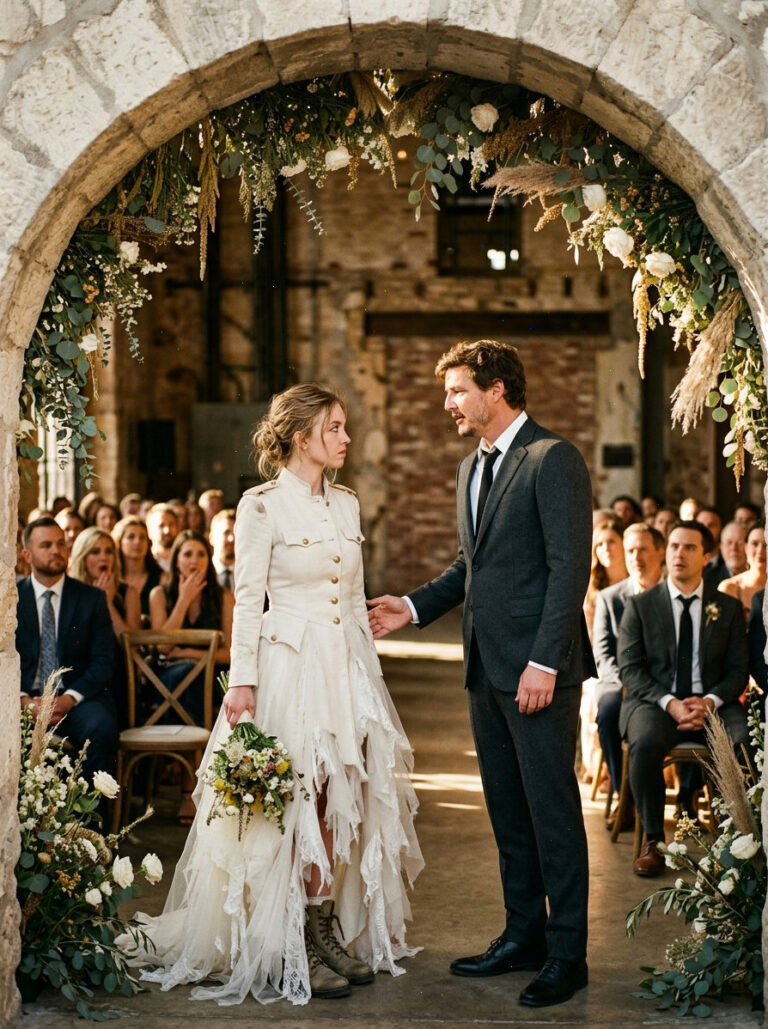
I didn’t cry when they destroyed my wedding dresses.
I should have. Four gowns, each one chosen for a different reason, each one meaning something. The princess cut I’d dreamed about since I was twelve. The lace one my grandmother would have loved. The lightweight one for the August Texas heat. The simple, elegant one I’d bought on a whim and somehow loved the most.
All of them ruined. Sliced, split, shredded — hanging in my childhood closet like crime scene evidence at 2 in the morning.
I just knelt there on the floor and stared.
My name is Madison Bennett. I’m 32 years old. I’m a Second Pilot Captain at the San Antonio Air Base. I have flown through storms that would make most people weep. I have landed aircraft in conditions where the margin between life and death is measured in seconds.
And I could not move.
My father, Frank, stood in the doorway like he’d won something. No apology. No shame. Just that look he’s worn my entire life — the one that says you got what you deserved.
“You did this to yourself,” he said. “All that arrogance. Acting like you’re better than everyone.”
My mother, Carol, stood behind him. She wouldn’t look at me. Not because she felt guilty — I know my mother. She wouldn’t look at me because she agreed with him and didn’t want me to see it plainly on her face.
And Tyler. My 28-year-old brother who still borrows gas money and calls it a loan. He was laughing. Actually laughing. Leaning against the hallway wall like this was the funniest thing he’d seen all year.
“No dress, no wedding,” my father said. “Problem solved.”
They left me in the dark with the scraps.
Let me tell you something about my family that most people don’t know, because from the outside, the Bennetts look like a perfectly normal San Antonio household. Frank coaches little league on weekends. Carol brings casseroles to sick neighbors. Tyler gets his cheeks pinched by every aunt at every gathering.
But I was always the problem.
The moment I enlisted, I became the cautionary tale they used at dinner to explain everything wrong with modern women. When I earned my pilot certification, my father didn’t call. He found out through a cousin and told my mother it was “embarrassing.” When I got promoted, he asked if I’d “slept my way up.” I’m not being dramatic. Those were his exact words.
Ethan — my fiancé, the man I was hours away from marrying — is an engineer from Dallas. We met in Houston right after a hurricane tore through and left neighborhoods underwater. I was part of an emergency transport team. He was coordinating structural assessments for a relief organization. We stood in the same muddy field arguing about the most efficient evacuation route, and somewhere in that argument, I fell in love with him.
He never once asked me to be smaller. He looked at me like I was exactly who I was supposed to be.
That’s why I said yes. That’s why we planned the wedding in Austin — neutral ground, a beautiful venue downtown, 140 guests, a mariachi band Ethan had booked as a surprise.
I had agreed to stay at my parents’ house those final two nights as a gesture of goodwill. A peace offering. I thought, maybe this is the moment. Maybe watching their daughter get married will soften something.
I was wrong.
Part 2: The Night Everything Shattered
The tension in my parents’ house that final evening was something I can only describe as pressurized — the kind of silence that exists not because people have nothing to say but because they are actively choosing not to say it yet.
Dinner was quiet. Frank sat at the head of the table and watched a game on the small TV in the kitchen corner. Carol served food without comment. Tyler ate quickly and disappeared to his room, reappearing twice to open the refrigerator and stare into it without purpose.
I ate half my plate and excused myself early.
In my old bedroom, I unpacked the garment bags slowly. I laid all four dresses out mentally — reviewing which one I’d wear for the ceremony, which for photos, which for the reception dancing, which as a backup if the heat became unbearable. Four contingencies. That’s how a pilot thinks.
I touched the main dress one last time before switching off the light. The fabric was cool under my fingers. I let myself feel it — that flicker of pure anticipation that cuts through all discipline and training and just lets you be a human being who is excited.
I fell asleep around ten.
At 2 a.m., a sound woke me.
In the military, you learn to distinguish between sounds that belong and sounds that don’t. The creak I heard was wrong — too deliberate, too careful. Someone was trying to be quiet and not quite succeeding.
I lay still for one full second. Then I turned on the lamp.
The garment bags were unzipped. The closet door was ajar. And the dresses — all four — were destroyed.
Not damaged. Not accidentally torn. Destroyed. With intent. With effort. Someone had taken time in the dark to make sure I had nothing to wear.
I dropped to my knees on the floor.
The bedroom door burst open before I could process anything further. My father stood there, and his expression told me everything — he had not stumbled upon this. He had come to see my reaction.
Behind him: my mother’s averted eyes. And Tyler’s smirk.
“You did this to yourself,” Frank said, his voice entirely level, the way people speak when they’ve been rehearsing. “All that arrogance. Acting like you’re better than everyone. Maybe this will bring you back down. Remind you you’re not above us just because you play soldier.”
I looked at my mother. I don’t know what I was looking for. A flinch. A flicker. Some involuntary human response that proved she was in there somewhere, the woman who used to braid my hair before school, who cried at my graduation even while claiming it was allergies.
There was nothing.
“No dress, no wedding,” my father said with finality. “Problem solved.”
He turned away. Tyler laughed once, clearly and deliberately, so I would hear it. They closed the door.
I sat in the wreckage for a long time.
Here is what runs through your mind in a moment like that: it is not grief, not immediately. Grief requires the luxury of time. What happens first is a rapid, cold assessment — the same process that fires in a cockpit when instruments fail. You inventory what you have. You eliminate what you cannot control. You isolate the one variable that remains in your hands.
I still had my uniform.
It hung in the back of the closet where I had placed it on arrival — not for any ceremonial purpose, simply because I traveled with it as a matter of routine. My formal dress uniform, the one I wore for official functions: pressed white shirt, dark trousers, the structured ceremonial jacket with the gold captain’s insignia on the shoulder and the service ribbons above the breast pocket.
I looked at it for a long time.
And then I picked up my phone and made a call.
Part 3: The Decision That Changed Everything
The person I called at 2:47 in the morning was not Ethan.
It was my commanding officer’s wife, Sandra — who also happened to be the most resourceful woman I had ever known, a former military seamstress who now ran an alterations business in San Antonio. She had altered my dress uniform twice over the years. She knew fabric the way surgeons know anatomy.
“I need something impossible,” I told her.
I explained what had happened. There was silence on the line — not hesitation, just Sandra thinking. She asked me two questions: what did I want to feel walking down that aisle, and what time did the ceremony start.
“Strong,” I said. “Eleven a.m.”
“Come to me at six,” she said. “Bring the uniform.”
I drove to Sandra’s house as dawn was beginning to color the sky pink over the highway. Her garage was already lit. She had coffee waiting.
For three hours, Sandra worked.
She did not transform my uniform into a gown — that was never the idea. What she did was deliberate and precise: she altered the fit to be closer to the body, formal and architectural. She added a single element — a length of ivory silk she had in her studio, which she attached as a modified skirt panel over the trousers, structured and clean, falling to the floor. Military silhouette on top. Something softer below. The gold insignia on the shoulder left untouched.
She added a cathedral-length ivory veil that attached at the back of the jacket collar, trailing behind me like — as she described it — “smoke from something that already survived the fire.”
I stood in her mirror at nine a.m. and did not recognize myself in the way you sometimes don’t recognize yourself when you look more like who you are than you’ve ever looked before.
“You’re going to make people cry,” Sandra said.
“Good,” I said.
I called Ethan on the drive to the venue. I told him I needed to explain something before he saw me. He listened without interrupting — he always listens that way, completely, as if silence is something he offers you intentionally.
When I finished, he said: “Madison. Just get here.”
I could hear him smiling through the phone.
I told my parents nothing. I did not return to the house. I texted a single line to my mother: I’ll see you at the ceremony. She did not respond.
What I did not know — what I found out later — was that my father had called several relatives that morning to tell them the wedding was likely canceled. He had been that certain. That satisfied. He had told my Aunt Rosa that Madison had “finally faced some consequences” and that the wedding was “up in the air.”
He arrived at the venue, with my mother and Tyler, fully expecting chaos.
What he found instead was a venue running exactly on schedule, flowers arranged, guests seated, mariachi band warming up softly in the garden outside. His daughter was not destroyed. His daughter had not called the wedding off. His plan had produced nothing.
And he had not yet seen what I was wearing.
Part 4: The Walk
At 10:58 a.m., I stood at the back of the aisle.
The venue was a historic stone building in Austin — exposed limestone walls, arched windows filtering amber morning light, wooden pews borrowed from a church two blocks away. Wildflowers wrapped every arch. The air smelled like cedar and late summer.
My maid of honor, Priya — my closest friend from the base — stood beside me. She had known since the six a.m. phone call. She had arrived at the venue early and said nothing to anyone. She had just squeezed my hand and taken her position.
The doors opened.
The first guests to see me were in the last rows — and I watched the information travel forward through the room like a wave. Heads turning. Hands reaching to touch the arm of whoever was sitting next to them. A low murmur building, the kind that isn’t rude, just involuntary, the sound people make when something exceeds what they were prepared for.
Ethan was at the altar. He saw me when I was about halfway down the aisle.
He had been smiling the contained, performative smile of a groom waiting — the smile that is really just anxiety wearing a cheerful mask. That smile disappeared. What replaced it was something I have no clean word for. His jaw shifted. His eyes went bright. He pressed his lips together once, hard, the way people do when they are fighting something overwhelming, and then he just — stopped fighting it. His expression opened completely.
He mouthed something. I am almost certain it was there you are.
I kept walking.
My father was in the third pew on the left. I did not look at him directly, but I have peripheral vision trained by years of cockpit work — I catch movement and position without turning my head. I saw him register what I was wearing. I saw the confusion, then the recognition of what the uniform meant, then something harder to name — something that looked, from the outside, almost like being struck.
He did not sit back down for a long time.
My mother, beside him, looked at her hands in her lap.
Tyler was on his phone until the woman next to him touched his arm and pointed. He looked up. He looked at me. He put his phone in his pocket and said nothing for the rest of the ceremony.
When I reached the altar, Ethan took both my hands.
“You’re the most extraordinary person I’ve ever seen in my life,” he said — quietly, for me, not for the room — and then the officiant began, and we got married.
Conclusion: The Twist No One Saw Coming
The reception was held in the garden outside the venue, and it was — by every measure I know how to use — extraordinary.
The mariachi band played for three hours. People danced who had not danced in years. Ethan’s family, who had driven up from Dallas, embraced me the way families are supposed to embrace — loudly, and without conditions.
My family sat at their assigned table.
My father did not give a toast. He had prepared one — Priya told me later she had overheard him rehearsing something in the parking lot before the ceremony, something about tradition and family values. He never stood up. He folded his napkin on the table and looked at the centerpiece for most of dinner.
My mother cried twice. Not at the ceremony — she held it together there, staring at her hands. She cried at the reception, quietly, when the band played a song I didn’t recognize until Ethan leaned over and told me it was the song his grandmother used to play, a ballad that his family associated with people who were brave enough to choose their own lives.
I do not know exactly what my mother was crying about. I may never know. But she cried.
Here is the part I did not expect: three weeks after the wedding, I received a letter. Not an email — a handwritten letter, in my mother’s handwriting, which I recognized immediately because she used to write me notes in my lunchbox that I memorized and still remember.
The letter was four pages long. I am not going to reproduce it here in full, because some things belong only to the people they’re written for. But I will tell you what it contained.
It contained an apology.
Not a qualified apology — not I’m sorry you were hurt or I’m sorry things went the way they did. A real one. A specific one. She named what she had done and what she had failed to do. She named the dress. She named the silence in the doorway. She named thirty-two years of compliance with a man whose definition of love was conditional on obedience.
She wrote: I spent so long being afraid of your father that I forgot I was also your mother. I watched you become everything I was too frightened to be, and instead of being proud, I resented you for it. I know that is not something you have to forgive. I only needed you to know that I see it.
I read it twice. Then I called Ethan into the room and read it to him.
Then I sat for a while with the particular weight of a thing that is not fixed but is, for the first time, honest.
My father has not contacted me. I do not expect him to. Frank Bennett built his identity around a version of his daughter that never existed — a compliant, diminished, domesticated version — and my wedding was the moment that version was cremated publicly and irrevocably. Men like Frank do not apologize for that. They simply go quiet and call their silence dignity.
Tyler texted me a week after the wedding. It said: That was actually kind of badass. I didn’t respond. I’m still deciding how I feel about Tyler, and I think I’m allowed to take my time.
As for the uniform: it is back in its garment bag, pressed and stored. But Sandra — who attended the reception as my guest and danced until eleven p.m. — kept the ivory veil and the silk panel she had created. She told me she wanted to display them in her studio.
“So I can tell people,” she said, “that I once helped a pilot get married in twelve minutes, and it was the most beautiful dress I ever made.”
I think about that a lot. About how something that was meant to destroy an occasion became the defining image of it. How the thing they thought they were taking from me — my dignity, my day, my moment of being seen — was the thing I walked in wearing.
You cannot ruin what someone already is.
You can only reveal it.
And on a Tuesday morning in August, in a stone venue in Austin, Texas, with a mariachi band and 140 witnesses and a man at the altar who looked at me like I was exactly who I was supposed to be — I was revealed completely.
My family couldn’t lift their heads.
I have never held mine higher.
— Madison

Evan Cole Editor-in-Chief | Breaking News & Public Policy
“From Washington to Wall Street, and Main Street to Hollywood—Evan Cole connects the dots.”
As the Editor-in-Chief at Newskilo, Evan leads a dynamic team of journalists dedicated to uncovering the truth behind the headlines. With over 15 years in digital media, Evan has a reputation for cutting through the noise.
While he is widely recognized for his deep analysis of U.S. fiscal policy (IRS & Stimulus), Evan’s expertise extends to global current events, corporate accountability, and cultural trends. Whether he is breaking down a complex government bill, exposing a tech giant’s failure, or analyzing the societal impact of a viral celebrity moment, Evan’s goal is simple: To tell the stories that shape our world with clarity, accuracy, and integrity.
Leave a Reply