
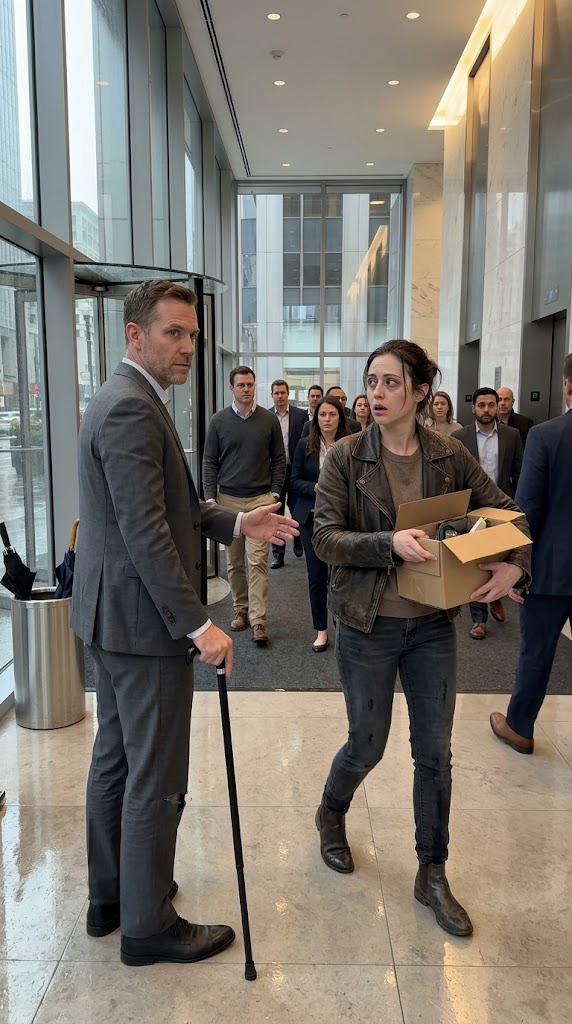
Hannah Mitchell had a system for surviving mornings.
It was not a good system. It was not the kind of system anyone would have chosen if they had been given real options. But it worked — barely, and only when everything went according to plan — and in the four years since her divorce left her the sole financial architect of a life built for two, barely-working-when-everything-went-according-to-plan had become the category she lived in.
The alarm went off at 5:45.
She was showered, dressed, and standing over the stove scrambling Tyler’s eggs by 6:10. Her son was seven, small for his age, with his father’s dark hair and her stubborn tendency to ask questions that had no simple answers. He ate at the kitchen table with one sock on and his backpack already strapped to his back, asking her whether fish could feel lonely. She told him she thought probably yes, that most things that were alive could feel the absence of other things. He considered this with the gravity of someone decades older and asked if she could buy him a second fish so the first one wouldn’t be sad.
She told him they’d talk about it this weekend.
She did not tell him that this weekend she needed to figure out how to pay Mrs. Patel’s babysitting balance, her car insurance that was now 12 days past the grace period, and Tyler’s co-pay from the pediatric visit three weeks ago that the insurance had only partially covered. She did not tell him that the phrase “we’ll talk about it this weekend” had become her linguistic holding area — a place where all the things she couldn’t give him yet were kept, carefully, so he wouldn’t feel the weight of them before he had to.
Tyler Mitchell did not need to feel that weight.
He was seven.
Mrs. Patel arrived at 6:55, slightly windswept from the April morning and carrying a container of homemade kheer she pressed into Hannah’s hands before Hannah could say anything. She was a 64-year-old retired schoolteacher who lived two floors up and had become, in all the ways that actually mattered, the village Hannah’s son needed around him. She was patient and curious and she knew every dinosaur Tyler could name and she never once made Hannah feel like accepting help was the same as failing.
Hannah kissed Tyler’s hair, grabbed her purse, and was out the door by 7:15.
She had 45 minutes to walk three blocks to the bus stop, ride 11 minutes into the Loop, walk four blocks to Vertex Innovations, badge through security, ride the elevator to the 14th floor, settle at her desk, open her inbox, and look like someone who had not been awake since 5:45 managing the logistics of another person’s entire small life before the workday even started.
She was good at it by now.
She had developed the pace, the route, the exact bus timing that gave her a 7-minute buffer on a normal day. She had memorized which intersections ran long on the traffic light cycles and which coffee cart vendor would hand you change fast without making you wait. She knew this part of the city the way soldiers know their terrain — not as scenery, but as a series of obstacles with known solutions.
She was, by any reasonable measure, a professional at getting to work on time under conditions that would have defeated most people before they put their shoes on.
Which was why, when Mrs. Patel’s text came in at 7:38, Hannah felt the specific, nauseating drop of a plan failing mid-execution.
Running 10 minutes late, dear. So sorry. Tyler was fine when I left him. I know you’re already on your way.
She already was.
She stopped under the awning of a dry cleaner on Wacker, read the text twice, did the math once, and understood immediately what it meant. Mrs. Patel wouldn’t arrive at the apartment until 7:48. Tyler couldn’t be left alone, not at seven, not in the building, not even for the twelve minutes it would take the neighbor from 4B to realize something was wrong. Mrs. Patel needed to be inside the apartment, door locked, before Hannah could in good conscience continue to her own job.
Which meant Hannah needed to go back.
Which meant even running — which she absolutely did, down the wet sidewalk in her leather boots with her purse slapping against her hip — she was not going to reach Vertex at 8:00.
She had made it back to the apartment, handed Tyler his forgotten library book he’d left on the counter, waited for Mrs. Patel’s key in the lock, waited for the woman to step inside and smile and say go, go, you’ll make it, go — and then she had turned and run again.
By the time she hit Maple Street, it was 7:47.
Three blocks to go.
She was calculating — could she badge in remotely, could she email ahead, could she reach her supervisor’s assistant before Richard himself arrived on the floor — when the sound hit her from behind.
The screech came first. Then the thud. Then a sound that was not quite a shout and not quite a scream but somewhere in between, the involuntary vocalization of a body absorbing more impact than it was designed for.
Hannah turned.
Twenty yards back, at the intersection she had just cleared, a man lay crumpled against the curb. The delivery cyclist was already half a block away, weaving through traffic without stopping, one backward glance the only acknowledgment that something irreversible had just occurred. The man on the ground wore a charcoal suit. Both of his hands had gone flat against the pavement in the instinctive aftermath of the fall. A briefcase had burst open somewhere in the impact and was now contributing a slow drift of papers to the morning wind. A travel mug lay on its side in the gutter, the last of its coffee running in a thin brown line toward the drain.
Hannah stood absolutely still.
She was aware of everything at once: the glass tower of Vertex three blocks ahead, the time on her watch, the weight of her purse strap, the wet leather of her boots, the small bruising certainty in her chest that said third strike and you’re out — Richard had been clear, had been almost looking forward to being clear, the way certain managers savor the procedural power of enforcement.
And then she was already walking toward the man on the ground.
She didn’t decide to. She genuinely did not make a choice in any conscious sense. Her body simply turned and moved, the way it moved toward Tyler when he cried at 2 a.m. — not thought, just response, as basic as breathing.
“Sir — are you okay?”
She heard the absurdity of the question the instant it left her. She was crouching before he could answer, getting her eyes level with his face, reading it the way you read the faces of people who are trying not to let you see how bad it is.
He was in his early to mid-40s. Clean-shaven, or had been before whatever part of his morning had preceded this. The tailored suit put him in a category of income Hannah dealt with only tangentially at Vertex — not the people who had earned the suits, but the people who kept the offices of the people who had earned the suits functioning and presentable. His face was pale in the way that happened when a body redirected all available resources to managing pain. Sweat had appeared at his temple despite the cold. His jaw was so tight the muscle beneath his ear had gone rigid.
“I’m fine,” he said.
Hannah had been a mother for seven years. She recognized a person in denial immediately.
“Your leg,” she said.
He looked down. The wince that crossed his face was the kind that stripped away everything else — the suit, the authority implicit in the suit, the reflexive dismissal, all of it. For one unguarded moment he was simply a man in serious pain looking at something that confirmed the pain was justified.
“Ankle,” he said quietly.
She looked. His right foot was canted at an angle that made her stomach clench. Not broken — she wasn’t a doctor, she couldn’t know — but absolutely requiring more than walking it off.
“I’m calling 911,” she said.
“No ambulance.”
It came out fast and firm. His eyes met hers — startlingly blue, unexpectedly sharp for a man who was still technically down on the pavement — and the look in them was the look of someone accustomed to the world organizing itself around his directives.
“I have a meeting I cannot miss.”
“With respect,” Hannah said, pulling her phone out, “you can’t stand.”
He proved her correct immediately by attempting to stand.
He braced both hands against the wall behind him, got his good leg under him, pushed — and the moment his right foot took any fraction of his weight, the breath left him in a sound that was almost a cry. He dropped back against the brick, breathing hard, face ashen.
Hannah was already on the phone with the dispatcher.
She gave the location clearly: Maple Street, east side, between Washington and Madison. She described his approximate age, the nature of the injury as she observed it, his level of consciousness. She kept her voice even and her eyes on the man, who had stopped arguing — whether from pain or the pragmatic recognition that the call had already been made, she couldn’t tell.
While they waited, she gathered the papers.
She did it automatically, practically — the wind was taking them, and documents scattered in a puddle were documents destroyed — and she stacked them against the front of the briefcase without reading them. She wasn’t trying to read them. She was trying to keep them dry.
One page turned in a gust.
The letterhead landed facing her.
She would think later about how ordinary the moment was. How she was kneeling on wet concrete in wet boots, hair starting to frizz from the damp, three blocks from a job she was about to lose, performing the basic act of picking papers up off the ground. And in the middle of that completely unexceptional act, the world shifted.
Benjamin Crawford
Chief Executive Officer
Vertex Innovations
She stared at the letterhead.
She looked at the man.
She looked back at the letterhead.
In the Vertex company directory — the internal one, updated every fiscal quarter, the one Hannah had been required to review during her onboarding and again after the reorganization two years ago — the CEO’s photo was a formal portrait. Navy suit, American flag pin, expression of polished authority, the studied neutral smile of someone photographed for annual report covers. Clean, bright office lighting. No rain. No pain. No vulnerability whatsoever.
The man against the brick wall of a Chicago sidewalk shared the eyes in that photo. The specific and unusual shade of blue. The shape of the brow. The way the left one sat fractionally lower than the right.
She looked at his face until the connection finished resolving.
“You work at Vertex,” she said.
It did not come out as a question.
He had been watching her read the letterhead. He watched her read his face now — saw the recognition land, saw her process it — and something shifted in his expression that was harder to name. Not alarm. Not annoyance. Something more like the reluctant respect of a man being seen clearly when he had expected not to be.
“I do,” he said.
“Benjamin Crawford.” She was still holding the page. “You’re Benjamin Crawford.”
He said nothing. Which was its own confirmation.
Hannah sat back slightly on her heels and looked at the CEO of the company that employed her — the company where she had worked for four years, where she had watched three rounds of layoffs from the relative safety of her cubicle, where she had asked for a performance review and a cost-of-living adjustment twice in two years and been told both times that the budget cycle didn’t allow for individual renegotiation outside of the standard annual process — looked at him sitting on a wet Chicago sidewalk in a ruined suit with a destroyed ankle, and then looked at her watch.
8:04.
She had missed the window by four minutes.
The ambulance arrived seven minutes after her call. She stayed the entire time. She answered the paramedics’ questions, confirmed the mechanism of injury, handed the briefcase to Benjamin Crawford directly, made sure the papers she had gathered were secured inside. When they asked if she knew him, she said she worked for his company.
He looked at her when she said it.
She did not look back.
She was already calculating whether the 14-floor elevator or the stairs would get her to her desk marginally faster.
The answer was the elevator. She took it at a near-sprint from the lobby, badge already in her hand, heart already steeled for whatever was waiting on the 14th floor.
Richard Morrow was waiting at her desk.
He was a compact man, 51, with the kind of institutional authority that lived in posture rather than size. He had worked at Vertex for 22 years, outlasting three CEOs and two complete company rebrands, and he wore the survival of all those restructurings like a second skin — the permanent vigilance of someone who understood that security lived in being the person who enforced the rules, not the person the rules were enforced upon.
He looked at Hannah walking off the elevator at 8:31 with wet boots and damp hair and absolutely no excuse that was going to matter.
“My office,” he said. “Now.”
She followed him.
She sat in the chair across from his desk — the one positioned slightly lower than his, a detail she had noticed and filed away on her first day — and she watched him produce a single sheet of paper from a manila folder that had clearly been prepared in advance.
Third tardiness violation. Immediate separation. Effective today.
He slid it across the desk with the composed satisfaction of a man who had been looking forward to this particular morning.
Hannah picked up the paper.
She thought about Tyler asking if fish could feel lonely. She thought about Mrs. Patel’s kheer container still sitting on her kitchen counter. She thought about the CEO of this company sitting on a wet sidewalk four blocks away, his ankle at a 30-degree angle that would require at minimum an X-ray and probably a cast, and the way he had looked at her when she said she worked for his company.
She signed the form.
She was not going to beg Richard Morrow for anything. Not for context. Not for one more conversation. Not for four years of on-time mornings and clean performance reviews and zero disciplinary actions before this month’s three-week cascade of babysitter delays and school schedule disruptions. She put the pen down, stood up, shook his hand once with the firm professionalism she had maintained every day for four years in this building, and walked to her desk to begin the 11-minute process of fitting her life at Vertex Innovations into a cardboard box.
Her team watched from their peripheries. Nobody said anything directly — not Jamie from accounting, not Shira from her project team, not Marcus who had sat across from her for two and a half years and knew she had a son named Tyler and a complicated relationship with the coffee machine on the south wall. They watched the way people watch things they know are wrong and have decided, in the private calculus of their own self-preservation, not to intervene in.
Hannah did not blame them.
She had made the same calculation herself, in the past, about other people.
The security guard held the lobby door. The morning air came in cold and smelled like rain and car exhaust and the coffee cart on the corner. Hannah stood on the marble step outside Vertex Innovations with her cardboard box and her clear conscience and the specific, horrible lightness of a person who has just lost the thing that was holding everything else up.
She should call Mrs. Patel.
She should update Tyler’s emergency contact information at the school to include — who? Who else was there?
She should start pulling up job listings.
She should check whether her health insurance had a COBRA continuation period and how long she had to elect it and whether she could actually afford the premiums on no income.
She should do all of these things immediately and she stood absolutely still instead, breathing the cold April air, because she needed ten seconds where she was simply a person standing outside on a April morning before she had to become a crisis management operation again.
Her phone rang.
Unknown number.
She answered because she always answered unknown numbers. You couldn’t afford not to, when your son’s school, his pediatrician, his dentist, the property management company for your building, and three separate collection agencies all had legitimate reasons to call you from numbers you’d never seen before.
“Ms. Mitchell.”
The voice was male, precise, unhurried — the voice of someone whose professional role required them to project calm regardless of the underlying urgency of the situation.
“This is Daniel Reeves. I’m the Chief of Staff for Mr. Benjamin Crawford. He asked me to reach out to you directly.”
Hannah gripped the cardboard box tighter.
“I see,” she said.
“Mr. Crawford has been informed of your employment situation this morning,” Daniel Reeves said. “He would like to speak with you in person. Are you available to come back to the building?”
Hannah looked up.
She was standing 40 feet from the entrance to Vertex Innovations. The glass facade caught the late-morning light and held it, turning the entire tower into something that looked almost warm from the outside.
“I’m available,” she said. “I’m actually standing outside right now.”
A brief pause. “We’ll have someone meet you at the lobby level in three minutes.”
The someone was a young woman in a navy blazer who introduced herself as Priya and spoke quickly and professionally and did not explain anything in the elevator beyond the fact that Mr. Crawford had asked that Hannah be brought directly to the executive conference room on the 22nd floor.
Hannah had never been on the 22nd floor.
The elevator opened onto a reception area that made the 14th floor look like a waiting room at a DMV. Clean lines, real art, the kind of quiet that costs money. A different quality of light came through the windows up here — higher, broader, the whole of the Chicago skyline visible in a sweep that included the lake going silver in the mid-morning distance.
Benjamin Crawford was seated at the far end of a long conference table. His right leg was elevated on a second chair, the ankle wrapped in compression bandaging that one of the building’s medical staff had clearly applied in the last hour. His jacket was off. His shirt was still coffee-stained. He looked like a man who had had a genuinely terrible morning and had decided to continue his workday anyway, which told Hannah a great deal about him that the letterhead had not.
Richard Morrow was also in the room.
He was standing near the windows. His arms were no longer crossed. His posture had changed entirely — the compact institutional authority was still there in the structure of his frame, but something beneath it had shifted, the way a building’s foundation shifts before the walls show cracks. He looked at Hannah when she entered and then looked away very quickly.
Benjamin Crawford did not look away.
“Ms. Mitchell,” he said. “Please sit down.”
She sat.
Crawford looked at Richard Morrow for a moment — just a moment, unhurried, the way a man looks at something he has already decided about and is simply completing the formality of observing.
“Richard,” he said. “Thank you for joining us. You can go back to your office. Someone from HR will be with you shortly.”
Richard opened his mouth.
He closed it.
He left the room.
Hannah watched the door close behind him.
Crawford looked at her directly then, with the same unsettling clarity she had felt from him on the sidewalk — the eyes that were more awake than the rest of him looked, the quality of attention that suggested he had been watching and cataloguing things well before other people realized they were being observed.
“I understand you were terminated this morning,” he said.
“Thirty-one minutes late,” she said. “Third violation.”
“The first two violations,” Crawford said, looking at a document on the table in front of him that she had not noticed, “occurred on March 4th and March 19th. Both within the same calendar month. Both within 15 minutes of the standard start time.” He looked up. “Were the circumstances similar to today?”
Hannah looked at him steadily. “Childcare delays. My son is seven. My babysitter was late.”
Crawford nodded once, slowly, the way someone nods when information is confirming something they had already suspected.
“I was informed by Mr. Morrow’s office,” he said, “that you signed your separation paperwork this morning without requesting an appeal.”
“I didn’t think an appeal would be productive,” she said.
“Why not?”
She held his gaze. “Because the procedure was followed correctly. And because I didn’t think the context would be received as a mitigating factor by the person conducting the review.”
Crawford was quiet for a moment.
“What you did this morning,” he said, “cost you your job.”
“I know.”
“You could have kept walking. You were already running behind.”
“I know that too.”
He leaned forward slightly, elbows coming to rest on the conference table, and looked at her with an expression she couldn’t entirely decode — not quite admiration, not quite something softer than that, but somewhere in that territory.
“I’ve been running this company for eleven years,” he said. “And in eleven years, I have had exactly one person — one person — stop to help me without looking first to see whether it was worth their time to stop.”
Hannah said nothing.
“Everyone else on that street kept moving,” he said. “Seven people walked past me in the 90 seconds before you reached me. I counted.”
She had not known he had counted.
“Your termination is being reversed effective immediately,” Crawford said. “The three tardiness violations are being expunged from your personnel file. The separation paperwork has not been processed and will not be.”
Hannah breathed in slowly.
“Additionally,” Crawford said, opening the folder in front of him, “I’d like to offer you a role transfer.” He turned the folder to face her. “Senior Operations Coordinator, executive support division, 22nd floor. The position has been open for six weeks. The salary is —” he tapped the number on the page — “considerably above your current compensation.”
Hannah looked at the number.
She looked at it for a long time.
She thought about Friday’s daycare payment. The car insurance. The pediatric co-pay. Tyler’s fish that didn’t have a friend yet.
“I’ll need to review the full job description,” she said.
Crawford almost smiled. “Of course.”
“And I want it in writing that the reversals are complete — the violations, the separation, all of it.”
“Already being drafted.”
She looked up from the paper to his face. “Mr. Crawford.”
“Ben.”
She noted that but didn’t use it yet. “Why are you doing this personally? You have an HR department.”
He looked at her for a moment with those startlingly level blue eyes.
“Because the HR department,” he said, “would have sent you a formal reinstatement letter and considered the matter closed. And that would have been accurate, but it would not have been enough.” He paused. “You made a decision this morning that cost you something real. I wanted to be the person who acknowledged that directly.”
Hannah Mitchell sat in a 22nd-floor conference room above the Chicago skyline, in wet boots, with damp hair, holding a folder that was about to change the architecture of her life — the careful, insufficient, barely-surviving architecture she had been maintaining alone for four years — and she felt something she had not felt in a long time.
Not gratitude, exactly, though that was in there.
Not relief, though God, that was in there too.
It was the feeling of being seen accurately by someone who had the actual power to act on what they saw.
“I accept,” she said.
Crawford nodded.
“One more thing,” he said.
He reached into the inside breast pocket of his coffee-stained jacket and produced a sealed white envelope. He set it on the table and slid it across to her with two fingers.
“This is a personal matter,” he said. “Not a company matter. You can open it later.”
She picked it up.
It was heavier than she expected.
She opened the envelope in the elevator on the way down.
Inside was a handwritten note on heavy cream stationery — three sentences in precise, clear handwriting — and a personal check drawn on an account she did not recognize.
The check was made out to Tyler Mitchell.
The memo line, in the same precise handwriting, read: For the fish.
The amount was enough to cover everything.
The car insurance. The co-pay. The babysitter balance. The second goldfish. And the first genuinely comfortable month Hannah Mitchell had experienced in longer than she could immediately remember.
She stood in the elevator as it descended, holding the check and the note, and the doors opened on the lobby with its marble floors and its morning light and its security guard who had held the door for her eleven minutes ago without making eye contact.
He held it again now.
This time, she met his eyes.
“Good morning, Gerald,” she said.
He looked up, surprised she remembered his name after four years of mostly transactional exchanges.
“Morning, Ms. Mitchell,” he said. And then — reading something in her face that said the balance of things had shifted, the way people who work in lobbies learn to read — he smiled. “Good day today?”
Hannah Mitchell walked out into the April morning with a sealed envelope and a job offer and the specific, unfamiliar lightness of a person who had done the right thing and, for once, in defiance of all available probability, had not been made to pay for it.
“Yeah,” she said.
“Good day.”

Evan Cole Editor-in-Chief | Breaking News & Public Policy
“From Washington to Wall Street, and Main Street to Hollywood—Evan Cole connects the dots.”
As the Editor-in-Chief at Newskilo, Evan leads a dynamic team of journalists dedicated to uncovering the truth behind the headlines. With over 15 years in digital media, Evan has a reputation for cutting through the noise.
While he is widely recognized for his deep analysis of U.S. fiscal policy (IRS & Stimulus), Evan’s expertise extends to global current events, corporate accountability, and cultural trends. Whether he is breaking down a complex government bill, exposing a tech giant’s failure, or analyzing the societal impact of a viral celebrity moment, Evan’s goal is simple: To tell the stories that shape our world with clarity, accuracy, and integrity.
Leave a Reply