
She leaned in so close I could smell her perfume — expensive, suffocating — and whispered it right into my ear while the camera flash was still going off.
“You really thought today would be about you?”
I felt my smile freeze on my face like cracked porcelain. The photo clicked. Everyone clapped. Ryan blew out his candles and kissed my cheek, and I stood there holding a paper plate with a slice of birthday cake I couldn’t eat, my hands shaking so badly I was afraid the fork would fall.
That was the moment I understood that Judith Parker hadn’t invited me to celebrate her son’s birthday.
She had invited me to watch myself lose.
Six months living in her basement had taught me things about my mother-in-law that Ryan still refused to believe. The passive remarks over breakfast. The way she’d touch his shoulder when I walked into the room. The quiet campaign she had been running since the day he married me — slow, patient, surgical — designed to make him see me the way she did.
Small. Temporary. A mistake he hadn’t admitted yet.
I’d told myself to hold on. That things would change when Ryan started his new job and we could move out. That I just had to survive a little longer without making a scene, without giving her the reaction she wanted.
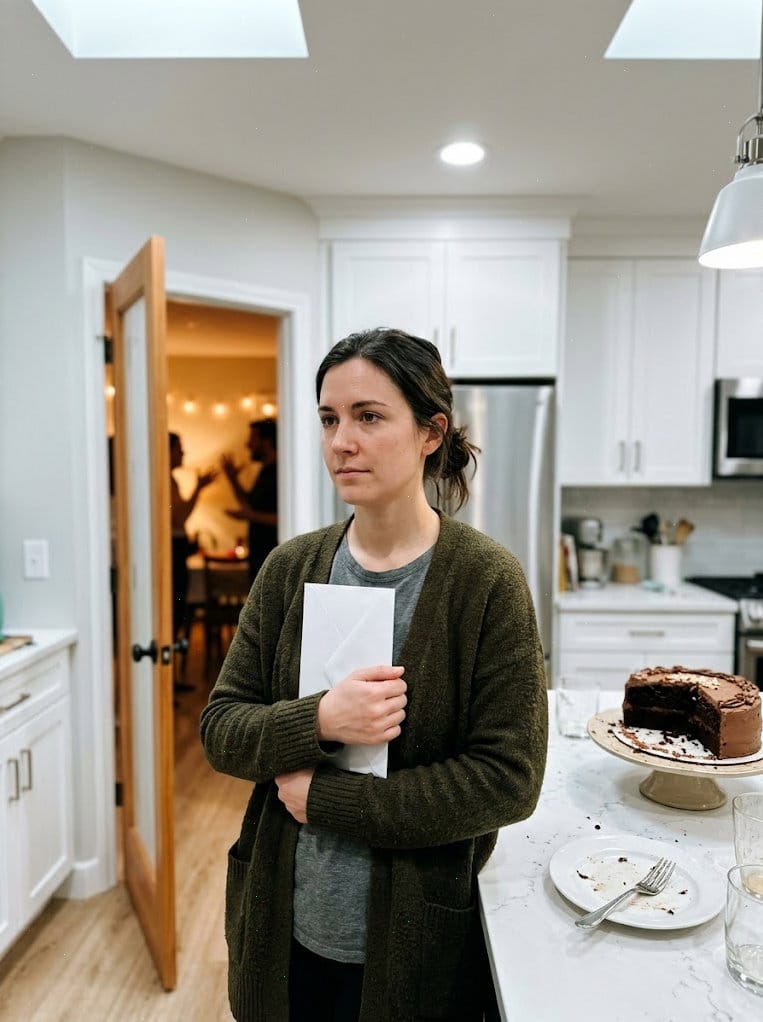
But then she followed me into the kitchen.
She pushed the swinging door shut behind us — harder than she needed to — and the noise of thirty guests disappeared behind that single thud.
“You embarrass me in my own house one more time,” she said, her voice barely above a whisper, “and I promise you, this night will end very differently.”
I looked at her. Really looked at her. The pressed blouse. The perfect hostess smile, still half-present on her face like a mask she hadn’t finished removing. And something inside me went very, very still.
Because what she didn’t know — what she couldn’t have known — was what I had found two weeks earlier.
The envelope. The date. The document with her name signed at the bottom.
I had been carrying it since then, waiting, trying to decide what to do with the truth inside it.
I set my cake plate down on the counter. I looked her straight in the eye. And I said, very quietly, “You’re right, Judith. Tonight is not going to end the way anyone expects.”
Three minutes later, a glass shattered in the living room. Then the screaming started.
Part 2: The Woman Who Controlled Everything — Except the Truth
By the time I pushed back through the swinging kitchen door, the living room had already split down the middle.
Judith had moved fast. I don’t know exactly what she said to Ryan’s aunt Patricia in those two minutes, but Patricia was standing near the gift table, face flushed, pointing at me while three other relatives clustered around her like she was the one who needed protection.
Ryan was in the center of the room looking back and forth between his mother and me, and I could see it happening in real time. That familiar shift in his expression. The one where he started calculating how to keep the peace instead of asking what was true.
I had watched him do it for eighteen months. Every argument, every tense dinner, every time I came upstairs and found him apologizing to her for something I had said — he defaulted to smoothing it over. He wasn’t a weak man. He loved me. But Judith had spent thirty-two years learning exactly how to make her son feel responsible for her feelings, and she was very, very good at it.
Judith stood near the fireplace with her arms folded, composed and unhurried, like a woman watching a fire she had set from a comfortable distance.
“Emily has been struggling to adjust,” she announced to the room. Calm. Concerned. Perfectly performed. “We’ve all been patient.”
Several heads nodded. Someone said, “Maybe she just needs some air.”
I knew what was happening. She was doing what she had done every single time I had come close to confronting her. She was reframing the story before I had a chance to tell it. She was turning herself into the gracious woman tolerating a difficult daughter-in-law, and turning me into the problem that needed to be managed.
It had worked every time before.
But I was holding the envelope.
The one I found two weeks earlier when I was looking for the utility bill in Judith’s filing cabinet — the one she’d asked me to locate while she was out and Ryan was at work. I wasn’t snooping. I wasn’t looking for anything except the account number she had written on a sticky note she couldn’t find.
What I found instead was a legal document, dated fourteen months ago — three months after Ryan and I got married.
It was a property transfer agreement. Judith had quietly moved ownership of the house we had been trying to save up to buy — the one Ryan had mentioned to her in confidence during a private conversation before we got engaged — into a trust under her own name.
The house had been listed as available. We had been saving for it specifically. When it suddenly sold, Ryan assumed it had gone to another buyer. Judith had expressed sympathy and suggested we stay with her “just until something else came along.”
She had bought it herself. Anonymously. And she had been renting it out for fourteen months.
She hadn’t wanted us out of her basement. She had engineered a reason for us to stay.
I stood in the doorway of her living room, the envelope pressed flat against my palm, and I felt something shift inside me that I cannot fully describe. It wasn’t anger, exactly. It was the cold, clarifying feeling of a person who has just understood the full size of what was done to them.
Ryan looked at me from across the room. His eyes were asking me to let it go. To come to him. To lower my voice and get through the night and we’d talk about it later.
I loved my husband. I want that to be clear.
But later was no longer something I was willing to afford.
Part 3: The Turning Point — What I Decided in Thirty Seconds
I had exactly thirty seconds before the room shifted again.
Judith was already moving toward Ryan, placing one hand on his arm in that practiced way she had, the way that said I am the one who needs protecting here. Two of her friends were watching me with the polite, cautious expressions of people waiting for me to confirm what they had already decided to believe.
I thought about every morning I had come upstairs in that house and smiled through a comment that was designed to make me feel like a guest. I thought about the grocery bags she’d moved to the back of the refrigerator. The laundry she’d taken out of the dryer before I got there and left in a pile on the floor. The small, constant, grinding accumulation of it — the kind of mistreatment that leaves no single mark large enough to point to but hollows you out over months if you let it.
I thought about the house we had wanted. The life she had quietly made impossible.
And I thought about Ryan, who deserved to know what his mother had actually done — not from me whispering it to him in the basement at midnight, where it was easy for doubt to creep in, but here, in front of every person she had spent decades performing her goodness for.
I walked to the dining table. I set the envelope down flat in the center, next to the birthday cake with its burned-out candles. I smoothed it with one hand.
The room went quieter than it had been all night.
“Ryan,” I said. “I need you to read something.”
He looked at the envelope. He looked at his mother. Judith’s expression did not change, but her hand dropped from his arm.
“Emily, this isn’t the time—” she started.
“It’s a property transfer document,” I said clearly. “Dated March of last year. The address is 412 Clearwater Drive.”
The color left Ryan’s face instantly. That was the address. He knew it immediately.
Judith said nothing. For the first time all evening, she said absolutely nothing.
Ryan’s cousin Marcus picked up the envelope from the table before anyone else moved. He opened it. He read the first paragraph. Then he looked up at Judith with an expression I had never seen on his face before.
Part 4: The Final Confrontation — The Night She Lost the Room
The silence lasted maybe four seconds. It felt much longer.
Marcus set the document back on the table without a word, but he stepped back from Judith in a way that was impossible to miss.
Ryan crossed the room in three steps and picked up the papers himself. I watched his eyes move across the page. I watched the moment he reached the signature line, because that was the moment his jaw tightened and he stopped moving entirely.
“Mom.” His voice was flat. Not angry yet. Flat in the way that comes right before anger reaches the surface. “Whose name is on this?”
Judith had been still for a full ten seconds, which was longer than I had ever seen her go without filling a silence. When she finally spoke, her voice had changed. The warm hostess tone was gone. What replaced it was something older and harder.
“I was protecting our family’s investment,” she said. “You weren’t ready to own property. You had just changed jobs. I was making sure it didn’t go to strangers.”
“You told me it sold,” Ryan said. “You sat with me the night I found out and told me how sorry you were.”
“I was sorry. I was sorry you couldn’t see what I was doing for you.”
“You’ve been renting it out.” He wasn’t asking. “For over a year.”
She lifted her chin slightly. “The income went into savings. For your future.”
“For my future.” He repeated it slowly. “While we slept in your basement and Emily—” He stopped. His hand was gripping the edge of the document so tightly the paper was creasing. “While Emily has spent six months trying to survive in this house, you’ve been renting out the home we wanted to buy.”
There was a sound from the back of the room. Ryan’s aunt Patricia — the same one who had been pointing at me ten minutes earlier — sat down heavily in a chair. Someone else set a glass down very carefully on the mantle, like they were afraid to make noise.
Judith looked at the room. I think she was calculating, even then, whether there was a version of this she could still control. Whether there was a way to reframe it, redirect it, make herself the center of the sympathy.
But the document was on the table. And Marcus had already read it. And Ryan was standing in the center of his own birthday party holding proof that the woman who had called herself his greatest protector had spent fourteen months quietly holding him in place.
“Get out,” Ryan said. His voice was very quiet.
Judith blinked. “Ryan—”
“This is your house,” he said. “I know that. We’ll be out by the end of the week.” He folded the document and put it in his jacket pocket. “But right now, I need you to leave this room.”
The party did not recover. Guests gathered their things in clusters of hushed conversation. The birthday cake sat untouched on the table, the candles cold and bent. Someone found their coat. Someone said a quiet goodbye near the door.
Judith left the room. I don’t know exactly where she went because I stopped watching her.
I was watching Ryan, who sat down on the couch, elbows on his knees, and pressed both hands over his face.
I sat beside him. I didn’t say anything. I just stayed close enough that our shoulders were touching.
After a long time, he said, “How long have you known?”
“Two weeks.”
“Why didn’t you tell me?”
I thought about the right way to answer that. “Because I needed to understand it myself first,” I said finally. “And because I wasn’t sure you’d believe me if it was just my word.”
He was quiet for a moment. Then he reached over and took my hand.
“I’m sorry,” he said. “I should have seen more of it.”
“Yes,” I said. “But now you have.”
Conclusion: What That Night Actually Cost — and What It Gave Back
We moved out of Judith’s house five days later. A friend of Ryan’s had a rental unit opening up, and we took it without hesitating, even though the ceilings were lower and there was only one window in the bedroom.
That window faced east. I watched the sun come through it every morning for weeks, and I thought about how strange it was — how something that had felt so crushing for so long could be followed so quickly by simple, ordinary light.
Judith and Ryan are in contact. They have hard conversations. He has drawn lines that she is slowly learning to work around rather than cross. It is not a healed relationship. It may never be. But it is an honest one, which is more than it was.
I learned something in that kitchen, in the moment before I walked back into that living room with the envelope in my hand.
Staying quiet does not keep the peace. It just defers the cost.
The damage Judith did to our first year and a half of marriage was real. The house we lost, the months of slow erosion, the mornings I swallowed something I should have said — none of that disappears because the truth eventually came out.
But the truth did come out.
And sometimes, that is the only thing standing between the life someone else designed for you and the one you actually meant to build.
I still have the photo from that night. The one taken a half-second before she whispered in my ear. Ryan is laughing at something someone said. I am smiling, looking at him. Judith is looking directly at the camera, composed and bright and completely in control.
It is the last photo where she was.

Evan Cole Editor-in-Chief | Breaking News & Public Policy
“From Washington to Wall Street, and Main Street to Hollywood—Evan Cole connects the dots.”
As the Editor-in-Chief at Newskilo, Evan leads a dynamic team of journalists dedicated to uncovering the truth behind the headlines. With over 15 years in digital media, Evan has a reputation for cutting through the noise.
While he is widely recognized for his deep analysis of U.S. fiscal policy (IRS & Stimulus), Evan’s expertise extends to global current events, corporate accountability, and cultural trends. Whether he is breaking down a complex government bill, exposing a tech giant’s failure, or analyzing the societal impact of a viral celebrity moment, Evan’s goal is simple: To tell the stories that shape our world with clarity, accuracy, and integrity.
Leave a Reply