
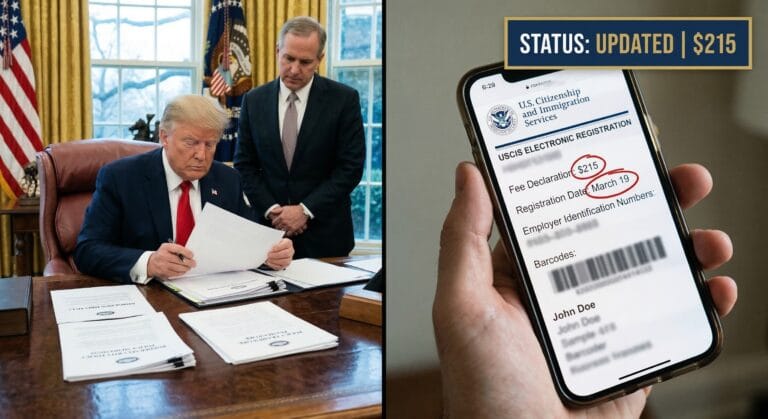
NEW YORK —
Corporate immigration departments and major financial institutions across Wall Street are facing an absolute federal deadline this week. The United States Citizenship and Immigration Services (USCIS) will permanently close the fiscal year 2027 H-1B electronic registration window exactly at noon Eastern Time on March 19, 2026. This uncompromising cutoff intercepts a sweeping administrative enforcement phase governed by the Trump administration. The mandate legally forces New York employers sponsoring highly skilled foreign nationals to clear a strict $215 electronic registration fee per candidate before the agency initiates its heavily scrutinized end-of-month selection lottery.
KEY TAKEAWAYS
- Projected Amount: $215 (Non-refundable electronic registration fee per beneficiary).
- Program/Mechanism: FY 2027 H-1B Specialty Occupation Visa.
- Notice Type: USCIS Electronic Registration Portal.
- Statutory Timeline: Registration window closes strictly at noon on March 19, 2026; late submissions face instant disqualification.
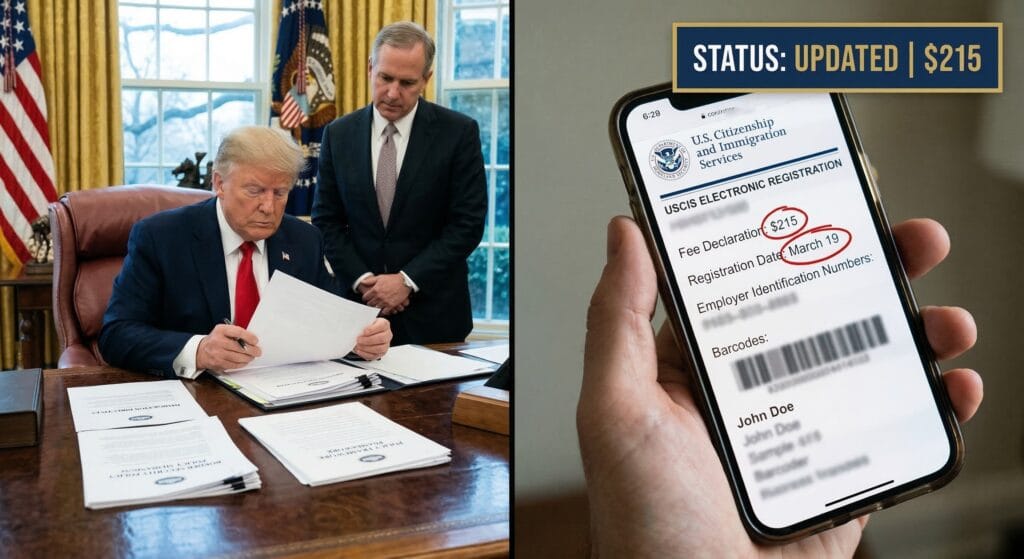
Analyzing the Viral Claims (The Pivot)
Digital employment forums and international collegiate networks frequently distort the mechanics of the federal immigration apparatus. High-velocity social media posts claim the federal government is now charging New York corporations a massive penalty tax simply to interview foreign quantitative analysts and software engineers. Algorithms routinely amplify these panic-inducing narratives. This leaves corporate recruiters and prospective visa holders with vastly distorted expectations of the actual bureaucratic process.
The statutory reality documented in the Federal Register reveals a structural evolution designed to combat systemic fraud. The $215 figure represents the standardized operational baseline for entering the H-1B cap-subject lottery. Years ago, the agency charged a nominal $10 fee, which inadvertently incentivized offshore consulting firms to flood the digital portal with hundreds of thousands of duplicate applications. Under the current executive framework, the Department of Homeland Security (DHS) instituted the $215 fee to cover the actual administrative cost of running the beneficiary-centric selection algorithm. The fee physically filters out speculative entries. Securing a mathematically viable position in the upcoming lottery requires meticulously validating these payments through the government’s digital system before the statutory countdown expires.
Eligibility & Regional Compliance
| Category | Requirement | Projected Amount |
| Registration Status | Submission via the USCIS portal before noon on March 19. | $215 per candidate |
| Corporate Account | Verified myUSCIS organizational account setup. | Mandatory compliance |
| Jurisdiction | Corporate entity operating within the state of New York. | Region-specific labor data |
| Filing Action | Remittance of non-refundable electronic entry fees. | Immediate liability |
Institutional Outlook (Deep-Dive Analysis)
The structural mechanics of the U.S. commercial immigration system represent a massive logistical and financial undertaking. For decades, the H-1B program operated through chaotic, paper-based application floods that routinely overwhelmed federal mailrooms. The complete transition to a pre-registration electronic lottery fundamentally altered how human resources departments allocate their recruitment capital. The Trump administration’s oversight of the current USCIS infrastructure has heavily emphasized a beneficiary-centric selection process. This modernization ensures that each unique foreign worker possesses the exact same statistical probability of selection, regardless of how many different New York companies submit a $215 registration on their behalf.
The Macroeconomic Ripple Effect in Manhattan
New York represents a massive epicenter for this specific policy collision. The state’s explosive economic engine relies heavily on international talent to staff Manhattan’s high-frequency trading floors, Brooklyn’s tech incubators, and upstate advanced manufacturing sectors. Financial analysts observing the corporate landscape note that the escalation from the legacy $10 fee to the current $215 baseline fundamentally alters the cost-benefit mathematics of foreign labor acquisition for smaller startups. While multinational banking conglomerates effortlessly absorb these upfront costs, early-stage New York ventures must strictly limit their sponsorships to absolute tier-one candidates.
When the federal government enforces rigid financial barriers within the labor market, immediate ripples propagate through local commerce. The March 19, 2026 deadline forces New York corporations to finalize their hiring pipelines a full six months before the October start of the federal fiscal year. The aggregate collection of these $215 fees injects tens of millions of dollars directly into the USCIS operating budget. This capital directly funds the agency’s fraud-detection directorates and anti-abuse initiatives. Institutional observers note that the beneficiary-centric system, funded entirely by these registration fees, actively dismantles the shadow economy of offshore staffing agencies that previously manipulated the New York tech and financial markets.
Electronic Rigidity and Bureaucratic Friction
Every single $215 transaction processed this week represents a distinct corporate intent to hire. The sheer volume of registrations originating from New York provides federal economists with real-time leading indicators regarding the state’s projected industrial expansion. If financial institutions in the Financial District submit record numbers of registrations, it mathematically signals massive anticipated capital expenditure and regional growth. Conversely, a sudden drop in paid registrations indicates a severe contraction in corporate hiring outlooks.
Executive branch policy heavily marginalizes manual processing across all immigration vectors. The modern architecture forces all New York employers and their retained legal counsel into the highly secured myUSCIS organizational account framework. This electronic rigidity ensures all $215 payments clear the Treasury through the Pay.gov portal instantly. It completely eliminates the bureaucratic friction of bounced paper checks that previously complicated the lottery pool and delayed the adjudication process.
Legislative analysts tracking USCIS operations point out that the noon Eastern Time cutoff on March 19 offers absolutely zero administrative grace. The system operates entirely without human intervention once the master calendar hits the deadline. The portal will simply lock. Observers note that employers who fail to secure their digital credentials or process their batch payments before server traffic peaks face severe operational hurdles. Missing the cutoff absolutely locks a corporate entity out of the FY 2027 cap-subject labor pool, forcing companies to export vital engineering and analytical roles to satellite offices in Toronto or London. Following the closure, the agency will run its randomized selection algorithm, with formal notification expected to flood corporate dashboards by the end of March.
PEOPLE ALSO ASK
What happens if a New York employer misses the March 19 deadline?
The USCIS electronic registration window operates under a strict statutory cutoff. Employers failing to submit their candidate profiles and the associated payments by noon Eastern Time are entirely locked out of the FY 2027 H-1B cap-subject lottery.
Is the $215 USCIS registration fee refundable if my candidate is not selected?
The federal government classifies the entry cost as a strictly non-refundable processing assessment. The payment covers the administrative overhead required to maintain the digital portal and execute the beneficiary-centric selection algorithm.
How does the end-of-month lottery process actually work?
The agency utilizes a randomized electronic algorithm to select enough unique beneficiaries to meet the annual 85,000 visa cap. Because it is beneficiary-centric, a foreign national entered by three different companies still only possesses one statistical entry in the draw.
CHECK OFFICIAL STATUS AT USCIS.GOV
Strict Journalistic Disclaimer: This report provides clinical analysis of current legislation, executive orders, and federal immigration protocols. The information contained herein does not constitute financial, legal, or immigration advice. Readers are directed to consult registered legal counsel or corporate immigration professionals regarding their specific institutional or individual filing requirements.

Evan Cole Editor-in-Chief | Breaking News & Public Policy
“From Washington to Wall Street, and Main Street to Hollywood—Evan Cole connects the dots.”
As the Editor-in-Chief at Newskilo, Evan leads a dynamic team of journalists dedicated to uncovering the truth behind the headlines. With over 15 years in digital media, Evan has a reputation for cutting through the noise.
While he is widely recognized for his deep analysis of U.S. fiscal policy (IRS & Stimulus), Evan’s expertise extends to global current events, corporate accountability, and cultural trends. Whether he is breaking down a complex government bill, exposing a tech giant’s failure, or analyzing the societal impact of a viral celebrity moment, Evan’s goal is simple: To tell the stories that shape our world with clarity, accuracy, and integrity.
Leave a Reply