
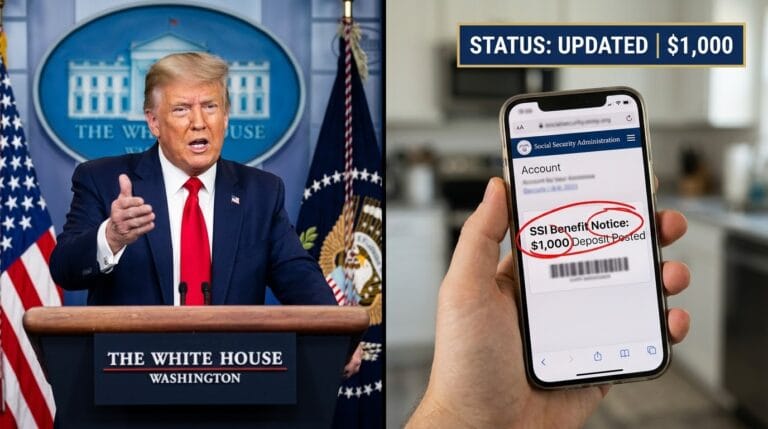
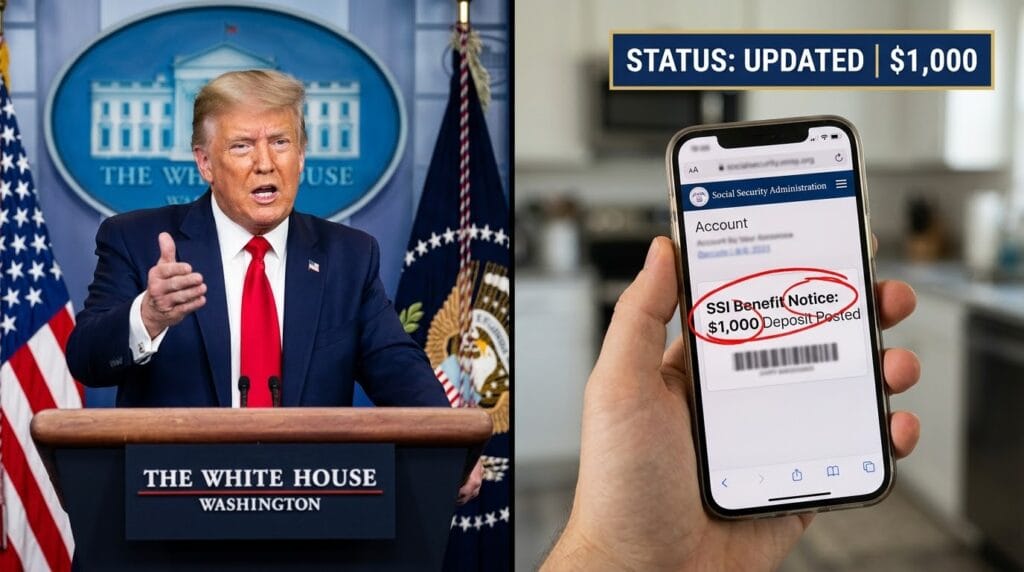
TALLAHASSEE — A sudden wave of policy apprehension is sweeping through Florida’s vast retiree demographic following recent executive branch commentary. Treasury Secretary Scott Bessent initiated a national fiscal debate when he publicly characterized the newly enacted $1,000 “Trump Accounts” as a potential mechanism for shifting the generational reliance on federal entitlement programs. This specific phrasing triggered immediate alarm among senior advocacy groups, forcing the White House to issue formal clarifications regarding the sanctity of March guaranteed disbursements for current Social Security and Supplemental Security Income (SSI) recipients.
KEY TAKEAWAYS
- Amount: $1,000 initial Treasury seed deposit
- Program: Trump Newborn Accounts (One Big Beautiful Bill)
- Notice Type: Social Security / SSI Verification Alert
- Timeline: March guaranteed benefits remain fully active
Analyzing the Viral Claims
Digital platforms across Florida are actively amplifying claims that the current administration plans to replace traditional Social Security payouts with privatized market accounts by the end of the fiscal quarter. Analysts observe a severe disconnect between these viral social media narratives and the actual legislative framework signed into law. The core panic stems from the Treasury Secretary’s remarks suggesting the new child savings initiative could act as a “backdoor” to privatizing retirement funds.
The White House Press Office explicitly countered this interpretation during recent briefings. Official administration statements confirm that the $1,000 Trump Accounts—established under the One Big Beautiful Bill (OBBB)—operate entirely separate from the existing Social Security trust fund. Press Secretary Karoline Leavitt stated on the record that the child investment accounts serve as an additive supplement for future generations, not a substitute for current retirees. The Social Security Administration verifies that all scheduled March direct deposits and paper checks will disburse without interruption or structural alteration.
Advocacy organizations like the AARP and the National Committee to Preserve Social Security and Medicare (NCPSSM) immediately mobilized their Florida chapters. These entities are distributing public alerts advising seniors to monitor the legislative language closely. They emphasize that while immediate benefits remain secure, the philosophical shift toward market-based retirement infrastructure requires intense voter scrutiny.
Eligibility & Regional Compliance
The legislative texts define strict parameters separating the new wealth-building initiative from legacy entitlement programs. Florida residents must understand the distinct operational boundaries governing the $1,000 capital injection versus standard retirement distributions.
| Category | Requirement | Projected Amount |
| Trump Newborn Account | U.S. Citizen born Jan 1, 2025 – Dec 31, 2028 | $1,000 Treasury Seed |
| Standard Retirement | Vested work history (40 credits) | Based on lifetime earnings |
| SSI Beneficiary | Aged, blind, or disabled with limited resources | Federally calculated monthly rate |
Tax filers claim the $1,000 newborn seed money by submitting IRS Form 4547 during the current tax season. This action establishes a tax-advantaged index fund for the child, locked until age 18. This mechanism draws zero capital from the payroll taxes that currently fund Florida’s retired population.
Institutional Outlook
The implementation of the $1,000 Trump Accounts represents a profound ideological pivot in federal economic strategy. Financial monitors tracking the rollout note that the policy attempts to address long-term systemic wealth gaps by minting an entire generation of immediate investors. Treasury models project that the initial $1,000 deposit, left to compound in an S&P 500 tracking fund without any additional contributions, could reach substantial valuations by the time the beneficiary reaches retirement age.
This long-term mathematical projection is precisely what prompted the Treasury Secretary’s controversial privatization remarks. The administration envisions a future where compound market growth reduces a citizen’s absolute dependency on the federal Social Security apparatus. By front-loading the capital investment at birth, the federal government establishes a parallel retirement asset.
Florida serves as ground zero for the political friction generated by this policy. The state houses one of the highest concentrations of SSI and standard retirement beneficiaries in the nation. Institutional analysts point out that any federal rhetoric involving the words “privatization” or “backdoor” immediately destabilizes consumer confidence among fixed-income populations. The Department of Treasury is currently executing a rapid damage-control operation to firewall the newborn investment narrative away from current senior benefit calculations.
The broader institutional design allows family members, employers, and philanthropic organizations to contribute up to $5,000 annually into these restricted accounts. Economic historians view this structure as a calculated transition away from the centralized custodial state. The architecture deliberately favors decentralized, market-driven resilience over guaranteed federal stipends. While the White House insists the traditional trust fund will remain untouched, legislative watchdogs argue that a successful, multi-decade run of the $1,000 child accounts will inevitably provide future congresses with the political leverage to scale back legacy entitlement programs.
PEOPLE ALSO ASK
Will the Trump Accounts reduce my current Social Security checks?
No. The Social Security Administration operates under current permanent law. The $1,000 seed deposits for newborns are funded through separate Treasury allocations authorized by the OBBB, not through the payroll tax revenues that sustain current retirement checks.
How do families in Florida open the $1,000 account?
Parents or legal guardians must complete IRS Form 4547 when filing their federal tax returns. The child must possess a valid Social Security Number and be born within the designated 2025-2028 eligibility window.
Can the government take back the $1,000 deposit?
The legislation structures these accounts as custodial private assets. Once the Department of Treasury deposits the initial $1,000 into the authorized index fund, the capital belongs to the child. It cannot be reclaimed to balance federal deficits or fund other federal programs.
CHECK OFFICIAL STATUS AT SSA.GOV
Journalistic Disclaimer: This report provides a clinical analysis of enacted federal legislation and institutional policy debates. It does not constitute financial, legal, or retirement planning counsel. All figures, quotes, and timelines are sourced from public legislative texts, executive branch press briefings, and federal agency operational notices.

Evan Cole Editor-in-Chief | Breaking News & Public Policy
“From Washington to Wall Street, and Main Street to Hollywood—Evan Cole connects the dots.”
As the Editor-in-Chief at Newskilo, Evan leads a dynamic team of journalists dedicated to uncovering the truth behind the headlines. With over 15 years in digital media, Evan has a reputation for cutting through the noise.
While he is widely recognized for his deep analysis of U.S. fiscal policy (IRS & Stimulus), Evan’s expertise extends to global current events, corporate accountability, and cultural trends. Whether he is breaking down a complex government bill, exposing a tech giant’s failure, or analyzing the societal impact of a viral celebrity moment, Evan’s goal is simple: To tell the stories that shape our world with clarity, accuracy, and integrity.
Leave a Reply