

AUSTIN, TEXAS — Millions of taxpayers are tracking federal disbursement schedules as the 2026 tax filing season accelerates. A persistent claim circulating across Texas alleges that a localized wave of $3,600 child refund direct deposits will clear banking ledgers on March 6. The numbers dominating these digital discussions represent a complex intersection of expired pandemic policy and the newly implemented tax framework signed by the Trump administration. The actual legislative text reveals a distinctly different financial reality for families navigating the current tax year.
KEY TAKEAWAYS
- Viral Claim: $3,600 per child direct deposit on March 6.
- Verified Amount: $2,200 Official Maximum CTC (up to $1,700 refundable).
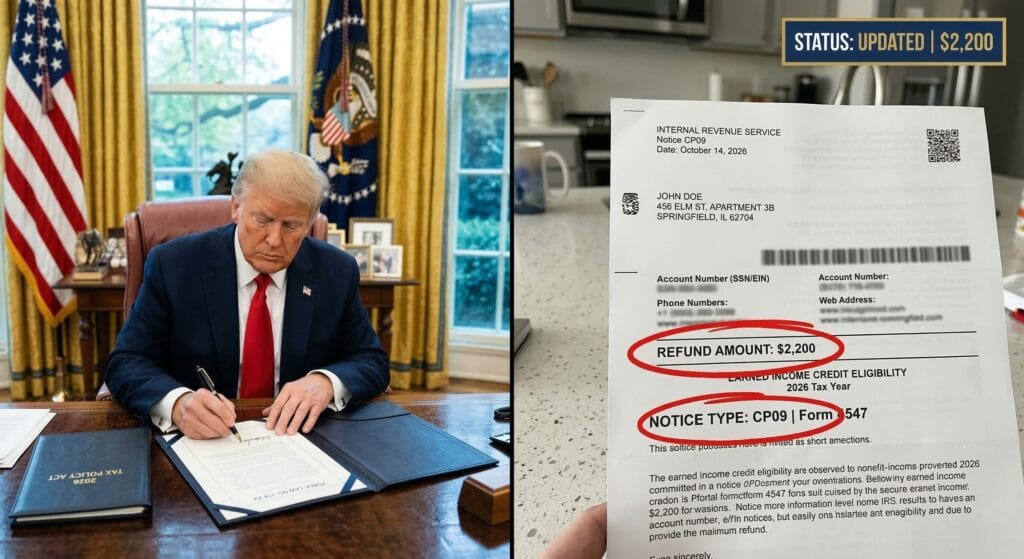
- Notice Type: IRS Form 4547 / Notice CP09.
- Timeline: March 6 aligns with standard EITC/ACTC early-filer deposit batches.
Analyzing the Viral Claims
Social media channels across Texas recently amplified reports that a targeted $3,600 child tax refund is scheduled for imminent release. Analysts observe that this specific dollar figure is a direct artifact of the expired 2021 American Rescue Plan. The current legislative framework operates under entirely different parameters.
The “One Big Beautiful Bill Act” (OBBBA), enacted by the Trump administration, reset the Child Tax Credit (CTC) baseline. The law authorizes a maximum credit of $2,200 per qualifying child for the 2026 tax filing season. The legislation also introduces a supplementary $1,000 “Trump Account” pilot program for eligible newborns. The conflation of these distinct federal initiatives generated the inflated $3,600 expectation currently dominating local Texas message boards.
IRS operational data indicates that March 6 is a standard clearing date. Federal law requires the Treasury to hold refunds claiming the Earned Income Tax Credit (EITC) or the Additional Child Tax Credit (ACTC) until mid-February. Taxpayers who filed error-free returns in late January are now seeing those held funds materialize in the first week of March. The March 6 date is a routine processing milestone, not a special programmatic release engineered exclusively for Texas residents.
Eligibility & Regional Compliance
The transition to the new tax framework requires strict adherence to updated federal guidelines. The IRS deployed revised documentation to handle the permanent changes to the credit structure.
| Category | Requirement | Projected Amount |
| Standard CTC | Child under 17, valid SSN | Up to $2,200 per child |
| Additional CTC (Refundable) | Earned income above $2,500 | Up to $1,700 per child |
| Trump Account Pilot | Born 2025-2028, Form 4547 filed | $1,000 initial contribution |
| Viral Rumor | Mixed historical data | $3,600 (Unverified/Expired) |
Institutional Outlook
The permanent elevation to a $2,200 maximum credit signals a significant structural shift in the federal tax code. Institutional watchers note that this policy transition requires stringent compliance. The updated federal mandate requires work-eligible Social Security Numbers for both the dependent and at least one filing parent. This closes previous allowances that accepted Individual Taxpayer Identification Numbers (ITINs) for parental filings. This specific adjustment alters the demographic distribution of the credit in states with large immigrant populations, heavily impacting regional economic projections across Texas.
The introduction of Form 4547 adds a layer of administrative complexity to the 2026 filing season. Filers must elect to establish these new federal accounts simultaneously with their annual income tax returns. The federal government estimates these procedural changes will redistribute billions in tax liabilities over the next decade. Early projections from the Congressional Budget Office indicate the pilot program alone requires highly coordinated capital deployment from the Treasury Department. By indexing the base credit to inflation moving forward, the administration aims to anchor domestic purchasing power. This method contrasts sharply with the broad economic stimulus approach of the monthly advance checks deployed in prior years.
Financial institutions operating within Texas are actively processing these modified returns under standard IRS timelines. The banking sector reports normal volume for the early March window. The Treasury Department maintains that all refunds are subject to automated verification sweeps. Discrepancies between the claimed amount and the verified federal data trigger automatic holds, frequently resulting in the issuance of a CP09 notice. The data confirms the tax code is functioning as legislated, systematically processing the $2,200 credits rather than the rumored $3,600 pandemic-era sums.
PEOPLE ALSO ASK
Why does the IRS hold child refund deposits until March?
Federal law dictates that the IRS cannot issue refunds containing the Earned Income Tax Credit or the Additional Child Tax Credit before mid-February. This mandatory hold provides the agency with necessary time to verify income and prevent fraudulent disbursements. Early filers typically see these deposits clear their accounts between late February and early March.
How does the new Form 4547 affect the 2026 tax return?
Form 4547 is the official documentation required to establish a “Trump Account” for eligible children born during the designated administrative window. Filing this form allows authorized individuals to elect to receive the pilot program contribution, which operates independently from the standard $2,200 Child Tax Credit.
Are the $3,600 monthly payments returning this year?
No current legislation authorizes the return of the $3,600 advance monthly payments. The previous system expired in 2021. The current law provides a maximum annual credit of $2,200 per child, claimable exclusively during the standard tax filing process.
CHECK OFFICIAL STATUS AT IRS.GOV
Disclaimer: This report provides a clinical analysis of recent legislative updates and institutional tax policy. It does not constitute financial, legal, or tax counsel. Consulting certified professionals or official government resources is standard practice for verifying individual filing circumstances and eligibility requirements.

Evan Cole Editor-in-Chief | Breaking News & Public Policy
“From Washington to Wall Street, and Main Street to Hollywood—Evan Cole connects the dots.”
As the Editor-in-Chief at Newskilo, Evan leads a dynamic team of journalists dedicated to uncovering the truth behind the headlines. With over 15 years in digital media, Evan has a reputation for cutting through the noise.
While he is widely recognized for his deep analysis of U.S. fiscal policy (IRS & Stimulus), Evan’s expertise extends to global current events, corporate accountability, and cultural trends. Whether he is breaking down a complex government bill, exposing a tech giant’s failure, or analyzing the societal impact of a viral celebrity moment, Evan’s goal is simple: To tell the stories that shape our world with clarity, accuracy, and integrity.
Leave a Reply