
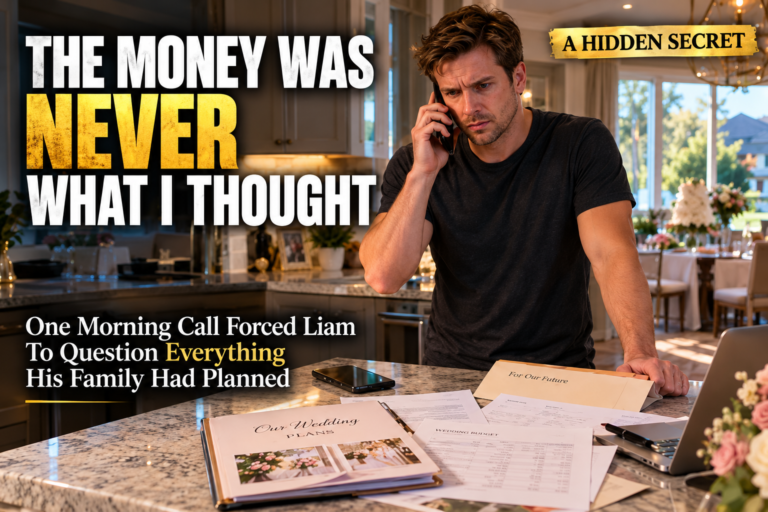
At 7:30 on a Tuesday morning, Liam’s mother called him three times before he finally answered.
His sister’s wedding was only six weeks away, and the venue had just reported that a major payment had failed. What Liam didn’t know was that the missed payment was connected to $260,000 that his father had quietly moved through a family trust—and a promise their grandfather had made more than a decade earlier.
“Liam, something went wrong with Cynthia’s wedding account.”
His mother sounded frightened.
That alone made him sit up.
Cynthia was his younger sister, and her wedding had been planned for almost a year.
It was supposed to be spectacular.
There was a designer dress, an elaborate reception, a destination bridal shower, expensive floral arrangements, a private ballroom, and even an ice sculpture that cost more than Liam thought any piece of frozen decoration should.
His mother had called it the celebration everyone would remember.
Now the venue was threatening to cancel parts of the arrangement because a payment had been rejected.
Liam asked why.
His mother mentioned an account connected to his grandfather’s trust.
That stopped him.
“Why would a wedding payment have anything to do with Grandpa’s trust?”
His mother went silent.
Then she admitted that Liam’s father had arranged something.
She couldn’t explain exactly what.
That was the first moment Liam knew this wasn’t simply a problem with a wedding bill.
His family had been keeping something from him.
And by midnight the previous night, Liam had already found part of the answer.
He worked in financial compliance, so when his father had asked him months earlier to help organize some property records, Liam had agreed.
The family files were complicated.
There were investment statements, property documents, insurance records, old legal correspondence, and trust paperwork.
While searching for a document concerning a commercial property, Liam noticed two unusual transfers.
One was for $140,000.
The other was $120,000.
Together, they totaled $260,000.
Both had been moved into an account connected to Cynthia’s wedding expenses.
At first, Liam assumed it was an error.
Then he looked at the source.
The money had come from an account associated with his grandfather’s trust.
He read the records again.
Then a third time.
His grandfather had always been careful with money.
He believed family wealth should provide stability, not create an expensive appearance.
The wedding seemed to be doing the opposite.
The more Liam investigated, the more uncomfortable he became.
The trust documents contained conditions attached to future distributions.
One phrase stood out:
Independent financial standing.
Cynthia didn’t have that.
Her parents had been helping with her living expenses.
They had covered bills before.
Her fiancé, Marcus, was between jobs.
And now hundreds of thousands of dollars had suddenly appeared in the middle of a wedding budget.
Liam called his parents.
Neither answered.
So shortly after midnight, he used the authority available to him and temporarily restricted the account.
He wasn’t trying to ruin his sister’s wedding.
He wanted to prevent additional money from moving until he understood what was happening.
At 7:30 the next morning, his mother called.
And now he knew why.
“Mom,” Liam said, “who authorized the $260,000 transfer?”
Her answer was hesitant.
“Your father.”
“Why?”
“He was trying to help Cynthia.”
“With the trust?”
“Not exactly.”
Liam looked at the documents on his kitchen table.
There was a notation beside the transfer.
Beneficiary adjustment pending.
His concern deepened.
“Mom, what did Grandpa actually promise Cynthia?”
She became quiet.
Then she said something Liam had never heard before.
“He made a promise to both of you.”
“Both of us?”
“You and Cynthia.”
“What kind of promise?”
“I thought your father had explained.”
“He didn’t.”
His mother took a breath.
“Maybe that’s why the money was moved.”
Before Liam could ask another question, his father called.
Liam let it ring.
A message followed.
We need to talk.
Then another.
Don’t make any more changes.
Liam stared at the screen.
He had already made the change.
And now he wanted answers.
When his father finally called again, Liam answered.
“Tell me why you moved the money.”
His father hesitated.
“Because Cynthia was going to lose the wedding.”
“That doesn’t answer my question.”
“It was complicated.”
“No. The transfer was simple. The reason isn’t.”
His father finally admitted that the money wasn’t intended as a permanent gift.
He had moved it temporarily.
Liam still didn’t understand.
“Why would you put trust money into a wedding account if Cynthia wasn’t supposed to receive it?”
His father paused.
“Because I was trying to prevent something worse.”
“What?”
“I’ll explain tonight.”
Liam wasn’t willing to wait.
His father finally told him that there were instructions left by his grandfather.
Instructions that might explain everything.
That was when Liam opened a file he hadn’t examined carefully before.
Inside was a scanned handwritten page.
The handwriting was unmistakable.
His grandfather’s.
There were only a few lines.
One sentence stopped Liam cold.
Liam must understand why Cynthia cannot receive her portion yet.
He printed the page.
Then the transfer records.
Then the trust agreement.
By the time his mother arrived, the dining table was covered with paperwork.
She looked at the pages and immediately understood what he had found.
“You found the letter.”
“You knew about it?”
“I knew there was a letter.”
“Did you know what it said?”
“No.”
“Did Dad?”
“I don’t know.”
Liam watched her carefully.
His mother finally admitted something else.
His grandfather had been concerned about Cynthia’s relationship with money.
It wasn’t because he didn’t love her.
It was because he had watched her make financial decisions without considering the consequences.
There had been a car she couldn’t comfortably afford.
Credit card balances her parents had covered.
Travel expenses.
Other purchases.
Each time, the family had stepped in.
Liam had done it too.
He simply hadn’t realized how often.
Cynthia asked.
Liam solved.
Cynthia worried.
Liam planned.
Cynthia ran short.
Liam helped.
It had become so normal that nobody questioned it anymore.
But his grandfather had noticed.
“He believed you would become responsible with money,” his mother told Liam.
“Eventually.”
“What did he want me to understand?”
“That being the responsible one doesn’t mean carrying everyone else.”
That sentence stayed with him.
His father arrived a short time later carrying another folder.
He sat at the table.
“The $260,000 wasn’t transferred because Cynthia was entitled to it.”
Liam waited.
“It was transferred because I was trying to protect the trust.”
“How?”
His father explained.
Cynthia and Marcus had agreed to finance part of the wedding through a private lender.
The wedding budget had grown far beyond what they could realistically afford.
What had started near $95,000 had climbed to almost $290,000.
The lender wanted collateral.
And the collateral being discussed was Cynthia’s expected trust distribution.
Liam looked at the documents.
“So they were going to use her future inheritance to finance the wedding?”
His father nodded.
That was the real crisis.
The wedding wasn’t simply expensive.
It had become financially dependent on money Cynthia wasn’t yet entitled to receive.
His father had moved $260,000 temporarily because he was trying to keep the wedding from collapsing while he figured out another solution.
But the trust administrator had flagged the transfer.
That was why the payment failed.
And that was why Liam’s father had been so desperate to stop him from asking questions.
His father finally admitted the truth.
He had promised Liam’s grandfather that if Cynthia ever tried to trade her future financial security for a lifestyle she couldn’t afford, he would stop her.
But instead of telling everyone what was happening, he had tried to quietly fix it.
He had made the situation more complicated.
Liam looked at him.
“You were trying to keep everyone happy.”
His father nodded.
“And it made everything worse.”
“Yes.”
For once, there was no excuse.
Just an admission.
The next step was obvious.
They had to talk to Cynthia.
She was at the venue.
When Liam arrived, the ballroom looked exactly like the kind of place his sister had dreamed about.
White flowers.
Crystal fixtures.
Decorated tables.
A partially completed ice sculpture.
Liam looked at the invoice.
$8,700.
He quietly shook his head.
Cynthia saw him.
“Why are you here?”
“We need to talk.”
“If this is about the payment, Dad is handling it.”
“He isn’t.”
Her expression changed when Liam told her the account had been restricted.
“You stopped my wedding?”
“No.”
“I stopped a financial arrangement that could have put your future inheritance at risk.”
Cynthia went silent.
Marcus walked over.
Liam asked whether he knew the trust was being discussed as collateral.
Marcus hesitated.
He claimed the arrangement had been presented as a temporary bridge.
But when Liam asked whether Cynthia knew the details, Marcus couldn’t answer.
Cynthia looked between them.
Then she asked Liam what her grandfather had actually intended.
Liam handed her the trust documents.
She read them.
Her expression changed.
Then she saw the condition about financial independence.
“He wrote this about me?”
“He wrote it because he believed you could build a stable life.”
Cynthia looked around the ballroom.
The flowers.
The decorations.
The expensive packages.
The commitments that had accumulated without anyone stopping them.
“I thought I had everything under control,” she whispered.
“I believe you.”
“Then why won’t you help me?”
Liam sat beside her.
“Because helping you doesn’t mean making sure nothing ever goes wrong.”
She looked at him.
“You could just give me the money.”
“I could.”
“Then why won’t you?”
“Because you would never get the chance to learn what you can do without it.”
Cynthia looked down.
Liam showed her the actual numbers.
The wedding had nearly $286,000 in commitments.
She and Marcus had only about $43,000 available.
For the first time, Cynthia saw the full picture.
The wedding wasn’t simply ambitious.
It wasn’t affordable.
She began asking questions.
What could be canceled?
What could be reduced?
Could the guest list change?
Could the venue be downsized?
Could the expensive extras disappear?
For the first time, she wasn’t asking how to find more money.
She was asking how to spend less.
That was the beginning of the change.
When they returned home, the family sat around the kitchen table and went through every expense.
No one hid anything.
The resort was canceled.
The guest list was reduced.
The elaborate decorations were scaled back.
The expensive menu was replaced.
The ice sculpture disappeared.
The wedding moved to a smaller room.
Cynthia even sold the car she had been making payments on.
Slowly, the numbers became manageable.
Her mother watched all of it.
Then Cynthia asked the question she had apparently been afraid to ask for years.
“Are you disappointed in me?”
Her mother started crying.
“I’ve been waiting for you to ask me that.”
Cynthia stared at her.
“I thought you wanted this.”
“I wanted you to be happy.”
“I thought I needed a wedding like this to prove I had made it.”
Her mother shook her head.
“You never had to prove that to me.”
That conversation changed something.
But there was still one more problem.
Marcus.
Liam spoke with him privately.
Marcus admitted that he had lost his job the previous year.
He hadn’t told Cynthia how serious the situation was.
He had been embarrassed.
The wedding kept getting more expensive, and instead of admitting that he couldn’t keep up, he convinced himself he would recover financially before anyone noticed.
He hadn’t.
Liam told him the only way forward was honesty.
So Marcus finally told Cynthia everything.
She listened.
Then asked why he hadn’t trusted her.
“I thought you’d leave.”
Cynthia looked at him.
“I might have.”
He nodded.
“But I would rather have heard the truth.”
Marcus agreed.
They realized they had both been trying to protect the relationship by hiding things from each other.
Instead, they had created a much bigger problem.
Cynthia made her decision.
“We’re starting over.”
That meant rebuilding the wedding.
And rebuilding their relationship.
A few days later, Cynthia opened another letter from her grandfather.
She had been afraid to read it.
She worried that his words would confirm every negative thought she had about herself.
Instead, the letter said something different.
He explained that refusing her immediate access to the trust was not the same as abandoning her.
He wanted her to have enough support to build a future, but not so much that money could hide difficult decisions.
He reminded her that family could love someone without financing every choice that person made.
Cynthia cried when she finished reading.
Then she folded the letter carefully.
“I want to change the wedding.”
Her father asked how much she wanted to spend.
“I don’t know yet.”
She smiled.
“But whatever it is, we can afford it.”
That became the new goal.
Not impressing everyone.
Not creating the perfect event.
Creating a celebration they could actually pay for.
Cynthia began working with a financial adviser.
Marcus found a new job.
It wasn’t glamorous.
It paid less than his previous position.
But it was steady.
They opened a savings account.
They started paying down their obligations.
And gradually, something changed.
They stopped asking the family to solve every problem.
A few weeks later, the trust attorney informed Liam that Cynthia had met the conditions for a small controlled distribution.
It wasn’t the full inheritance.
It wasn’t available for luxury spending.
It was designed to support professional development and financial stability.
Cynthia accepted the arrangement without arguing.
Liam was surprised.
“You’re not angry?”
“I was.”
“And now?”
She smiled.
“Grandpa was right.”
Liam laughed.
“Don’t say that too loudly.”
She laughed too.
Then she said something he hadn’t expected.
“You know, I used to think you were boring.”
“I probably was.”
“No.”
She shook her head.
“You were scared.”
Liam looked at her.
“You thought if you controlled everything, nobody could get hurt.”
He couldn’t deny it.
Cynthia continued.
“You don’t have to protect me anymore.”
“I know.”
“Do you?”
Liam smiled.
“I’m learning.”
“So am I.”
That was the real inheritance.
Not the money.
The lesson.
Eventually, Liam accepted the role of successor trustee.
But he changed the structure.
He wanted an independent review process.
No family member would secretly control another person’s financial access.
No one would make major financial decisions for someone else without their knowledge.
And family money would no longer be used to maintain appearances.
The $260,000 was still sitting untouched.
Now the family had to decide what to do with it.
They gathered around the dining table.
Liam presented his proposal.
The money would return to the trust.
Separate accounts would be established for education, housing, and genuine emergencies.
Each person would have clear responsibilities.
No hidden arrangements.
No surprise transfers.
No financial decisions made behind someone’s back.
Cynthia listened carefully.
“What happens to my inheritance?”
“You still have it.”
“Just not all at once.”
“Correct.”
She thought about it.
Then nodded.
“What if I need help?”
“You ask.”
“And if you say no?”
“You figure out another way.”
She smiled.
“That sounds like you.”
“I’m trying to improve.”
Everyone laughed.
Then Cynthia made an unexpected request.
She wanted part of her inheritance protected for ten years.
Not because anyone was forcing her.
Because she wanted to protect herself from making an emotional decision later.
She wanted to know that when she reached forty, she would still have something she had built toward.
Liam agreed.
The $260,000 went back into the trust.
The wedding went forward.
It was much smaller than Cynthia had originally planned.
There were no ice sculptures.
No destination bridal shower.
No elaborate extras.
But there was something different.
Nobody was pretending.
Cynthia walked down the aisle in a beautiful dress.
Marcus waited for her.
Their parents watched.
Liam stood nearby.
The celebration was simple.
It was also completely paid for.
Later, Cynthia stood beside Liam.
“Do you regret freezing the account?”
“No.”
“Even when Mom was furious?”
“No.”
She laughed.
“Even when Dad wouldn’t talk to you?”
“He knew I was right.”
“That isn’t why.”
“I know.”
Then she looked around the room.
“I almost missed all of this.”
“How?”
“I was so focused on making the wedding look perfect that I forgot what I actually wanted.”
“What did you want?”
“To be married.”
Liam smiled.
“That’s an important difference.”
She touched his shoulder.
“Thank you.”
“For what?”
“For being the person who finally said no.”
Liam looked at her.
“I was terrified.”
“You didn’t look terrified.”
“I was.”
She smiled.
“Good.”
They both laughed.
Months passed.
The family changed gradually.
Cynthia kept her new budget.
She and Marcus built savings.
They reduced their remaining debt.
They stopped expecting their parents to solve every problem.
Marcus kept his new job and eventually earned a promotion.
Liam discovered that being a trustee wasn’t about controlling everyone.
It was about creating a structure that allowed everyone to make responsible choices.
His parents changed too.
They stopped confusing financial support with protection.
They stopped hiding information because they were afraid of conflict.
And family conversations became easier.
Six months after the wedding, Liam received an update from the trust attorney.
Cynthia had completed her first financial review.
She had increased her savings.
Reduced her debt.
Built an emergency fund.
And made her first independent investment.
Liam called her.
“I’m proud of you.”
She laughed.
“Don’t sound surprised.”
“I’m not.”
“You are.”
“Maybe a little.”
She paused.
Then asked, “Do you know what Grandpa’s greatest gift was?”
“What?”
“He made us uncomfortable.”
Liam laughed.
“That doesn’t sound like a gift.”
“It was.”
She explained that her grandfather could have simply left them money.
Instead, he left them reasons to learn.
Liam looked at the old silver watch he had received from Cynthia.
He had worn it every day since the wedding.
“What are you doing tonight?” she asked.
“Nothing.”
“Good.”
“Why?”
“Mom wants everyone over for dinner.”
“What are we celebrating?”
“Nothing.”
Liam laughed.
“That’s new.”
That evening, they gathered around the same table where the $260,000 had once caused so much confusion.
There were no financial statements.
No contracts.
No trust documents.
No spreadsheets.
Just dinner.
Cynthia brought dessert.
Marcus brought a bottle of wine.
Their mother made far too much pasta.
Their father told a story everyone had already heard twice.
And Liam simply sat there for a moment, looking around the room.
The family wasn’t perfect.
There were still disagreements.
Still mistakes.
Still conversations that weren’t easy.
But nobody needed money to make everything appear fine anymore.
After dinner, his mother joined Liam in the kitchen.
“I was so angry with you that morning,” she said.
“I know.”
“I thought you were taking something away from Cynthia.”
“I know.”
She dried a plate.
“But you weren’t.”
Liam looked at her.
“You were giving her something.”
“What?”
“The chance to become herself.”
Liam smiled.
“I think Grandpa would have liked that.”
His mother looked toward the dining room.
“I think he would have been proud of all of us.”
Liam touched the watch on his wrist.
For years, he had believed his grandfather’s legacy was the money, the properties, and the complicated trust documents.
Now he understood that those things were only part of it.
The real inheritance was a lesson.
A family can love without rescuing.
Someone can say no without abandoning the person they love.
A difficult truth can sometimes be kinder than a comfortable lie.
And helping someone become independent can be more meaningful than simply paying their way.
The $260,000 remained in the trust.
It was no longer connected to a wedding.
It carried no hidden expectations.
It simply waited for the future it had been intended to support.
Years later, when Cynthia and Marcus bought their first home, they made the down payment with money they had saved themselves.
Liam attended the closing.
Outside the building, Cynthia looked at him.
“You know what’s funny?”
“What?”
“Grandpa’s trust helped us buy this house.”
“Indirectly.”
“Exactly.”
She looked back at the house.
“It didn’t pay for it.”
“No.”
“It taught us how to.”
Liam nodded.
The old watch ticked quietly beneath his sleeve.
For the first time, he fully understood what his grandfather had meant.
Time was the one inheritance nobody could spend twice.
And the family had finally learned how to use theirs.
Not trying to impress people.
Not shielding one another from every difficult decision.
Not using money to cover uncomfortable truths.
Just talking.
Listening.
Making mistakes.
Learning.
Growing.
And choosing, day after day, to remain a family without making anyone pay for the privilege of belonging.
Sometimes love requires helping.
Sometimes it requires stepping back.
Sometimes it requires saying no.
And sometimes one person has to stop the money long enough for everyone else to finally understand what the money was never meant to solve.

Evan Cole Editor-in-Chief | Breaking News & Public Policy
“From Washington to Wall Street, and Main Street to Hollywood—Evan Cole connects the dots.”
As the Editor-in-Chief at Newskilo, Evan leads a dynamic team of journalists dedicated to uncovering the truth behind the headlines. With over 15 years in digital media, Evan has a reputation for cutting through the noise.
While he is widely recognized for his deep analysis of U.S. fiscal policy (IRS & Stimulus), Evan’s expertise extends to global current events, corporate accountability, and cultural trends. Whether he is breaking down a complex government bill, exposing a tech giant’s failure, or analyzing the societal impact of a viral celebrity moment, Evan’s goal is simple: To tell the stories that shape our world with clarity, accuracy, and integrity.
Leave a Reply