
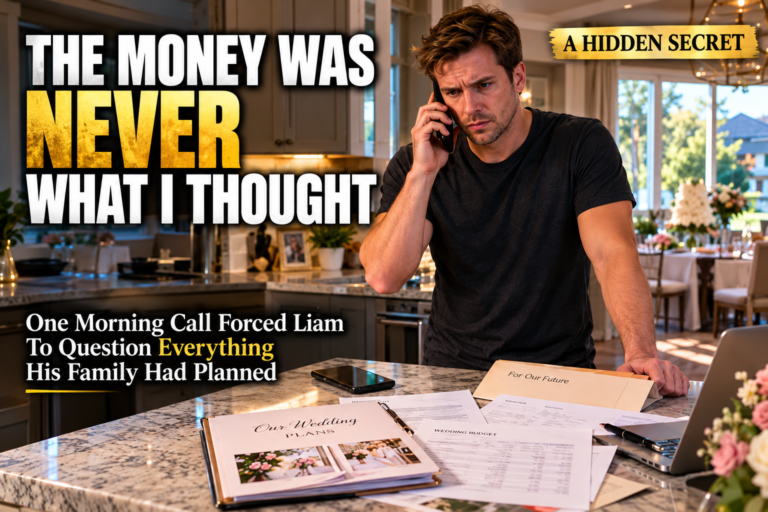
At 7:30 on a Monday morning, my mother called because my sister’s wedding payment had been rejected.
By breakfast, I had discovered that $260,000 had been moved into my sister’s wedding account without my knowledge. By the end of the day, I would learn that the money wasn’t really about the wedding at all.
It was about an inheritance, a promise my grandfather had made before he died, and a family habit none of us wanted to admit was hurting us.
My phone had already buzzed twice before I answered.
Mom.
I knew something was wrong because my mother didn’t call that early unless something serious had happened.
“Liam?”
Her voice was unusually tense.
“What happened?”
“The venue called about Cynthia.”
I immediately thought of the wedding.
My younger sister was supposed to get married in six weeks. For almost a year, our family had been discussing everything from the guest list to the flowers.
The original budget had been around $95,000.
Then it grew.
The venue changed.
The dress became more expensive.
There was a destination bridal shower, upgraded catering, special transportation, elaborate decorations, and an ice sculpture that cost more than I wanted to know.
Eventually, the projected total approached $287,000.
I had always assumed our parents were helping.
What I didn’t know was how much they were helping.
“The payment didn’t go through,” Mom said.
“What payment?”
“The next venue installment.”
I sat down at the kitchen table.
“Why?”
“They said the account was restricted.”
“What account?”
She hesitated.
“The trust account.”
My grandfather had been gone for eleven years.
He had created a family trust before his death, but my parents rarely discussed the details. I knew both Cynthia and I were beneficiaries, and I knew my father had responsibilities connected to it.
Whenever I asked questions, Dad gave me the same answer.
“You’ll understand when the time comes.”
At thirty-two, I had stopped accepting that answer.
“Why would a wedding payment involve Grandpa’s trust?”
Mom went quiet.
“Your father arranged something.”
“What did he arrange?”
“I don’t know all of it.”
That scared me.
My mother always knew everything.
If she truly didn’t know, someone had deliberately kept information from her.
Or from me.
Then she asked, “Did you freeze the account?”
“Yes.”
Silence.
“I found the transfers last night.”
“What transfers?”
“Two of them.”
I opened the folder sitting beside me.
“One was $140,000. The other was $120,000.”
Mom didn’t speak.
“That’s $260,000,” I said. “And it went into Cynthia’s wedding fund.”
“That wasn’t supposed to be permanent.”
“Then what was it supposed to be?”
“I don’t know.”
I looked at the paperwork again.
One note kept catching my attention.
Beneficiary adjustment pending.
“Mom, what exactly did Grandpa leave us?”
She took a breath.
“He made a promise to both of you.”
“Both of us?”
“You and Cynthia.”
“What promise?”
“I thought your father explained.”
“He didn’t.”
She was quiet again.
Then she said something that changed the entire conversation.
“Maybe that’s why the money was moved.”
Before I could ask what she meant, another call appeared.
Dad.
Mom said, “Whatever you do, don’t make another decision until your father comes home.”
“Why?”
Her answer was almost a whisper.
“Because I don’t think he transferred that money for Cynthia’s wedding.”
The call ended.
I stared at my phone.
The wedding suddenly seemed like the smallest part of the problem.
The night before, I had been reviewing family financial records.
My father had asked me months earlier to help organize some property documents, and because I work with financial paperwork regularly, I was comfortable sorting through the files.
There were investment statements, property records, tax documents, insurance information, and trust documents.
I was looking for something unrelated when I found the transfers.
At first, I thought they were an error.
Then I checked the dates.
Then the authorizations.
Then the source of the money.
It wasn’t my parents’ checking account.
It wasn’t one of their ordinary investments.
It was connected to my grandfather’s trust.
I read the records several times.
My grandfather had always been careful about money.
He believed family wealth should provide stability, not create an expensive lifestyle that nobody could maintain.
That was why the wedding numbers bothered me.
The family had somehow gone from a $95,000 celebration to nearly $287,000.
And now $260,000 had been moved to keep everything going.
At 12:03 that morning, I used the authority I had to temporarily restrict the account.
I wasn’t trying to punish Cynthia.
I wanted to stop further transactions until I understood what was happening.
Then I found something else.
A clause in the trust.
The inheritance wasn’t automatically available simply because Cynthia and I were beneficiaries.
There were conditions.
One phrase stood out:
Upon establishment of independent financial standing.
I read it twice.
Cynthia wasn’t financially independent.
Her wedding was being supported by our parents.
Her fiancé, Marcus, had recently lost his job.
Their living expenses had also received help from the family.
Even the wedding deposits were tied to family money.
Then my father’s call came through.
I answered.
“Tell me why you moved the money.”
His voice was tired.
“Because your sister was going to lose the wedding.”
“That doesn’t explain why you used the trust.”
“It was temporary.”
“Was Cynthia supposed to receive that money?”
“No.”
The answer came immediately.
“Then why was it in her wedding account?”
“Your mother thought it was the best way to handle the situation.”
I frowned.
“Handle what situation?”
He paused.
“I’ll explain tonight.”
“No. You’re going to explain now.”
“Liam, there are things your grandfather left instructions about.”
“What instructions?”
“I can’t explain everything over the phone.”
“You’ve kept me out of this for years.”
“This isn’t your burden.”
“Then why am I responsible for the account?”
He went silent.
Finally, he said, “You’re about to understand.”
The call ended.
A few minutes later, I opened another file.
It contained a scanned page written in my grandfather’s handwriting.
There were only a few lines.
One sentence stopped me completely.
Liam must not receive his portion until he understands why Cynthia cannot receive hers yet.
I sat there staring at the screen.
My grandfather had been gone for more than a decade.
Yet somehow, that sentence felt like it had been written for that exact morning.
My mother arrived before my father.
I placed the documents on the dining table.
She looked at them and immediately knew what I had found.
“You found his letter.”
“I found part of it.”
She sat down.
“Did you know?”
“I knew there were instructions.”
“Did you know what they said?”
She shook her head.
“Not everything.”
I pushed the trust document toward her.
“Why was Cynthia’s inheritance restricted?”
My mother looked down.
“Your grandfather worried about her relationship with money.”
That wasn’t something I had never noticed.
Cynthia had always spent first and worried later.
When she was younger, our parents had covered a credit-card balance.
Later, they helped with rent.
Then came the car payment.
Then travel.
Then other expenses.
Nobody called it a problem.
They called it helping family.
My grandfather had apparently seen the pattern much earlier.
“He didn’t think Cynthia was irresponsible as a person,” Mom explained. “He thought she needed to learn how to manage money before receiving a large amount of it.”
I nodded slowly.
“Then why did Dad move $260,000?”
Mom looked away.
“Because the wedding had gotten out of control.”
That wasn’t the whole answer.
I knew it.
She knew it.
Then Dad walked through the door.
He carried a brown folder.
He placed it on the table.
“The money wasn’t a gift,” he said.
I looked at him.
“What was it?”
“An attempt to stop something worse.”
He opened the folder.
Inside were loan documents.
Cynthia and Marcus had been discussing a private loan to cover the growing wedding expenses.
The amount was approximately $310,000.
I stared at the number.
“What was the collateral?”
Dad slid one document toward me.
Cynthia’s expected trust distribution.
I looked up.
“They were going to use her inheritance as security?”
“She had agreed to the preliminary arrangement.”
My mother looked shocked.
“I didn’t know it was that far along.”
Dad continued.
“That was why I moved the $260,000.”
I shook my head.
“You moved it to make the wedding appear funded.”
“I thought I could prevent the loan from being finalized.”
“But the trust administrator flagged the transfer.”
“Yes.”
“And that’s why the venue payment failed.”
“Yes.”
Everything finally connected.
The wedding wasn’t the real emergency.
The real emergency was that Cynthia had nearly traded part of her financial future for a wedding she couldn’t afford.
Dad lowered his eyes.
“I knew your grandfather’s instructions.”
“Then why did you do it?”
“I was trying to protect your sister.”
“You were trying to protect her from the consequences of her own decisions.”
He didn’t answer.
After a long silence, he said, “Maybe.”
I met Cynthia at the venue that afternoon.
The ballroom looked exactly like the kind of place she had dreamed about.
White flowers.
Crystal decorations.
Huge tables.
A half-finished ice sculpture.
I looked at the invoice.
$8,700.
For ice.
Cynthia saw me.
“Why are you here?”
“We need to talk.”
“If this is about the payment, Dad said he’d handle it.”
“He can’t.”
Her expression changed.
“What did you do?”
“I restricted the trust account.”
“You stopped my wedding?”
“No.”
I handed her the documents.
“I stopped a loan from using your inheritance as collateral.”
She looked at the page.
Then at me.
Then at Marcus.
“What is this?”
Marcus looked uncomfortable.
Cynthia’s voice became quieter.
“Did you know?”
“I knew your father was helping.”
“That isn’t what I asked.”
He didn’t answer.
Cynthia looked back at me.
“How much money was transferred?”
“$260,000.”
Her face went pale.
“I didn’t know.”
“I believe you.”
She looked around the ballroom.
For the first time, she seemed to see the room the way I did.
Not as a dream.
As a bill.
“How much do we actually owe?” she asked.
I opened the spreadsheet.
“About $286,000 in commitments.”
She swallowed.
“How much do we have?”
“About $43,000 available.”
She sat down.
For several seconds, she didn’t speak.
Then she whispered, “I thought everything was under control.”
“I know.”
“I really believed it.”
“I know.”
She looked at me.
“Then why won’t you help me?”
I sat beside her.
“Because helping you doesn’t mean protecting you from every consequence.”
She looked down.
“You sound like Grandpa.”
“He probably knew this conversation would happen someday.”
She picked up his trust document.
Her eyes moved across the page.
“Did he really think I couldn’t handle money?”
“He thought you needed to learn how to handle it.”
“That feels like the same thing.”
“It isn’t.”
She looked toward the ballroom.
“I wanted one perfect day.”
“You can still have a good day.”
“But it won’t look like this.”
“No.”
She was quiet.
Then she asked, “What if we change everything?”
That was the first real solution anyone had suggested.
Not borrowing more.
Not moving more trust money.
Not asking someone else to rescue them.
Changing the plan.
That evening, the entire family sat around the kitchen table.
Every expense went on paper.
The original wedding budget.
The deposits.
The loan.
The remaining savings.
The outstanding bills.
Nothing was hidden.
Cynthia canceled the destination bridal shower.
She removed the ice sculpture.
She reduced the guest list.
She changed the menu.
She sold a car she could no longer justify keeping.
Marcus admitted that he had only about $8,000 left and still owed his brother approximately $6,000.
He had been too embarrassed to tell Cynthia.
She looked at him.
“Why didn’t you tell me?”
“I thought you’d leave.”
She shook her head.
“I might have been upset. But I deserved the truth.”
That sentence changed something between them.
They had both been trying to protect each other from information neither of them wanted to hear.
The difference was that their silence had made the situation worse.
Then Cynthia asked her mother a question.
“Are you disappointed in me?”
Her mother started crying.
“I’ve been waiting for you to ask me that.”
“Why?”
“Because I thought protecting you meant making sure you never had to fail.”
Cynthia looked down.
“I don’t know how to do this without someone fixing it.”
Her father answered quietly.
“Then maybe it’s time we stop fixing it.”
Nobody spoke.
It was painful.
But it was honest.
Later that night, Dad brought out one final envelope.
It had Cynthia’s name on it.
My grandfather had written it years earlier.
Cynthia didn’t want to open it.
“What if he was disappointed in me?”
I told her, “Maybe you should read it because he knew you might need to hear it.”
She opened the envelope.
Her eyes moved across the page.
Then she handed it to me.
My grandfather’s message was simple.
He explained that withholding the inheritance wasn’t meant to abandon Cynthia.
He wanted her to have enough resources to build a future, but not enough money to avoid learning how to build one.
He told her that family could love her without paying for every decision she made.
Cynthia cried quietly.
Then she folded the letter.
“I want to change the wedding.”
“How much?”
“I don’t know yet.”
She looked at Marcus.
“Something we can actually afford.”
For the first time, nobody tried to stop her.
The changes happened quickly.
The venue agreed to preserve part of the deposit if they downsized.
The guest list became smaller.
The reception moved to a less expensive room.
The menu changed.
The expensive extras disappeared.
The final wedding budget came down to approximately $64,000.
It was still a significant amount.
But this time, they could actually pay for it.
Cynthia called me after she paid the first revised invoice.
“I did it.”
“With your own money?”
“Yes.”
“How does it feel?”
“Terrifying.”
I laughed.
“Good.”
“Good?”
“If you’re scared and still making the decision yourself, you’re probably paying attention.”
She laughed.
“Grandpa would have liked that.”
“I think he would have.”
Marcus also found a new job.
It wasn’t his dream position.
The salary wasn’t impressive.
But it was stable.
He accepted it.
Cynthia began working with a financial adviser.
For the first time, she started looking at her finances herself.
No parents.
No Liam.
No promises that everything would somehow work out.
Just numbers.
She started building savings.
She paid down debt.
She learned what she could actually afford.
A few weeks later, the trust attorney approved a small educational distribution for Cynthia.
It wasn’t the inheritance she had expected.
It was controlled funding intended to help her build financial stability.
When Liam told her, he expected an argument.
Instead, she nodded.
“That seems fair.”
“You’re not angry?”
“I was.”
“And now?”
She smiled.
“Grandpa was right.”
I laughed.
“You’re actually saying that?”
“Don’t get used to it.”
That conversation stayed with me.
Because Cynthia wasn’t becoming a different person overnight.
She was simply beginning to take responsibility for her own decisions.
And I was learning something too.
My grandfather hadn’t only written instructions for Cynthia.
He had written them for me.
I had spent years believing being responsible meant fixing things.
If Cynthia had a problem, I solved it.
If my parents were worried, I helped.
If the family needed something, I stepped in.
I thought that made me dependable.
Sometimes it did.
But sometimes it prevented other people from becoming dependable themselves.
That evening, I accepted the position of successor trustee.
But I changed the way the trust would be managed.
No single family member would control another person’s access to information.
Financial decisions would receive independent review.
Family money would not be used simply to maintain appearances.
And no one would be expected to prove their love through financial support.
Then we faced the final question.
What would happen to the $260,000?
The money was still untouched.
We gathered around the dining table.
I placed the proposal in front of everyone.
“We return the money to the trust.”
Nobody argued.
Then I explained the new structure.
There would be separate provisions for education, housing, and legitimate emergencies.
Everyone would have access according to clear rules.
Nobody would have to depend on another family member’s permission.
Cynthia asked, “What happens to my inheritance?”
“You still have it.”
“Just not all of it right now.”
“Correct.”
She nodded.
“What if I need help?”
“You ask.”
“And if you say no?”
“Then you find another solution.”
She smiled.
“That sounds like you.”
“I’m trying to become less controlling.”
Everyone laughed.
Then Mom spoke.
“I owe Cynthia an apology.”
Cynthia looked at her.
Mom continued.
“I thought protecting you meant making sure you never experienced disappointment.”
She started crying.
“I taught you to expect someone else to solve things.”
Dad nodded.
“And I did the same.”
Cynthia looked at both of them.
“I let you.”
“Yes,” Mom said.
“I was afraid to fail.”
“So were we.”
I sat quietly.
For years, I had thought our family had a responsible person, an irresponsible person, and two parents trying to keep everyone happy.
Now I understood it differently.
We had four people dealing with fear in four different ways.
My mother tried to protect everyone.
My father tried to control the situation.
Cynthia tried to spend her way into feeling successful.
And I tried to solve everything.
None of us had been protecting the truth.
Cynthia surprised all of us when she made one final request.
She wanted part of her inheritance locked away for ten years.
“So I can’t make one emotional decision and undo everything,” she explained.
I looked at her.
“Are you sure?”
“Yes.”
She wanted to reach forty and know that something substantial still existed because of decisions she had made herself.
We agreed.
The $260,000 went back into the trust.
The wedding continued.
And it turned out to be one of the most meaningful family events we had ever attended.
Not because it was extravagant.
Because nobody was pretending.
On the morning of her wedding, Cynthia found me sitting outside.
She handed me a small box.
Inside was my grandfather’s old watch.
“Dad had it,” I said.
“He gave it to me.”
“Why?”
“He said Grandpa wanted you to have it.”
Inside the box was a short handwritten note.
Time is the only inheritance nobody can spend twice.
I stared at the words.
Cynthia smiled.
“I think he knew what he was doing.”
I closed the box.
“You keep it.”
She shook her head.
“No.”
She put it in my hand.
“You taught me something.”
“What?”
“That saying no doesn’t mean you don’t love someone.”
I looked at her.
“And you taught me something.”
“What?”
“Sometimes you have to let people make their own decisions.”
She laughed.
“Even bad ones?”
“Especially those.”
Then she went inside to get ready.
The wedding was beautiful.
Not because it looked like the original plan.
Because it finally belonged to Cynthia and Marcus.
There were fewer guests.
A simpler dress.
A smaller reception.
No unnecessary extras.
But when Cynthia walked down the aisle, she looked happier than I had ever seen her.
She wasn’t trying to prove anything.
She was simply getting married.
Later that evening, she found me near the edge of the reception.
“Do you regret freezing the account?”
“No.”
“Even when Mom was furious?”
“No.”
“Even when Dad wouldn’t talk to you?”
I smiled.
“He eventually did.”
She laughed.
Then she looked around the room.
“I almost missed all of this.”
“Because of the wedding?”
“Because I was so focused on making the wedding look perfect that I forgot what I actually wanted.”
“What did you want?”
She smiled.
“To be married.”
That answer stayed with me.
The months afterward were quieter.
Cynthia and Marcus built their savings.
They paid down their remaining debts.
They stopped asking our parents to solve every financial problem.
Cynthia continued working with her adviser.
Marcus stayed at his new job and eventually earned a promotion.
Their marriage wasn’t perfect.
But it was honest.
That was more important.
My parents changed too.
They stopped making financial decisions for their adult children.
They stopped confusing support with control.
And our family conversations became easier because nobody was pretending anymore.
Six months after the wedding, I received an update from the trust attorney.
Cynthia had completed her first financial review.
She had increased her savings.
Reduced her debt.
Built an emergency fund.
And made her first independent investment.
I called her.
“I’m proud of you.”
She laughed.
“Don’t sound so surprised.”
“I’m not surprised.”
“You are.”
“Maybe a little.”
She was quiet for a moment.
Then she said, “Do you know what Grandpa’s biggest gift was?”
“What?”
“He didn’t just leave us money.”
I looked at the old watch sitting on my desk.
“What did he leave us?”
“A reason to grow up.”
I smiled.
That sounded exactly like him.
That night, our family gathered for dinner.
The same table where we had once discussed the $260,000 transfer was covered with plates instead of financial statements.
No contracts.
No spreadsheets.
No arguments about the trust.
Just food.
Cynthia brought dessert.
Marcus brought wine.
Mom made too much pasta.
Dad told an old story we’d all heard before.
And everyone laughed.
I looked around the table and realized something.
The money had never been the real inheritance.
The real inheritance was the lesson that came with it.
Helping someone doesn’t mean removing every consequence from their life.
Saying no doesn’t mean you stopped caring.
And family shouldn’t be measured by how much one person can provide for everyone else.
Sometimes the most responsible thing you can do for someone you love is refuse to make their decision for them.
That $260,000 could have paid for a wedding.
Instead, it forced us to have a conversation we had avoided for years.
And strangely enough, losing the dream wedding gave Cynthia something much more valuable.
She learned how to build a life she could actually afford.
I learned that being responsible doesn’t mean carrying everyone.
My parents learned that protecting their children doesn’t mean shielding them from every difficult consequence.
And our family finally learned that money can solve a problem without solving the reason the problem exists.
Years later, I still have my grandfather’s watch.
It doesn’t represent wealth to me.
It represents time.
The time we wasted pretending.
The time we spent fixing things for one another.
And the time we finally decided to be honest.
If you had discovered that $260,000 of family money had been moved behind your back to keep a loved one’s expensive plans alive, would you have stopped the transfer—or would you have helped quietly and dealt with the consequences later?

Evan Cole Editor-in-Chief | Breaking News & Public Policy
“From Washington to Wall Street, and Main Street to Hollywood—Evan Cole connects the dots.”
As the Editor-in-Chief at Newskilo, Evan leads a dynamic team of journalists dedicated to uncovering the truth behind the headlines. With over 15 years in digital media, Evan has a reputation for cutting through the noise.
While he is widely recognized for his deep analysis of U.S. fiscal policy (IRS & Stimulus), Evan’s expertise extends to global current events, corporate accountability, and cultural trends. Whether he is breaking down a complex government bill, exposing a tech giant’s failure, or analyzing the societal impact of a viral celebrity moment, Evan’s goal is simple: To tell the stories that shape our world with clarity, accuracy, and integrity.
Leave a Reply