
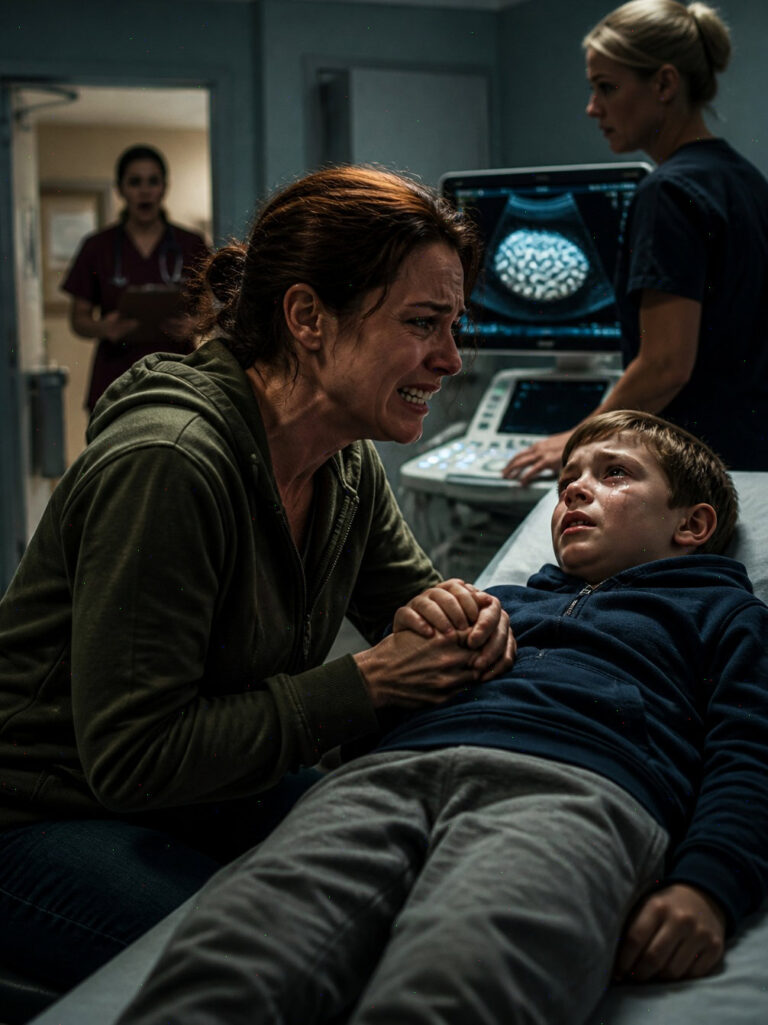
The doctor stared at my son’s ultrasound, went completely pale, and asked me the one question no mother ever wants to hear.
“Ma’am… is your husband here?”
For three weeks, my ten-year-old Daniel had been disappearing right in front of me. The basketball sat flat in the garage. The cartoons he loved got no reaction. He’d curl up on the couch with one arm across his stomach, face turned toward the cushions like he could hide the pain if he stayed quiet enough.
“Mom,” he whispered one night. “It hurts again.”
My husband Scott barely looked up from his phone. “You baby him too much.”
So I waited until Scott left for work. Grabbed my keys. Helped Daniel into his hoodie. Drove to a clinic across town — far enough that Scott would never think to look.
The doctor examined him. Ordered bloodwork. Then an ultrasound.
When the nurse opened the door, her voice was soft in the way that means nothing is soft anymore.
The doctor was staring at the scan. Not confused. Afraid.
Then he looked at me and asked who had been alone with Daniel these past few weeks.
Daniel’s hand started trembling in mine.
And I realized — he wasn’t just sick.
He was protecting someone with his silence.
Part 2: The Boy Who Stopped Being Himself
Daniel Carter was not a quiet child by nature.
He was the kind of kid who made a house feel too small — running down the hallway in socks at 7 AM, bouncing a basketball in the kitchen, building couch-cushion forts of breathtaking architectural ambition. He laughed loudly at cartoons he had already seen three times. He asked questions that had no clean answers and expected you to try anyway.
For the first six years of his life, it was just the two of us — Daniel and me, Emily Carter, in a small apartment in Columbus. When I met Scott, Daniel was four. Scott was charming in those early years. Patient, even. He taught Daniel to throw a spiral, bought him his first real basketball, and said all the right things about becoming a family.
So I married him.
I believed him.
And for a while, I told myself I hadn’t been wrong to.
But homes reveal people over time in ways that dates and early courtship cannot. The patience Scott had performed gradually compressed into irritation. The warmth thinned. He corrected Daniel constantly — his posture, his laugh, the way he held his fork — with the particular contempt of a man who had decided that a child’s natural energy was a character flaw requiring correction.
“You let him get away with everything,” Scott told me regularly. “That’s why he acts like this.”
The stomach aches started in early October.
First, a mild complaint after dinner one evening — Daniel pressed his hand to his middle and winced. I gave him a heating pad and sat with him until he fell asleep.
Then nausea. Then a loss of appetite that widened like a crack in a wall — slow enough that you keep telling yourself it’ll stop, until one morning you notice the crack has reached the ceiling.
Daniel stopped asking for Saturday pancakes. He left half a birthday cake on his plate — Daniel, who had once eaten three slices and asked if there was more. He moved through the house more carefully, always with one hand trailing along the wall, like he was no longer fully certain of the floor beneath him.
I watched all of this and I told myself: virus. School bug. Too much screen time. I told myself the story that kept the fear at a manageable distance.
But the morning Daniel bent to pick up a toy truck and grabbed the coffee table like the room had tilted — that was the morning I stopped telling myself stories.
I told Scott that night. I told him clearly: something is wrong with Daniel.
Scott didn’t look up from his phone.
“He’s fine. You’re projecting.”
“He can barely walk across the room without bracing himself.”
“Because you’ve taught him that performing weakness gets your attention.”
I stared at my husband for a long moment.
Then I went to Daniel’s room.
He was sitting on the edge of his bed in the dark, sweating through his pajamas, jaw clenched against something I could now see was real physical pain — not performed, not exaggerated, not the calculated manipulation of a child angling for attention.
“Mom,” he said, and his voice was so small I barely recognized it. “Please help me.”
I smoothed his hair. I told him it would be okay.
I waited until Scott left for work the next morning.
Then I grabbed my keys, helped Daniel into his hoodie, and said we were going for a drive.
He didn’t ask where.
That silence frightened me almost as much as the pain.
Part 3: The Clinic, the Scan, and the Secret He Had Been Carrying Alone
I chose the clinic deliberately — a small, quiet practice tucked between a pharmacy and a dentist’s office on the far side of Columbus. Far enough from our neighborhood that Scott would have no reason to know we’d been there.
The doctor who examined Daniel was a calm, methodical man named Dr. Reeves. He worked through the exam without rushing, asking Daniel easy questions in an easy tone, touching his abdomen gently and watching his face the whole time. Daniel tried to be brave. He always tried to be brave.
Dr. Reeves ordered bloodwork. Then an ultrasound.
The waiting room clock was the loudest thing in the world.
Daniel lay on the exam table with his hand over his stomach, staring at the ceiling, and I sat beside him and smoothed his hair and pretended that my hands were not shaking.
The nurse came to the door.
“Mrs. Carter. The doctor needs you now.”
In Dr. Reeves’ office, the ultrasound image was already pulled up on the monitor. He was staring at it when we walked in. Not with the distracted focus of a doctor processing routine results — with the taut, controlled expression of someone who has found something that demands careful handling.
He looked at me. Then at Daniel. Then at me again.
He asked, in a lowered voice, who had been alone with Daniel over the past several weeks.
The question landed wrong. It was specific in a way that neutral medical questions are not.
I felt something shift in the room.
I looked at Daniel.
Daniel was looking at the floor.
“Before I explain what we found,” Dr. Reeves said carefully, “I need to ask — is your husband with you today?”
“No,” I said. “Why?”
He turned the monitor toward us.
In the gray, grainy image, there was a bright white cluster of small spheres — stark and unnatural against the soft tissue surrounding them, arranged in a twisted, irregular ring.
“What is that?” My voice barely worked.
“High-powered neodymium magnets,” Dr. Reeves said. His tone was grim and precise. “Desk toys — the small silver spherical kind. When a child swallows one, it typically passes. But when multiple magnets are swallowed at separate intervals, they travel through different sections of the digestive tract and find each other through the intestinal walls. They attract across the tissue and pinch it closed.”
He paused.
“The bowel tissue between them is dying. He needs emergency surgery. Today.”
My heart was hammering. My ears were ringing.
Scott had a set of silver magnetic spheres on his home office desk. He counted them obsessively, snapped them into geometric shapes, called them his stress relievers. He kept them in a small wooden bowl next to his keyboard and became visibly irritated if anyone touched them.
I knelt in front of Daniel. I cupped his face.
“Daniel. Baby. Look at me.”
He opened his eyes. They were wide and swimming.
“Did you swallow Scott’s magnets?”
Daniel shook his head frantically. “I didn’t eat them, Mom. I swear.”
“Then how did they get inside you?”
Daniel squeezed his eyes shut. His entire small body began to shake.
“He made me,” he whispered.
The silence in the clinic was total.
“He said it was a test,” Daniel cried, the words coming out in a broken, rushing torrent, like something that had been held under pressure for weeks finally giving way. “When I broke the garage window with my basketball — he took me inside and made me swallow three of them. He said if I cried, I was weak. And then last week when I forgot to take out the trash — he made me swallow two more.”
I couldn’t breathe.
“Why didn’t you tell me, baby? Why didn’t you—”
“Because he said if I told you, he would put them in your food,” Daniel sobbed. “He said they would rip your stomach apart and it would be my fault.”
I stopped moving.
Every molecule of fear in me — the ambient, creeping dread of the past month — crystallized in a single second into something that was not fear at all.
It was clarity.
Dr. Reeves was already holding the clinic phone.
“Mrs. Carter,” he said quietly, “I am calling an ambulance to transfer him to City General for emergency surgery. As a mandated reporter, I am also required to contact the police.”
“Do it,” I said. “Call them. Tell them everything he just said.”
Part 4: The Arrest, the Surgery, and the Elevator Doors
The next three hours happened in the compressed, hyper-vivid way that extreme situations do — each moment too bright and too loud, then suddenly silent, then moving too fast.
The ambulance came. They rushed Daniel straight into the surgical wing at City General. Before the anesthesiologist asked me to step back, I held Daniel’s hand and made him a promise.
“He will never come near you again,” I said. “I promise you that on everything I have.”
Daniel looked at me for a long moment. Then he nodded, and the tension in his face — the tightness that had lived there for a month — softened slightly.
They took him through the double doors.
I sat in the surgical waiting room and gave my full statement to two detectives — Detective Harris, a tall, methodical woman who wrote everything down twice, and her partner, Detective Ngozi, who said very little but missed nothing.
I told them about the magnetic toys on Scott’s desk. The systematic dismissiveness. The month of stomach aches. The progressive silence from a child who used to fill every room with noise.
Forty minutes into my statement, my phone buzzed.
Scott.
Detective Harris looked at me. “Answer it. Speaker.”
I swiped the screen.
“Where the hell are you?” Scott’s voice was tight and controlled — the particular anger of a man who had come home expecting his world to be in its assigned position and found it had moved without his permission. “I came home for lunch. The house is locked. Your car is gone.”
“Daniel was in pain,” I said. My own voice surprised me — it was completely calm. “I took him to the hospital. City General. Pediatric surgery on the third floor.”
“Unbelievable.” The contempt in his voice was as comfortable and automatic as breathing. “You are so hysterical. You coddle him constantly. I’m coming down there right now and we are putting an end to this.”
He hung up.
Detective Harris stood, adjusted her radio, and looked at her partner.
“Let him come,” she said.
Twenty-three minutes later, the elevator at the end of the corridor slid open.
Scott walked out in his work suit — charcoal grey, perfectly pressed, a man who had taken the time to look composed before arriving at the hospital where his son was in emergency surgery. His jaw was set in that expression I had spent three years learning to read: arrogant, impatient, certain that whatever was happening was an inconvenience he would quickly resolve.
He spotted me and crossed the waiting room with the stride of a man who had never once doubted that the room belonged to him.
“Do you have any idea how much I had to cancel?” he said. “Where is he? What story did he tell the doctors to get out of school?”
I stood.
I did not back up.
I stepped directly into his space.
“He didn’t tell a story, Scott,” I said quietly. “He told them about the magnets.”
The mask slipped. It was a fraction of a second — so fast that if I hadn’t been watching for it, I might have missed it. His eyes darted to the exit. His jaw tightened in a completely different way.
“I don’t know what you’re talking about,” he said. “The kid lies. You know he lies.”
“He doesn’t lie,” Detective Harris said, stepping out from the alcove to his left, flanked by two uniformed officers.
Scott turned fast.
“Whoa — officers, this is a misunderstanding. My wife is emotionally unstable. My stepson has a history of behavioral—”
“You’re under arrest,” Harris said, and the handcuffs were on his wrists with the efficient finality of someone who had done this thousands of times and felt the particular satisfaction of doing it correctly. “Felony child abuse. Aggravated assault causing serious bodily harm. Reckless endangerment of a minor. We have a warrant executing at your residence right now for the remaining magnetic toys.”
Scott’s composure fell apart completely. The polished, certain man who had spent three years telling me I was hysterical was gone — replaced by something pale and desperate and small.
As the officers walked him toward the elevator, he turned back.
“Emily,” he said, and his voice had changed entirely — pleading now, stripped of the performance. “Tell them it was an accident. Tell them you misunderstood—”
The elevator doors were already moving.
“You were wrong about one thing, Scott,” I said.
He looked at me through the narrowing gap.
“I don’t panic,” I said. “And I don’t baby him.”
The doors closed.
“I protect him.”
Conclusion: The Sound That Undid Me Completely
The surgery lasted four hours and seventeen minutes.
Dr. Reeves came out still in his scrubs and told me they had removed six inches of Daniel’s necrotic intestine and retrieved all five magnets. The bowel had been on the edge — another day or two, he told me carefully, and the outcome would have been very different.
“He’s going to be okay,” he said.
I sat back down in the plastic chair and put my face in my hands and stayed there for a while.
When Daniel woke up in recovery, his eyes immediately swept the room in a fast, panicked arc — the reflex of a child who had spent a month bracing for something.
“Mom?”
“Right here.”
“Where is he?”
“He’s in jail, Daniel,” I said. “He’s not coming home. He’s never coming near us again.”
Daniel closed his eyes. And for the first time in a month — the first time in longer than that, I think — the tension left his face completely. His body went soft against the mattress.
He smiled.
It was small and tired and the most beautiful thing I had ever seen.
The weeks that followed were hard in the specific way that the aftermath of survival is hard — not the sharp, adrenaline-edge of crisis, but the slower, more demanding work of rebuilding. There was a hospital stay, then a discharge with dietary restrictions and follow-up appointments. There was a divorce attorney, and then the divorce itself. There was a child psychologist named Dr. Okafor who had a gift for making ten-year-old boys feel like their feelings were normal and their bravery was real.
There was an apartment — smaller than the house, on a quieter street, with a good-sized hallway and a kitchen where I could hang Daniel’s drawings on the refrigerator without asking anyone’s permission.
Scott’s trial moved through the system over the following eight months. The desk toy manufacturer’s forensic analysis confirmed the magnets matched his set. Daniel testified in a closed session with a victim advocate beside him. Dr. Reeves provided expert testimony about the mechanism of injury and the level of deliberate intent required to force a child to swallow objects at separate intervals over multiple weeks.
Scott received fourteen years.
On the morning the verdict was read, I was not in the courtroom.
I was at Daniel’s school, watching him play pickup basketball at recess through a chain-link fence. He moved fast and careless and loud — elbowing for position, arguing a foul call with passionate inaccuracy, laughing when he missed a shot.
Alive. Completely, carelessly, beautifully alive.
Six months after we moved into the apartment, I came home from the grocery store and turned my key in the lock and stepped into the hallway.
And I heard it.
Socks on hardwood. The irregular, percussive thump of a basketball being bounced without regard for the neighbors below us or the lamp on the side table.
I set down the grocery bags.
I stood in the doorway of my own hallway.
And I leaned against the wall and I closed my eyes and I listened to my ten-year-old son filling that apartment up with everything he had — all the noise and mess and careless, glorious aliveness of a child who had decided, somewhere in the long road between that clinic and this moment, that it was safe to take up space again.
I don’t know how long I stood there.
Long enough.

Evan Cole Editor-in-Chief | Breaking News & Public Policy
“From Washington to Wall Street, and Main Street to Hollywood—Evan Cole connects the dots.”
As the Editor-in-Chief at Newskilo, Evan leads a dynamic team of journalists dedicated to uncovering the truth behind the headlines. With over 15 years in digital media, Evan has a reputation for cutting through the noise.
While he is widely recognized for his deep analysis of U.S. fiscal policy (IRS & Stimulus), Evan’s expertise extends to global current events, corporate accountability, and cultural trends. Whether he is breaking down a complex government bill, exposing a tech giant’s failure, or analyzing the societal impact of a viral celebrity moment, Evan’s goal is simple: To tell the stories that shape our world with clarity, accuracy, and integrity.
Leave a Reply