
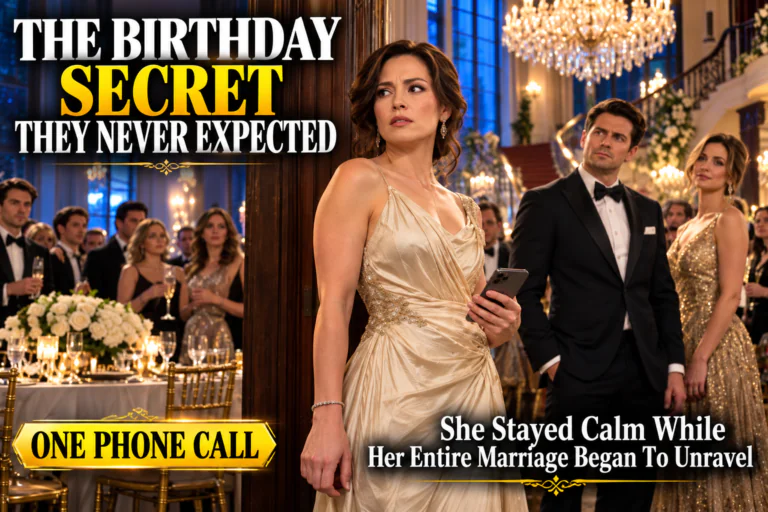
I was standing beneath a chandelier at my thirty-fourth birthday party when I realized I had spent eleven years protecting the wrong person.
Fifty people were in the ballroom. My husband was beside me. His friend was standing nearby in an expensive dress that had just been splashed with sparkling water.
It should have been an awkward moment.
Instead, it became the moment my entire understanding of my marriage changed.
The strange thing is, I don’t remember the cake.
I don’t remember the flowers.
I barely remember what anyone was wearing.
I remember the chandelier.
It had six rows of crystal pieces hanging above the center of the ballroom, catching the warm light and scattering it across the tables.
For some reason, while everyone was staring at me, I kept looking up.
Maybe my mind needed somewhere else to go.
My name was printed on small gold cards beside every plate.
Claire Vince.
Thirty-four.
Isaac Vince’s wife.
That was how most people in that room knew me.
Very few knew me as Claire Hart, the daughter of Daniel and Evelyn Hart.
Even fewer remembered that I had once been part of a family where five older brothers would have done almost anything to make sure I was okay.
I had spent eleven years keeping those brothers at a distance.
I thought I was protecting my marriage.
That night, I finally understood that I had been protecting the person who had made me believe I needed the distance.
It started with something incredibly ordinary.
A waiter moved behind me while carrying a tray.
His arm brushed mine.
My glass tipped.
Sparkling water spilled across Celeste Morgan’s champagne-colored dress.
I immediately apologized.
“I’m so sorry. It was an accident.”
Celeste looked down at the dress.
Then she looked at Isaac.
She didn’t need to say anything.
I watched my husband’s expression change.
The pleasant smile he had been wearing for guests disappeared.
“You did that deliberately.”
I stared at him.
“What?”
“You heard me.”
“Isaac, I didn’t. The waiter bumped me.”
He stepped closer.
The conversations around us slowly stopped.
People began watching.
Someone lowered a glass.
Someone else quietly moved a chair.
I could see the birthday cake across the room.
Three tiers.
White frosting.
Thirty-four small gold candles.
My mother used to say birthdays were reminders that we had made it through another year.
Standing there, I wondered what she would have thought of that particular year.
Isaac told me I had embarrassed him.
Celeste folded her arms and quietly said I had always been careless.
That was when I looked at her properly.
There wasn’t much anger in her face.
There was satisfaction.
Something inside me went completely still.
For years, I had explained away little moments like this.
I told myself Isaac was stressed.
I told myself he was under pressure.
I told myself my brothers were probably right about him being controlling, but I refused to believe they understood my marriage better than I did.
Then Isaac reached for my arm and pulled me away from the center of the room.
Nobody stepped in.
Some guests looked away.
Others watched silently.
And suddenly I remembered something my oldest brother Marcus had told me eleven years earlier.
“If you ever need us, Claire, don’t call because you’re angry. Call because you’re ready.”
I hadn’t understood him at the time.
I understood him now.
When the moment finally ended, Isaac seemed to expect me to cry.
He expected an apology.
He expected me to explain myself.
Instead, I walked to a nearby table and picked up my phone.
“What are you doing?” he asked.
I didn’t answer.
There were five names in my phone I hadn’t called in eleven years.
Five brothers.
Five people I had deliberately kept out of my marriage.
I pressed Marcus’s name.
He answered almost immediately.
“Claire?”
I closed my eyes.
“My brothers,” I said quietly. “It’s time.”
There was a pause.
Then his voice became serious.
“Where are you?”
“At the Vince mansion.”
Another pause.
“Are you safe?”
I looked around the ballroom.
“No.”
His response came immediately.
“Stay where you are.”
One by one, my other four brothers joined the call.
Five voices.
Five men who hadn’t heard me ask for help in more than a decade.
And when I finally said, “I need you to come,” none of them asked me to explain.
They simply said they were coming.
What I didn’t know was that they had been waiting all those years without giving up on me.
Eleven Years Earlier
My family was never ordinary.
My father, Daniel Hart, built the family business from one warehouse near the river.
My mother, Evelyn, handled the accounts and made sure all six of us understood the same lesson:
Money could disappear.
Responsibility stayed.
By the time I was in my twenties, my brothers were already involved in different parts of the business.
Marcus handled construction and property.
Ethan worked in transportation.
Julian managed finance.
Noah ran the family foundation.
Gabriel handled technology and security.
And I was the only daughter.
I was also the only one who wanted nothing to do with the family business.
I wanted something simple.
A small home.
A quiet marriage.
Maybe children.
Maybe a garden.
I wanted to build a life where nobody knew my last name before they knew me.
Then I met Isaac.
He was charming.
He remembered small things.
He knew which restaurants made me uncomfortable.
He remembered that I liked old bookstores.
He noticed when I was nervous and knew exactly what to say.
I fell for him.
My brothers didn’t.
At first, I thought they were simply being protective.
Later, I realized they had noticed things I hadn’t.
Isaac asked a lot of questions about my family.
At first, they sounded innocent.
How valuable was the old warehouse?
How many properties did Marcus manage?
Who handled the family trust?
What had Dad left each of us?
I answered a few questions.
Then I stopped.
My brothers warned me.
I married Isaac anyway.
For a while, I was happy.
Then little changes began.
Isaac never directly told me to stop seeing my family.
He didn’t have to.
He said things like:
“They don’t respect our marriage.”
“They still treat you like a child.”
“They’ll never accept that you’re capable of making your own decisions.”
I defended my brothers.
Then I started skipping family dinners.
Then holidays.
Then phone calls.
Eventually, I changed my number.
That decision still hurts when I think about it.
My brothers had never abandoned me.
I had simply allowed my husband to convince me that the people who loved me were a threat to our marriage.
For eleven years, I believed the distance made us stronger.
That night, I realized the distance had only made Isaac more comfortable.
Five Cars at the Gate
The first car arrived twenty-three minutes after my call.
Then another.
Then another.
Guests began whispering.
Isaac looked toward the windows.
“Who did you call?”
I said nothing.
A security guard entered the ballroom.
“Mr. Vince, there are vehicles at the front gate.”
“How many?”
The guard hesitated.
“Five.”
Isaac looked at me.
The room became strangely quiet.
Then the lights went out.
A few people gasped.
The emergency lights came on moments later.
Five men stood near the entrance.
Marcus.
Ethan.
Julian.
Noah.
Gabriel.
My brothers.
They didn’t make a dramatic entrance.
They didn’t need to.
Marcus looked directly at Isaac.
“You don’t understand Claire.”
Isaac tried to laugh.
It didn’t sound convincing.
Julian walked to a nearby table and placed a thin folder on it.
“We need to talk.”
Isaac stared at the folder.
“What is that?”
Julian looked at me.
“Claire, do you want to tell him?”
I couldn’t answer.
Because I noticed something on the first page.
My signature.
The document was eleven years old.
I stared at it.
“I never signed this.”
Julian’s expression changed.
“That’s what we thought.”
The Paperwork I Was Never Supposed to See
The document concerned the financial arrangement my father had established before my wedding.
I knew Dad had placed part of my inheritance into a family trust.
I had always assumed it was modest.
I never asked for details.
I wanted to prove that I could build my own life without relying on my family.
Julian turned another page.
My father’s trust included several properties, investment accounts, and an ownership interest in one of the family’s companies.
I looked at Isaac.
He wouldn’t meet my eyes.
“You knew about this?”
He hesitated.
“I knew there was a trust.”
“How much did you know?”
He didn’t answer.
Marcus stepped forward.
“You knew enough.”
Isaac immediately objected.
But Gabriel had records.
Emails.
Business documents.
Messages.
Financial requests.
They weren’t accusations pulled from thin air.
They were records that needed to be examined properly.
My brothers had discovered that Isaac had been trying to gain influence over assets that were legally mine.
Then Julian explained something I hadn’t known.
Dad had anticipated that someone might someday try to interfere with my financial independence.
He had placed safeguards into the trust.
If anyone attempted to gain control through deception, pressure, or improper financial arrangements, the trust could be protected from outside access.
I looked at Isaac.
“You’ve been trying to get control of it.”
He said nothing.
That silence told me more than any explanation could have.
Then Celeste stepped forward.
“This is ridiculous.”
I looked at her.
She suddenly seemed much less confident.
“You don’t understand what happened,” she said.
“Then explain it.”
She hesitated.
Isaac finally told her to stop.
Celeste looked at him.
“You told me everything would be yours.”
Nobody spoke.
That sentence changed the room.
For the first time, I understood that whatever had existed between Isaac and Celeste had been built around promises involving a future he didn’t actually own.
Then Gabriel showed me another file.
A recorded conversation from months earlier.
Isaac’s voice.
Celeste’s voice.
My name.
They were discussing ways to gradually gain access to assets connected to my trust.
I stopped the recording.
My hands were cold.
Isaac stepped toward me.
“Claire, listen.”
“No.”
My voice was calmer than I expected.
“I listened to you for eleven years.”
He tried to explain.
I raised my hand.
“You told me my brothers wanted my money.”
He said nothing.
“They never asked me for a dollar.”
Silence.
“You told me they wanted to control my life.”
Again, silence.
“They didn’t.”
My brothers remained quiet.
That mattered.
They weren’t telling me what decision to make.
They weren’t ordering me to leave.
They were simply standing there while I finally saw the situation clearly.
Then Gabriel showed me something else.
Some business paperwork contained digital versions of my signature.
One document had been dated while I was overseas.
I had never signed it.
Isaac tried to explain that he had been trying to protect the company.
But he had used my name without my permission.
I looked at him.
“You used my name.”
“I was going to fix it.”
“You used my name.”
He lowered his head.
That was the moment I realized my brothers hadn’t come because of an argument at my birthday party.
They had come because they had discovered something much bigger.
I turned to Marcus.
“What happens now?”
He answered simply.
“You decide.”
That frightened me more than anything else.
For eleven years, someone else had slowly made decisions for me.
Now I had to make my own.
I looked at Isaac.
Then at my brothers.
“I want my life back.”
Marcus nodded.
“Then let’s start there.”
Going Home
We left before midnight.
Not because anyone had won.
Not because I had forgiven Isaac.
I was simply exhausted.
We drove to my childhood home.
I hadn’t been there in eleven years.
The house seemed smaller than I remembered.
The hallway looked narrower.
The old oak tree in the yard seemed enormous.
Inside, everything was still there.
Family photographs.
The old piano.
The hallway clock.
Even a small ceramic bird I had accidentally broken when I was nine.
I started laughing when I saw it.
Gabriel reminded me that I had cried over that bird for three days.
“I was nine.”
“You said it was your best friend.”
“It was.”
For the first time that night, I laughed without forcing it.
We gathered in the kitchen.
Marcus made coffee.
Ethan complained about the refrigerator.
Noah found an old box of photographs.
Julian reviewed the paperwork.
Gabriel worked quietly on his laptop.
It felt normal.
And I realized how much I had missed normal.
Eventually, I asked Marcus the question I had been carrying for years.
“Why did you let me go?”
He looked at me.
“We didn’t.”
“But I left.”
“Yes.”
“And you didn’t stop me.”
“You told us you were happy.”
“I wasn’t.”
“We didn’t know that.”
I looked down.
Marcus continued.
“If we’d forced you home, you might have spent the next decade believing we were responsible for your marriage ending.”
That stayed with me.
He was right.
I had needed to make the decision myself.
Even if it took eleven years.
Choosing Myself
The next morning, my brothers showed me the information they had collected.
There were financial records, property documents, business messages, and other paperwork that needed professional review.
One message stood out.
It said:
“Claire trusts nobody outside the family. Keep her isolated.”
I read it twice.
Then I put it down.
“What happens to Isaac?”
Julian answered carefully.
“That depends on what you want.”
I looked at Marcus.
“You could destroy him.”
Marcus shook his head.
“We can document what happened and let the appropriate professionals handle the consequences.”
I thought about that.
For years, I had believed strength meant having powerful people behind me.
I was beginning to understand that real strength was different.
It was being able to stand in front of a difficult decision and make it yourself.
“I want everything documented.”
Julian nodded.
“I want my accounts separated.”
“Already underway.”
“I want my name removed from anything I didn’t authorize.”
“Already being handled.”
“And I want to speak with Isaac.”
Marcus studied me.
“Are you sure?”
“Yes.”
That afternoon, I returned to the mansion.
The ballroom had already been cleaned.
The flowers were gone.
The tables were empty.
Even my birthday cake was sitting in the refrigerator.
I stood there for a moment, then closed the door.
Isaac was waiting in the study.
He looked tired.
“I knew you’d come back.”
“I didn’t come back.”
His expression changed.
“I came for my belongings.”
He looked down.
I sat across from him.
“I want to ask you something.”
He nodded.
“Did you ever love me for me?”
He took a long time to answer.
“Yes.”
I believed him.
Then I asked another question.
“Did you also love what you thought I could give you?”
He looked away.
“Yes.”
That answer hurt.
But it was honest.
And after eleven years of confusion, honesty mattered.
I stood.
“Then we’re finished.”
He called my name.
“You’re really choosing your family?”
I turned toward him.
“No.”
He looked almost relieved.
Then I finished the sentence.
“I’m choosing myself.”
Eight Months Later
The separation process took eight months.
There were meetings.
Documents.
Financial reviews.
Legal questions.
Long conversations I never expected to have.
But there were also ordinary mornings.
I learned how I liked my coffee.
I started walking again.
I joined my mother’s old community garden.
And I bought a yellow chair for my apartment.
Isaac had always said yellow was childish.
It turned out I liked yellow.
A lot.
My brothers didn’t suddenly take over my life.
They simply became part of it again.
Marcus called every Sunday.
Ethan sent photographs of questionable meals.
Julian taught me how to understand financial statements.
Noah invited me to help with the family foundation.
Gabriel sent me technology recommendations I rarely understood.
Sometimes they annoyed me.
Sometimes we argued.
Sometimes I wanted to hang up on all five of them.
It felt wonderful.
It felt like family again.
Then, several months into the separation, Celeste asked to meet me.
We sat in a quiet café.
She apologized for that night.
She explained that Isaac had told her our marriage was already finished.
He had convinced her that my family was controlling me.
She admitted she believed him partly because she wanted to believe him.
I respected the honesty.
Before we left, she gave me an envelope.
Inside was a letter written by my father.
I recognized his handwriting immediately.
I had never seen the letter before.
It said something I desperately needed to hear.
My father hadn’t wanted my brothers to control me.
He wanted them to protect my ability to choose.
There was a difference.
He had written that I could leave the family business.
I could marry whoever I wanted.
I could build a life anywhere.
But he didn’t want me to confuse independence with isolation.
One sentence stayed with me:
Family is not a cage when the door is open.
I took the letter home.
My brothers were stunned when they saw it.
Then Marcus opened a drawer.
Inside was another letter from Dad.
Ethan had one.
Julian had one.
Noah had one.
Gabriel had one.
Five letters.
Five brothers.
The same message.
Protect Claire’s choices.
Don’t control them.
I cried that night.
Not because I was broken.
Because I finally understood what my family had been trying to give me all along.
A choice.
Building Something of My Own
I didn’t want Isaac’s money.
I wanted my name back.
There was a difference.
My brothers offered to manage the family assets with me.
I refused.
“I want to learn.”
Julian smiled.
“Good.”
For months, I studied.
I learned about investments, property management, contracts, business operations, and financial planning.
Something unexpected happened.
I discovered that I actually enjoyed it.
Not because of the money.
Because I liked understanding how decisions worked.
Eventually, I started helping Noah with the family foundation.
Then I proposed a new program.
I wanted to help women who had become financially disconnected from their own households.
Not by treating them as helpless.
By teaching them.
Financial education.
Access to professional resources.
Basic document review.
Questions to ask.
Things to understand before signing.
I called it The Open Door Project.
The first meeting had twelve women.
Some were nervous.
Some were embarrassed.
Some didn’t know where to begin.
I recognized that feeling.
I stood at the front of the room.
“My name is Claire Hart.”
It felt strange saying it.
Then it felt right.
“I spent eleven years believing independence meant doing everything alone.”
The room became quiet.
“I was wrong.”
One woman asked what changed.
I thought about the ballroom.
The phone.
My brothers.
My father’s letter.
Then I answered.
“My definition of family changed.”
The program grew.
We brought in financial counselors.
We connected people with legal professionals.
We held workshops.
We taught people how to understand documents and ask better questions about their own finances.
Sometimes someone would arrive with nothing but a folder and a phone number.
We started there.
One document.
One question.
One decision.
One step.
The Birthday That Became Something Else
Almost a year after that terrible birthday, my father’s old property near the river became available for renovation.
I had never known it belonged to my trust.
It had once been a neighborhood gathering place.
There were old photographs on the walls.
Community dinners.
School events.
Families sitting together.
My mother appeared in several of the pictures.
I knew immediately what I wanted to do.
We renovated the building.
Not into another luxury property.
Into a community center.
The Open Door Project moved there.
We created classrooms, financial counseling offices, a legal resource area, a small café, a children’s reading room, and a large meeting hall.
Above the entrance, we placed my father’s words:
Family is not a cage when the door is open.
The opening ceremony happened on my thirty-fifth birthday.
Birthdays had once made me uncomfortable.
Now I looked around the room and saw neighbors, counselors, teachers, families, small-business owners, and women who had attended our workshops.
I stood on the small stage.
“This building belonged to my father,” I said.
“But it was always meant to belong to people.”
Then I told them what I had learned.
My family didn’t rescue me.
I saved myself by finally accepting that I didn’t have to do everything alone.
My brothers didn’t make the decision for me.
They reminded me that I still had the right to make it.
That distinction mattered.
Later that evening, Gabriel handed me an envelope.
It was from Isaac.
The note was short.
He admitted that he hadn’t understood me.
He said he hoped someday I could forgive him.
I folded the paper.
Gabriel asked what I planned to do.
“I don’t know.”
And for the first time in my life, not knowing didn’t frighten me.
Some Doors Stay Closed
I never answered Isaac.
Not because I hated him.
Because forgiveness didn’t require another conversation.
Eventually, I heard that his marriage to Celeste had ended.
Months later, The Open Door Project received a large anonymous donation.
Gabriel investigated.
I told him not to.
He laughed.
“You’ve changed.”
“I know.”
The donation had come from Celeste.
She didn’t want recognition.
A week later, she visited the center.
We talked.
She admitted that she had once thought I was weak.
I told her I had thought the same thing about myself.
She said watching me leave without trying to destroy Isaac changed the way she understood strength.
I smiled.
“I took what belonged to me.”
She nodded.
“That’s what I finally understood.”
We didn’t become close friends.
We didn’t need to.
Some people belong in your life.
Some belong in your history.
And sometimes someone belongs in both places just long enough to teach you something.
One Year After That Night
I eventually returned to the old Vince mansion.
The property had been sold.
The ballroom had been renovated.
The chandelier was still there.
I stood beneath it for a moment.
I remembered everything.
The dress.
The water.
The silence.
My husband’s voice.
The phone call.
Five cars at the gate.
The documents.
My father’s letter.
Then I looked up.
The chandelier wasn’t watching me.
It had never been.
It had simply been there.
I smiled and walked away.
My thirty-sixth birthday was very different.
There was no mansion.
No ballroom.
No elaborate party.
Just my brothers, a few close friends, my mother’s recipes, and a cake Gabriel insisted was too small.
“There are eight people,” he complained.
“Then eat less.”
Everyone laughed.
Marcus lifted his glass.
“To Claire.”
I immediately groaned.
“No speeches.”
“Too late.”
He smiled.
“To the woman who finally called us.”
Everyone laughed.
I looked around the table.
Five brothers.
Five men I had once believed I had lost.
They had been there all along.
Not waiting to control me.
Not waiting to make my decisions.
Just waiting for the door to open.
I lifted my glass.
“To family.”
Then I added:
“And to making your own decisions.”
Our glasses touched.
Later, after everyone left, I stood in the kitchen.
My phone buzzed.
Marcus.
Love you, little sister.
Ethan sent another message about dessert.
Gabriel sent photographic evidence that the birthday cake really had been too small.
I laughed.
For years, I thought my story would always be defined by that birthday.
The ballroom.
The chandelier.
The embarrassment.
The phone call.
But a life is rarely defined by its worst evening.
It is defined by what comes afterward.
The Open Door Project eventually expanded into several cities.
Women walked through our doors carrying questions, paperwork, uncertainty, and sometimes nothing more than a phone number.
We helped them begin.
One document at a time.
One question at a time.
One decision at a time.
Whenever someone asked me how I found the courage to change my life, I never started with the mansion.
I never started with the chandelier.
I started with the phone.
Because that was the moment I stopped waiting for someone else to decide what happened next.
I had spent eleven years believing strength meant surviving alone.
It didn’t.
Strength was admitting I needed help.
Strength was listening when people who loved me tried to warn me.
Strength was accepting that mistakes didn’t have to become my identity.
And strength was understanding that forgiveness could exist without reopening a door that needed to stay closed.
Years later, the old Hart Community Hall became one of the busiest places in the neighborhood.
Children read in the library.
Families gathered for community dinners.
Small businesses held meetings.
Women attended workshops.
People walked in carrying questions and walked out with a plan.
Sometimes I would stand beneath my father’s sentence near the entrance.
Family is not a cage when the door is open.
Every time I read it, I understood it a little differently.
Family shouldn’t decide your life.
Love shouldn’t erase your voice.
Marriage shouldn’t require you to disappear.
And independence shouldn’t mean isolation.
One evening, as I was locking the front door, a young woman approached me.
“Are you Claire?”
“Yes.”
“I heard your story.”
I smiled.
“Which part?”
She gave a nervous laugh.
“The part where you finally called your brothers.”
She held out a folded piece of paper.
“I don’t know what to do.”
I looked at the paper.
Then I opened the door again.
“Come inside.”
She looked surprised.
“Are you sure?”
I smiled.
“Yes.”
She stepped through.
And I realized that was the real ending.
Not revenge.
Not victory.
Not watching someone else lose everything.
A door opening.
Someone walking through it.
A choice being returned to the person who had almost forgotten she was allowed to choose.
For eleven years, I thought I had closed the door to my family.
The truth was much simpler.
It had never been locked.
I had just forgotten that I was allowed to open it.
What do you think matters more in the end: proving you can stand alone, or knowing when to let the people who truly love you stand beside you?

Evan Cole Editor-in-Chief | Breaking News & Public Policy
“From Washington to Wall Street, and Main Street to Hollywood—Evan Cole connects the dots.”
As the Editor-in-Chief at Newskilo, Evan leads a dynamic team of journalists dedicated to uncovering the truth behind the headlines. With over 15 years in digital media, Evan has a reputation for cutting through the noise.
While he is widely recognized for his deep analysis of U.S. fiscal policy (IRS & Stimulus), Evan’s expertise extends to global current events, corporate accountability, and cultural trends. Whether he is breaking down a complex government bill, exposing a tech giant’s failure, or analyzing the societal impact of a viral celebrity moment, Evan’s goal is simple: To tell the stories that shape our world with clarity, accuracy, and integrity.
Leave a Reply