
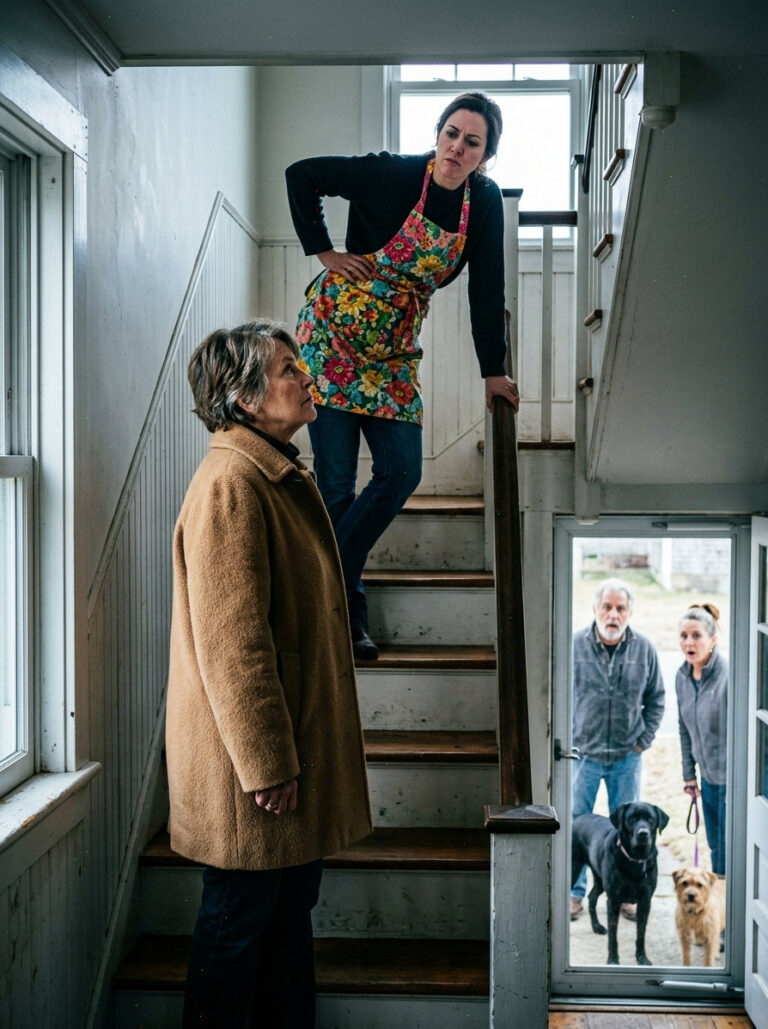
I had driven since dawn from Philadelphia, my spine stiff and my hands aching from gripping the wheel, dreaming only of the quiet reading corner in my beach house—but when the front door opened, my daughter-in-law stood there wearing my hand-stitched apron, smiled an icy smile, and said, “There’s no space for extra guests.”
At first, I thought the sharp January wind coming off the Atlantic had made me mishear her. But then I saw the three unfamiliar SUVs lined along the curb of my property. I saw the wet towels draped carelessly over my wicker chairs. I heard the thumping music from upstairs and the thundering footsteps of teenagers I didn’t even recognize tracking mud onto the runner I had scrubbed on my hands and knees just last spring.
Tiffany stood in the doorway of the house I had rebuilt board by board after my husband Winston died. Her dark bob was smooth as glass, her lip gloss shining too brightly for a gray winter afternoon. And tied around her narrow waist was my cream apron. The one with the tiny blue flowers I had hand-stitched during a snowstorm while Winston slept under morphine in the next room.
Part 2: The Needle, The Mortgage, and The Memory
That house was not a gift. No one had handed it to me after Winston died and said, “Rest now. You’ve earned this.” I built every secure thing in my life the hard way, and the house by the sea had been the hardest and most beloved of all. When Winston passed, I was fifty years old with bills, crushing grief, a teenage son, and a sewing machine that groaned every time I asked too much of it.
I took alterations from anyone who asked. Wedding hems. School uniforms. Bridesmaid dresses bought in the wrong size. I worked with cheap coffee at midnight, pins in my mouth, swollen fingers in February, and a ledger where every dollar mattered. Whatever survived after rent went into an envelope I kept inside a flour tin above the refrigerator. I called it my little piece of air. Twelve years later, that little piece of air became a half-rotted cottage on the Rhode Island coast with damp walls and salt in the window frames.
I painted walls until my shoulders burned. I ripped out moldy cupboards, patched plaster from YouTube videos, and sanded floors myself. I stitched my initials into the hems of the curtains because for the first time in my adult life, I owned something that belonged only to me. It was proof that after exhaustion and loneliness, I could still make a haven with my own hands. My son Peter knew this. He had helped me scrape paint from the porch railings. He knew this house was the place where I could still feel Winston near without drowning in his absence.
Part 3: The Cold Welcome
“I told Peter I’d be here today,” I said slowly, standing on the bottom step of my own porch.
Tiffany shrugged, leaning against the doorframe, blocking the entrance without appearing to do so. “He must have forgotten. He’s swamped at work. But we’ve already settled in. My family needed a reset. Honestly, Rosalind, there’s no room for extra guests.”
Extra guests. In my own house.
It was not panic. It was not a slip. It was a calculated message. Everyone inside had stopped moving. Tiffany’s sister sat up on the couch. Her mother closed a cabinet door. One of the teenage boys paused halfway down the stairs, staring at me with the avid look adolescents reserve for the first scent of adult scandal. They were all watching, waiting to see whether the old woman would cry, whether she would shout and embarrass herself, whether she would beg for a bed in her own home like some foolish sentimental widow.
I looked at the mud on the rug, the flattened rosemary by the broken pot, and finally at Tiffany’s pleased, polished face. “All right,” I said softly. I turned around, walked to my car, and drove to a cheap hotel three miles away.
Part 4: The Midnight Realization and The Side Window
I didn’t cry in that hotel room. Clarity filled me. The humiliation at the door had been too clean, too theatrical. Tiffany had not simply wanted the house for a weekend. She wanted me to understand that my own property had become, in her mind, negotiable.
The next morning, I drove back. The street was quieter. I walked up to the front door and slid my key into the lock. It didn’t fit. The lock had been changed.
I stepped back silently. I still had the small skeleton key for the side gate. I slipped into the narrow path between the house and the neighbor’s fence, crouching beneath the cracked kitchen window. Voices drifted out.
“I’m telling you,” Tiffany said to her mother. “Once the paperwork is filed, the rest is easy. By the time she realizes what’s happening, the conservatorship petition will already make her look unstable. Peter has examples. That time she forgot her charger and drove back to Philly without it. We don’t need much. Just enough to say she’s having memory problems.”
My vision narrowed. A conservatorship is a court-supervised process for transferring an incapacitated individual’s rights to someone capable of providing supervision regarding care or finances. They weren’t just taking a vacation. They were building a legal cage.
“The house is worth almost triple what she paid,” Tiffany continued. “Once the sale goes through, we can put her somewhere lovely. She’ll have a little room. She should be grateful.”
I crept through the mudroom door they had forgotten to change and went straight to the printer nook. There were four pages in the tray. A real estate listing packet. A luxury rental transition plan. And a Petition for Emergency Temporary Conservatorship of Rosalind Margaret Hale. Applicant: Peter Winston Hale, son.
Part 5: The Masterstroke Payoff
I didn’t scream. I didn’t confront them. I quietly folded the papers, slipped them into my camel coat, and walked back out the mudroom door.
I drove straight to the office of Winston’s old estate lawyer, a ruthless bulldog of a man named Arthur who owed me a favor for tailoring his daughter’s wedding dress overnight a decade ago. I placed the papers on his mahogany desk. Arthur read them, his face turning a dangerous shade of red.
“They want to claim you’re incompetent to manage the property,” Arthur said. “They need a judge to sign off on the emergency order to freeze your assets before you can defend yourself.”
“How do we stop them?” I asked.
“We don’t stop them,” Arthur smiled darkly. “We obliterate them. This house is solely in your name, Rosalind. They are currently trespassing.”
We spent the next four hours executing a legal masterclass. First, I legally transferred the deed of the beach house into an Irrevocable Trust. I named Arthur as the unyielding trustee, meaning I legally no longer owned the asset they were trying to steal—making the conservatorship petition entirely useless for seizing the property. Second, Arthur drafted an immediate, legally binding Cease and Desist, paired with a formal Eviction Notice citing illegal trespass and property damage.
But I wanted the final blow to be personal.
Three days later, Peter and Tiffany stood before a probate judge, armed with their pathetic file of “evidence” claiming my memory was failing. I walked into the courtroom looking sharper than I had in twenty years, wearing the exact camel coat I wore the day I bought the house. Arthur walked beside me.
When the judge asked Peter to explain why I needed an emergency conservator, Peter couldn’t look me in the eye. He mumbled about my “declining state.”
Arthur stood up. “Your Honor, Mrs. Hale is perfectly lucid. In fact, she is so legally astute that 72 hours ago, she transferred all her assets into an Irrevocable Trust. Furthermore, we have submitted Exhibit A: a timestamped audio recording from Mrs. Hale’s own kitchen security camera.”
I hadn’t just taken the papers from the printer. I had activated the indoor pet camera I used to check on the house during the winter. The courtroom speakers crackled to life, playing Tiffany’s exact words: “By the time she realizes what’s happening, the conservatorship petition will already make her look unstable… The house is worth almost triple what she paid.”
The color drained from Tiffany’s glossy face. Peter looked like he was going to be sick.
The judge didn’t just dismiss the petition; he threatened Peter with perjury and referred the case to the district attorney for attempted elder fraud.
As we walked out of the courthouse, Peter reached out to me, tears in his eyes. “Mom, please, I’m sorry. Tiffany pushed me—”
I stopped, looking at the boy who used to help me scrape paint off the porch railings. “You changed the locks, Peter. You let her wear my apron.”
I handed him the eviction notice. “You have 24 hours to get your extra guests out of my house.”

Evan Cole Editor-in-Chief | Breaking News & Public Policy
“From Washington to Wall Street, and Main Street to Hollywood—Evan Cole connects the dots.”
As the Editor-in-Chief at Newskilo, Evan leads a dynamic team of journalists dedicated to uncovering the truth behind the headlines. With over 15 years in digital media, Evan has a reputation for cutting through the noise.
While he is widely recognized for his deep analysis of U.S. fiscal policy (IRS & Stimulus), Evan’s expertise extends to global current events, corporate accountability, and cultural trends. Whether he is breaking down a complex government bill, exposing a tech giant’s failure, or analyzing the societal impact of a viral celebrity moment, Evan’s goal is simple: To tell the stories that shape our world with clarity, accuracy, and integrity.
Leave a Reply