
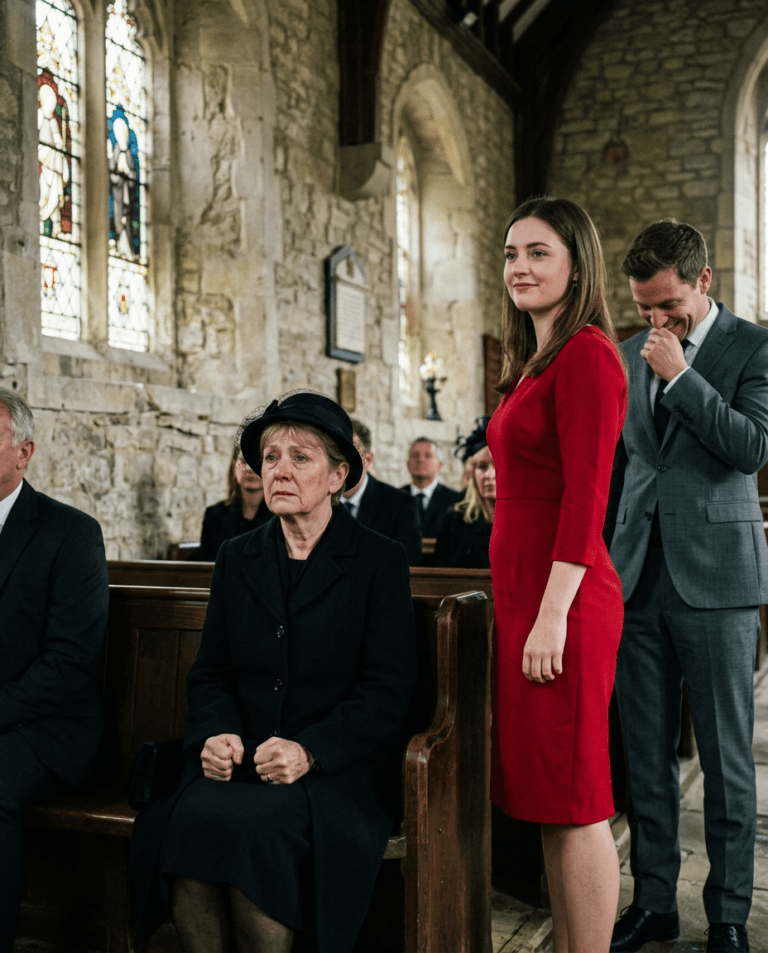
The church was silent when the doors swung open.
Not gently. Not slowly.
They hit the wall with a bang that echoed off every stone surface — and every head turned at once.
My son-in-law, Ethan Caldwell, walked in laughing.
Not a nervous laugh. Not the kind that escapes when grief becomes too much. A real, easy laugh — like a man arriving late to dinner with people he liked.
His suit was perfect. His hair was perfect. And on his arm was a woman in a red dress, scanning the pews with the casual curiosity of someone walking into a room she had already decided belonged to her.
The priest stopped mid-sentence.
Someone behind me whispered, “Is that—”
And then the woman in red passed my row.
She slowed. Looked down at me. And leaned close enough that I could smell her perfume — sharp, expensive, and completely wrong in that place.
“Looks like I won,” she whispered.
I felt something crack open in my chest.
My daughter was in that coffin. My Emily. Thirty-one years old, four months pregnant, and gone in the space of one ordinary Thursday afternoon.
I wanted to stand up. I wanted to take that woman by the arm and drag her back out those doors. I wanted to make a sound so raw it would shake the windows.
But I sat completely still.
I pressed both hands flat on my thighs, fixed my eyes on the casket, and breathed through my nose until the impulse passed.
Because Emily had taught me something — not with words, but with everything she endured in silence — that the loudest person in a room is rarely the most powerful one.
Part 2: What I Should Have Seen
Emily had come to me six weeks before she died.
It was the middle of July, still and hot outside, and she showed up at my door wearing a long-sleeved blouse. White linen, buttoned at the wrists.
I didn’t say anything right away. I put the kettle on. I set out two cups. I watched her wrap both hands around her mug even though it was 85 degrees outside.
“I’m fine, Mom,” she said, before I had asked a single question.
“I didn’t say you weren’t.”
She looked out the window toward the garden. That practiced smile — the one she had been wearing for two years — sat on her face like something she had ironed on that morning.
“Ethan is just stressed,” she said. “The business is going through a rough patch. Once the baby comes, things will settle.”
She was four months along. She talked about the nursery color she had picked — a pale sage green. She described the mobile she had ordered, little crescent moons that played a soft chime.
I listened. I smiled. And somewhere underneath the conversation, I felt dread moving like cold water through a pipe.
“Stay here,” I told her, when she got up to leave. “Just for a few days. You can rest. The baby can rest.”
She kissed my cheek.
“I’m fine,” she said again.
She was not fine.
I know that now the way you know things after it’s too late — with a certainty that sits in your bones and doesn’t move.
Three weeks after that visit, Emily collapsed at home. Ethan called the ambulance. By the time I reached the hospital, the nurses were speaking in the soft, careful way that means the news is already decided.
She never regained consciousness.
The baby — a girl, they told me — was delivered but did not survive.
Ethan cried in the hallway outside the ICU. He held my hand. He said all the things a grieving husband is supposed to say.
And I stood there holding his hand and thinking: where were you when she was wearing long sleeves in July?
Part 3: The Envelope
I learned about Michael Reeves the night before the funeral.
He had called my phone, introduced himself as Emily’s attorney, and asked if he could speak with me privately before the service.
We sat in a small office at the back of the funeral home — just the two of us, the hum of an air conditioner, and a folder he set on the table between us.
He told me Emily had come to him eight months ago.
She had come alone, paid his retainer in cash — money she had been setting aside in small amounts for over a year — and instructed him very clearly that if anything happened to her, the will was to be read publicly, at the funeral, before the burial.
“She was specific about the timing?” I asked.
“Precise,” he said.
He told me she had also provided him with documentation. Medical records. Photographs. Financial records that she had quietly gathered, photographed, and emailed to a private account Ethan didn’t know existed.
I thought about the long sleeves.
I thought about how many times she had said I’m fine in a voice that meant the opposite.
She had known, I realized. Not that she would die — but that if she did, no one would believe the truth unless she had already built the case herself.
My daughter had been quietly preparing her own defense for eight months while living with the man who made it necessary.
I cried in that small back office in a way I hadn’t been able to cry since the hospital. Not for her death — I had already done that. I cried because of how alone she must have felt. Because she hadn’t told me. Because I had let her get back in that car.
Michael handed me a tissue and waited.
Then he said, “She left a letter for you. Separate from the legal documents. I’ll give it to you after the reading.”
I nodded.
“She also wanted you to know one thing, directly from her,” he added.
He opened the folder and read a single handwritten line.
Tell Mom I wasn’t fine. But I wasn’t alone either. I was always paying attention.
Part 4: The Reading
The moment Michael stood up from the side aisle, the room changed.
I felt it before I fully understood it — a shift in the air, attention moving like a current toward the front of the church.
Ethan noticed him too. He sat up slightly. His arm stayed around the woman in red, but his jaw tightened.
When Michael reached the front and announced that the will would be read before the burial, a ripple moved through every pew.
Ethan scoffed.
“My wife didn’t have anything worth leaving,” he said, loud enough for the first three rows to hear. Confident. Dismissive. The voice of a man who had been unchallenged for so long he had forgotten that wasn’t a permanent condition.
The woman in red glanced at him and smiled.
Michael opened the envelope without looking at either of them.
He began with the financial provisions. Emily had, over fourteen months, moved a portion of marital assets — done carefully, legally, within her rights — into a separate trust. The trust was modest but deliberate. It covered the cost of the funeral in full, so that Ethan would not control a single detail of how she was buried.
A murmur moved through the room.
Then Michael read the beneficiary designations.
The house — a property that had belonged to Emily’s grandmother and been transferred to Emily by name, not jointly — was left to me, her mother, in full. Not to the estate. Not to Ethan. To me, by name, with a recorded deed that pre-dated the marriage and had never been altered.
Ethan’s scoff was gone.
He was leaning forward now. Both elbows on his knees.
Michael read the next provision.
Emily had submitted a formal written statement to the court — filed six weeks before her death, the same week she had visited me in the long-sleeved blouse — alleging a pattern of coercive control. The statement had been notarized, witnessed, and sealed pending the outcome of proceedings she had quietly initiated.
Those proceedings, Michael explained, had not concluded. But the filing meant that Ethan’s access to any shared marital estate was now subject to legal review, and that a copy of Emily’s complete documentation — photographs, medical records, financial records — had already been forwarded to both her family’s attorney and the relevant civil authority.
The woman in red was no longer smiling.
Ethan stood up.
“This is insane,” he said. “She never told me—”
“She wasn’t required to,” Michael said flatly.
The silence that followed was complete.
Every face in that room was turned toward Ethan Caldwell. The priest. The family. The friends who had sat in polite discomfort while he walked in laughing. They were all watching now.
He looked around the room as if he expected someone to back him up.
No one moved.
He sat back down.
Michael closed the envelope.
He walked to me and placed Emily’s personal letter in my hands.
I held it in both palms and looked down at her handwriting — slanted slightly to the left the way it always had been since she was a little girl learning cursive at the kitchen table.
I didn’t open it there.
I waited until I was outside, alone, with the afternoon light coming down through the trees.
The Thing She Needed Me to Know
Emily’s letter was three pages long.
I have read it more times than I can count. I will not share all of it here — it belongs to me, and to her, and to the daughter she was carrying who didn’t get the chance to know her.
But she ended it with one paragraph I carry everywhere.
She wrote:
I didn’t tell you everything because I was ashamed. Not of what he did — I knew, eventually, that wasn’t mine to carry. I was ashamed that I had stayed. That I had made excuses. That I had let time pass. But I want you to know I was never passive. I was building. Quietly, carefully, on my own terms. I was making sure that when it ended — one way or another — it ended with the truth already on the record. I was always paying attention. I just needed you to know that.
She was always paying attention.
That is the thing I come back to when the grief becomes too heavy to hold upright.
We talk about survival as if it only counts when you walk away. But sometimes survival looks like documentation. Like a sealed envelope given to a quiet lawyer. Like long sleeves and a practiced smile and a private email account and a statement filed six weeks before the end.
Sometimes survival looks like making sure the truth outlasts you.
Ethan Caldwell is currently under civil review. The woman in red did not stay long after the reading ended.
And on a Tuesday morning three months after the funeral, I received the deed to Emily’s grandmother’s house in my name.
I sat in the driveway and put my head on the steering wheel and wept.
Not from grief that time.
From something that felt, carefully and quietly, like my daughter keeping her word.

Evan Cole Editor-in-Chief | Breaking News & Public Policy
“From Washington to Wall Street, and Main Street to Hollywood—Evan Cole connects the dots.”
As the Editor-in-Chief at Newskilo, Evan leads a dynamic team of journalists dedicated to uncovering the truth behind the headlines. With over 15 years in digital media, Evan has a reputation for cutting through the noise.
While he is widely recognized for his deep analysis of U.S. fiscal policy (IRS & Stimulus), Evan’s expertise extends to global current events, corporate accountability, and cultural trends. Whether he is breaking down a complex government bill, exposing a tech giant’s failure, or analyzing the societal impact of a viral celebrity moment, Evan’s goal is simple: To tell the stories that shape our world with clarity, accuracy, and integrity.
Leave a Reply