
I was standing in a conference room in Phoenix, mid-sentence, when my phone buzzed the third time.
Emma’s name.
I excused myself and stepped into the hallway.
The line was quiet at first. Then her voice came through — small and shaking, like she was trying not to fall apart completely.
“Mom… Grandpa and Grandma made me leave.”
My back hit the wall.
“What do you mean, baby?”
“They put my suitcase outside,” she whispered. “And left me a note.”
I couldn’t breathe. “Where are you right now?”
“Mrs. Donnelly’s house. She saw me sitting on the porch.”
I told her not to move. I told her I was coming. And then I asked her to send me a photo of the note.
It came through thirty seconds later.
My mother’s handwriting. Neat. Calm. Written on one of her little floral recipe cards like it was a grocery list.
Pack your things and move out. We need the space. You’re not welcome here.
I read it three times.
Emma was fourteen years old. I had left her there for three days while I flew out for a work conference. No matter how complicated things had been between me and my parents over the years, I had never — not once — imagined they would do this to a child.
I called my mother immediately.
She picked up sounding irritated.
“I’m busy, Claire.”
“Did you throw my daughter out of the house?”
A pause.
“Don’t be dramatic. Tyler needed the room.”
I felt something cold move through me.
“My daughter is fourteen.”
“She’s old enough to stay with a friend,” she snapped. “Your sister is going through something. Family helps family.”
“Emma is family.”
Silence.
Then my father got on the line.
“Watch your tone,” he said. Flat. Confident. Like a man who had never once been told no. “We made a temporary adjustment.”
“You left her outside with a suitcase.”
“It’s just words,” he said. “You always overreact.”
And that was it.
That one sentence. That was the moment everything changed.
The panic left. The desperation left. Even the anger drained away — and what sat underneath all of it was something much quieter and much more dangerous.
Clarity.
I hung up. I called my lawyer. Then I called Daniel Mercer, an old colleague who now handled child welfare cases in Denver. By the time I boarded my flight home, Emma was safe at Mrs. Donnelly’s house, and I had copies of that note saved in four separate locations.
Then one more message arrived from my mother.
Don’t cause a scene. Tyler needs stability. Emma will survive one night somewhere else.
One night somewhere else.
I read it once. Set my phone face-down on the tray table. Stared at the clouds for a long time.
Part 2: The Night That Doesn’t Just Go Away
When the plane landed, I called Mrs. Donnelly first.
She was a sixty-three-year-old retired schoolteacher who had lived three doors down from my parents for over twenty years. She told me Emma had shown up on her porch with her suitcase and her backpack, sitting very still, not crying — just waiting.
“She didn’t want to bother anyone,” Mrs. Donnelly told me. “That’s what she said. She didn’t want to be a bother.”
I had to press the phone against my chest for a moment.
When I picked it back up, I asked how Emma was doing now.
“She ate two bowls of soup,” Mrs. Donnelly said. “She’s watching television. She keeps saying she’s fine.”
I knew what that meant. Emma had been saying she was fine since she was nine years old and her father walked out. She had learned very young that falling apart wasn’t something adults rewarded you for.
I grabbed my rental car and drove straight to Mrs. Donnelly’s house.
When Emma saw me walk through the door, she didn’t run to me. She just looked up from the couch, and something in her face — this tension she had been holding for hours — finally let go. Her chin wobbled. Her eyes filled up.
“I didn’t do anything wrong,” she said.
“I know, baby.”
“I asked Grandma why and she just walked back inside.”
I sat down next to her and held her for a long time without saying anything. Because there was nothing to say that would make it make sense. Some things don’t make sense. Some people love you only as far as their own comfort allows — and when you become inconvenient, they simply step over you.
Emma had just learned that lesson about her grandparents at fourteen years old.
And I had decided that lesson was going to cost them something.
That night, after Emma was asleep in my hotel room, I sat at the small desk by the window and opened my laptop. I pulled up documents I had been holding onto for two years. Property records. A will drafted in 2019. A separate agreement signed by my parents when they moved into a house — a house that, as it turned out, was not entirely theirs.
My grandfather had left that house to both my mother and to me in a shared trust. My parents had been living there for eleven years, and they had simply never told me that my name was on the deed.
I had found out by accident eighteen months earlier, during an unrelated conversation with an estate attorney. I had said nothing. I had filed the paperwork quietly. I had waited, not because I planned to use it — but because something in me had known this family’s kindness always came with a hidden ceiling.
Now I knew exactly how high that ceiling was.
Part 3: The Folder
My lawyer’s name was Patricia Osei. I had worked with her for six years. She was methodical, precise, and completely unmoved by emotion in a way I had always admired.
She called me the morning after I landed.
“You have full legal standing,” she said. “The trust document is airtight. Do you want to move forward?”
I looked across the hotel room at Emma, still asleep, her suitcase sitting open on the luggage rack.
“Yes,” I said.
Patricia prepared the documents that same day.
What they contained was straightforward. The house my parents lived in — the house they had occupied for eleven years, the house where they had decided my fourteen-year-old daughter was not welcome — was held in a trust that named both my mother and me as joint beneficiaries. My parents had no unilateral right to treat it as entirely their own. And based on the language of the original trust agreement, certain actions — including documented cases of child neglect or endangerment on the property — could trigger a clause that allowed me to petition for sole management of the asset.
Daniel Mercer had confirmed that leaving a minor outside on a doorstep with a note telling her she was unwelcome constituted neglect under the statute.
Mrs. Donnelly had agreed to provide a written statement.
The photo of the note — my mother’s neat handwriting on her little floral recipe card — had already been forwarded to Patricia’s office.
I printed everything at the hotel business center. I put it in a plain manila folder. I drove to Emma’s school to let the counselor know what had happened and arrange additional support. Then I drove to my parents’ house.
I did not call ahead.
Part 4: The Living Room
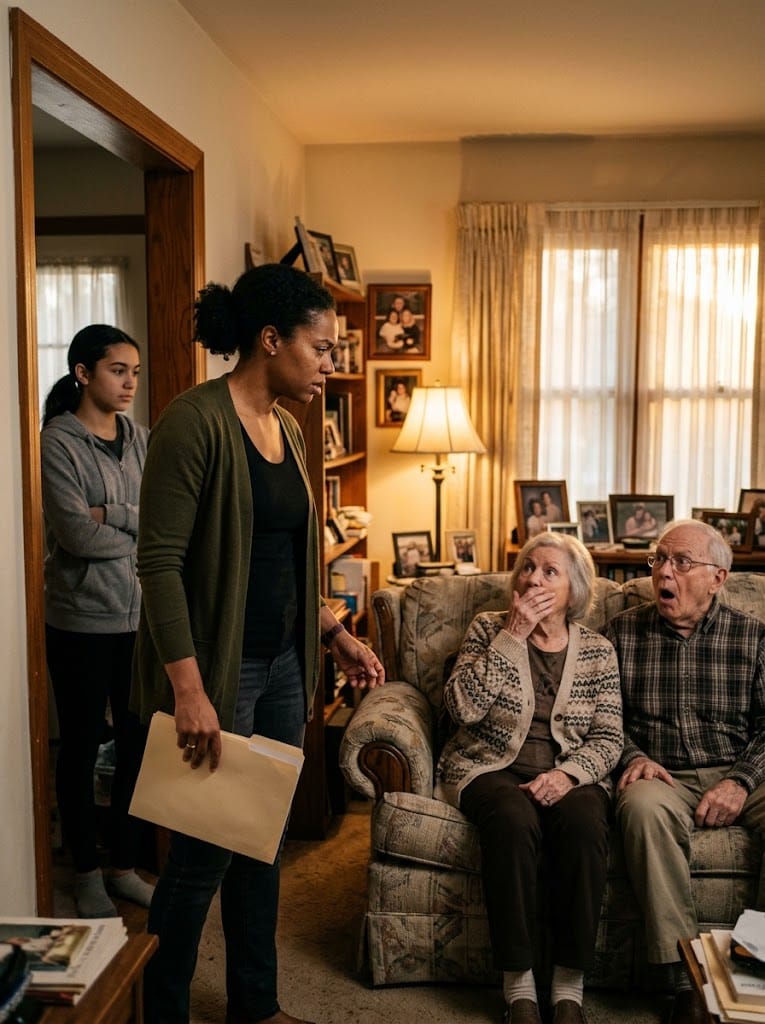
My mother opened the door and looked at me the way she always did when she expected an argument — chin lifted slightly, eyes already prepared to dismiss whatever I was about to say.
My father was in the armchair behind her.
Tyler was on the couch. Seventeen years old, earbuds in, pretending not to notice us.
Emma walked in behind me and stood near the door with her arms crossed, watching.
I didn’t say anything. I just walked to the coffee table and placed the folder down.
My mother looked at it the way you look at something you don’t understand yet.
“What is this?” she said.
“Read it.”
She picked it up. My father leaned forward to look over her shoulder.
I watched them read the first page.
I watched the slight furrow in my mother’s brow deepen into something else.
I watched my father’s posture change — the careful confidence he always carried slowly compressing into something smaller.
He was the one who spoke first.
“Wait,” he said. His voice was different now. Quieter. Almost careful. “What is this? How did you even—?”
“It’s the trust document,” I said. “Grandpa left the house to both Mom and me. You’ve been living here for eleven years without telling me my name was on it.”
My mother set the folder down.
“Claire,” she started.
“I’m not here to argue,” I said. “I’m here so you understand clearly what happened yesterday and what it means.”
My father flipped to the second page.
“This is the statement from Mrs. Donnelly,” I said. “This is the photograph of the note you left for Emma. And this—” I pointed to the third page “—is the clause in the trust agreement that’s now been triggered.”
The room was very quiet.
Tyler had taken his earbuds out.
My father looked up at me slowly. The man who had told me I always overreact. The man who had said it’s just words. He looked at me like he was seeing someone he didn’t quite recognize.
“You’re not actually going to—” he began.
“I’m not here to take the house,” I said. “I want you to understand that I could. I want you to understand that what you did to Emma has consequences. And I want you to understand that the next time she is in your home — if she is ever in your home again — she will be treated as family. Without conditions. Without convenience. Without a note on a recipe card.”
My mother’s eyes were wet.
My father said nothing.
I picked up the folder.
“Patricia will be in touch about the trust restructuring,” I said. “You’ll want to have your own attorney look at it.”
I turned around. Emma was still standing near the door, arms still crossed. But her chin was up.
We walked out together.
The Lesson That Cost Everything
I didn’t do what I did for revenge.
I did it because Emma needed to see that what happened to her was not normal. She needed to see that the people who dismissed her did not get to walk away from it without consequence. She needed to understand — at fourteen years old — that she was worth fighting for, even when the fight was hard and the people on the other side were family.
Some of the most painful lessons I have ever learned came wrapped in the word family. That word can be used to demand loyalty, silence complaints, and excuse behavior that would never be tolerated from a stranger.
But family is not a title that protects you from accountability.
Love without reliability is not love. It is convenience wearing love’s face — and the moment you become inconvenient, the mask comes off.
Emma knows that now. She also knows something more important.
She knows her mother walked through that door with a folder and did not shake.
That is the thing I hope she carries with her long after she forgets the rest.

Evan Cole Editor-in-Chief | Breaking News & Public Policy
“From Washington to Wall Street, and Main Street to Hollywood—Evan Cole connects the dots.”
As the Editor-in-Chief at Newskilo, Evan leads a dynamic team of journalists dedicated to uncovering the truth behind the headlines. With over 15 years in digital media, Evan has a reputation for cutting through the noise.
While he is widely recognized for his deep analysis of U.S. fiscal policy (IRS & Stimulus), Evan’s expertise extends to global current events, corporate accountability, and cultural trends. Whether he is breaking down a complex government bill, exposing a tech giant’s failure, or analyzing the societal impact of a viral celebrity moment, Evan’s goal is simple: To tell the stories that shape our world with clarity, accuracy, and integrity.
Leave a Reply