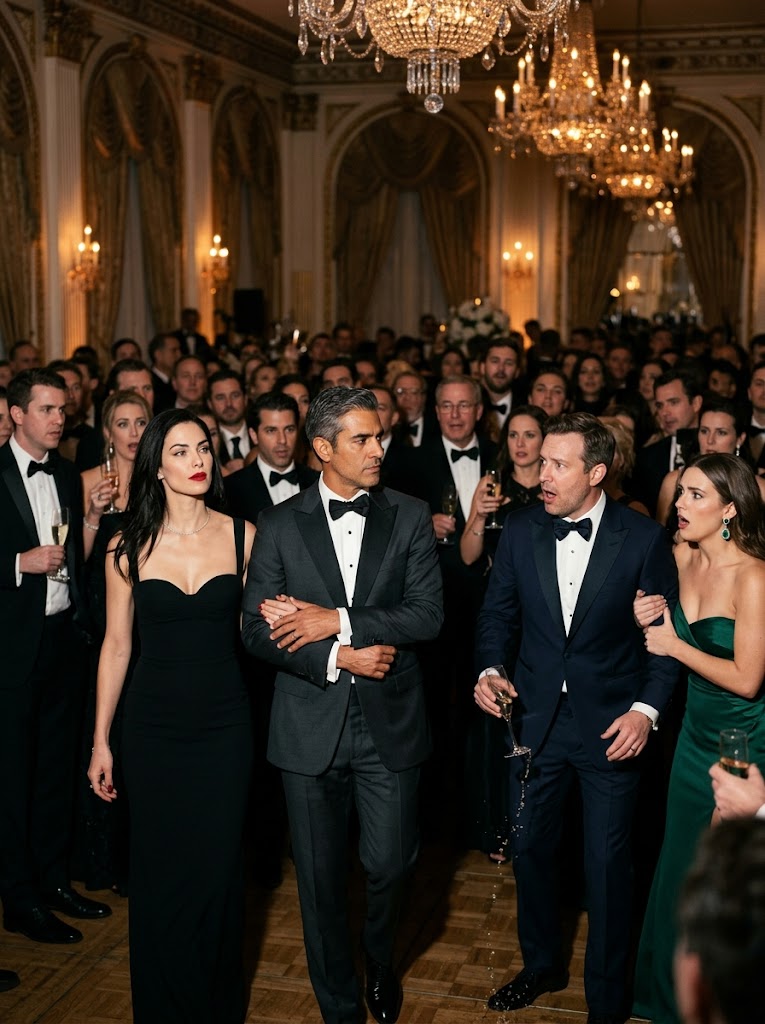
The ballroom went quiet in the cruelest way.
Not silent. The string quartet still played. Waiters still moved through the crowd with silver trays. Three hundred rich people still pretended they had never been impressed by anything in their lives.
But when I stepped through the side entrance of the St. Regis Charity Gala on the arm of Rafael Costa, the sound of the room fell by half.
Across the ballroom, my husband Preston Vale turned — champagne glass in hand, his mistress beside him.
Sloane Mercer was wearing my emerald earrings.
Preston had told New York I was too fragile to attend. He told his mother I was “resting.” He told his attorney I was becoming unpredictable. Then he brought my former best friend to the most important social event of the season and expected me to vanish quietly from my own marriage.
I did not vanish.
I wore black, because Preston hated black on a woman. I wore red lipstick, because he had spent four years telling me my mouth looked better when it didn’t draw attention. And I walked in with the one man Preston Vale had been afraid to mention even in private.
Rafael didn’t smile. Didn’t look around for approval. He simply placed my hand more securely on his arm and said, low enough that only I could hear: “Breathe, Ava.”
So I did.
Three weeks earlier, I had been sitting on my closet floor. Not crying — I had stopped that. Crying was the only language Preston knew how to dismiss. He called it hysteria. Dramatics. One of those little storms women create when they don’t understand how fortunate they are.
I understood my fortune perfectly. Thirty-fourth floor. Park Avenue. A doorman who knew every senator’s name. A ring discreet enough to look tasteful and expensive enough to make strangers glance twice.
And still, every morning, I woke up feeling like someone had erased another inch of me during the night.
Before Preston, I was Ava Whitaker — investigative reporter at the New York Ledger. I had written about developers who bribed inspectors, police chiefs who buried complaints, contractors who stole from public housing and called it administrative leakage. Then I married Preston Vale. Heir to Vale Capital. Son of a philanthropist. Grandson of a senator. Master of turning cages into gifts.
The morning the gala invitation arrived, he laid the cream envelope on the counter without handing it to me.
“You’ll wear the ivory Dior,” he said. “Hair low. No red lipstick.”
“It makes me look alive,” I said before I could stop myself.
He paused. Preston disliked surprises in women — especially his wife. He smiled slowly. That smile was the last mistake he ever made with me.
Part 2: How I Found the File — and Found Rafael Costa
The file had been sitting in my own home for eleven months.
Not hidden. Not locked. Sitting in a manila folder inside a lateral filing cabinet in Preston’s home office, the one room in the apartment I had stopped entering not because he forbade it, but because the look on his face when I opened that door had taught me, over four years, that my presence there was unwelcome. That my curiosity was a liability. That a woman who read documents she hadn’t been handed was a woman making trouble.
I stopped being a woman who made trouble in year two of our marriage.
I started again on a Tuesday in March.
It began with Sloane.
Sloane Mercer and I had been friends since before Preston — before Park Avenue, before the doorman, before I learned to soften my opinions at dinner parties. We had met at a press event in 2018, two twenty-something women in uncomfortable heels comparing notes on sources and editors and the specific exhaustion of being smart in a room that preferred you decorative. She had been a financial journalist then. Sharp, funny, the kind of woman who could make a balance sheet read like a thriller.
I had introduced her to Preston at a fundraiser in 2021.
I had not known, that evening, that I was handing my marriage to someone I trusted.
The first sign had been small. A texture shift. Sloane started canceling lunches with explanations that were slightly too polished, the way stories are polished when someone has rehearsed them. She stopped asking about my writing. She started asking, carefully and often, about Preston’s schedule.
I noticed. I filed it in the place where women file things they are not yet ready to confirm.
The confirmation came on a Saturday morning when Preston forgot to clear his second phone.
He had left it on the bathroom counter, face-up. It buzzed once. The preview text was four words: Can’t stop thinking. Tonight?
The contact name was listed as S.
I stood in the bathroom doorway in my robe for a long time, looking at that S. I was not shocked. That was the worst part. I was not shocked at all — only clarified, the way you feel when a doctor confirms what you already suspected and the diagnosis is simultaneously devastating and a relief.
I did not confront Preston that morning. I had been an investigative reporter for five years. I knew that confronting a subject before your file was complete was how you lost the story.
Instead, I went into his office.
The lateral cabinet was unlocked. The manila folder was the third one from the front, labeled in Preston’s precise handwriting: Vale Capital — Internal — Q3 Compliance Review.
Inside was not a compliance review.
Inside was a document that told me exactly why Rafael Costa — the Rafael Costa, Costa Pacific Holdings, the man whose name made Manhattan real estate attorneys go quiet — had been trying to reach Preston Vale for fourteen months without receiving a response.
Vale Capital had not been losing money through market exposure.
Vale Capital had been bleeding through a structured siphoning arrangement that Preston had designed personally, moving assets through three shell entities into an offshore account in the Cayman Islands.
The account had a second signatory.
Sloane Mercer.
I sat on the floor of Preston’s office for forty minutes, reading. Then I photographed every page on my personal phone, replaced the folder precisely as I had found it, and walked to the kitchen to pour myself a glass of water with hands that barely shook.
That afternoon, I called a number I had saved three years earlier, after writing a piece on Costa Pacific’s Port Authority dispute that had never run because Preston had asked me, gently and then firmly, to leave it alone.
Rafael Costa answered on the second ring.
“Ava Whitaker,” he said. Like he had been expecting it.
“Ava Vale,” I corrected. Then: “We should meet.”
The silence on his end lasted one second.
“Name the place,” he said.
Part 3: What Rafael Knew — and What He’d Been Building
We met at a corner table at Bemelmans Bar on a Wednesday afternoon, in the low amber light and the quiet of the Carlyle, surrounded by Ludwig Bemelmans murals of Central Park animals in winter scarves.
I ordered a club soda. Rafael ordered nothing.
He was not what Preston had made him sound like in the rare moments he mentioned the name at all. Preston described Rafael Costa the way powerful men describe other powerful men they fear — with clinical precision and thin contempt. Old money playing new rules. Latin temperament. Not someone who understands the architecture of this city.
The man across from me understood the architecture of everything.
He was in his mid-forties, compact and unhurried, with the particular stillness of someone who had learned long ago that urgency was a form of weakness. He wore no watch I could see. His suit was charcoal, impeccably cut, and he sat with his hands flat on the table as I laid out what I had found in Preston’s office.
He listened to everything without interrupting.
When I finished, he looked at me for a long moment.
“How long have you had this?” he asked.
“Three weeks.”
“Why did you wait?”
“I needed to understand what I had before I handed it to someone who might use it in a way I couldn’t control.”
Something shifted in his expression. Not warmth exactly. Recognition.
“You were a reporter,” he said.
“I am a reporter,” I said. “I just haven’t had anything worth writing in four years.”
He nodded slowly, as if confirming something to himself.
Then he told me what he had been building for fourteen months.
Vale Capital’s siphoning operation had not only defrauded Costa Pacific of a $47 million co-investment. It had defrauded eleven other institutional partners, three of which were pension funds — teachers in Connecticut, municipal workers in New Jersey, retired city employees in Brooklyn. The structured shell arrangement was sophisticated enough to survive a casual audit. But Rafael’s team had not conducted a casual audit. They had conducted the kind of audit that cost $2 million in forensic accounting fees and produced a 340-page document that was currently sitting with two federal investigators and one assistant U.S. attorney who was preparing a referral.
“Then why,” I asked, “do you need anything from me?”
“I don’t need anything from you,” he said. “Preston Vale has one remaining asset that isn’t frozen or encumbered. One investment position that the shell structure doesn’t touch, because it’s held in your name. A Tribeca property acquired in 2022.”
I was very still.
“He put it in your name,” Rafael said, “because he needed distance from it while the siphoning operation was active. It is currently the collateral that three of his remaining lenders believe secures their exposure.”
I looked at my club soda.
“He used my name,” I said, “as a shield.”
“Yes.”
“Without telling me.”
“Yes.”
I thought about the grapefruit at the kitchen island. The ivory Dior. The red lipstick that aged me. The career I had been allowed to find charming in the past tense.
“What do you need from me?” I asked.
“I need you to sign a single document,” Rafael said, “that removes the encumbrance and allows the position to be properly disclosed in the federal filing. With your signature, the case closes cleanly. Without it, it becomes complicated.”
“And if I sign it?”
“Then Preston Vale has no remaining legal shelter. The federal referral proceeds. And you, as a non-participating spouse with documented evidence of non-disclosure — ” he paused — “are protected entirely.”
I looked at him directly.
“You planned to ask me this at the gala,” I said. It was not a question.
“I was going to send a representative,” he said.
“I have a better idea,” I said.
Part 4: The Ballroom, the Envelope, and What Happened After
I will tell you what it felt like to walk through that door.
It felt like something architectural. Like the restoration of a load-bearing wall that someone had quietly removed from a building over four years, and the building had learned to compensate, and lean, and hold itself at an angle it was never designed to hold — and now the wall was back, and everything straightened.
I felt Rafael’s arm beneath my hand, steady and unhurried. I heard the string quartet playing. I saw the chandeliers throw gold light across three hundred people in their finest clothes, and I saw the exact moment Preston Vale saw me.
He went still the way animals go still before something larger arrives.
Sloane saw me a half-second later. Her hand gripped Preston’s arm and the emerald earrings — my earrings, the ones I had worn to our third anniversary dinner, the ones that had disappeared from my jewelry case in January with an explanation I no longer remembered believing — caught the chandelier light and glittered with a kind of terrible irony.
I did not look at Sloane for long. She was not the point.
The point was the sealed cream envelope in Rafael’s jacket pocket with the Vale Capital insignia on the flap. The document inside. My signature, which I had given at Bemelmans Bar three days ago, already notarized, already filed — a copy for Rafael, a copy for the federal record, and one original that Rafael had insisted on delivering in person.
Not because the delivery required a ballroom. Because Preston Vale had spent fourteen months ignoring every certified letter, every representative, every legal notification Rafael’s team had sent. He had relied on social architecture — on the assumption that Rafael Costa would not cross the threshold of a St. Regis Charity Gala, that certain rooms in New York still belonged to certain names, that money old enough had immunity from money new enough.
Rafael Costa had crossed the threshold in a charcoal Brioni tuxedo and someone else’s wife on his arm.
The crowd parted without being asked.
I watched Preston’s face as we crossed the ballroom floor. Watched him calculate and recalculate, watched the champagne glass tilt in his grip, watched him perform the specific social math of a man trying to determine whether the room had seen what he had seen and whether he could still reframe it.
He could not.
Three hundred people had seen it. Three hundred people who knew both our names, who had attended our wedding, who had listened to Preston describe my career as a charming phase at their dinner tables, were watching his wife cross the floor of the St. Regis on the arm of the man whose name had made Preston’s voice go careful for two years.
Geraldine Holt, the gala’s chair and the woman who had placed Preston on three nonprofit boards, was watching from the bar with an expression I recognized from my reporting days: the look of a witness deciding which side of a story she wanted to be on.
Preston moved to intercept us at the center of the room. He positioned himself the way he always positioned himself — centered, controlled, wearing the particular smile that was designed to make the person across from him feel slightly disorganized.
“Ava,” he said. Then, with studied neutrality: “Rafael.”
“Preston,” Rafael said. He reached into his jacket.
The room held its breath. I don’t mean this as a figure of speech. I mean I watched, in real time, as conversations stopped mid-sentence, as wine glasses paused mid-lift, as Geraldine Holt took a single step forward from the bar.
Rafael produced the envelope. Set it against Preston’s chest. Preston’s hand came up reflexively to take it, the way hands do when objects are placed against them, before the mind has processed whether accepting the object is wise.
“The original,” Rafael said. “For your records.”
Preston looked down at his own hands holding the envelope with the Vale Capital insignia. His own insignia. His own name, on a document that named him in a federal securities fraud referral, delivered by hand, in front of everyone who had ever mattered to him professionally, socially, dynastically.
The silence was enormous.
Then I leaned in, close enough that only Preston could hear, and I said the thing I had composed on the closet floor three weeks earlier, the sentence I had been carrying since the Tuesday I opened the filing cabinet, the words that contained everything: the grapefruit, the ivory Dior, the red lipstick that aged me, the career discussed in the past tense, the four years of slow erasure.
I said: “I wore the red lipstick.”
And then I turned, and Rafael and I walked back toward the side entrance, and behind us, I heard the single sound of Preston Vale’s champagne glass meeting the marble floor.
Conclusion: What Happened After the Glass Hit the Floor
The federal referral was formalized six weeks later.
Vale Capital entered receivership in April. The Tribeca property — the one in my name, the one Preston had used as a silent shield — was properly disclosed, cleared of encumbrance, and eventually returned to the defrauded institutional partners as part of the settlement pool.
The teachers in Connecticut. The municipal workers in New Jersey. The retired city employees in Brooklyn who had never heard of Preston Vale and never would.
Sloane Mercer cooperated with federal investigators in exchange for a reduced exposure agreement. The emerald earrings were returned via a courier I did not send and could not explain, in a small velvet box with no note.
I did not wear them again.
My divorce was finalized on a Thursday, in a conference room with large windows facing downtown Manhattan. Preston’s attorney was polished and efficient. Mine was a woman named Judith who had once been profiled in the Ledger for dismantling three consecutive prenuptial agreements that their architects had believed were airtight.
I signed the last document at 2:17 PM and walked out into a city that was still standing.
Rafael Costa and I are not a love story. I want to be precise about this, because the story invites the assumption. He was a man with leverage and I was a woman with information, and for one evening in the St. Regis Grand Ballroom, our interests aligned with enough elegance to make three hundred people set down their champagne.
He called once afterward, to confirm the filing was complete.
“You didn’t have to walk in with me,” I said. “You had the document. You could have sent a representative.”
“I could have,” he said.
“Why didn’t you?”
A pause.
“He spent four years making you smaller in rooms full of people,” Rafael said. “I thought you deserved to be the largest thing in one.”
I did not have a response to that. I thanked him, and we ended the call, and I sat for a while in the apartment I had rented in the West Village — small, undesigned, nothing elegant on the breakfast plate — and I thought about a woman in a closet floor three weeks earlier, carrying a secret too fragile to share.
I am a reporter again. The Ledger offered me a column in May. I cover financial accountability. I cover the architecture of control. I cover the specific way power insulates itself from consequence, and the specific, rare occasions when it does not.
I cover it in red lipstick.
Because it makes me look alive.
And I am.

Evan Cole Editor-in-Chief | Breaking News & Public Policy
“From Washington to Wall Street, and Main Street to Hollywood—Evan Cole connects the dots.”
As the Editor-in-Chief at Newskilo, Evan leads a dynamic team of journalists dedicated to uncovering the truth behind the headlines. With over 15 years in digital media, Evan has a reputation for cutting through the noise.
While he is widely recognized for his deep analysis of U.S. fiscal policy (IRS & Stimulus), Evan’s expertise extends to global current events, corporate accountability, and cultural trends. Whether he is breaking down a complex government bill, exposing a tech giant’s failure, or analyzing the societal impact of a viral celebrity moment, Evan’s goal is simple: To tell the stories that shape our world with clarity, accuracy, and integrity.