I was standing outside the auditorium in a wrinkled gown when my father leaned toward my mother and whispered, “At least after today, we’re done wasting money on this failure.”
He said it like I wasn’t there.
I smiled. That’s what I’d learned to do.
My brother Marcus showed up late. Sunglasses on. Good camera around his neck — mostly for selfies. My sister Emma asked if we’d be done before four. She had plans at the mall.
My mother checked her watch before the ceremony even started.
No one brought flowers.
They didn’t know I’d worked three jobs for four years. They didn’t know about 2 AM lab shifts, or the janitors shutting off hallway lights while I was still running protein samples. They didn’t know I’d maintained a perfect GPA in molecular biology — because no one ever asked what molecular biology meant.
And they absolutely did not know about the calls from Boston.
I’d kept that secret folded inside me for six months. Quiet. Fragile. Because if it fell apart, I wanted to be the only one who heard it break.
Dean Morrison stepped to the podium. Standard speech. Hard work. Sacrifice. The future.
Then his tone shifted.
“Before we confer degrees, we’d like to recognize one student whose work has already reached beyond this campus.”
My stomach dropped.
He talked about research. Protein folding. Neurodegenerative disease. A published paper. An international conference.
Every sentence landed closer.
“Sarah Elizabeth Thompson — would you please join me on stage?”
The world went silent.
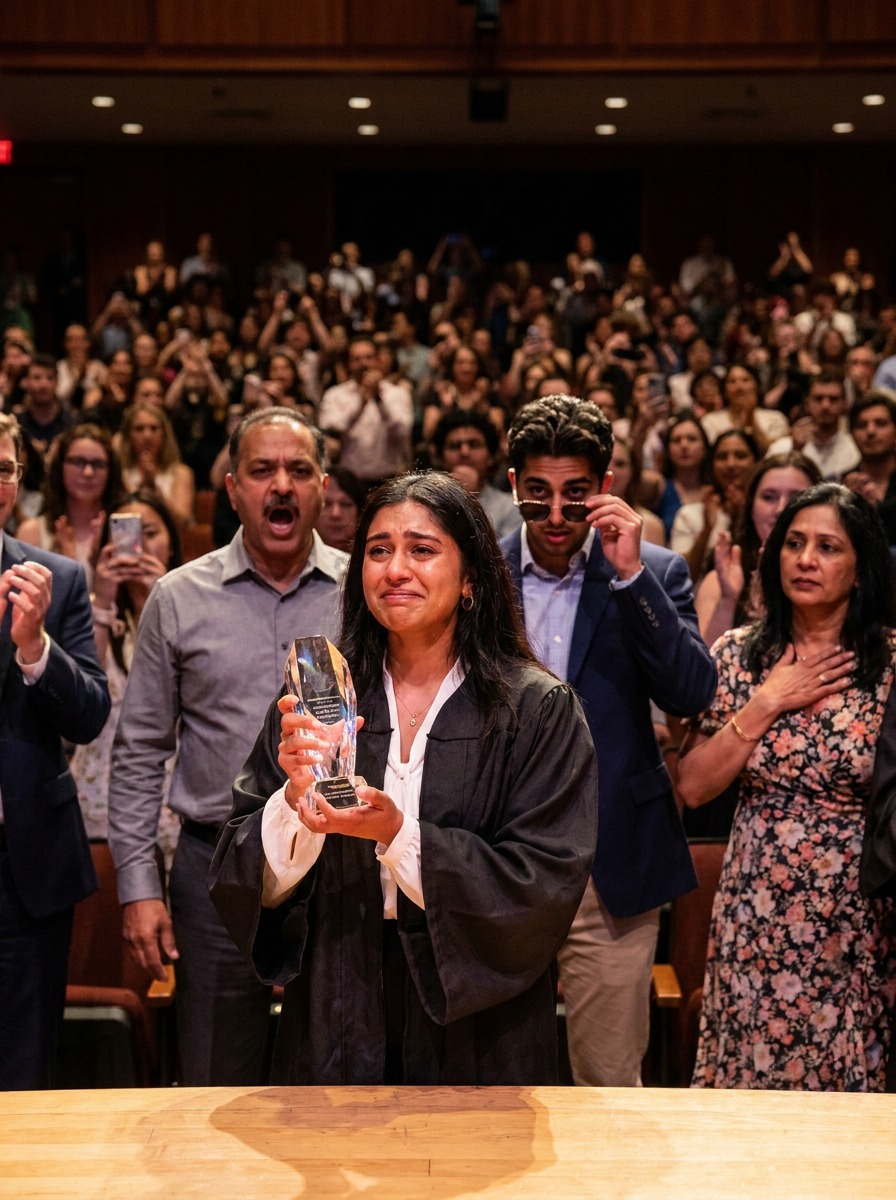
I stood before I even decided to. Hundreds of eyes turned. Including four from the row where my family sat completely frozen.
Dad’s mouth opened. Mom’s hand stopped mid-reach for her watch. Marcus lowered his sunglasses.
Dean Morrison handed me a crystal award that caught the light like ice. Outstanding Undergraduate Research Award. Exceptional work with potential medical impact.
The applause was enormous. Impossible.
I looked out at my family. For the first time all morning — they weren’t bored. They weren’t embarrassed.
They were staring at me like I was a stranger.
Then Dean Morrison turned back to the microphone.
“There is one more announcement regarding Miss Thompson.”
And in the front row, I saw her — the woman from the video call six months ago.
The woman from Harvard Medical School.
When she smiled at me, my mother forgot how to breathe.
Part 2: What Nobody Knew About the Lab
The secret had started eighteen months earlier, in a basement research lab that smelled like antiseptic and old coffee.
Dr. Karen Ellison had noticed me during my sophomore year, not because I raised my hand or stayed late to impress anyone, but because I’d caught an error in a published methodology that her entire graduate class had missed. She called me into her office on a Tuesday morning, slid the paper across her desk, and circled the error in red pen.
“How long did it take you to find that?” she asked.
“About ten minutes,” I said.
She hired me as a research assistant that same afternoon.
What followed was the most consuming, solitary, quietly thrilling period of my life. While Marcus attended networking brunches and my parents funded his third “fresh start,” I was logging twelve-hour sessions in Dr. Ellison’s lab, learning protein aggregation techniques that most graduate students wouldn’t encounter until their second year of a PhD program.
I said nothing to my family. Not because I was ashamed — but because I had tried before.
When I was nineteen, I’d explained my research focus at a family dinner. Molecular biology. Neurodegenerative pathways. The possibility that misfolded proteins were the upstream cause of early-onset Alzheimer’s progression.
My father had nodded slowly and asked if I was planning to become a nurse.
My mother asked if the science classes were at least easy.
Marcus said, “So basically you’re studying brain stuff.”
I stopped explaining after that.
By junior year, Dr. Ellison and I had co-authored a preliminary paper on a protein interaction mechanism that had never been documented. It was small. Specific. But it was ours — and three months after we submitted it to a peer-reviewed journal, it was accepted.
I was twenty-one years old with a published paper and nobody in my family knew my middle name.
The calls from Boston started six months before graduation.
The first call came on a Wednesday, while I was pulling a double shift at the coffee shop. I stepped into the storage room to take it, heart hammering, surrounded by stacked bags of dark roast. A woman introduced herself as Dr. Patricia Wren, Admissions and Research Fellowships, Harvard Medical School.
“We’ve been following your publication,” she said. “We’d like to discuss a research fellowship opportunity.”
I sat down on a bag of coffee because my legs stopped working.
Over the next six months, Dr. Wren and I spoke eleven times. The fellowship was real. The funding was real. The five-year research position — with a full stipend, lab access, and a path toward an MD-PhD — was real.
I told no one. Not Dr. Ellison until month four. Not my roommate. Not my sister Emma, who had once announced at a family dinner that I was “wasting my twenties on science no one cares about.”
I carried it alone because it was mine. The one thing in my life that had not been handed to someone else or compared to Marcus. I needed to walk into that auditorium holding it quietly before I let anyone else touch it.
Part 3: The Stage, The Award, and the Moment Everything Shifted
When Dean Morrison called my name, I counted five steps to the stage stairs. Five steps I had rehearsed in my apartment at midnight, alone, because I had known this was coming and I had also been completely terrified of it.
The crystal award was heavier than I expected.
I could feel the light moving through it — warm, prismatic — and for one disoriented second I thought: this is what it feels like to be seen.
The applause from six hundred strangers was louder than any sound my family had ever made on my behalf.
I found their faces in the crowd almost immediately. My father was sitting forward now, both hands braced on his knees, wearing the expression of a man recalculating something important. My mother’s watch was in her lap, forgotten. Emma’s phone was face-down.
And Marcus — my golden-child brother, Harvard Law, BMW, pool house, birthday steakhouses — was sitting with his sunglasses in his hand, turning them over and over, unable to look directly at the stage.
Dean Morrison spoke warmly about the research. Protein folding. Potential implications for Alzheimer’s treatment. Peer-reviewed publication. Undergraduate. He emphasized the word each time like a quiet correction.
Undergraduate.
The woman in the front row — Dr. Patricia Wren — stood when the applause peaked. She was small, precise, in a charcoal blazer, and she did not applaud. She just looked at me with the calm, assessing expression of someone who had made a very good decision and knew it.
I looked back at my mother.
Her face was the color of paper.
She was not embarrassed. She was not bored. She was not watching the clock.
She was staring at her twenty-two-year-old daughter — the failure, the coffee shop girl, the one whose science nobody bothered to understand — standing on a stage holding an award that reflected light across four hundred upturned faces.
Dean Morrison leaned back toward the microphone.
“There is one more announcement regarding Miss Thompson,” he said.
The room fell quiet in the specific way that rooms do when something important is about to land.
“Miss Thompson has been selected as this year’s recipient of the Hargrove-Ellison Research Fellowship — a fully funded five-year position at Harvard Medical School, beginning this fall.”
The silence lasted exactly two seconds.
Then the auditorium erupted.
Part 4: What Happened After the Applause
I walked off the stage on legs that felt borrowed.
Dr. Wren met me at the bottom of the steps, shook my hand, and said simply, “We’re glad you said yes.”
I nodded because words had temporarily left me.
When I turned around, my family was standing in the aisle. Not seated. Standing. Moving toward me — or trying to, through the crowd of other families and friends pressing forward with congratulations and flowers and cameras.
My father reached me first.
He was not a man who showed emotion in public. Or in private. He was a man of practical assessments and quiet disappointments, and for twenty-two years those assessments had consistently landed on me like a verdict.
He stopped two feet away.
He looked at the award in my hands. He looked at my face. Then he looked somewhere past my shoulder — at nothing, or at something internal — and his jaw moved but nothing came out immediately.
“Sarah,” he finally said.
I waited.
“I didn’t—” He stopped. Started again. “I didn’t know.”
“I know,” I said. “That’s because you never asked.”
It wasn’t cruel. It wasn’t triumphant. It was just the truest sentence I had in that moment, and I said it quietly, the way you say something that has been waiting inside you for years and finally finds an exit.
He nodded once. Slowly. A single, heavy nod, the kind that contains ten years of revision.
My mother arrived next, and what I remember most is that she reached for my face — both hands, cupping my jaw the way she hadn’t done since I was small — and she said, with her voice completely broken: “I’m sorry. I am so sorry, baby.”
I did not say it was fine, because it hadn’t been.
I said, “I know, Mom.”
Emma stood behind them, phone in her pocket for the first time in memory, looking at me with an expression I hadn’t seen from her before: pure, uncomplicated wonder. “That was you?” she whispered. “That whole time, that was you?”
“That whole time,” I said.
And Marcus. My golden-child brother. The family masterpiece. He was the last one to reach me, and when he did, he didn’t say anything for a long moment. He just looked at the Harvard fellowship card that Dr. Wren had placed in my hand. Then he looked at his own hands — the ones that had held a camera mostly for selfies all morning.
“You’re going to Harvard,” he said.
“I’m going to Harvard,” I confirmed.
He laughed. Not a mocking laugh. A low, surprised, genuine laugh — the laugh of a man recognizing something he had missed for a very long time. Then he pulled me into a hug that lasted longer than any hug we’d shared since childhood, and he said into my shoulder: “I’m proud of you, Sarah. I should’ve said that a long time ago.”
Conclusion: The Thing About Quiet People
Here is what I know now, standing on the other side of that morning:
The most dangerous people in any room are not the ones performing loudest. They are the ones sitting quietly at the edge of the row, smoothing wrinkled gowns with trembling hands, carrying secrets too fragile to share before they’re certain.
I spent four years being the family’s footnote. The afterthought. The “science thing” nobody understood.
But I also spent four years building something no one could take credit for, argue with, or compare to a Harvard Law degree. Something entirely, irreversibly mine.
The crystal award sits on my desk in Cambridge now, in a small apartment that is nothing like my parents’ house and everything like the life I built. On hard days in the lab, I turn it in my hands and watch the light move through it.
It reminds me that the people who overlook you are not the authority on your value.
It reminds me that silence is not the same as surrender.
And it reminds me of my father’s face in that auditorium — mouth open, recalculating — and how, for one clean, crystalline second, the word he had wrapped around me for years finally, publicly, came undone.
Failure.
He never said it again.
My name is Sarah Thompson. I graduated with a perfect GPA, a published paper, and a Harvard fellowship I kept secret for six months.
And the morning I walked across that stage, my family arrived like they were attending a punishment.
They left like they were attending something else entirely.

Evan Cole Editor-in-Chief | Breaking News & Public Policy
“From Washington to Wall Street, and Main Street to Hollywood—Evan Cole connects the dots.”
As the Editor-in-Chief at Newskilo, Evan leads a dynamic team of journalists dedicated to uncovering the truth behind the headlines. With over 15 years in digital media, Evan has a reputation for cutting through the noise.
While he is widely recognized for his deep analysis of U.S. fiscal policy (IRS & Stimulus), Evan’s expertise extends to global current events, corporate accountability, and cultural trends. Whether he is breaking down a complex government bill, exposing a tech giant’s failure, or analyzing the societal impact of a viral celebrity moment, Evan’s goal is simple: To tell the stories that shape our world with clarity, accuracy, and integrity.