
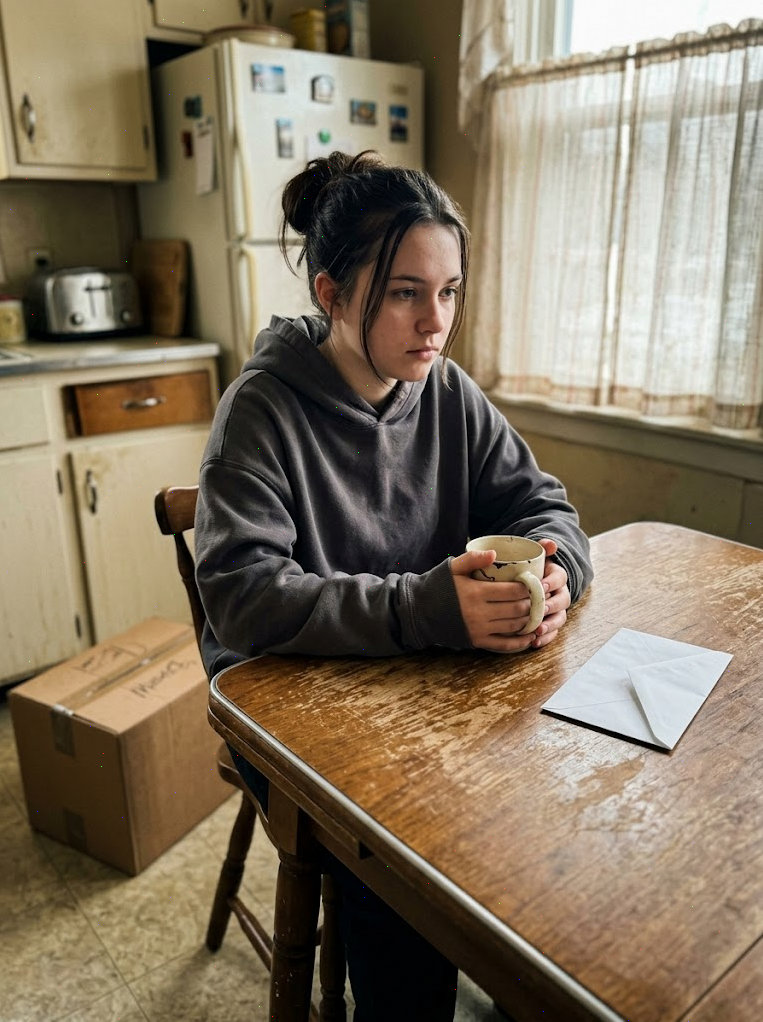
My father got married eighty-nine days after my mom died.
I counted it twice. Once when the wedding invitation arrived — gold-printed, with a photo of him standing next to a woman I barely knew — and again the night he appeared in my doorway, arms folded, and told me to give my room to her daughter.
Her name was Madison. Fifteen years old, loud, already calling our house in Cedar Rapids “ours” before a single box had been unpacked. I was seventeen, still sleeping in the pale blue room my mom had painted herself, still waking up some mornings half-expecting to hear her downstairs. My grief hadn’t settled into anything manageable yet. It still felt raw — something constantly smoldering just beneath the surface of ordinary moments.
My dad didn’t seem to notice.
“Madison needs stability,” he said. “You’re almost an adult. You can stay in the den for now.”
The den had no door. No closet. No privacy. It was where he watched TV at midnight and where overnight guests dropped their luggage.
I looked at him steadily. “You want me to give her Mom’s room?”
He frowned. “It’s not your mother’s room. It’s just a bedroom.”
And that was the sentence that clarified everything.
To him, the house was just space — neutral, replaceable, ready to be reassigned. To me, it still held my mother everywhere. Her handwriting on the pantry shelf labels. The shape worn into the arm of her reading chair. The scarf she had hung by the door the last time she came home from the hospital and never reached for again. He was repainting over a life before it had even finished fading.
Lorna stepped in behind him with a soft voice and a perfectly composed expression. “Sweetheart, no one is trying to erase anything. We all just need to adjust.”
Everyone adjusting. Everyone except them.
So I said yes. That was what caught him off guard — no tears, no argument, no scene for him to dismiss or talk over. I packed two bags and a few boxes of books. I took my mom’s recipe card — the one in her handwriting, soft and creased from years of handling — and the small jewelry box she had left on my dresser before she went to the hospital the last time. I called my uncle Ray, my mom’s brother, who had already told me quietly months earlier that I had a place if things at home ever became something I needed to leave.
By the following evening, I was gone.
Madison got the pale blue room. Lorna got her picture-perfect household. And my father got the quiet he had apparently been arranging his life around.
For eleven days, everything seemed fine on his end.
Then a certified letter arrived in his mailbox — and he hasn’t stopped calling since.
Part 2: The Calls That Weren’t About Missing Me
The first call came on a Tuesday morning just after seven.
I was at Ray’s kitchen table, eating toast, when my phone buzzed on the countertop. My dad’s name on the screen. I watched it ring twice, turned it face-down, and finished eating.
He called again an hour later. Then Lorna called from her own number — which I was mildly surprised I even had saved. Then my dad called a third time before noon.
I texted him: I’m fine. I’ll call when I’m ready.
I want to be honest about what I felt during those first eleven days at Ray’s. It wasn’t triumph. It wasn’t relief, exactly. It was more like the strange quiet of a tension you’ve been bracing against for so long that when it finally releases, you don’t know how to hold your body anymore. I slept a lot. I ate whatever Ray put in front of me. I sat with his dog on the back porch and let myself do absolutely nothing for the first time in months.
Ray didn’t ask me many questions. That was his way — he made space without filling it, the same way my mom used to. The similarity was a comfort and an ache at the same time.
That evening, he came home and set his keys on the counter with the careful look of someone carrying information they weren’t sure how to hand over.
“Your dad called me,” he said. “Asked if I knew about the letter.”
I hadn’t told Ray about the letter yet. That morning I had received a voicemail from an estate attorney — professional, brief, asking me to call back at my earliest convenience to discuss my mother’s formal will, which had been filed with the probate court. I had sat with my phone in my hands for a long time after listening to it.
Ray sat down across from me at the kitchen table.
“Did your mom ever talk to you,” he said slowly, “about what she’d set aside?”
She had. Once. It was a Tuesday afternoon near the end, when she was having a clearer day. Just the two of us in her room, the window cracked, the curtain lifting slightly in the breeze. She had held my hand and said things I half-listened to because I was still refusing, somewhere underneath everything, to fully accept what “near the end” meant.
I was seventeen. I hadn’t wanted to hear it.
Sitting in Ray’s kitchen now, I was starting to.
My dad called again that night. I picked up.
“We need to talk,” he said. His voice had a tight, controlled quality I hadn’t heard from him before — the voice of someone managing something. “Come home.”
The word home. Like Madison wasn’t asleep in my pale blue room at that exact moment.
“About what?” I said.
A pause. Long enough to be its own answer.
“The letter,” he said.
Part 3: What My Mother Had Quietly Done
The estate attorney’s office was on the third floor of a brick building downtown, the kind of place with frosted glass and the faint smell of old paper.
I went alone. Ray offered to come. I said no — I needed to sit in that chair and hear whatever was in that room as myself, not as someone being accompanied.
The attorney, a calm woman in her fifties named Ms. Okafor, had my mother’s file open on the desk. She explained things in plain language, which I appreciated. My mom, she said, had updated her will eight months before she passed — well before the diagnosis reached its final stage, while she was still sharp and deliberate and fully herself.
The house in Cedar Rapids had been purchased jointly by my parents — but my mother had inherited a significant portion of the down payment from her own parents years before the marriage. That inheritance, Ms. Okafor explained, had been legally designated. My mother had worked with an attorney to ensure that her share of the home’s equity — which, given the down payment proportion, was the larger share — would transfer directly to me upon her death, held in trust until I turned eighteen.
There was also a separate account. Not enormous, but meaningful. Saved over years, quietly, in my mother’s name alone.
All of it came to me.
My father had known a will existed. What he had not known — what Lorna had certainly not known — was the specific terms. He had assumed it was a standard document. He had assumed the house was his to manage, to reorganize, to fill with a new family.
He had been wrong.
Ms. Okafor slid a summary sheet across the desk. I read it twice without speaking.
Then I asked her what my father’s options were.
She explained them carefully. He could contest — but the will had been properly executed and witnessed, and my mother had taken steps specifically to make it difficult to challenge. Or he could negotiate — which, given that I now held a legal claim to a majority equity stake in the house he was living in with his new wife and stepdaughter, meant negotiating with me.
I thanked her, picked up my copy of the documents, and drove back to Ray’s.
I sat in the driveway for a while with the engine off.
My mother had done this quietly, without telling me the full shape of it, because she hadn’t wanted the last months I had with her to be about logistics and legal protection. She had handled it so I wouldn’t have to think about it until I was old enough to use it.
That was so entirely her that it made my chest hurt.
Part 4: The Conversation at the Front Door
My dad asked me to meet him at the house on a Saturday morning.
I drove there alone. The oak tree in the front yard had lost most of its leaves. The front door still had the same brass knocker my mom had found at a flea market and polished herself. I sat in my car for a moment looking at it.
Then I got out and knocked.
He opened the door too quickly, like he’d been watching from the window. He looked older than I remembered, which wasn’t possible in three weeks — but grief and shock do things to a face.
“Come in,” he said.
I stepped into the hallway. Lorna was not there. Strategically, I suspected.
We sat in the living room. He had printed something — several pages, paper-clipped. His own attorney’s summary, I guessed.
“I didn’t know,” he started. “About the terms. I want you to know that.”
“Okay,” I said.
“I thought — ” he stopped. Restarted. “I made some decisions quickly. After your mom. I know that.”
“Eighty-nine days,” I said. Not to be cruel. Just because it was the number, and it was true.
He flinched slightly. “I was trying to — I don’t know what I was trying to do.” He looked at his hands. “I was scared of being alone in this house.”
I understood that, actually. I didn’t say so, but I did.
“Madison is a good kid,” he said. “And Lorna — she’s not trying to replace anyone.”
“I know that,” I said. “But you told me it was just a bedroom. While I was still figuring out how to wake up without expecting to hear Mom downstairs. You told me to grow up and move to the den.”
The room was very quiet.
“I know,” he said. Quietly. No argument. Just two words sitting there.
I looked at him — my father, who had coached my youth soccer games and taught me to drive in an empty parking lot and who had also, eighty-nine days after my mother’s death, handed her room to a stranger’s daughter without blinking.
People are not one thing. That was something I was learning.
“I’m not going to force you out of the house,” I said. “That’s not what I want.”
He exhaled.
“But I’m not moving back in the way things were,” I said. “I need time. I need you to understand what you asked me to give up — not just the room. All of it.” I paused. “And when I’m eighteen, we’re going to have a real conversation about the estate. With both attorneys present.”
He nodded slowly. “That’s fair.”
I stood up. He stood too, like he wasn’t sure whether to reach for a handshake or a hug and had frozen halfway between.
“Dad,” I said. “I’m not done being your daughter. I just need you to stop acting like grief has an expiration date.”
I drove back to Ray’s. He had made soup. We ate it without talking much, which was exactly right.
What I Know Now
My mom knew things I didn’t.
She knew that grief makes people do strange, frightened, sometimes selfish things — and she knew that I would be in the house with the person most likely to hurt me without meaning to. So she did what she could from the only position she had left: she planned.
She could not stop my father from remarrying. She could not keep Madison out of the pale blue room. She could not hold my hand through those first raw weeks when I was waking up and reaching for a life that had already changed shape.
But she made sure I had ground to stand on.
That is the thing about quiet people who love you carefully — they build things you don’t find until you need them. She wasn’t dramatic about it. She didn’t leave me a letter full of warnings or instructions. She just went to an attorney on a Tuesday, signed the papers, went home, and made dinner.
I am eighteen now. I have a copy of her will in a folder in my desk drawer, beside her recipe card.
I don’t know yet what the future looks like with my father — whether we find our way back to something real, or whether too much was lost too fast. I’m trying to stay open to both possibilities without demanding an answer before it’s ready to arrive.
What I know is this: I left with two bags and my mother’s jewelry box, and I did not fall apart.
She knew I wouldn’t.
She had already made sure of it.

Evan Cole Editor-in-Chief | Breaking News & Public Policy
“From Washington to Wall Street, and Main Street to Hollywood—Evan Cole connects the dots.”
As the Editor-in-Chief at Newskilo, Evan leads a dynamic team of journalists dedicated to uncovering the truth behind the headlines. With over 15 years in digital media, Evan has a reputation for cutting through the noise.
While he is widely recognized for his deep analysis of U.S. fiscal policy (IRS & Stimulus), Evan’s expertise extends to global current events, corporate accountability, and cultural trends. Whether he is breaking down a complex government bill, exposing a tech giant’s failure, or analyzing the societal impact of a viral celebrity moment, Evan’s goal is simple: To tell the stories that shape our world with clarity, accuracy, and integrity.
Leave a Reply