
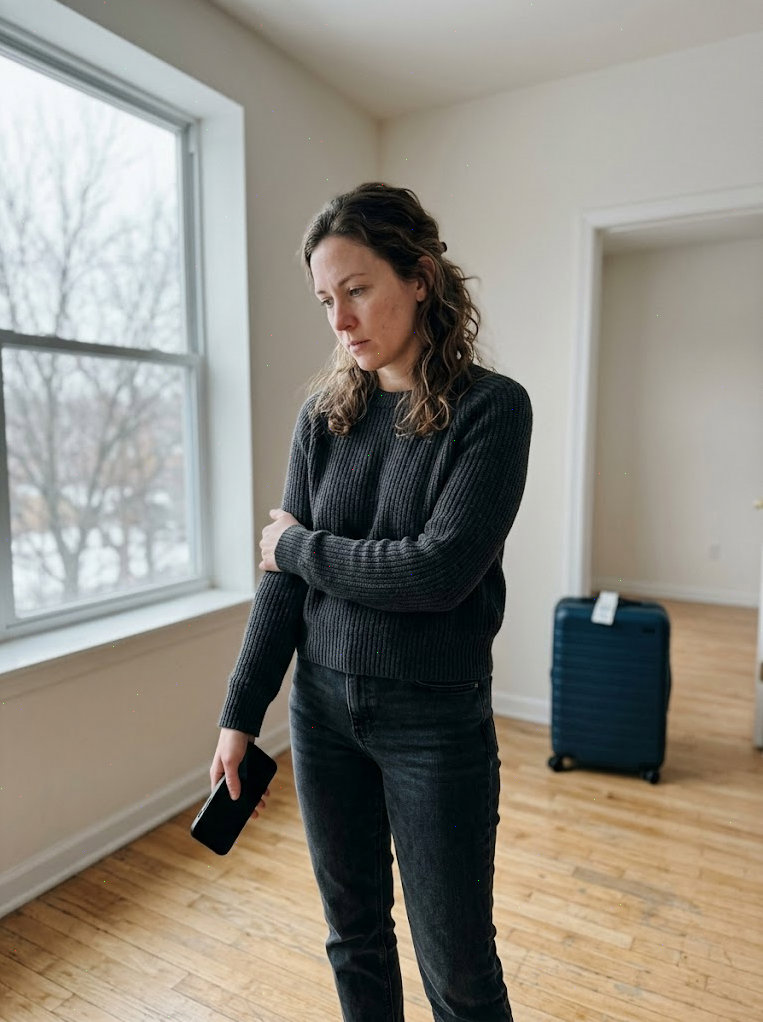
On the morning of my sister’s wedding, I carried one suitcase downstairs and my mother looked at it and laughed.
Not cruelly. Just lightly, the way you laugh at something too insignificant to bother with.
“You will never make it past the Canadian border with that life,” she said, and turned back to the hall mirror to fix her earring.
My father didn’t look up from his coffee. “Let her go. She’ll be back in a week.”
Three nights before that moment, they had called me into the dining room and told me I was not allowed at my own sister’s wedding. Not asked. Told. My mother used the phrase “weird social anxiety” with her chin lifted like she was describing a minor inconvenience. My sister Emily sat across from me in her engagement glow and said, without making eye contact, “Claire, don’t make this harder than it has to be.”
I had panic disorder. The kind that locks your chest in a grocery store line. The kind that makes your hands shake so badly a glass rattles when you pick it up. My mother called it my “performance issue.” My father called it weakness. I had lived in that house for years — paying rent, working remotely from my bedroom, told to stay upstairs whenever company came over so the neighbors wouldn’t ask questions.
I begged them to let me attend. I promised I’d sit in the back. I promised I’d leave before the reception if I felt anything coming. My father stood so fast his chair scraped the floor and said, “For once in your life, stop making everything about you.”
On wedding morning, the house smelled like hairspray and cut flowers. I picked up my bag and walked downstairs. Emily never came out of the bridal suite. My mother watched me cross the room, earring in hand, and waited for me to fail.
At the airport, I dropped my passport twice in line. My vision blurred at the edges. My chest was locked so tight I couldn’t feel my own breath. The officer checked my documents, stamped them, waved me through.
My phone lit up just before I reached the gate. One final message from my mother:
Don’t come back unless you’ve learned how to be normal.
I turned the phone off, boarded the plane, and left my family behind before my sister even said her vows.
What none of them knew was that hidden inside an old novel on my bookshelf was a single folded letter that had already set everything in motion.
Part 2: The Family That Celebrated Without Looking Back
The group text arrived three days after the wedding.
A photo album — Emily and her husband cutting the cake, my parents glowing at the reception table, everyone laughing in rented ballroom light. My mother’s caption: The most beautiful day. So grateful for every person who made it perfect.
I was not in a single photo. Not mentioned once.
I was sitting in a furnished room in Toronto with jet lag and a tea going cold on the nightstand when I saw it. I stared at the screen for a long time. Not crying. Just absorbing the specific weight of being erased from a day that was supposed to include you.
My mother sent me a separate message a week later. Your father and I have decided it’s best if you take some time to reflect. When you’re ready to rejoin the family properly, we’ll talk.
Emily called once, about two weeks after the wedding. Not to ask how I was. To tell me Mom was hurt I hadn’t sent a gift. “Just send something small,” she said. “Apologize for the drama. It would go a long way.” She hung up before I answered.
For months, I carried all of it in silence. The bruise from my father’s grip on my arm after the restaurant panic attack. The memory of my mother saying “going through something embarrassing” when church friends asked where I was. The way Emily’s face had looked in the dining room that night — not conflicted, not guilty. Just impatient.
I cried a lot in that Toronto apartment. I won’t pretend otherwise. I sat on the floor some nights and genuinely questioned whether I was what they said I was — too broken to function, too embarrassing to include, too much work to love properly.
But I had also made an appointment with a therapist my first week in the country. And I had the contract. And I had the letter folded inside that novel.
The letter was a skilled worker visa approval. I had applied six months before the wedding, quietly, from my bedroom, while the family assumed I was too paralyzed by anxiety to plan anything at all.
The contract was with a mid-sized accounting firm in Vancouver, fully remote. I had been hired three months before my father told me I wasn’t welcome at my sister’s wedding.
I had not been running away. I had been preparing to leave with everything I needed to actually build something.
Part 3: The Turning Point
The first year in Canada was the hardest thing I have ever done, and also the first time in my adult life I felt like I was living in the right direction.
My therapist, Dr. Anand, used a phrase in our fourth session that I wrote on a sticky note and kept on my monitor for two years: Your nervous system learned fear as survival. Now we teach it that safety is also possible. It sounds simple. It was not simple. It was hard, methodical, unglamorous work — exposure exercises in coffee shops, breathing through elevator rides, standing in lines without leaving, learning to recognize the difference between danger and the body’s memory of danger.
By month eight, I could walk into a grocery store without a plan for escape.
By month fourteen, I had been promoted at the firm.
By the end of year two, I had been asked to contribute to a podcast series about remote work and mental health. I said yes, then spent an entire week convinced I would cancel. I didn’t cancel. I sat in front of a microphone in a borrowed studio and spoke about panic disorder clearly and without shame for the first time in my life.
My family sent no messages during any of this. Occasionally Emily posted something that made it clear life at home was continuing without a gap where I used to be.
But things were shifting in ways I couldn’t see yet.
Emily’s husband lost his job in year two. My parents, I learned from a cousin, had taken out a home equity loan they were struggling to service. The image they had maintained so carefully — the tidy family, the successful daughters, the nothing-is-wrong-here presentation — had started to develop cracks that couldn’t be hidden at church.
And apparently, somewhere in that, my name started coming up again.
My cousin sent me a message: Your mom has been asking if I know how to reach you. She says she’s tried your old email.
I had a new email. I had a new number. I had not given either of them to my family.
I sat with that message for three weeks before I decided what I wanted to do with it.
Part 4: The Final Confrontation
Today marks exactly four years since I walked out that door with one suitcase while my mother fixed her earring and predicted my failure.
This morning, I opened my laptop and recorded a sixty-second video.
I did not script it. I sat in my apartment — my apartment, in a city I chose, in a life I built from scratch — and I spoke directly to the camera.
I told them I was well. I told them I had been well for a long time. I showed them, briefly, the view from my window — my window, in my apartment, in a country my mother said I would never survive. I held up my phone and read my mother’s last message out loud, the one she sent at the airport gate four years ago: Don’t come back unless you’ve learned how to be normal.
Then I looked back at the camera and said, quietly: “I didn’t learn how to be normal. I learned how to be okay. Those are completely different things. I hope someday you understand the difference.”
I sent the video to my mother, my father, and Emily.
Exactly fifteen minutes later, my mother called.
I let it ring.
Then Emily called. I let that ring too.
Then a text from a number I didn’t recognize — my father, on a new phone: Claire. Please pick up. We need to talk.
I set the phone face-down on the table and made a cup of coffee.
I am not cruel. I do not wish them suffering. But I had spent years performing normalcy for people who used my pain as a reason to exclude me, and I had nothing left to prove to them and no performance left to give.
I texted back, once, simply: I’m well. I hope you are too. I’m not available right now.
Then I turned the phone over, looked out my window, and finished my coffee.
What Four Years of Silence Taught Me
The hardest thing about leaving people who were supposed to love you is that the grief doesn’t follow logic.
You can know, clearly and completely, that you were treated badly — and still miss them anyway. Still have dreams where the family is whole. Still feel a reflex of guilt at the holidays that takes years to stop obeying.
What I know now, four years out, is this: the people who called my anxiety weakness were the ones afraid to examine their own. My mother’s composure at every social event cost her something — I could see it when I was old enough to look. My father’s need to project a perfect family came from somewhere deep and unexamined. They didn’t know how to hold a daughter who showed what they worked hard not to feel.
That doesn’t make what they did acceptable. It just makes it human.
I was not defective. I was inconvenient to a particular story they needed to tell.
The panic disorder is still part of my life. It probably always will be. But it no longer runs the day. It is one voice in a much larger conversation — one I have learned to chair instead of be held hostage by.
My name is Claire Bennett. I made it past the border. I made it past a lot of things.
And I am — finally, slowly, imperfectly — okay.

Evan Cole Editor-in-Chief | Breaking News & Public Policy
“From Washington to Wall Street, and Main Street to Hollywood—Evan Cole connects the dots.”
As the Editor-in-Chief at Newskilo, Evan leads a dynamic team of journalists dedicated to uncovering the truth behind the headlines. With over 15 years in digital media, Evan has a reputation for cutting through the noise.
While he is widely recognized for his deep analysis of U.S. fiscal policy (IRS & Stimulus), Evan’s expertise extends to global current events, corporate accountability, and cultural trends. Whether he is breaking down a complex government bill, exposing a tech giant’s failure, or analyzing the societal impact of a viral celebrity moment, Evan’s goal is simple: To tell the stories that shape our world with clarity, accuracy, and integrity.
Leave a Reply