
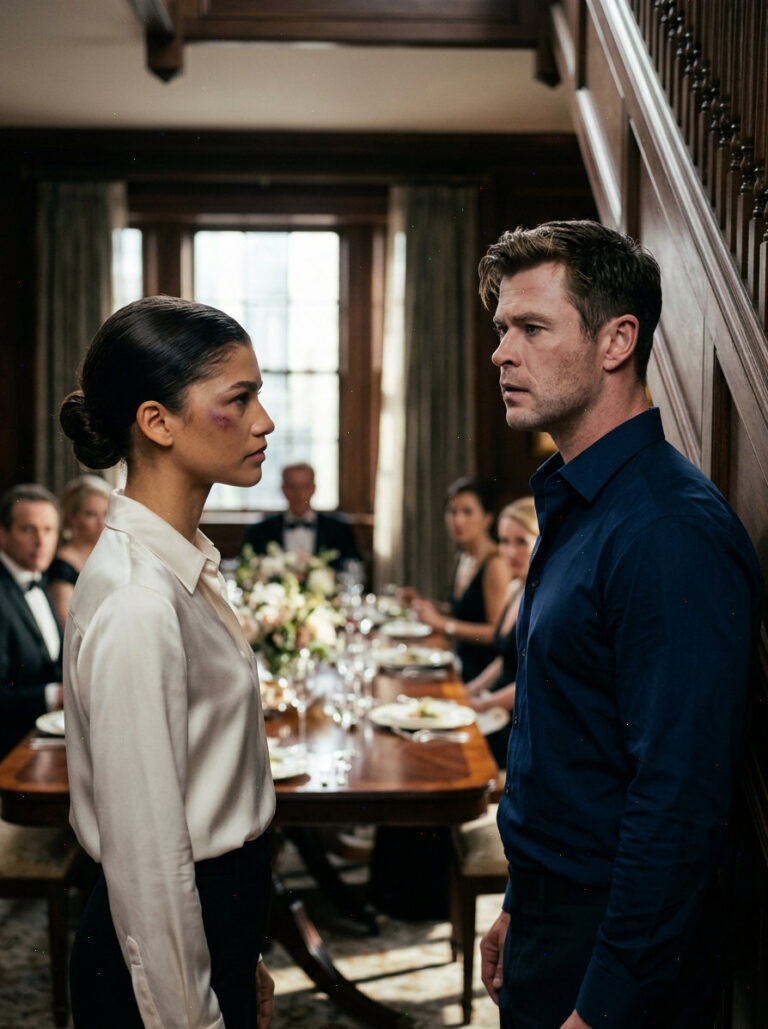
He slapped me four times over a bag of coffee.
Not cheap coffee. Not burnt coffee. Just the wrong brand.
I stood in our marble kitchen holding the grocery bag, and I watched Daniel’s face shift — the way it always shifted when something small became an excuse for something ugly. His mother Evelyn was already perched at the island in her silk robe, stirring tea she hadn’t made herself. She never made anything herself.
“Wrong brand,” he said. Quietly. That was always the warning sign. The quiet before.
“Daniel, it’s—”
The first slap stopped my sentence cold.
The chandelier above us caught the light like nothing horrible was happening beneath it. Rain hit the tall windows. Evelyn stirred her tea.
“Look at her,” she sighed. “Still staring like a wounded animal.”
He grabbed my chin. “Answer me when I speak.”
I looked at him. Calmly. Maybe too calmly.
“It was coffee,” I said.
“It was disrespect.”
Fourth slap.
The sound cracked through the house like a gunshot no one would report. My cheek lit up. My ears rang. I didn’t fall — I had learned not to fall, because falling only encouraged him to feel powerful, and a powerful Daniel was a dangerous one.
Evelyn smiled into her cup. “A wife must be corrected early. Your father understood that.”
Daniel leaned close enough for me to smell three glasses of whiskey on his breath. “Tomorrow morning. Breakfast. A real one. No attitude. No cold face. No pretending you’re better than this family.”
Better than this family.
I almost laughed out loud.
For three years — three full years — I had let them believe I was the quiet charity case Daniel had rescued. That’s the story they told at dinner parties. The soft-spoken wife with no powerful parents, no loud circle of friends, no visible army standing behind her. They mocked my plain work dresses. They joked about my “small” office downtown. They rolled their eyes when I locked certain documents in the study safe instead of leaving them on the desk like a woman with nothing to hide.
They never asked what kind of documents those were.
They never asked why the bank called my phone, never Daniel’s.
They never once wondered why the deed to this house — this house, with its marble kitchen and chandelier and tall rain-lashed windows — had my maiden name printed clearly above his.
Nobody handed me this life. I built it before Daniel ever walked into it. I was just… quiet about it. My mother called it patience. My lawyer called it strategy. I used to call it nothing, because I genuinely believed I would never need to use it.
Then came the first slap. Eight months ago. Over a dinner reservation.
He held my face afterward and cried and told me it would never happen again. I believed him the way you believe a weather forecast — optimistically, against evidence.
Then it happened again. Over a dry-cleaning pickup. Then again. Over a phone call he didn’t like.
After the third time, I stopped crying. I started counting.
That night, after the fourth slap over a bag of coffee, I washed blood from the corner of my mouth and stood in our bathroom staring at the purple swelling rising beneath my left cheekbone. My hands were completely still. Behind me, through the wall, I could hear Daniel on the phone, laughing.
“Yeah, she learned her lesson. By morning she’ll be begging.”
I opened the drawer beneath the sink and removed the small voice recorder I had placed there six months earlier, after the first slap he swore would be the last. The red light blinked steadily. Everything was there. Every threat. Every crack. Every moment Evelyn encouraged him while stirring tea she hadn’t made.
I held it for a long moment.
Then I touched my cheek once.
And I made three calls.
The first — to my lawyer. The second — to the bank. The third was to the person Daniel feared most in the world. The one name I had never mentioned in three years of marriage. The one card I had kept so carefully hidden that even Evelyn, with all her surveillance and scheming, had never thought to ask about.
Part 2: What I Built Before He Ever Found Me
Most people assumed I had married into money. That was the story that made sense to them — the quiet girl who had somehow landed in a marble-kitchen townhouse with a chandelier and a man whose family had held social columns for thirty years.
The truth was almost funny.
I had purchased this property two years before I met Daniel. Cash transaction. My maiden name on every document, every deed, every account. I had structured it that way deliberately — not because I expected to be abused, but because my mother, who had rebuilt her life from nothing after my father left, had taught me one rule above all others: Never let your security live in someone else’s name.
My office downtown, the one they called “small,” managed seven figures in real estate assets across three states. My assistant, Marcus, fielded calls I didn’t take on weekends. My lawyer, Patricia, had been with me for six years before Daniel and I ever exchanged numbers at a mutual friend’s gallery opening.
Daniel had been charming then. Genuinely charming — the kind that fills a room, that makes you feel seen, that makes every other conversation feel slightly gray by comparison. His family was old money with new polish. His mother Evelyn threw parties where the guest lists included senators and network anchors.
I should have noticed the warning signs earlier. Looking back, they were always there — the small corrections, the way he watched my reactions when he said something dismissive, the flicker of satisfaction when I went quiet instead of pushing back.
But I had never been pushed before. Not like that. Not physically.
The first time it happened, I told myself the story every woman tells herself: He’s under pressure. He’s not himself. It won’t happen again. I put my faith in the version of Daniel I had fallen in love with and waited for him to come back.
He came back, held my face gently, and wept.
I gave him the benefit of the doubt I no longer had.
The second time, I called Patricia from the bathroom and spoke in a whisper while Daniel apologized through the door. She didn’t say I told you so. She said: What do you want to do?
I said: Not yet.
She said: Then start keeping records.
That was the day the recorder went under the bathroom sink. That was the day I began photographing every bruise on my phone’s encrypted cloud folder. That was the day I began quietly, systematically, building an architecture that would be impenetrable by the time I was ready to use it.
The third slap accelerated the timeline. The fourth — over coffee — closed it.
That night, making my three calls, I was not angry. I was not shaking. I was not grieving the marriage, the man, the version of the future I had once imagined.
I was simply ready.
Part 3: The Breakfast Table
I woke at five in the morning.
I showered carefully around the swollen side of my face, dressed in a white silk blouse — clean, pressed, absolutely deliberate — and went downstairs to begin cooking.
I made everything. Eggs three ways. Smoked salmon. Fresh bread from the bakery on Clement Street that Daniel had once told me was “too artisan to be taken seriously” before eating three slices in a row. Fresh-squeezed juice. Good coffee — the right brand, the expensive kind, the kind I genuinely preferred.
The long mahogany dining table, which seated twelve, was set with the china his grandmother had given us as a wedding gift. Crystal glasses. Fresh white flowers from the garden. Every place setting perfectly aligned.
By seven-thirty, the guests had arrived through the side entrance, which Marcus — my assistant — had let them in through quietly, before Daniel woke.
They seated themselves. They spoke in low voices. They drank the good coffee.
At eight-fifteen, I heard Daniel’s alarm go off upstairs.
I heard the shower. The silence while he shaved. The familiar sounds of a man readying himself for a morning he expected to be a victory lap.
His footsteps on the staircase were light. Confident. He was already wearing his satisfaction before he reached the bottom step.
He saw the table through the archway. The full setting. The steam rising from dishes. The flowers.
He smiled.
“It’s good that you’ve finally come to your senses.”
He said it to my back as I stood at the kitchen counter.
I turned and looked at him.
And I gestured toward the dining room.
“Sit down, Daniel,” I said. “We have a lot to discuss.”
He was still smiling when he stepped into the dining room doorway.
Then his hand shot out and grabbed the door frame.
The smile disappeared so completely it was as if it had never existed.
Part 4: The Guests He Never Expected
Seated at the head of the table, directly in Daniel’s eye line: Patricia, my lawyer, in her gray power suit, a leather portfolio open in front of her.
Beside Patricia: Richard Okafor, the senior partner at the firm that had handled my family’s real estate holdings since before I turned twenty-five. A man whose name appeared on financial documents Daniel had been desperately trying to access for two years without understanding why he was always blocked.
Beside Richard: A woman Daniel had never met but would recognize instantly — because her photograph appeared in the industry profiles he obsessively read. She was the lead investigator from the domestic violence legal advocacy organization Patricia had connected me with four months ago, the one that specialized in high-asset cases with documented evidence trails.
And at the far end of the table, last, sitting with her hands folded and her expression unreadable: Daniel’s father’s former business partner. The man Daniel had spent a decade trying to impress. The man who, it turned out, had been quietly aware of the Hargrove family’s financial misrepresentations for years and had his own reasons to be in that room on that morning.
I watched Daniel’s knees buckle.
I watched him grip the door frame harder.
“Who — who are these people?” His voice was barely a voice. “How did you — when did you—”
“Eight months ago,” I said quietly. “After the first time.”
He turned to look at me. Truly looked at me, perhaps for the first time in our marriage — not at the version he had constructed and corrected and kept small, but at the actual person standing in front of him.
The bruise on my cheek was fully visible in the morning light. I had not covered it. I had chosen, very deliberately, not to.
Patricia looked up from her portfolio. “Mr. Hargrove, please take a seat. There are several documents requiring your attention, and we’d prefer to complete this with civility.”
Evelyn appeared at the top of the staircase in her silk robe. She looked down at the dining room. She looked at the guests. She looked at my face.
For the first time in three years, she had nothing to say.
Conclusion: What He Never Understood About Quiet Women
Daniel signed the separation agreement at that table. He did not have a lawyer present — his own attorney, when reached by phone, advised him in terse language that contesting the property documentation would be, in the lawyer’s exact words, “an extraordinary waste of your resources.”
The audio recordings were preserved as evidence. The photographs were preserved. The financial documentation — the deeds, the accounts, the asset records in my maiden name — were already beyond reach.
He left the house that morning with two bags and the car registered in his name.
Evelyn left without her silk robe, which she had apparently forgotten in her haste.
I stood in the marble kitchen afterward, alone, and I made myself a fresh cup of coffee — the right brand, the one I had always preferred — and I stood at the tall windows and watched the morning move across the city.
My cheek still hurt. It would hurt for another week.
But my hands were still.
Patricia called at noon. “It’s done,” she said.
“I know,” I said.
There is a specific type of woman that certain men will always underestimate: the quiet one. The one without a loud army, without visible wealth, without the habit of announcing herself. The one who folds her documents and locks them carefully and says little, because she has learned that words are currency best spent deliberately.
They see the quiet and they read it as weakness. They see the stillness and they read it as fear. They see a woman standing calmly in a marble kitchen holding the wrong brand of coffee and they read it as an opportunity to feel powerful.
They never ask what’s in the safe.
They never ask whose name is on the deed.
They never ask about the three calls made after midnight to the lawyer, the bank, and the one person whose name, spoken aloud, would have ended everything immediately — months ago, if only they had been paying attention.
Pay attention to the quiet ones.
We are not small. We are not afraid.
We are simply waiting for the right morning to set the table.

Evan Cole Editor-in-Chief | Breaking News & Public Policy
“From Washington to Wall Street, and Main Street to Hollywood—Evan Cole connects the dots.”
As the Editor-in-Chief at Newskilo, Evan leads a dynamic team of journalists dedicated to uncovering the truth behind the headlines. With over 15 years in digital media, Evan has a reputation for cutting through the noise.
While he is widely recognized for his deep analysis of U.S. fiscal policy (IRS & Stimulus), Evan’s expertise extends to global current events, corporate accountability, and cultural trends. Whether he is breaking down a complex government bill, exposing a tech giant’s failure, or analyzing the societal impact of a viral celebrity moment, Evan’s goal is simple: To tell the stories that shape our world with clarity, accuracy, and integrity.
Leave a Reply