
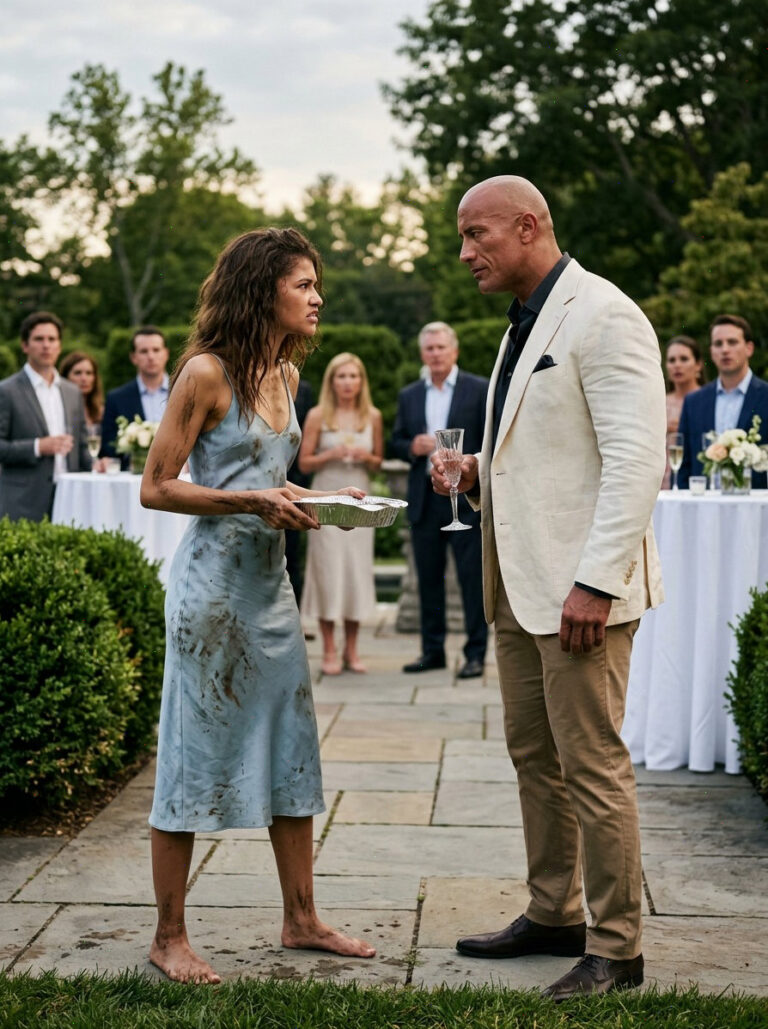
I showed up to the Whitmore BBQ soaked, muddy, and holding a ruined peach cobbler.
And Charles Whitmore looked me dead in the eye, raised his champagne glass, and said: “Ryan, your fiancée looks like trash.”
The crowd laughed.
I want you to understand something — I had spent two years being made to feel small by that family. Two years of polite smiles hiding pure contempt. Two years of Ryan defending me in private while his parents dismantled me in public.
And that afternoon, standing in front of sixty people in designer clothes, mud on my face and my blue dress destroyed, I genuinely thought: this is the moment I walk away forever.
My name is Emily Carter. I’m a public school teacher. I grade papers at midnight. I pack my own lunch. I drive a 2019 Honda Civic with a cracked side mirror I keep meaning to fix.
The Whitmores own half this county.
That morning, I left my apartment two hours early. I wanted everything to be perfect. I pressed my dress. I baked the cobbler from scratch — Ryan’s grandmother’s recipe, the one he told me his mom used to make before she decided store-bought was “more refined.”
I was ten minutes from the estate when I saw her.
An elderly woman. Standing near a rain ditch on Route 9. Trembling. Completely alone.
Every car was passing her like she was invisible.
I pulled over without thinking.
She was confused, exhausted, her silk blouse soaked through, her shoes buried in mud. She couldn’t find her phone. Couldn’t remember her address. Only kept saying her home had iron gates and a long stone driveway “somewhere nearby.”
I want to be honest — part of me hesitated. I was already cutting it close on time. I knew showing up late to a Whitmore event was its own kind of social crime. I knew Charles would notice.
But she was shaking.
I helped her into my car, turned the heat on full, and we started driving.
We hit three dead ends. Twice the car sank in soft mud on unmarked roads and I had to get out and push. Rain hammering down. My dress. My shoes. The cobbler sliding sideways on the passenger seat.
After forty minutes, she pointed weakly through the windshield.
“That gate… there.”
I looked up and felt the air leave my body.
Massive iron gates. Stone pillars. A carved W at the center.
She touched my arm before going inside. “You have more class than most people who enter this house.”
I didn’t know what she meant yet.
I would in about four minutes.
Part 2: The Laugh That Broke Something in Me
I’ve been embarrassed before. Every teacher has. You mispronounce a word in front of thirty teenagers and you survive it. You wear the same outfit twice in one week and nobody actually cares.
But standing on that patio, watching sixty people laugh at Charles Whitmore’s joke — that was a different species of humiliation.
It wasn’t just the words.
It was the performance of it. The way he raised his voice so the furthest tables could hear. The way he paused for effect, like a man who had rehearsed contempt. The way he looked around at his guests and received their laughter like applause he had earned.
I looked at Ryan.
He was moving toward me, face tight with apology, but his father waved a hand — I’ve got this — and Ryan stopped. He actually stopped walking.
That landed somewhere separate from the humiliation. That landed somewhere that would take me longer to examine.
Diana Whitmore — Ryan’s mother, always composed, always impeccably dressed — stood near the rose garden with two of her friends. She didn’t laugh. But she didn’t do anything else either. She simply turned back to her conversation.
That was its own kind of statement.
I had brought homemade cobbler to a family that had a catering staff. I had worn a dress I saved for. I had driven through a rainstorm and pushed my car through mud and done something genuinely decent — and I had arrived at this party looking like proof of every assumption they’d ever made about me.
I felt my throat close.
I felt my fists close too.
I made a decision: I was leaving. Not dramatically. Not with a speech. I was going to set the cobbler down, find my keys, and be in my car before anyone could stop me or make it worse.
I was three steps into turning around when the patio doors opened.
Part 3: The Room Goes Silent
I want to try to describe the quality of silence that fell over that patio, because it was unlike anything I have experienced before or since.
It wasn’t the silence of an awkward pause. It wasn’t the silence of a room waiting for someone to speak.
It was the silence of sixty people simultaneously realizing they had misread something fundamental.
She walked through those doors — the woman I had found shaking in the rain on Route 9 — and she was transformed. Fresh clothes, ivory and tailored. Silver hair set and calm. Posture that I can only describe as owned — the kind of ease that doesn’t come from confidence, it comes from decades of never having to prove anything to anyone.
She walked with the Whitmore estate’s head of household staff at her elbow.
I learned later that his name was Gerald. He had worked for the Whitmore family for twenty-three years. I had never seen him flustered. He was visibly flustered now — not from fear, but from the particular anxiety of someone who has just been handed an enormous responsibility.
The jazz quartet had stopped.
Plates were set down.
Charles Whitmore turned around, and his face — I watched it happen in real time — drained. Not just color. Expression. Everything left his face at once, like a power failure in a building.
He knew her.
He absolutely knew her.
Ryan appeared at my side. He was staring at the elderly woman with an expression I couldn’t read. Then he looked at me. Then back at her.
“Emily,” he said, very quietly. “How do you know Margaret Whitmore?”
I turned to look at him.
Whitmore.
“She’s — ” I started.
“My grandmother,” Ryan said. “She’s been living in her private residence on the north side of the property for the last three years. She almost never comes to family events. She and my father — ” he stopped. “They don’t speak.”
Margaret Whitmore — the matriarch of the entire family, the woman whose name was on the original deed to every piece of property Charles had inherited — had been standing in a ditch in the rain while her son’s BBQ guests drank champagne forty minutes away.
And I had stopped.
She crossed the patio slowly, and the crowd parted without anyone saying a word.
She stopped in front of Charles.
He opened his mouth.
She didn’t let him.
Part 4: What She Said
“Charles.”
One word. His name. She said it the way you’d set down something fragile — precisely, deliberately, with full awareness of what it was.
He closed his mouth.
“I have been standing in the rain on Route Nine for forty-five minutes,” she said. Her voice was quiet but carried the way a teacher’s voice carries — trained to reach the back of the room without effort. “My driver took a wrong turn and left me. I had no phone. No shelter. I was two miles from this house.”
The crowd was absolutely still.
“Forty-seven cars passed me.” She let that sit for a moment. “Forty-seven. I counted.”
She turned then, slowly, and looked at me across the patio.
I hadn’t moved. I was still standing there, muddy dress, ruined shoes, cobbler in my hands, tears I refused to cry burning at the back of my eyes.
“This young woman,” Margaret Whitmore said, “pulled over. She put me in her car. She drove in the rain for nearly an hour. She pushed her car out of the mud — twice — to find my way home.”
She paused.
“She arrived late to your party because of me. She arrived looking the way she does because of me.”
She turned back to Charles.
“And the first thing you said to your son about her,” she said, “was that she looked like trash.”
Charles said nothing. His champagne glass had been lowered to his side. I noticed, distantly, that his knuckles were white around the stem.
“I have watched you perform your wealth at this party for thirty-five years,” Margaret said. “I have watched you decide who deserves your respect based on the car they drive and the school they attended.”
She looked at him for a long moment.
“This woman has more genuine character than anyone standing on this patio. Including you.”
Someone in the crowd made a small sound — not a laugh. Something more like a breath released.
“Her name is Emily Carter,” Margaret said. “And if you speak to her that way again — in my house, on my property, at a party you host with my inheritance — you will find out very quickly how little of this life you actually own.”
The silence after that was total.
Ryan’s hand found mine.
Margaret walked toward me, and when she reached me, she looked at the cobbler dish in my hands. A small smile crossed her face.
“Is that peach?” she asked.
“It’s your recipe,” I said. My voice came out steadier than I expected. “Ryan gave it to me.”
She looked at Ryan — a long, warm look I’d never seen directed at any Whitmore before — and then back at me.
“Come inside,” she said. “We’ll eat it where it’s dry.”
Conclusion: What No One Tells You About Class
I stayed at the Whitmore estate that night longer than I planned to.
Not at the BBQ. Margaret and I sat in her private sitting room on the north side of the property — the room her late husband had built for her overlooking the garden — and we ate the cobbler warm from her kitchen staff’s oven and she told me stories about this family I was about to marry into.
Some of them were funny. Some of them were sad. All of them were honest.
She told me that Charles had always been afraid of people who weren’t afraid of him. That his cruelty was specific — targeted at exactly the people whose goodness made him feel his own limitations most clearly.
“You threatened him before you even arrived,” she said. “He knew Ryan loved you the way his father never loved his mother. That alone was enough.”
She asked about my students. We talked for two hours.
Before I left, she held my hand at the door and said something I’ve thought about every day since.
“The right people always stop,” she said. “That’s how you know them.”
Ryan and I married the following spring.
The ceremony was held in that garden — Margaret’s garden. She insisted.
Charles gave a toast that was correct and distant and said nothing real.
Margaret gave one that made half the room cry.
I wore a white dress with no mud on it.
I arrived exactly on time.

Evan Cole Editor-in-Chief | Breaking News & Public Policy
“From Washington to Wall Street, and Main Street to Hollywood—Evan Cole connects the dots.”
As the Editor-in-Chief at Newskilo, Evan leads a dynamic team of journalists dedicated to uncovering the truth behind the headlines. With over 15 years in digital media, Evan has a reputation for cutting through the noise.
While he is widely recognized for his deep analysis of U.S. fiscal policy (IRS & Stimulus), Evan’s expertise extends to global current events, corporate accountability, and cultural trends. Whether he is breaking down a complex government bill, exposing a tech giant’s failure, or analyzing the societal impact of a viral celebrity moment, Evan’s goal is simple: To tell the stories that shape our world with clarity, accuracy, and integrity.
Leave a Reply