
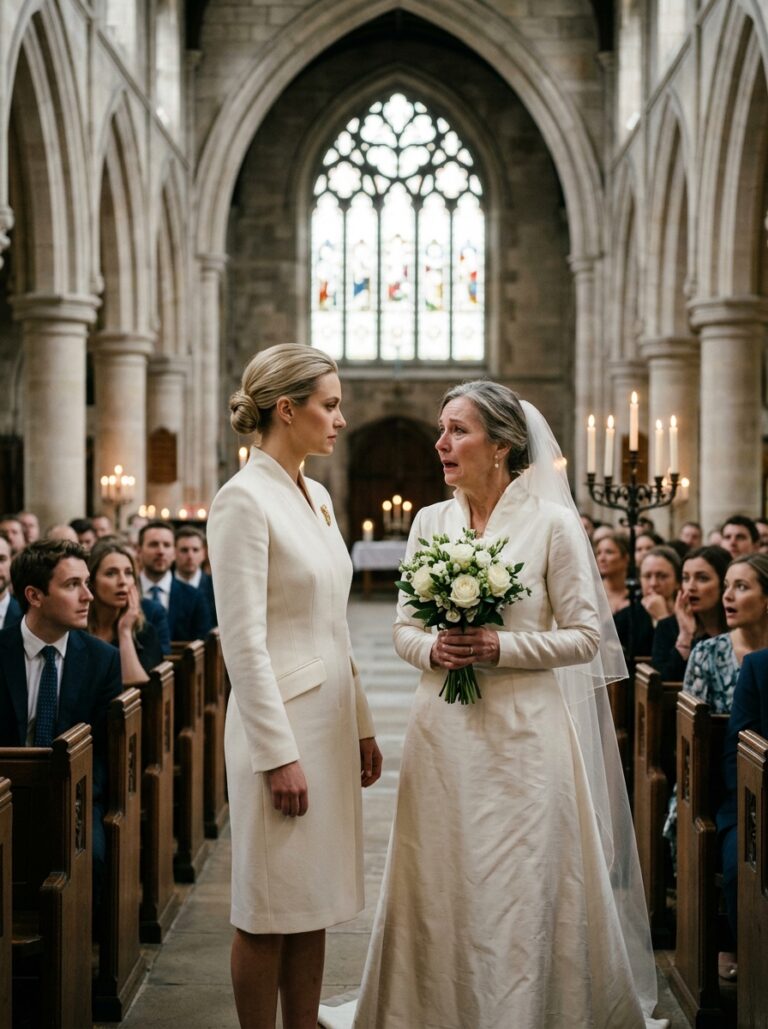
I was standing in the back of the church when my mother said “I do” to my ex-husband.
I wore white.
Not to be dramatic. Because the dress belonged to me first—designed for a wedding that never happened, bought three years ago when Evan and I almost eloped. I never returned it. Call it instinct.
The guests noticed. A few gasped. My aunt grabbed her husband’s arm like the building was falling.
Evan’s face went pale the moment he turned around and saw me.
My mother didn’t turn. Not yet.
But I wasn’t there to cause a scene.
I was there because everything I’d spent five months building quietly, carefully, legally—was already in motion. Had been for weeks. The wedding was just the deadline I’d given myself.
Let me back up.
The invitation arrived on a Tuesday. White envelope, gold lining. My mother’s name printed beside my ex-husband’s name like it was the most natural thing in the world. Together at last.
I read it once. Then I laughed—cold, sharp, the kind of sound that doesn’t belong to grief. It belongs to clarity.
Evan had filed for divorce seven months earlier. Said I was too distant. Too focused on building our investment firm and not focused enough on being soft, warm, available. He said it calmly, like a performance review.
My mother sat beside me on my couch that same night, smoothing my hair back with her hand.
“Men need warmth, Clara,” she whispered. “You’ve always been a little difficult.”
I believed her. For exactly two weeks, I believed her.
Then she moved into my spare room—not the house Evan and I shared, but the property my grandfather had placed in a trust under my name alone. The one Evan never paid much attention to. The one my mother always said was “too big for just you.”
I said nothing. I watched.
The divorce hearing was quiet. Evan wore a navy suit. My mother wore pearls. Their hands brushed under the table once, and my lawyer’s eyes flicked to me to gauge my reaction.
I had none. Not visible ones.
I signed every document cleanly, without hesitation. No tears. No outburst. No dramatic exit.
That unsettled them more than anything else could have.
Evan leaned in afterward, voice low. “Don’t embarrass yourself, Clara. Just move on.”
My mother kissed my cheek. Smelled like my childhood home, like Sunday mornings, like something I used to trust completely.
“You’ll thank me one day,” she said softly. “He deserves someone who knows how to love.”
I looked at her perfect smile for a long moment.
“You’re right,” I said. “He deserves exactly what’s coming.”
She paused. Just half a second—then laughed, and everyone around her laughed too.
They all thought I was bitter and broken and making empty threats.
None of them knew what I’d already found.
Part 2: What They Hid — And What I Found
The hotel receipts came first.
Tucked inside Evan’s gym bag in the back of our closet, behind a row of his suits—eleven receipts from a boutique hotel forty minutes outside the city. The kind of place with valet parking and room service and no questions asked. The dates spanned fourteen months.
Not recent. Not a sudden thing. Going back to when my mother was still attending our dinner parties, sitting at our table, complimenting Evan’s cooking and telling me quietly, privately, that I didn’t appreciate what I had.
Fourteen months of receipts.
I counted them on the floor of our closet at two in the morning with every light in the house on.
Then I photographed each one. Dated, organized, saved in three separate cloud locations.
I put them back exactly as I found them.
Two days later, Evan’s laptop was left open on the kitchen counter while he showered. He’d borrowed my charger—his was upstairs—and he forgot the screen was unlocked.
I wasn’t snooping. I walked in to make coffee and the folder was right there on his desktop, labeled with a client name I didn’t recognize.
It wasn’t a client.
It was a series of wire transfers—forty-one of them over eighteen months—moving money in increments of eight to twelve thousand dollars out of our joint business operating account into a personal account I’d never seen on any of our shared financial statements.
Small enough to hide inside normal operating costs if you weren’t examining the line items.
I had never examined the line items because I trusted my husband.
I photographed the screen. Then I closed the folder, made my coffee, and said good morning to Evan when he came downstairs like absolutely nothing had happened.
The third discovery took longer.
I’d always known about my 2019 medical history—a difficult year, a therapist I’d seen for eight months, documented anxiety and a period of what my doctor called “situational depression” following a miscarriage Evan and I never fully discussed publicly. I had never hidden it from Evan. I trusted him with it.
What I didn’t know was that someone had submitted a formal medical records request under a third-party authorization—pulling those exact files.
I found out when my former therapist’s office sent a routine notification letter to my address. Standard procedure when records are released. Most people don’t read those letters carefully.
I read it four times.
The request had been submitted five months before Evan filed for divorce. The authorization was signed by my mother, using a Power of Attorney document I had signed in 2017 for a completely different purpose—to allow her to handle my grandfather’s estate paperwork while I was traveling for work.
She had repurposed it.
Those records had been pulled and were sitting somewhere—in a file, attached to a strategy—before I ever knew the marriage was ending.
They were building a case to make me look unstable before they made their move. Not out of cruelty alone. Out of calculation. Because an “emotionally fragile” ex-wife is a discredited one. Easier to dismiss. Easier to defeat in court if it ever came to that.
Part 3: What I Built While They Celebrated
I did not call Evan.
I did not call my mother.
I called my attorney on a Monday morning and asked her to come to my office, not hers.
We sat across from each other for three hours. I laid out everything I had—the receipts, the wire transfer photographs, the medical records notification, a timeline I’d built going back twenty-two months. I was thorough because I am thorough. I had always been thorough. It’s why the business worked.
She looked at the documents for a long time. Then she looked at me.
“Clara,” she said. “Do you understand what you have here?”
“I’m starting to,” I said.
She referred me to a second attorney who specialized in business fraud and asset recovery. He reviewed the wire transfer documentation and spent two weeks cross-referencing the amounts against our company’s tax filings and operating expense reports. What he found was that Evan had moved approximately $340,000 out of the business over eighteen months—structured carefully to avoid triggering automatic fraud alerts, categorized as vendor payments and consulting fees for entities that, when researched, either didn’t exist or were shell accounts.
The third attorney I brought in specialized in civil litigation and intellectual property.
Because here is what Evan never understood about the company we built together: I started it. The original incorporation documents were filed under my name alone in 2016. Evan joined in 2018. His role was formalized under an operating agreement that assigned him a 40% equity stake—but the foundational IP, the proprietary investment methodology, the client relationships I had established in the first two years, all of it was documented under my original sole proprietorship.
When Evan restructured the business in 2021—something I’d agreed to because he said it would make us more attractive to institutional investors—he and his personal attorney had quietly reclassified the equity terms.
Except they missed a document.
A 2017 IP assignment filing that I had submitted to protect the core methodology before Evan joined. It had never been transferred, never been superseded, never been included in the 2021 restructuring because nobody on Evan’s side had thought to look for it.
My intellectual property attorney found it in forty minutes.
By April, I had filed a civil fraud complaint regarding the wire transfers. The forensic accountant had submitted his preliminary findings. The IP dispute was formally documented and served.
Evan had no idea.
My mother had no idea.
They were busy planning a wedding.
Part 4: The Church, The Envelope, and The Moment She Understood
I drove to the church alone.
No attorney. No friend beside me. No one who could later be called a witness to anything I said or did.
I wore the white dress. I carried a single sealed envelope.
Inside the envelope was nothing illegal, nothing threatening—just a one-page summary. A timeline. Eleven dates, eleven amounts, three attorney names, and a single sentence at the bottom:
The forensic review was completed on June 3rd. The civil complaint was filed on June 7th. Today is June 14th.
The ceremony was already in progress when I arrived. I stood at the back for six minutes, watching.
My mother was radiant. Evan was composed. The priest was mid-ceremony, somewhere between the vows and the ring exchange.
I walked down the center aisle slowly.
Not fast. Not running. Deliberately, heel to toe, the way you walk when you have absolutely nothing to fear.
The guests noticed before the altar did. I heard the sound shift—whispers, then silence, then a collective intake of breath moving like a wave from the back pews toward the front.
Evan turned first.
I watched his face do the thing faces do when the worst possible outcome materializes in a physical form in front of you. He gripped the edge of the altar.
My mother turned last.
And I finally, after thirty-four years, saw her without her armor.
Not guilt. Not shame. Something older and colder—the look of someone who has spent a lifetime believing they are untouchable and has just, in a single moment, understood that they are not.
I walked to the front pew. I set the envelope on the altar railing. I looked at my mother—not at Evan, not at the priest, not at the two hundred people holding their breath.
Just at her.
“I’m not here to stop anything,” I said quietly. “I just needed you to know it was already done.”
She reached for the envelope.
I turned and walked back down the aisle.
Conclusion: What Happened After
The civil fraud case settled eleven months later.
I won’t publish exact figures. What I will say is that the $340,000 in fraudulent wire transfers was recovered, and additional damages were assessed by the court.
The IP dispute resulted in a formal reassignment of the core methodology to my sole ownership and a licensing fee structure that will pay out for the next fourteen years.
Evan’s new venture—the one he’d been quietly building with my money while telling me I was emotionally fragile—collapsed within four months of the filing becoming public record. His investors withdrew.
My mother stopped calling me after the settlement was announced.
She sent one text, eight months later. Four words.
You didn’t have to.
I read it for a long time.
Then I typed back two words.
I know.
Because that was the part she could never understand—and the part that changed everything for me. I didn’t do any of it out of anger. I was never angry, not really. Anger is reactive. Anger makes mistakes. What I felt was something quieter and more durable.
I felt clear.
Clear about who I was. Clear about what they had tried to build me into—a footnote, a cautionary tale, an unstable woman who couldn’t hold her husband, who couldn’t manage her grief, who signed the papers and disappeared quietly.
They had chosen the wrong woman to underestimate.
And in the end, the white dress wasn’t a statement.
It was a reminder—to me, more than anyone—that what was mine had always been mine.
The church. The envelope. The expression on my mother’s face when she finally understood.
None of that was the victory.
The victory was every quiet Monday morning I sat across from my attorneys and built, document by document, the case they never saw coming.
The victory was understanding that silence is not the same as surrender.
And the victory—the real one, the one I carry with me every day—was learning that the most powerful thing I ever did wasn’t showing up at that wedding.
It was choosing, five months earlier, to stop performing grief for an audience that wanted me broken.
I was never broken.
I was just building.

Evan Cole Editor-in-Chief | Breaking News & Public Policy
“From Washington to Wall Street, and Main Street to Hollywood—Evan Cole connects the dots.”
As the Editor-in-Chief at Newskilo, Evan leads a dynamic team of journalists dedicated to uncovering the truth behind the headlines. With over 15 years in digital media, Evan has a reputation for cutting through the noise.
While he is widely recognized for his deep analysis of U.S. fiscal policy (IRS & Stimulus), Evan’s expertise extends to global current events, corporate accountability, and cultural trends. Whether he is breaking down a complex government bill, exposing a tech giant’s failure, or analyzing the societal impact of a viral celebrity moment, Evan’s goal is simple: To tell the stories that shape our world with clarity, accuracy, and integrity.
Leave a Reply