
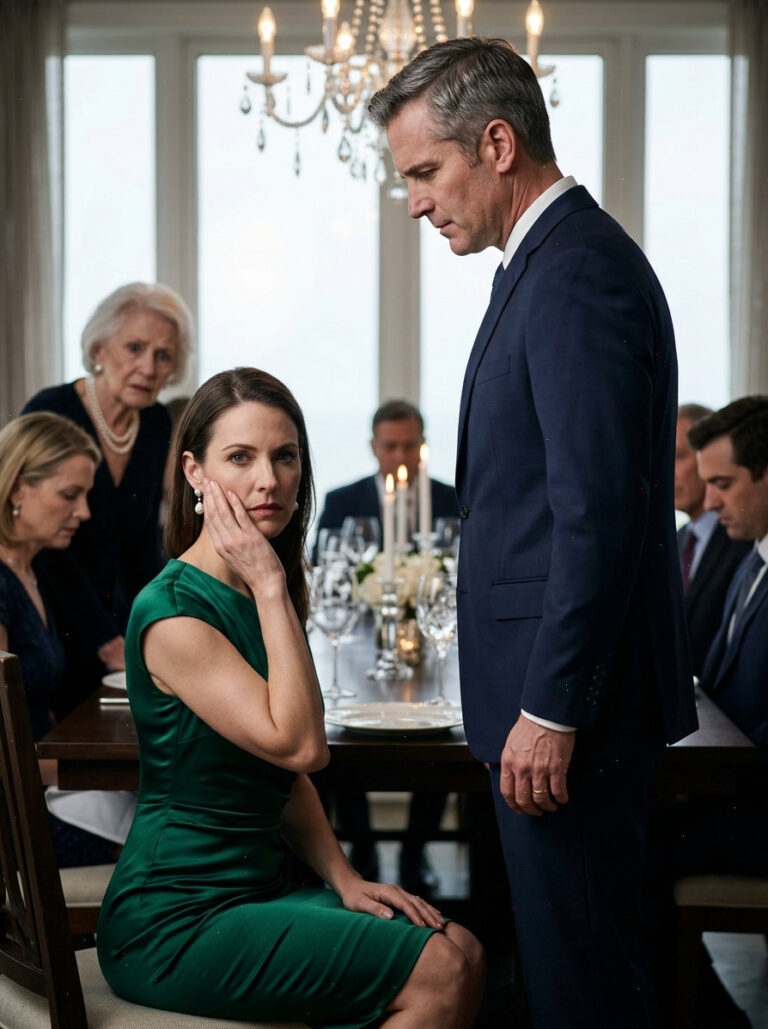
I was laughing at Daniel’s joke when it happened.
One second I was swirling wine in my glass, the chandelier light catching the rim, my earrings swaying. The next — my head turned sharply to the side.
The sound wasn’t loud. But every fork in the room stopped.
Nobody moved. Not Daniel. Not his wife. Not the cousins with their eyes suddenly fixed on their plates like the pattern had become fascinating. My father-in-law cleared his throat. Just once. Like it was an awkward pause before dessert.
Richard stood above me. Navy suit still perfect. Breathing steady. His wedding ring catching the light like it always did at these dinners — these performances.
“You humiliated me,” he said. Coldly. Quietly. Like he was correcting an error at a board meeting.
I touched my cheek slowly. No blood. Somehow that almost seemed to frustrate him more.
Then I heard her.
Evelyn — his mother — leaned across the table. Seventy-one years old, silk blouse pressed perfectly, pearls she never took off. Her voice was barely a breath.
“I stayed,” she whispered. “Please… don’t become me.”
Richard heard every word. His jaw tightened.
“Mother.” One word. A warning with thirty years of weight behind it.
She pulled back instantly. And in that single movement — that small, immediate flinch — I saw everything. Not just her fear. Mine.
Daniel laughed first. Soft. Cruel.
“Oh, Clara. Don’t start drama. You know how Richard is.”
I looked directly at him.
“Do I?”
Richard smiled. The smile. The one he used in courtrooms and charity galas. The one that made donors open their checkbooks.
“You’re emotional,” he said smoothly, hand settling on my shoulder like a signature.
“Go clean yourself up.”
For three years, everyone in this city called me lucky. What none of them noticed was the old laptop locked inside my home office safe, the camera I’d mounted above the wine cabinet eleven months ago, or the patient attorney named Mara Chen waiting for exactly the right moment.
I stood slowly. Richard’s hand slipped away.
“I’ll go wash my face,” I said.
His smile returned. Satisfied. He mistook calm for surrender. He always did.
Part 2: What Was on the Note
Inside the bathroom, I locked the door and stared at the red mark spreading across my cheek. Then I unfolded the piece of paper Evelyn had pressed into my hand at the table.
Four lines. Written in pressed, urgent ballpoint — the kind of handwriting that belongs to someone who has rehearsed a thought for years without ever saying it aloud.
The Meridian account. Ask Mara about 2019. He didn’t stop with me. The box is under the floorboard in the east guest room. I’ve been waiting for someone brave enough to open it.
I read it three times.
Then I sat down on the cold marble floor of Richard Harlow’s guest bathroom, in his family’s Gold Coast mansion, in the emerald dress he’d chosen for me to wear to his mother’s birthday dinner, and I understood for the first time that I had not stumbled into a marriage.
I had been selected for a role.
The Meridian account. I knew that name. I had processed documents related to that name — years ago, before Richard, when I was still doing compliance work at Davenport & Ellis. A private equity vehicle with a complex offshore structure, flagged twice internally, never escalated. My supervisor at the time — a careful man named Howard Park — had looked at me across his desk and said simply, “Some files close themselves, Clara. Let this one close.”
I let it close.
I married Richard Harlow fourteen months later.
I had told myself for three years that the timing was coincidence.
Sitting on that marble floor, I stopped telling myself that.
I called Mara at 11:47 PM. She picked up on the second ring, which told me she had been waiting.
“It’s time,” I said.
“I know,” she said. “I saw the upload.”
Part 3: What the Camera Had Captured — and What I Didn’t Know It Had
Mara Chen had been practicing family law and civil litigation in Chicago for nineteen years, but the reason I’d chosen her specifically — the reason Ben Okafor, the forensic auditor, had recommended her — was a single case from 2021. A tech executive in Evanston. His wife had come to Mara with a phone recording and a suspicion. Mara had left that case eighteen months later with a full criminal referral to the state AG’s office and a settlement that restructured the executive’s entire asset portfolio.
She didn’t just win divorces. She followed the money.
“The dinner footage is clean,” she told me that night. “Audio is clear. The shoulder contact, his statement, the full context — all of it. But Clara, that’s not what I need you focused on right now.”
“Then what?”
“The camera above the wine cabinet. The one you installed in March.”
I felt something shift in my chest.
“What did it capture?”
“Over the past eleven months,” Mara said, “it recorded forty-one separate instances of Richard receiving visitors in that room after midnight. Eleven of those visitors have identifiable faces. Three of them are currently under federal investigation — separately, unrelated to Richard, or so the investigators believed.”
She paused.
“Ben cross-referenced the Meridian account this morning, after you first texted me Evelyn’s note. Clara — Richard isn’t just a controlling husband. He has been laundering money through a private equity structure for six years. The Meridian account isn’t dormant. It’s been active. And your name is on two of the filing documents as a signatory.”
The floor felt very cold.
“I never signed—”
“I know you didn’t,” Mara said. “Your signature was forged. Which means you are simultaneously a potential victim and the most valuable witness in this case. Which is exactly why I need you out of that house before 6 AM.”
Part 4: The Box Under the Floorboard
I went back to the dinner.
I know. Every instinct says don’t — but I had to. Richard expected me to return to the table composed and apologetic. Disappearing into the bathroom for forty minutes would have raised exactly the kind of suspicion I couldn’t afford yet.
So I walked back in. I sat down. I accepted the dessert plate the server placed in front of me. I watched Richard tell a story about a golf tournament in Scottsdale, charming the table the way he always did, and I ate my crème brûlée slowly while Evelyn watched me from across the table with those tired, waiting eyes.
Under the table, she touched my wrist once. Brief. Light.
East guest room. Third plank from the window wall.
I found the box at 2:14 AM.
Richard was asleep. The house was quiet in that specific way large houses get quiet — not silent, but held, like the walls themselves were listening.
The east guest room was at the far end of the second floor, used for visiting relatives twice a year and otherwise locked. I had a key. Richard had given it to me once when his college roommate visited, and I had never given it back — one of dozens of small oversights he’d made because he fundamentally did not believe I was paying attention.
I was always paying attention.
The third plank from the window wall. I used a letter opener from the writing desk. The plank lifted cleanly, like it had been lifted before — many times, carefully, and always replaced.
Inside the box: a USB drive. A leather notebook filled with dates, account numbers, names, and a handwriting I recognized as Evelyn’s — meticulous, compressed, going back to 2009. A burner phone, battery dead. And a folded photograph.
In the photograph: Richard, approximately fifteen years younger, standing beside a man I recognized from federal news coverage as Gerald Marsh — indicted in 2023 for securities fraud, currently appealing. Standing between them, hand on both their shoulders, smiling: Howard Park.
My former supervisor. The man who had told me to let the Meridian file close.
I photographed everything with my phone. Replaced the plank. Left the room exactly as I’d found it.
Then I went to our bedroom, looked at my husband sleeping with one arm across his face the way he always slept, and I packed two bags from the guest closet he didn’t use.
At 5:58 AM, I walked out the front door.
At 7:00 AM, I was in Mara’s office.
At 7:43 AM, we were on a call with a federal prosecutor named Sandra Yee, who had been building a case around the Meridian account for eight months and had been waiting — patiently, professionally — for someone on the inside to open a door.
The Twist: What Richard Never Understood About the Woman He Married
Here is what Richard Harlow never grasped, in three years of marriage, in every dinner and every performance and every calculated moment of public humiliation designed to remind me of my place:
I was not a compliance officer who got lucky and married a powerful man.
I was a compliance officer who noticed, three years before I ever met Richard Harlow, that the Meridian account was wrong — and who was prevented from escalating it by a supervisor who was already compromised. Who spent the following years quietly building a case history, not because I knew I’d ever be in a position to use it, but because that is what you do when you see something wrong and nobody will let you say so out loud.
I did not marry Richard Harlow by accident.
I married him because Ben Okafor — who had been following the Meridian thread from the outside for four years — told me that the fastest way to the center of the structure was through the family. And because Mara Chen told me that evidence gathered from within a marriage, by a spouse who is herself a victim, carries a specific and very powerful legal weight.
I spent three years inside Richard’s life, collecting.
Evelyn knew. Not at first — but by year two, she had begun to suspect that I was not simply surviving. She was watching me the same way I was watching everything else. And last spring, she had left a message with my personal attorney — not Mara, a separate one — that said only: Tell her to check the east guest room when she’s ready. I’ve been ready for years.
The night of the dinner, Richard made an impulsive decision in front of twelve witnesses, in a room with a camera he didn’t know existed, in a house where his own mother had been quietly waiting to hand me the last piece I needed.
He thought he was reminding me who had power.
He was actually starting a clock.
Sandra Yee’s team executed search warrants on three properties and two financial institutions at 6:15 AM, eleven days after I walked out of that house. Richard was detained for questioning at his law firm at 9:30 AM. Howard Park surrendered voluntarily through his attorney at noon.
Evelyn called me that afternoon. I picked up.
“Did it work?” she asked.
“Yes,” I said.
A long pause.
“Good,” she said quietly. “I’ve been holding that box for sixteen years.”
I thought about what to say. About what it costs to hold something for sixteen years in silence, in pearls, at dinner tables, waiting for someone who wouldn’t flinch.
“You didn’t become you,” I finally said. “You became the reason I didn’t.”
She didn’t respond. But I heard her breathe — slow, and for the first time, I thought, without weight.
The case is ongoing. I cannot share every detail. But I can tell you this: the forged signatures on the Meridian documents, which Richard had placed there to create a fall-back liability, became the single most important element in establishing that I was a deliberate target, not a willing participant — and in positioning me as the prosecution’s central cooperating witness.
The man who built his entire life on controlling the narrative, on polished smiles and perfect suits and knowing exactly when to make someone feel small — handed me the case against him at his mother’s birthday dinner table, in front of twelve witnesses, under chandelier light.
And I walked out calm, because calm was always the plan.
The heels on the marble floor weren’t a retreat.
They were a countdown.

Evan Cole Editor-in-Chief | Breaking News & Public Policy
“From Washington to Wall Street, and Main Street to Hollywood—Evan Cole connects the dots.”
As the Editor-in-Chief at Newskilo, Evan leads a dynamic team of journalists dedicated to uncovering the truth behind the headlines. With over 15 years in digital media, Evan has a reputation for cutting through the noise.
While he is widely recognized for his deep analysis of U.S. fiscal policy (IRS & Stimulus), Evan’s expertise extends to global current events, corporate accountability, and cultural trends. Whether he is breaking down a complex government bill, exposing a tech giant’s failure, or analyzing the societal impact of a viral celebrity moment, Evan’s goal is simple: To tell the stories that shape our world with clarity, accuracy, and integrity.
Leave a Reply