
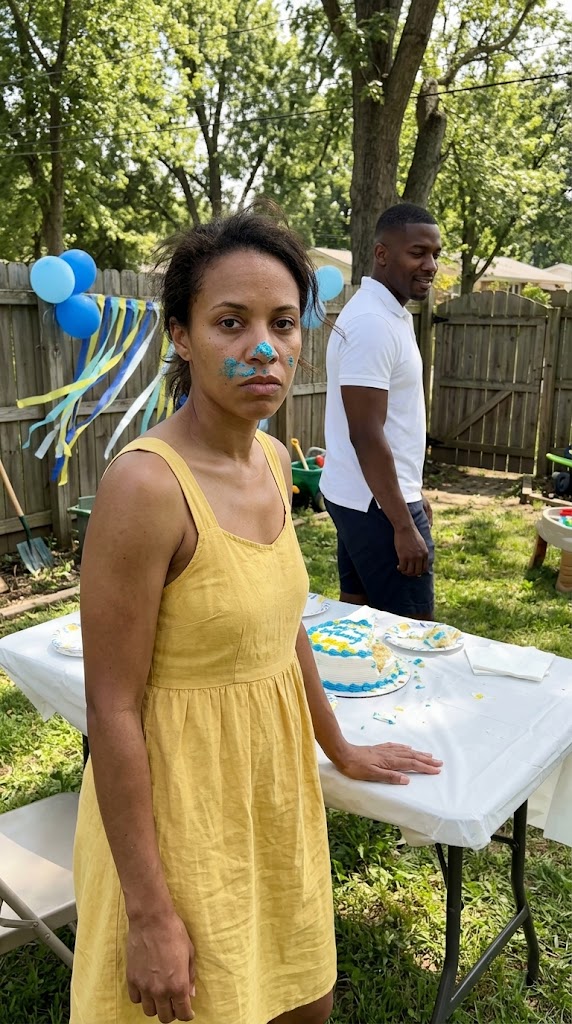
She spent three days making that cake, and not one person in that backyard knew what it had cost her to stand there smiling.
Not the neighbors who showed up with grocery store card envelopes and stood awkwardly near the folding chairs. Not the coworkers who came out of politeness and spent most of the afternoon on their phones. Not even Darius — the man who had shared her bed, her home, and the last seven years of her life — had any real idea who Marissa Cole was when she wasn’t cooking his meals, raising his son, or stretching a paycheck into something that barely fit.
He thought he knew her.
He was wrong in a way that would cost him everything he had.
The Cake That Took Three Days
It started on a Thursday morning before the sun came up.
Marissa moved through the kitchen by memory, pulling flour and sugar from the lower cabinet, setting the butter out to soften on the counter. The house was quiet. Eli was still asleep — she could hear the particular kind of silence that meant a child was deeply, completely out — and Darius hadn’t come home yet from wherever he and Vanessa had been the night before.
She didn’t check her phone.
She tied her apron and got to work.
Eli had made his request two weeks earlier at breakfast, holding up three fingers with enormous seriousness. “Three layers, Mom. And blue frosting. Like dinosaurs.” He had said it with the absolute conviction of someone who had thought this through for a very long time, and Marissa had pressed her lips together to keep from smiling too wide because she didn’t want him to think she was laughing at him.
“Three layers,” she agreed. “Blue like dinosaurs.”
She’d written it on a sticky note and put it on the refrigerator.
The first attempt on Thursday went wrong in the middle — the second layer collapsed slightly when she stacked it, leaving a visible lean that she knew would only get worse under the weight of the frosting. She unmolded it, set it aside, and started the batter again from scratch. It was past midnight when she finally got the structure right.
Friday she spent on the frosting.
The first batch was too purple. The second was closer but still too electric, more neon than the soft dinosaur blue Eli had probably imagined. She adjusted the gel coloring by tiny degrees until she landed on something that looked like the sky in an old storybook — bright enough to feel special, deep enough to feel real.
She piped rosettes along the base of each tier until her wrist ached.
She fixed three of them three times before she was satisfied.
By Saturday morning, she stood back and looked at the finished cake on the kitchen counter — three layers, blue frosting, a small plastic brachiosaurus she’d ordered online tucked between the second and third tier — and felt something settle in her chest.
It wasn’t pride exactly. It was more private than that.
It was the quiet satisfaction of a woman who had learned, through years of doing everything mostly alone, that effort was its own kind of love. That the hours no one saw still counted. That doing something right, even when no one was watching, was never wasted.
She showered, put on the yellow sundress Darius had once told her looked “too much,” and started setting up the backyard.
Everything Was Warm for Exactly One Hour
The guests started arriving at two.
Marissa moved between conversations with the particular grace of a woman who had become very good at being present without being seen. She refilled cups, settled small disputes between Eli and his friends over a plastic ring toss game, made sure the table was level and the streamers weren’t going to fall.
She watched Eli sprint across the grass in his dinosaur party hat and felt the specific kind of joy that only comes from watching a child be unreservedly happy.
This was what she had built.
Not a luxurious party. Not the kind of children’s birthday event you saw in lifestyle content, with rented backdrops and custom balloon arches that cost more than a month’s grocery run. Just a real backyard on a real Saturday afternoon in suburban Atlanta, with real people who showed up because a little boy was turning five.
She had made every detail of it with her own hands.
Darius arrived at 2:45, later than he’d promised, Vanessa’s perfume arriving a few seconds before he did. He moved through the party with the easy confidence of a man who believed his presence was itself a contribution. He shook a few hands, ruffled Eli’s hair, accepted a cup of lemonade without thanking anyone for it.
Marissa watched him from across the yard and felt the familiar low-grade exhaustion of seven years of choosing silence over confrontation.
She brought the cake out at 3:15.
The crowd gathered.
Eli’s eyes went wide the way they only do when you are five years old and the entire world still has the capacity to astonish you.
“Mom,” he breathed. “It’s blue.”
“Like dinosaurs,” she confirmed.
She leaned down and kissed the top of his head. She lit the five candles. The whole backyard began to sing, a little off-key and perfectly sincere.
“Make a wish, baby,” she whispered when the singing ended.
Eli squeezed his eyes so tight his whole face folded. He pulled in the biggest breath his small body could hold.
He blew.
All five candles went out.
Everyone clapped.
And for one brief, fragile, irreplaceable second, Marissa Cole felt the weight she had been carrying lift just slightly off her shoulders.
That second lasted about four heartbeats.
What Darius Did
She didn’t see his hand move.
One moment she was smiling at Eli, watching him reach out to touch the plastic brachiosaurus on the cake. The next moment, something gripped the back of her head — fingers wrapped in her hair — and drove her face down into the three layers of blue frosting she had spent three days making.
The impact sound was soft. Almost gentle.
Blue buttercream filled her nose. The table edge caught her forearm. Her palms slapped the tablecloth.
The backyard went absolutely, completely silent.
She didn’t hear the crowd’s reaction. She didn’t hear Eli. She didn’t hear the wind or the balloons or anything except the rushing of blood in her ears.
What she did hear, cutting through all of it, was a laugh.
High-pitched, deliberate, already shaped for a camera.
Vanessa had her phone up before Marissa had even lifted her face from the cake. The screen caught the afternoon light. She was laughing, steadying her shot, already composing whatever caption she planned to attach to this moment.
Marissa stood up slowly.
She didn’t scream. She didn’t throw anything. She didn’t cry — and this was not strength in the sense of suppression, but rather the response of a woman who had moved so far past this specific kind of pain that the shock of it registered more as information than injury.
She wiped frosting from her eyes with the back of her hand.
She looked at Darius.
He was already turning back toward Vanessa, sharing the moment with her, the two of them briefly in their own private world of cruelty. His mouth was already curving back toward a smirk.
He didn’t look at Eli.
He didn’t look at the guests standing around them in rigid, horrified silence.
He didn’t look at his wife’s expression, which was not the devastation he was expecting.
He had done this, she understood in that moment, because he had decided she was small enough to humiliate in front of everyone she knew. In front of neighbors. In front of coworkers. In front of their son on his fifth birthday.
He had decided she was nothing.
Seven years of that decision — seven years of budget cuts and lonely mornings and polite silences and pretending she hadn’t noticed things she absolutely noticed — and this was where it had arrived.
Blue frosting on her face. His girlfriend’s laughter on video. Their son standing two feet away, not yet old enough to understand what he was watching.
Marissa reached up and wiped the last of the frosting from her chin.
She heard the back gate latch.
What Darius Did Not Know
She had been born Marissa Elaine Voss.
Not Cole. Not the name she had taken when she married him. Voss.
As in the Voss Group — the Atlanta-based investment and real estate conglomerate that most people in the American Southeast had interacted with in one form or another without ever connecting the name to the woman behind it.
As in Reginald Voss — her father — who had built a privately held business empire over forty years worth roughly $1.1 trillion in diversified holdings across commercial real estate, infrastructure, tech investment, and private equity.
As in the inheritance that had been structured in her name since she was nineteen years old, sitting quietly in trust accounts and holding companies under legal entities that had no obvious connection to a woman named Marissa Cole who drove a car with a cracked dashboard and made her son’s birthday cakes from scratch.
She had left that world on purpose.
This was the part people always struggled to understand, whenever she eventually had to explain it — and she had explained it only to her attorney, her father, and her closest childhood friend. She had not wanted to live inside the machinery of her family’s wealth. She had watched it consume people she loved. She had watched it make people dishonest, performative, and fundamentally unable to trust that anything anyone did around them was genuine.
So at twenty-four she had walked away from the family compound, taken her mother’s maiden name, and built something smaller.
She wanted to know what her life felt like when it was only hers.
She met Darius at twenty-five, at a coffee shop in midtown Atlanta. He was charming in the specific way that men who have never been told no tend to be — effortlessly, almost accidentally, in a way that only later reveals itself as practiced. She had told herself she was being careful. She had not been careful enough.
She stayed because of Eli.
She stayed, and she scaled herself down, and she lived inside the version of life that Darius believed was the entirety of what she had.
She had not corrected that impression.
Until now.
The Gate Opens
The man who came through the back gate first was named Charles Odom.
He was sixty-two years old, wore a charcoal suit that had been tailored in London, and had been Reginald Voss’s chief legal counsel for twenty-seven years. He was followed by two members of a private security firm out of Washington, D.C., both in plain clothes, both radiating the specific quality of stillness that comes from professional training.
Behind Charles was Reginald Voss himself.
He was seventy years old, six-foot-two, silver-haired, and moved through the backyard with the unhurried certainty of a man who had not been made to hurry for several decades. He was wearing a pale blue linen shirt and holding the hand of a small boy — Eli’s older cousin, who had apparently been at the Voss estate and insisted on coming.
Reginald had not been to this house before.
Marissa had kept the boundary clear. She had chosen this life. She had not wanted her family’s presence to contaminate it.
She had called him Thursday night, after the second layer of cake collapsed and the house was silent.
She had told him what she needed.
He hadn’t asked questions. He had listened, said “I’ll have Charles draw it up,” and told her he loved her before hanging up.
The backyard registered his arrival in stages.
One guest near the back gate stepped aside instinctively. Then another. Then a ripple of confused, recalibrating attention moved through the crowd as people recognized, without necessarily knowing how they recognized it, that something had fundamentally shifted in the social architecture of this backyard birthday party.
Darius turned last.
He looked at the silver-haired man walking toward him and felt something he would later describe, in the dissolution proceedings, only as “like the ground moved.”
He looked at Marissa.
She was still wiping frosting from her cheek. She looked back at him with an expression that was not triumphant, not even particularly angry. Just steady. Just finally, completely, done.
“Darius,” she said, “I’d like you to meet my father.”
The Four Minutes That Ended Everything
What followed was not theatrical.
It was quiet, in the way that the most consequential things often are.
Charles Odom introduced himself to Darius with the particular professional courtesy of a man who has spent a career delivering catastrophic information in measured tones. He produced a document. He explained, briefly and clearly, the basic landscape of Marissa’s actual legal and financial identity, the trust structures, the nature of the holdings, the pending dissolution petition that had been filed that morning in Fulton County.
He explained that the prenuptial agreement — which Darius had signed without reading carefully at the insistence of his own attorney, who had failed to catch a specific clause written by Charles Odom’s firm — provided for full asset recovery in the event of documented emotional abuse, physical abuse, or public humiliation.
He explained that Vanessa’s video, which had already been posted to two social media platforms, constituted documentation.
He said all of this in a voice you could have read a bedtime story in.
Darius’s face changed several times during this recitation.
The smirk vanished first. Then the color. Then whatever it was he had organized himself around the belief that he was — the kind of man who could grab his wife’s head and put it in a birthday cake in front of forty people and face no consequence more serious than her crying.
“You need to understand,” Charles said, “that you are not in a position to negotiate. You are in a position to receive terms.”
Darius looked at Marissa again.
“You were — you were a —”
“I was your wife,” she said. “That’s what I was.”
Eli had been shepherded to his grandfather

Evan Cole Editor-in-Chief | Breaking News & Public Policy
“From Washington to Wall Street, and Main Street to Hollywood—Evan Cole connects the dots.”
As the Editor-in-Chief at Newskilo, Evan leads a dynamic team of journalists dedicated to uncovering the truth behind the headlines. With over 15 years in digital media, Evan has a reputation for cutting through the noise.
While he is widely recognized for his deep analysis of U.S. fiscal policy (IRS & Stimulus), Evan’s expertise extends to global current events, corporate accountability, and cultural trends. Whether he is breaking down a complex government bill, exposing a tech giant’s failure, or analyzing the societal impact of a viral celebrity moment, Evan’s goal is simple: To tell the stories that shape our world with clarity, accuracy, and integrity.
Leave a Reply