
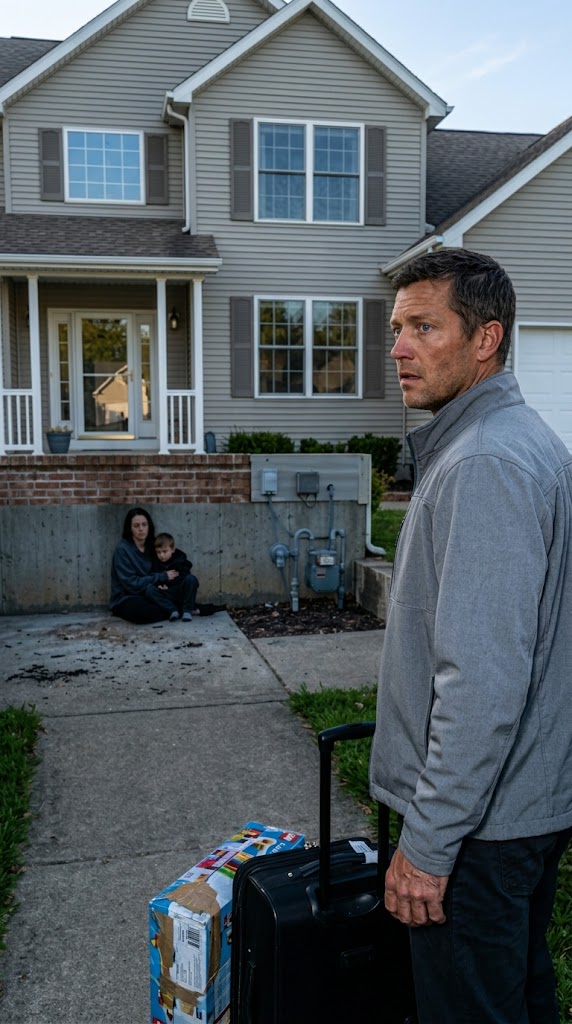
The cab pulled away and left him standing alone on the front path with a suitcase, a toy box, and five years of everything he thought he knew.
Marcus Webb had not told a single person he was coming home.
Not his mother Helen. Not his sister Claire. Not his wife Maya, who he had not been able to reach clearly on the phone for three months and had convinced himself it was the connection, the time zones, the exhaustion on both ends of a long-distance marriage doing what long-distance marriages do.
Not even his son Ethan, who was four years old when Marcus left for Riyadh and would be nine now, and who Marcus had spent five years imagining in specific and detailed ways — laughing across the marble floors, growing taller than the measurements Marcus had scratched into the doorframe before he left, asking questions that got harder and more interesting every time they managed a video call that didn’t freeze and drop after six minutes.
He had imagined coming home so many times that the imagination had taken on the quality of a plan. He would walk through the front door. Maya would turn around from whatever she was doing. Ethan would hear his voice and come running. There would be a moment of pure, uncomplicated arrival — the kind that justifies every day of the absence.
He had the gifts. Chocolates from the duty-free in Dubai. A gold bracelet in a small velvet box that he had researched for two weeks on his phone in the labor camp dormitory, reading reviews and asking a colleague who knew about jewelry whether the clasp was good quality. A toy construction set so large it had needed its own check-in tag on the flight.
He stood on the path and looked at his house.
It was large. It was polished. It was exactly what he had designed it to be before he left — a proper home, the kind his own childhood had never contained, built on a corner lot just outside the city with a front garden and a back yard and marble floors and enough rooms that nobody would ever have to feel crowded.
He had built it with money from his first two-year contract in Saudi Arabia. He had gone back for a second contract to furnish it and build the savings buffer. When the second contract extended, he had sent money home every single month without exception.
Eight thousand dollars.
Every month for five years.
Wired to his mother Helen’s account because when he had first set up the arrangement, Maya did not yet have a bank account in her own name and his mother had volunteered to manage the household finances while he was away. It had seemed sensible at the time. Helen had always been organized about money, or at least had always projected that quality convincingly.
“Make sure Maya has everything,” he had said, every time.
“Make sure my son never goes without.”
“Of course,” his mother had said. “Of course. She’s fine. She was just out shopping. She’ll call you later. Ethan is growing so fast. You focus on your work.”
He had focused on his work.
Now he stood outside his house at 9:47 PM on a Thursday in October, and the house was blasting music.
Not the background music of a household winding down for the evening. Party music — the kind with bass that he could feel in his chest from the front path. Through the front windows he could see the warm, chandelier-lit glow of a gathering in full motion. Silhouettes. Movement. The occasional loud burst of group laughter over the music.
He stood still for a moment.
Then he set the toy box carefully against the garden wall, picked up his suitcase, and walked around to the back.
The back yard was a different country.
Dark, in the way of a space that nobody had thought about for a long time. The grass was high and patchy. There was an overflowing bin near the back utility door that he recognized as the one he had installed himself — it had a slight list to the left that he had always meant to correct. The smell hit him before his eyes fully adjusted — something stale and greasy and wrong in a way that took him a moment to identify.
It was the smell of not enough.
He had grown up with that smell. He had spent twenty years of his adult life working specifically so that smell would never exist in any space that belonged to him.
He moved toward the back utility room window.
He heard the voice before he saw anything.
Small. Thin. Careful, in the specific way of a child who has learned through practice to keep the volume of their needs below a certain threshold.
“Mom… I’m hungry.”
Marcus Webb had survived five years in Riyadh without crying once.
The back of his throat closed like a fist.
Then Maya’s voice — and this was what broke him, not the words but the quality of it, the texture of a voice that had been quietly holding itself together for so long that the holding-together had become the voice:
“Shh, baby. Don’t let Grandma hear. Eat this. I washed it. It won’t taste too bad.”
He stepped to the window.
The utility room was lit by a single bulb — the maintenance light, a bare socket he had installed for changing the water heater filter. Maya was sitting on the concrete floor with her back against the wall. Ethan was in her lap. They were sharing a bowl that held what looked like plain rice and something he couldn’t identify. Maya’s hair was unwashed and loose. She was wearing a sweater Marcus recognized — a gray oversized one she had owned before they were married, years before he left, the kind of garment that only survives that long because it becomes the thing you reach for when nothing else matters.
His son was wearing a T-shirt that was too small for him.
Forty feet away, through the walls of Marcus’s own house, his mother was pouring expensive wine for people he had never met.
He stood at that window for three seconds.
He counted them. He does not know why he counted them. They were the last three seconds of the version of his life in which he was uncertain about what had been happening.
Then he picked up his suitcase and walked to the front door.
He had a key. He used it.
The music hit him like something physical. The entry hall — his entry hall, the one with the custom tile he had sourced from a supplier in Phoenix after three weeks of back-and-forth — was set up for a party. Coats on the hooks he had installed for Maya and Ethan. A champagne bucket on the console table where he had always imagined the family photos would eventually go.
Faces turned.
His mother Helen was nearest to the door — mid-60s, fully made up, wearing the kind of outfit that communicates both money and the desire to be seen having it. She had a wine glass in her right hand. The glass was good crystal — he recognized it as part of the set he had specifically purchased and shipped home two years ago as a gift for Maya.
The sequence on his mother’s face lasted less than a second before she composed herself. But he saw all of it. The flash of seeing him. The rapid internal calculation. The arrival of the prepared expression — warm surprise, the delighted mother welcoming her son home.
His sister Claire was three steps behind her, frozen with her mouth slightly open, her own glass held at an angle that suggested she had stopped mid-gesture when she registered who was standing in the doorway.
Behind them both, a room full of people Marcus had never seen, now turned and quiet and watching.
The music was still playing.
Marcus looked at his mother.
He did not raise his voice. He had never been a man who raised his voice — it was a fact about himself he had confirmed definitively in Riyadh, where there had been real reasons to be angry and he had always found that the stillness was more effective and more honest than the volume.
He said four words.
“Where is my family.”
Not a question. The sentence structure of a question with the absolute flatness of a statement, and underneath it something that everyone in that room felt simultaneously — the specific gravity of a man who has just understood the full extent of what has been done to him and has not yet decided what he is going to do about it.
His mother began: “Marcus, you should have called, we weren’t expecting—”
“Where is my family.”
Same four words. Same flatness. A different quality — quieter, if anything, and somehow therefore louder.
Claire put her glass down on the nearest surface.
One of the guests — a man in his 50s whom Marcus had never seen in his life — stood up from the sofa with the instinct of someone who recognizes that they are in the wrong place at the wrong time.
“They’re in the back,” Claire said. Her voice was very small.
He found them exactly as he had seen them through the window.
Maya heard the utility room door and looked up — and her face did the thing that five years of imagining had not prepared him for. It did not do the thing he had imagined, which was joy. It did something more complicated. It crumpled, briefly, with the specific expression of someone who has been holding it together alone for so long that the arrival of someone who was supposed to have been there all along makes the holding-together suddenly, unbearably impossible.
She said his name.
That was all. Just his name. In the voice she had used when they first knew each other, before the house and the contract and the five-year absence — a voice he had not heard in so long that hearing it now was like being handed something he hadn’t realized had been taken.
Ethan looked up from the bowl.
Children do not always recognize a parent they haven’t seen in five years. Marcus had thought about this. He had prepared himself, emotionally, for the possibility of his son not knowing him — of having to re-introduce himself, of earning back a familiarity that the distance had eroded.
But Ethan looked at him for exactly two seconds.
And then Ethan said, “Daddy.”
Marcus dropped to his knees on the concrete floor.
He wrapped one arm around Maya and one arm around his son and he stayed there for a long time without speaking because there was nothing to say that was more true than what was already happening.
Maya was shaking. Ethan was holding onto his father’s jacket with both small fists, his face pressed into Marcus’s shoulder.
The muffled party music thumped through the walls.
Marcus stayed in the utility room for eleven minutes.
He gave Ethan the chocolates from his jacket pocket — the ones he had been carrying since Dubai. He watched his son eat with the particular focused urgency of a child who has spent time not knowing when the next good thing would arrive.
He held Maya’s hand and did not ask questions yet. There would be time for questions. There were a great many questions. He could feel them organizing themselves in his mind into a kind of structure — the same way he approached a problem site at work, beginning with the most critical damage and working outward from there.
But for now he held her hand and let her breathe.
When he finally stood up, his knees ached from the concrete floor. He looked at Maya, who was watching him with an expression he recognized as fear — not of him, but of what was about to happen, of whether this moment of arrival would be immediately complicated by something worse.
“Stay here,” he said quietly. “Keep the door closed.”
He went back through the house.
The party had not exactly continued, but it had not exactly ended either. It had reached a suspended state — the guests uncertain, frozen in social amber, waiting for a resolution they couldn’t predict. Some had gathered near the front door with coats in hand.
Helen was standing in the center of the living room with the specific upright posture of a woman preparing a defense.
“Marcus,” she said. “Before you say anything—”
“How long,” Marcus said.
“I don’t know what you—”
“How long has my wife been living like that.”
Helen’s chin lifted slightly. “You don’t understand the situation here. Maya has been—”
“How long.”
The question settled over the room. One of the guests near the door quietly opened it and left. Another followed.
Claire, to her credit, answered.
“From about the second year,” Claire said. She was looking at the floor. “Mom started taking more. Then more. By the third year she wasn’t giving Maya anything at all.”
Helen turned on Claire with an expression of pure fury.
“Three years,” Marcus said.
He said it as though testing the weight of the number. Three years. Thirty-six months. Two hundred and eighty-eight thousand dollars sent home that had never reached the people it was sent for.
He looked around his living room. At the furniture he did not recognize. At the wine bottles. At the chandelier that had been installed at some point without his knowledge. At the crystal glasses — Maya’s glasses — on the tray.
He looked at his mother.
“I want you out of this house tonight,” he said. “Both of you.”
“This is my son’s house,” Helen said, her voice rising. “I have rights—”
“You have until I count to ten to decide whether you leave on your own or I call the police and explain to them the financial arrangement we had for five years,” Marcus said. “That’s not a threat. I’m simply telling you what happens next.”
The room was completely silent except for the distant, oblivious thumping of the playlist nobody had thought to turn off.
Helen looked at him for a long moment.
And then she set down her glass and walked to get her coat.
The guests were gone by 11 PM. Claire left without speaking but paused at the door and looked back at Marcus with an expression he was not ready to interpret yet. There would be a conversation with Claire at some point — a harder, more complicated one than the conversation with Helen, because Claire’s culpability was of a different and more ambiguous kind. That conversation would have to wait.
He turned off the party music himself. The silence that followed was the best sound he had heard in five years.
He ordered food — real food, enough of it, from a place that was still open, using a credit card that had his own name on it. He sat on the kitchen floor with Maya and Ethan while they waited, because Maya said Ethan was more comfortable on the floor right now, had gotten used to it, and Marcus said that was fine, the floor was fine, he had slept on considerably worse floors.
Ethan fell asleep against Marcus’s arm before the food arrived.
Maya told him everything in the way she had always told him difficult things — quietly, without dramatizing, in the voice of someone who is simply describing what is true. She told him about the first year, when Helen had given her a small allowance and told her the rest was being saved. She told him about the second year, when the allowance shrank and the explanations became vaguer. She told him about the third year — about being told she and Ethan could use the back room because the main rooms were for guests, about the back yard being locked, about the food.
She told him about the phone calls she had tried to make to him that had somehow never connected.
Marcus sat with that particular piece of information for a long moment.
Then he asked Maya if she was alright.
She looked at him for several seconds.
“I am now,” she said.
In the weeks that followed, Marcus Webb did several things methodically and without rushing.
He had the account records pulled — five years of wire transfers, meticulously documented in the way that international workers must document their financials. He had a conversation with an attorney who specialized in financial fraud, and who told him, with the careful precision of a professional who has seen this specific situation before, that the documentation he had was significant.
He had the conversation with Claire — the harder one, the one that did not resolve cleanly but that opened something that had been sealed for a long time. Claire had known. She had not orchestrated it but she had known and had chosen, for reasons that were her own to explain, to say nothing. That conversation is still continuing, in the way that some reckonings do not finish in a single session.
He had the locks changed on the house.
He opened a bank account in Maya’s name and his name jointly, and then, after a conversation with Maya, in Maya’s name alone as well. He explained his reasoning: there should be money that no one can take from her. Not even him. She should have her own access to the thing he had always intended for her.
She cried at that. He was not prepared for how much that small administrative action affected her — what it meant to her, after three years of nothing, to be handed financial reality in her own name.
He took Ethan to the toy store and let him choose anything he wanted. Ethan chose a construction set — not unlike the one Marcus had checked in as oversized luggage from Riyadh, the one that had been sitting in the front garden all evening, which Marcus had retrieved and which was now in the back yard where Ethan had set it up in the first three days and had not stopped working on since.
Marcus would sometimes watch him through the back window — his son, who was nine years old now and had spent three years learning to be quiet about his hunger, building things in the yard with a focused intensity that broke Marcus’s heart and filled it back up in almost the same instant.
He still doesn’t know how to fully quantify what was taken from him.
The money, he can quantify. The attorney helped him with that. The legal process is ongoing, as legal processes are, moving with the particular pace of official things that cannot be rushed.
But the mornings Ethan woke up hungry and had been taught to be quiet about it — those he cannot put into a filing. The three years Maya spent being told she was a guest in her own home — the precise weight of that damage is still revealing itself, slowly, in the ways she sometimes pauses before she opens the refrigerator, as if checking first whether she is allowed.
That damage will take longer than any legal proceeding.
But Marcus Webb is home now.
The front door has his name on it, on a small brass plate he installed himself the weekend after everything happened — because he had always intended to do that and had never gotten around to it.
He comes home every evening now to lights that belong to his family, and food that is there because it is supposed to be there, and a son who hears the key in the lock and comes running across the marble floors exactly the way Marcus spent five years imagining he would.
He is rebuilding, with the same methodical patience he applied to five years under a Saudi sun, from the inside out.
This time, he is not doing it from a distance.

Evan Cole Editor-in-Chief | Breaking News & Public Policy
“From Washington to Wall Street, and Main Street to Hollywood—Evan Cole connects the dots.”
As the Editor-in-Chief at Newskilo, Evan leads a dynamic team of journalists dedicated to uncovering the truth behind the headlines. With over 15 years in digital media, Evan has a reputation for cutting through the noise.
While he is widely recognized for his deep analysis of U.S. fiscal policy (IRS & Stimulus), Evan’s expertise extends to global current events, corporate accountability, and cultural trends. Whether he is breaking down a complex government bill, exposing a tech giant’s failure, or analyzing the societal impact of a viral celebrity moment, Evan’s goal is simple: To tell the stories that shape our world with clarity, accuracy, and integrity.
Leave a Reply