
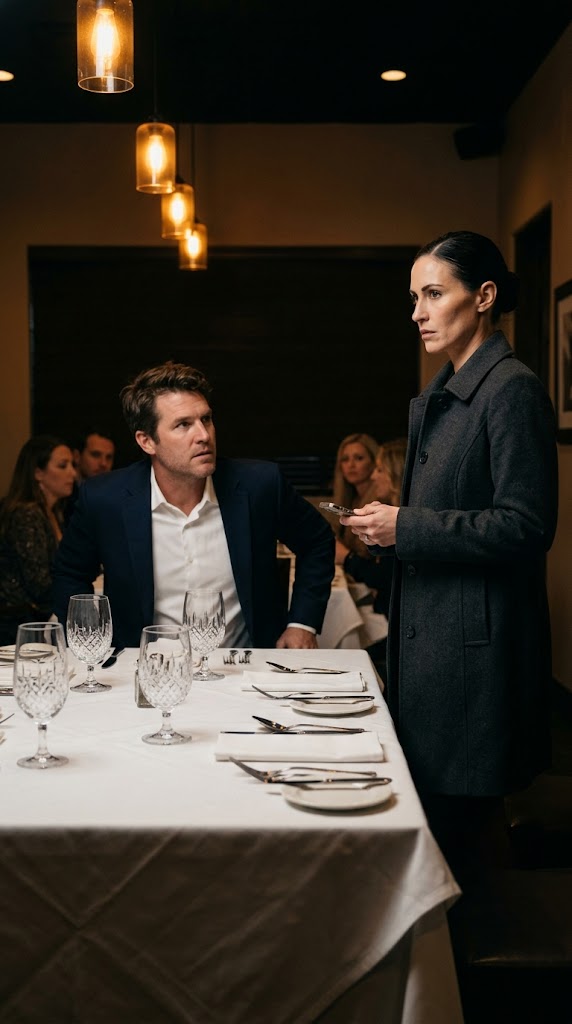
The ring hit the table at 8:23 PM.
Valeria Reyes did not slam it. She did not throw it. She did not cry.
She placed it next to his whiskey glass with the kind of deliberate, unhurried precision of someone who has spent nine years walking into catastrophic situations and knows exactly which thread to pull.
The sound it made — that small, sharp contact of platinum against dark walnut — was nothing. A fraction of a second of acoustic reality in a restaurant built for discretion.
But at that table, surrounded by six people she had cooked for, traveled with, and in some cases grieved beside, that sound landed like the first crack in a structure that was already compromised.
Nobody laughed.
Valeria had been twelve minutes late.
That detail mattered to her in the way that small details always mattered — not as an excuse, but as evidence. Twelve minutes late because the acquisition call with the Singapore team had pushed past six, because three companies were simultaneously deteriorating on her desk, and because she had been managing the slow-motion collapse of other people’s certainties for so long that she sometimes forgot she was allowed to have certainties of her own.
She was still in her coat when she came through the front door of Elara — the kind of Scottsdale restaurant that Garrett Westfield always chose for group dinners. Dim pendant lighting in amber tones. White linen tablecloths so precisely set they looked like they’d been ironed onto the tables themselves. Waiters who were hired, specifically and successfully, to appear as though they heard nothing.
Garrett loved this place. He loved the kind of spaces where money was assumed and nothing as unpolished as an emotional outburst could survive the atmosphere. It was the same instinct that governed most of his choices — the condo in North Scottsdale, the custom suits, the careful curation of the dinner guests he surrounded himself with.
Valeria had always understood this about him. She had accepted it as texture, not warning.
That was, she now recognized, her first structural error.
She was four steps from the entrance to the private dining room when she heard his voice.
“I don’t want to marry her anymore.”
She stopped.
In her professional life, Valeria had trained herself to achieve a very specific kind of internal stillness under pressure — the kind that allows you to hear the full sentence before your nervous system reacts, to let the information land completely before you decide what it means. It was a skill built across hundreds of deposition rooms, across phone calls at midnight with panicked CEOs, across conference tables where someone was always, always hiding something.
She achieved that stillness now, standing alone in the restaurant entrance, coat still buttoned, phone still warm from the call that had just ended.
“She’s… I don’t know. She’s pathetic, honestly. I almost feel sorry for her.”
Then the laughter.
Not a polite, uncertain laugh. Not the laugh of people who were uncomfortable. A warm, settled laugh — the laugh of a group that felt safe, that trusted their privacy, that believed completely that they were sealed inside their own world.
Valeria recognized every voice in it.
Simon Aldrich. She had been in his wedding three years ago. She had held his daughter the week after she was born.
Meredith Cole. Who had texted her two days ago asking for a restaurant recommendation for her anniversary dinner.
Jenna Park. Who had been the first person Garrett called the night Valeria’s mother died, and who had shown up to the hospital with coffee at 2 AM.
She stood still for another four seconds.
Not because she was deciding whether to go in.
Because she was running calculations.
Valeria Reyes was thirty-four years old and a named partner at Calloway & Reyes, a boutique firm specializing in financial restructuring. Her specific expertise — the thing that had made her name in the industry by the time she was thirty-one — was identifying, within a corporate structure that appeared functional, the exact point of hidden vulnerability. She had an almost uncomfortable instinct for it. The debt instrument buried three layers down. The supplier agreement that had been quietly renegotiated in a way that shifted all the risk. The key-person dependency that nobody had documented and nobody wanted to talk about.
She could look at a company that appeared to be standing and tell you, precisely, why it wasn’t.
In four seconds behind a wooden partition in a Scottsdale restaurant, she applied that same instinct to the last three years of her life.
And what she found was not a surprise.
It was a confirmation.
She walked to the table.
Jenna saw her first. The color left her face in a clean, immediate drop — like a window shade. She opened her mouth. No sound.
She didn’t need to warn anyone. Garrett turned on his own.
Valeria watched the sequence move across his face. She had seen it before, many times, on the faces of executives when she walked into a room with information they didn’t know she had. First: the flash of genuine surprise — involuntary, impossible to fake in reverse. Second: the rapid recalibration, the visible internal calculation of exactly what she could have heard and for how long. Third: the mask — in Garrett’s case, the warm, slightly concerned expression of a reasonable man dealing carefully with an emotional situation.
He was good at it. He’d had years of practice.
She didn’t give the mask time to fully set.
She reached up with her right hand, took hold of the engagement ring on her left — the large solitaire he had selected with what she had always privately considered excessive attention to optics, a three-carat round brilliant in a platinum cathedral setting — and she removed it.
She placed it next to his whiskey glass.
The sound was minimal. A single clean note of metal against wood.
The laughter was gone.
Garrett half-rose from his chair.
“Valeria—”
She raised one hand, palm out. A simple gesture. The same one she used in conference rooms to stop someone from continuing before they made their situation worse.
“It’s fine,” she said. Her voice was level. Not forced, not performing calm — actually calm, in the way that she was always actually calm in the moment of maximum pressure. “You won’t have to marry me.”
The table was completely still.
She looked at Garrett’s face.
And she saw it — the thing she had not expected to see, or perhaps the thing she had been hoping she would not see, because seeing it closed a door she had kept slightly open for the last several months.
Relief.
It moved across his face in under two seconds, and he buried it almost immediately beneath the performance of concern. But she had spent nine years reading people in rooms where everyone was performing something, and she saw it with total clarity.
He was relieved.
Not relieved to end the tension of a scene. Not relieved she wasn’t screaming. Relieved in the deep, exhaling way of someone who has just been handed an exit they did not have to engineer themselves.
She filed that information away.
“I think there’s been a misunderstanding,” Garrett said. His voice had landed in reasonable mode — warm, modulated, the voice he used with investors he needed to walk back from a ledge. “You clearly heard something out of context. Can we just—”
“No,” Valeria said simply. “We can’t.”
She pulled out the chair closest to her — not her usual seat, just the nearest one — and sat down.
The table did not know what to do with this. She watched the micro-adjustments move around the group. Simon, whose laugh she had identified immediately, now had his hands in his lap and was looking at the tablecloth. Meredith had picked up her wine glass and was holding it without drinking. Jenna still had not closed her mouth.
“I’m not going to make a scene,” Valeria said, looking around the table evenly. “I just want to cover one thing before I leave. Because I think there’s some information that’s missing from this conversation.”
Garrett’s expression shifted. Something moved behind his eyes that hadn’t been there before. A calculation of a different kind.
“Valeria.” His voice had a different quality now. A private-warning quality. “This isn’t the place.”
“Westfield Capital’s Series B extension,” she said.
The name of his company in her mouth, with that specific phrase attached to it, had a physical effect on him. She watched it happen.
“The extension that closed in September. The one that kept the company out of a very serious liquidity situation going into Q4.”
Nobody at the table was looking at anything except her now.
“The lead investor pulled out three days before closing,” she continued. “I assume Garrett mentioned that to some of you. It was a difficult period.” She paused, as if considering how to phrase the next part. “What he likely didn’t mention is that the lead investor pulled out because of a covenant issue in the existing debt structure that his legal team had missed. A relatively technical issue, but one that, from the investor’s perspective, created unacceptable downstream risk.”
Garrett’s jaw was tight.
“It’s the kind of issue that, if you know what you’re looking at, can be reframed. Restructured. The terms can be reset in a way that addresses the risk on paper in a manner the investor’s own counsel will accept.” She laced her fingers on the table in front of her. “I made four phone calls in one afternoon. I restructured the covenant terms. I wrote the revised language myself and had it reviewed and executed before the close-of-business deadline.”
The silence at the table had a new texture.
“I did this,” she said, “because Garrett asked me to. As his fiancée. Informally. Not as a retained attorney. Not as a consultant on record. As someone who loved him and wanted his company to survive a bad week.”
She let that land.
“Which means,” she said, “that my fingerprints are nowhere in the official record. And Garrett received full credit for the resolution with his board and his investors.” She looked at him directly. “Which I was completely fine with, at the time.”
Garrett’s hand was resting on the table. She could see the tension in it.
“In addition to the Series B situation,” she continued, “I’ve spent approximately sixty hours over the past fourteen months advising, informally, on three separate supplier contract renegotiations, two HR-related liability issues, and one situation in Q1 of this year that I am not going to describe in detail but that Garrett knows exactly what I’m referring to, and that would have resulted in a regulatory filing that would have been extremely difficult to explain to his Series B investors.”
Meredith set her wine glass down.
“I want to be clear,” Valeria said. “I’m not raising any of this as a legal matter. I have no interest in making any of this a legal matter.” She paused. “I am raising it because I think it is relevant context. Given what I heard five minutes ago.”
She stood up.
She picked up her coat from the back of the chair.
“I’ll have my firm contact you next week to discuss what a proper, compensated engagement would look like going forward,” she said to Garrett, in exactly the same tone she used when closing a meeting. “If you’d prefer to retain outside counsel for the outstanding issues, that’s completely your choice. I would recommend you do it quickly, given the Q1 matter.”
She looked at him for a long, even moment.
His face was the color of the white tablecloth.
“I genuinely hope the company does well,” she said. And she meant it — that was the particular, clarifying devastation of the thing. She wasn’t lying. “You built something real. I was glad to help protect it.”
She picked up the ring from beside his glass and placed it gently in her coat pocket. It was a significant piece of jewelry. She would donate it. She had not decided to whom, yet, but the decision felt clean and right in a way that surprised her.
“Enjoy your dinner,” she said to the table.
She walked toward the exit.
She did not look back.
But she heard, behind her, the specific quality of silence that she recognized from conference rooms and restructuring negotiations — the silence that descends when a group of people simultaneously realizes that the situation they thought they were in was entirely different from the one they were actually in.
She heard Garrett say her name once, quietly, with a quality in his voice she had never heard there before.
She kept walking.
The drive back to her condo took eleven minutes.
She did not cry. Not that night, and not in the nights that followed immediately after — not because she was suppressing anything, but because something that had been quietly, slowly compressing inside her for months had simply stopped. She was not numb. She was, with uncomfortable accuracy, more present than she had been in a long time.
She poured herself two inches of bourbon and sat in her kitchen without her phone and thought, with the methodical honesty she applied to everything else, about the actual architecture of the last three years.
The conclusions she reached were not comfortable.
But they were structural. They were true. And she had spent too many years patching other people’s damaged foundations with temporary fixes to apply the same approach to herself.
She had known, somewhere beneath the engagement ring and the Polanco dinners and the weekends in Sedona, that something was misaligned. She had identified the feeling and chosen, each time, to restructure the terms rather than acknowledge the underlying problem.
She knew that instinct well. She’d seen it in boardrooms across the country. A business that knows it is failing but continues to optimize the quarterly report. The energy of competence applied in exactly the wrong direction.
She had loved Garrett. She was honest enough to hold that as true alongside everything else.
But love, she now understood with the full weight of the word, was not the same as structural soundness.
On Thursday morning, her phone rang at 7:15 AM.
It was David Farrow — Garrett’s CFO. She had always liked David. He was a straight-line thinker in an environment that often rewarded the opposite.
“I heard what happened,” he said immediately. “I want you to know — on behalf of everyone who actually knows what you did for this company — I’m sorry.”
“You don’t need to apologize,” she said.
“I know.” A pause. “I’m doing it anyway.”
She appreciated that.
At 9 AM, she received a text from Meredith: I don’t know what to say. I’m so sorry. Can I call you?
She responded: Give me a few days.
She did not hear from Simon.
At 10:30, she received an email from Garrett. Four paragraphs. The first two were an explanation of what she had heard — context, mischaracterization, stress. The third was an acknowledgment that things had not been right between them and suggested couples therapy. The fourth referenced, carefully and indirectly, the outstanding business matters and expressed hope that they could handle everything with mutual respect and discretion.
She read it once and did not respond.
She forwarded it to her associate, Priya, with a single line: File this. We’ll need it for the scope-of-engagement conversation next week.
The week that followed was quiet in the way that structural changes are always quiet after the event. The building doesn’t collapse loudly. The collapse is the moment when the underlying support fails. After that, it’s just the slow, sequential adjustment of everything that had been resting on it.
Her office knew something

Evan Cole Editor-in-Chief | Breaking News & Public Policy
“From Washington to Wall Street, and Main Street to Hollywood—Evan Cole connects the dots.”
As the Editor-in-Chief at Newskilo, Evan leads a dynamic team of journalists dedicated to uncovering the truth behind the headlines. With over 15 years in digital media, Evan has a reputation for cutting through the noise.
While he is widely recognized for his deep analysis of U.S. fiscal policy (IRS & Stimulus), Evan’s expertise extends to global current events, corporate accountability, and cultural trends. Whether he is breaking down a complex government bill, exposing a tech giant’s failure, or analyzing the societal impact of a viral celebrity moment, Evan’s goal is simple: To tell the stories that shape our world with clarity, accuracy, and integrity.
Leave a Reply