
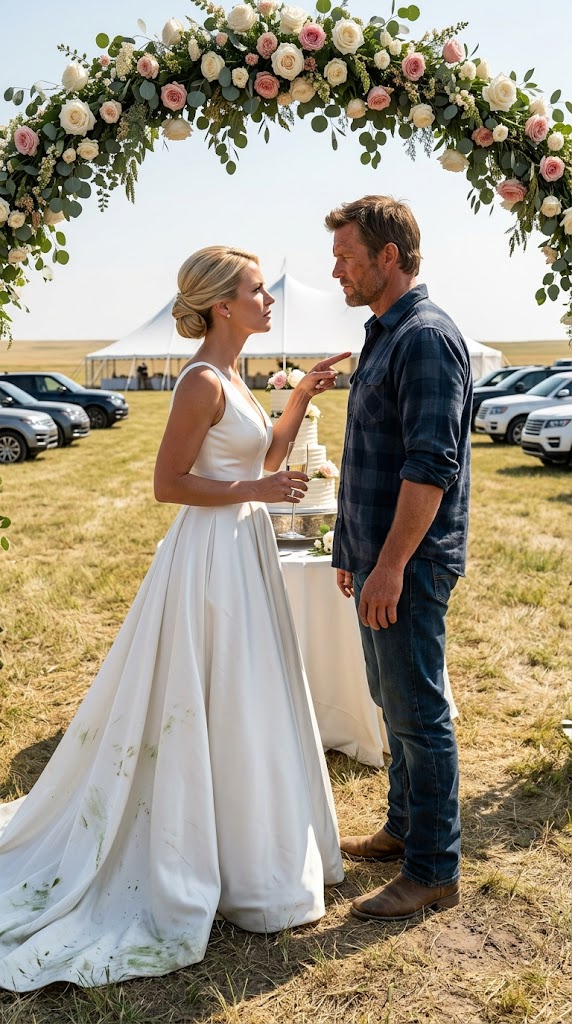
The dirt driveway looked different.
That was the first thing I noticed — the first thing that cracked the easy comfort I’d been riding since I left Denver that morning. Six hours on the highway with my boys asleep in the back seat, the windows down, the dry pine smell of Montana filling the cab. I had been looking forward to this trip for four months. The kind of looking forward that keeps a man honest when everything else feels like noise.
But the driveway looked different. The gravel had been freshly raked. There were orange cones — actual traffic cones — guiding vehicles off my land and into the front pasture in perfect organized rows.
I slowed the truck to a stop and stared through the windshield.
Leo, thirteen, sat up straight. Sam, ten, pressed his forehead against the glass.
There were forty luxury SUVs parked in my front pasture. Forty. I’m not estimating. I sat there and I counted them the way you count things when your brain refuses to accept what it’s seeing. Black Escalades, white Range Rovers, a slate gray Mercedes Sprinter van with a floral company logo on the side. All of them parked in perfect diagonal rows on the grass I had spent years managing.
Beyond the vehicles, a massive white event tent covered the entire clearing where my boys and I had watched more sunrises than I could remember. I could see white linen tablecloths through the open tent walls. Candelabras. Centerpieces with peonies and eucalyptus. Waitstaff in black uniforms carrying silver trays.
Under the oak tree I planted fifteen years ago — the one I planted the same summer my father died, the one I planted because I needed to do something that would outlast me — a string quartet was playing something delicate and polished that drifted all the way across the pasture.
And beneath a floral arch wrapped in white roses, there was a five-tiered wedding cake.
“Dad,” Leo said slowly. “Is somebody… getting married on our ranch?”
Sam didn’t even blink. He just stared.
I turned off the engine.
I need you to understand what this land means before I tell you what happened next, because without that context, nothing that follows makes sense.
I bought this ranch in the worst year of my life. My marriage had ended after twelve years in the kind of slow-motion collapse that doesn’t announce itself — it just quietly takes things away, one by one, until you wake up one morning and realize the house you’re living in doesn’t feel like yours anymore.
The divorce was brutal. Not ugly, not screaming. Just brutal the way that long and quiet things are brutal. The lawyers, the mediation, the division of everything you thought you’d built together. I came out of it with joint custody of my boys, a rented apartment in Denver, and the particular hollowness of a man who has been completely reorganized.
I found the Montana ranch on a Thursday evening, sitting alone in that apartment with a glass of bourbon and nothing to do with my hands. Forty acres, a stream, a ridge with a view of two mountain ranges. The main house was modest — four bedrooms, solid bones, a wood stove in the living room. The pasture was overgrown. The fences needed work. The pump house sat like a forgotten gray box behind the barn.
I made an offer that weekend.
That ranch became the only place where I knew exactly who I was. No lease. No landlord. No neighbors close enough to care about. Just open land, clean water, and enough silence to hear your own thoughts. Every summer I drove up with my boys and we fished the stream and slept with the windows open and ate terrible food and it was, genuinely, the best time of my life.
I left the property management in the hands of Vance Harrington.
Vance was a local name in Billings real estate — the kind of man who wore pressed shirts to outdoor events and had a firm handshake for everyone he met. He came recommended by two separate people I trusted. He managed a dozen properties across the county. For three years, he maintained my ranch without a single complaint. Hired the landscapers. Checked the fences. Sent me quarterly reports that were thorough and professional.
For three years, not a single problem.
I want you to hold that fact.
I told my boys to stay in the truck.
I climbed out and started walking across the pasture toward the tent, feeling the string quartet slow and then falter and then stop entirely as I crossed the open ground. I watched the polite conversations in white chairs die one by one as forty people in formal wear turned to look at the man in the dusty flannel shirt and worn leather boots walking toward their beautiful event.
I was almost to the floral arch when she appeared.
She had separated herself from her bridesmaids with the practiced ease of a woman who is always aware of being watched. She moved across the grass with her heels sinking slightly with each step, her custom silk gown catching the light, her long train dragging behind her across my land. She was holding a champagne flute and smiling the specific smile of someone who is about to enjoy themselves.
She stopped two feet in front of me.
She looked at my flannel shirt. She looked at my boots. She looked at my face.
“Who are you,” she said, and it was not a question, “and what are you doing crashing a private venue?”
I kept my voice completely level. “Ma’am, I think there’s been a massive misunderstanding. My name is—”
“Do not interrupt my wedding day with this.” She cut me off clean, her voice dropping to a sharp whisper that somehow carried across the entire silent crowd. “I don’t know how you got past the gate, but I am asking you, very politely, to leave this property right now.”
“This is my property,” I said. “I hold the deed. I’ve owned this land for—”
“I will have you arrested for trespassing.” She said it loudly now, making sure every guest heard every word. “I will call the sheriff right now and have you removed from my wedding in handcuffs if you say one more word to me.”
She was performing. That was the thing I understood immediately. She wasn’t confused or frightened or even genuinely angry. She was performing for an audience that she had assembled on my land, and the performance required me to be a small and easily dismissed problem.
The groom was watching from the arch. A man I also did not recognize — mid-forties, dark suit, fixed smile. He didn’t move. He didn’t say a word. He just watched.
I said, calmly, “Ma’am, I can show you the deed right now. I’ve owned this property for seven years. My name is on every county land record in—”
That’s when she did it.
She looked down at my boots. She took one slow, composed breath through her nose. And then she lowered her chin and spat at my feet. Deliberately. Without breaking eye contact. The way someone does when they want you to understand exactly how little they think of you.
I heard Sam’s voice from the truck, small and confused and absolutely clear across the quiet pasture.
“Dad… she just spit on you.”
The entire crowd heard it.
She turned back to her guests with a composed, dismissive smile, adjusting the flute in her hand like nothing had happened. “That’s right!” she called after me loudly, for the crowd, the performance fully restored. “Keep walking!”
I stood there for exactly three seconds.
Then I walked back to my truck. Not fast. Not slow. I climbed in, started the engine, and I looked at my boys.
“Don’t touch anything,” I said to Leo. “And Sam, don’t say a word until I tell you.”
Then I drove — not out the gate, not down the driveway, not away from any of it. I drove slowly around the perimeter of the tent, past the catering tables, past the cake, past the quartet who watched me in absolute silence, and I parked the truck directly next to the pump house.
The small gray building in the back corner of my property that controls every single industrial agricultural sprinkler on forty acres of Montana land.
I stepped out. My boys climbed out behind me.
Leo looked at the pump house door. He looked at me. He was thirteen and smart enough to understand what was about to happen.
“Dad,” he said quietly. “Are you sure?”
“Come here,” I said. “Both of you. It’s time for a lesson in agricultural irrigation.”
I want to be precise about the sequence of what happened next, because there were consequences and it’s important to get this exactly right.
I opened the pump house door and I threw the main switch.
The industrial water pump on a forty-acre working ranch is not a quiet piece of machinery. It is a piece of heavy infrastructure that sounds, when it activates, like a turbine engine spinning to life beneath the earth. You feel it in your chest before you hear it. The ground around the pump house vibrates. The pipes clank and pressurize all at once.
And then, six seconds later, thirty-seven agricultural sprinkler heads erupted from the ground across my front pasture in every direction, throwing arcs of pressurized well water in rotating columns across the entire event setup.
The first scream came from the tent.
The second scream was higher — a bridesmaid, I think, who had been standing in the open air closest to the nearest sprinkler head and took the first full blast directly to the face.
What followed over the next four minutes is genuinely difficult to describe in a way that does it justice, but I am going to try.
The white linen tablecloths absorbed water instantly and began to sag, pulling centerpieces off the edges of tables. The peonies and eucalyptus arrangements slid and fell in clusters. The candelabras, which had been unlit in the daylight, toppled.
The catering table went first — the ice sculptures on the far end began sheeting water down across the food display, and two catering staff scrambled to pull silver trays from the spreading pools.
The string quartet packed their instruments with the focused, terrified speed of professionals who have been caught outdoors in a disaster before. I watched the cellist tuck her instrument under her body and sprint for the nearest SUV.
The five-tiered wedding cake stood in the open air directly beneath the floral arch, which was, as it happened, three feet from sprinkler head number fourteen. The top two tiers came down first, slowly and then very fast. The entire structure leaned, caught a direct horizontal stream, and collapsed into the grass in a cascading white and ivory avalanche that sent frosting spraying in a ten-foot radius.
Forty guests in formal wear ran in every direction.
And in the middle of all of it, standing at the floral arch completely soaked through — her custom silk gown plastered against her body, her immaculate upswept hair collapsing in wet ropes down her face, her mascara running in black rivers down both cheeks, her champagne flute somehow still in her hand even though it was now full of sprinkler water — was the bride.
She was not screaming.
She was staring at me.
And even from thirty yards away, I could see that something in her expression had shifted entirely. The performance was gone. The entitled calm was completely gone. What was left underneath was something I hadn’t expected, and it took me a moment to identify it.
She looked afraid.
I had already called 911 from inside the pump house while the sprinklers were running.
I didn’t call to report trespassers, though I had every right. I called because I needed official documentation. I needed a record of the date, the time, the location, and the situation before anyone had the opportunity to reframe what was happening here.
The two sheriff’s department cruisers came up my dirt driveway seven minutes later, kicking rooster tails of dust behind them and parking at the edge of the field.
By the time the deputies stepped out, the sprinklers had been running for nine minutes and the event was effectively over. Guests were sheltering in SUVs. The tent had partially collapsed on one side where the water pooling in the roof had exceeded the drainage capacity. The catering equipment was scattered. The cake was gone.
The bride was standing at the floral arch, still holding the flute, completely soaked, when the deputies approached her.
I walked to meet the deputies myself with my phone in my hand, the photos of my deed pulled up on the screen, and two years of county property tax receipts in the glove box of my truck that I had already retrieved.
The senior deputy — a heavyset man named Garrett with a calm, seen-it-all manner — looked at me, looked at the soaked wedding, looked at the bride, and said, with genuinely impressive composure, “Sir, you want to explain what’s going on here?”
I explained everything. I showed him the deed photographs. I gave him the county parcel number. I showed him three years of property tax payment confirmations. I showed him the service agreement I had signed with Vance Harrington’s property management company, which included a strict clause prohibiting commercial use of the property without my written consent.
Deputy Garrett looked at all of it. He looked at the bride. He looked back at me.
“Where’s the property manager?” he asked.
That was the question.
I found Vance Harrington behind the collapsed section of the tent, standing with two other men in dark suits, all three of them completely soaked, having a very quiet, very tense conversation that stopped the moment I appeared.
Vance looked at me and for a single moment his face did something I had never seen it do in three years of professional interaction. It went completely blank. Not surprised. Not confused.
Blank, in the way that faces go blank when a person realizes they have run out of road.
“Hey,” he said. That was it. That was all he had.
“Vance,” I said. “What is happening on my ranch?”
He opened his mouth. He closed it. He looked at the two men beside him, neither of whom offered anything.
“I can explain this,” he said finally.
“I really hope so.”
Deputy Garrett had followed me and was now standing two feet behind my left shoulder, notepad open.
What Vance explained, over the next twenty minutes, in a halting, qualified, increasingly desperate account that fell apart at several key points under the deputy’s calm follow-up questions, was this:
He had been renting my ranch out as a private event venue for two years.
Not once. Not occasionally. Regularly. Weddings, corporate retreats, private parties. He had built an entire secondary income stream using my land, my facilities, my infrastructure, my oak tree, and my floral arch. He had never asked for my permission. He had never disclosed a single dollar. He had collected rental fees — the bride’s event alone had been booked for twelve thousand dollars — and deposited them into a private account.
He had been doing this, by his own accounting when pressed, at least eighteen times.
When Deputy Garrett asked him whether he had written authorization from the property owner to rent the venue commercially, Vance said, and I am quoting him directly:
“It was always going to come up at some point.”
I stood there in the wreckage of an eighty-thousand-dollar wedding on my own land and I let that sentence exist in the air for a moment.
The groom had appeared beside the bride. He had been one of the men in dark suits beside Vance. He was, as it turned out, not just the groom — he was a business partner of Vance’s. The booking. The setup. The contract. The twelve-thousand-dollar venue fee. He had known. He had signed the contract knowing full well that the property manager who was renting him this venue did not own it.
The bride did not know.
That is the part I want to be careful about, because it matters.
When she understood what had happened — when Deputy Garrett walked her through the ownership documentation and she realized that the man she had spit at in front of forty guests was the actual owner of the land she was standing on — she sat down in the wet grass in her ruined gown and she did not speak for a long time.
When she finally looked up at me, she said, very quietly, “He told me his family had owned this ranch for thirty years.”
Her groom, standing six feet away, said nothing.
She looked at him. He looked at the grass.
“Is that true?” she asked him.
He said nothing.
She asked him three more times. He said nothing each time.
The deputies separated everyone after that.
I will not tell you that I felt good about what happened to the bride. I will not pretend I didn’t feel something when I watched her sitting in the wet grass, mascara destroyed, gown ruined, the entire architecture of what was supposed to be the best day of her life dissolved in a field of sprinkler water.
I felt bad for her. Genuinely.
She had been deceived by someone she trusted. She had planned and prepared and invested an enormous amount of money and emotional energy into an event built on a foundation that someone else had stolen. She didn’t know. I believe that completely.
She had also spat at my boots in front of my children, but I understood now that she had done it from a position of false certainty. She had believed, completely, that she was on legitimately rented property and that I was the problem. That doesn’t make it acceptable. But it makes it explicable.
Before the deputies moved everyone to their vehicles, she found me standing by the pump house with my boys.
“I owe you an apology,” she said. She didn’t dress it up. “I am genuinely sorry for what I said to you and what I did.”
I looked at her for a moment.
“I appreciate that,” I said.
She nodded once and walked back toward the deputy waiting for her statement.
Leo watched her go. He looked at me.
“Are you actually not mad at her?” he asked.
“I’m mad at the situation,” I said. “There’s a difference.”
He thought about that for a while.
The consequences unfolded over the following weeks with the procedural thoroughness of things that are well-documented from the beginning.
Vance Harrington was charged with commercial fraud, breach of fiduciary duty, and unauthorized commercial use of private property. The investigation opened by the county found records of twenty-two separate bookings over twenty-six months. Total collected revenue: just over two hundred and fourteen thousand dollars.
The groom was named in a related civil complaint for knowingly participating in a fraudulent commercial transaction. The bride ultimately dissolved the engagement. I learned that detail from the county clerk’s office, which I mention only because it was not a surprise to anyone who had been standing in that pasture.
My attorney filed civil suit against Harrington’s property management firm. The case was settled fourteen months later. I will not state the settlement amount, but I will tell you that it covered every dollar of legal fees and then some, and that Vance Harrington no longer operates a property management company in the state of Montana.
My ranch is still mine. The oak tree still stands. The floral arch, which actually belonged to a rental company that had to come retrieve it, is someone else’s problem now.
The pasture recovered. Grass always does.
Last summer I drove back up with my boys for the first time since everything happened. Six hours, bad radio, gas station coffee. The driveway was overgrown at the edges again, the way I like it. No traffic cones. No luxury SUVs. No string quartet.
Just the land. The stream. The silence.
Sam, who had been ten during all of it and is now eleven and slightly more philosophical about things, stood at the edge of the pasture where the tent had been and looked at the grass for a long time.
“Dad,” he said finally.
“Yeah.”
“Do you think she ever got married? The lady in the white dress?”
I thought about it.
“I don’t know, bud.”
He nodded slowly, the way kids nod when they’re filing something away to think about later.
“I hope she found somebody honest,” he said.
I looked at him.
Eleven years old, standing in a Montana pasture, and he’d already put his finger on the exact center of the whole thing.
“Yeah,” I said. “Me too.”
We fished until dark. The stream was cold and clear and completely indifferent to everything that had happened on the land above it, the way water always is. Leo caught three. Sam caught one and argued for twenty minutes that it was bigger than Leo’s, which it was not, but I let it go.
That night I sat on the porch of the main house and listened to the complete absence of string quartets.
It was the best sound I had heard in a long time.

Evan Cole Editor-in-Chief | Breaking News & Public Policy
“From Washington to Wall Street, and Main Street to Hollywood—Evan Cole connects the dots.”
As the Editor-in-Chief at Newskilo, Evan leads a dynamic team of journalists dedicated to uncovering the truth behind the headlines. With over 15 years in digital media, Evan has a reputation for cutting through the noise.
While he is widely recognized for his deep analysis of U.S. fiscal policy (IRS & Stimulus), Evan’s expertise extends to global current events, corporate accountability, and cultural trends. Whether he is breaking down a complex government bill, exposing a tech giant’s failure, or analyzing the societal impact of a viral celebrity moment, Evan’s goal is simple: To tell the stories that shape our world with clarity, accuracy, and integrity.
Leave a Reply