
My son Mauricio and I talked every Sunday for twelve years.
Didn’t matter how far he moved. Didn’t matter how big his company got. Didn’t matter that his name started appearing in business publications next to words like visionary and disruptive.
He was still my boy.
He still asked if I was taking my blood pressure meds.
He still laughed at my old truck and told me one day he was going to buy me new boots because mine “belonged in a museum.”
And then, slowly and without any moment I could point to as the turning point, that version of him disappeared.
The calls got shorter. Then less frequent. Then the things he said began to feel rehearsed — like a man reading carefully from a script someone else had written.
The last time I heard his voice was Christmas Eve. He barely finished saying Merry Christmas, Dad before a woman’s voice slid onto the line, smooth as ice.
“Mauricio is very busy, Mr. Salazar. He’ll call you back.”
He never did.
I didn’t tell anyone what I was planning.
I packed a change of clothes, filled a cooler with water and sandwiches, checked the oil in my truck, and drove 1,200 miles from Coahuila to Punta Mita — where Mauricio had been living for a year with his wife, Renata, in a beachfront mansion I had seen exactly once, in a photo he posted to social media and then deleted three days later.
I kept telling myself, the whole drive, that I was probably overreacting. That he was fine. That successful men get busy and distant and I needed to stop treating him like he was still fifteen.
But the feeling in my gut got worse the closer I got. Not better.
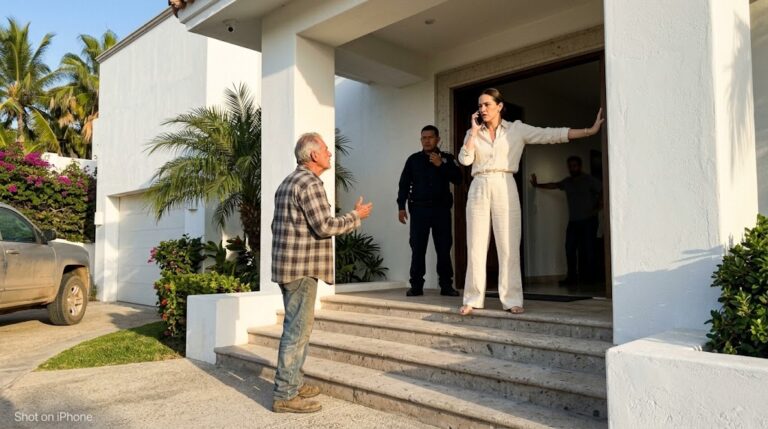
I pressed the intercom. Said my name. The gate buzzed open.
Renata met me at the door in cream designer clothes with a smile she hadn’t made for family.
“Mauricio can’t receive visitors right now.”
I heard my son’s voice from somewhere inside.
I did not get back in my truck.
Part 2: The Son I Raised — and the Man He’d Become
Mauricio grew up in a three-bedroom house outside of Saltillo with a mother who worked double shifts at the hospital laundry and a father who spent eighteen years on a sheet metal line.
He was the kind of kid who took nothing for granted because he had watched us not take anything for granted.
He studied while other kids played. He worked construction summers in high school to save for his first laptop. He got a partial scholarship to study computer engineering in Monterrey and made up the rest with a loan he paid off in three years.
By his late twenties, he had co-founded a software company that started small and grew fast. By thirty-three, it had been acquired by a larger firm and he’d walked away with more money than I could visualize.
I was proud of him in a way I didn’t have words for.
Not because of the money. Because of the distance he had traveled on his own terms.
He met Renata at an industry conference two years after the acquisition. She was sharp, polished, fluent in four languages, and moved through expensive rooms like she had been born in them. When Mauricio brought her to Coahuila for a weekend to meet me, I shook her hand and smiled and tried not to examine the way she looked at the house — like she was calculating the square footage and finding it insufficient.
I told myself I was being unfair.
She made Mauricio happy, visibly. He smiled more around her. He dressed better. He moved with a kind of confidence I hadn’t seen in him since the year the company took off.
So I let the small things go.
The way she answered his phone when I called.
The way she spoke for him at dinner sometimes, finishing sentences he hadn’t quite started.
The way he stopped visiting and started scheduling.
I let all of it go until Christmas Eve, when my son’s voice disappeared mid-sentence and her voice replaced it, and the number I had called every Sunday for twelve years went quietly, permanently, to voicemail.
Part 3: 1,200 Miles and What the Gut Knows
I left Coahuila at 4:30 in the morning on a Tuesday.
I didn’t sleep much the night before. Not from anxiety, exactly. From the specific, patient restlessness of a man who has made up his mind and is simply waiting for daylight to start moving.
My neighbor Beto asked where I was headed when he saw me loading the cooler into the truck bed.
“South,” I said.
He nodded like that was a complete answer, because it was.
I drove through desert and mountain and coastal highway. I drank bad gas station coffee and ate sandwiches over the steering wheel and stopped twice to stretch my back by the side of the road.
I thought about Mauricio the whole way. Not the versions other people knew — the magazine version, the acquisition version, the version in the cream-colored house with the security cameras. I thought about the boy who used to fall asleep on the couch doing homework. The seventeen-year-old who called me from a pay phone when his first car broke down in the rain. The man who, two years into his company’s growth, called me from a conference hotel at midnight just to tell me he wished I could see what he was building.
That was my son.
And that was the voice that had gone quiet.
I had called his personal cell twelve times in the two months since Christmas. Texted seven times. Sent one email. His assistant had responded to the email, politely, to inform me that Mauricio was traveling extensively and would be in touch soon.
That email had been signed by someone named Paola.
I did not know who Paola was.
I reached Punta Mita at 3:40 in the afternoon.
The mansion sat behind a high white wall on a lot that backed up directly to the ocean. Palm trees. Security cameras on every corner. An intercom panel at the gate that looked like it cost more than my truck.
I pressed the buzzer. Gave my name.
A short silence. Then the gate clicked open.
I drove in and parked on the stone driveway.
Renata was already at the door.
Part 4: The Door, the Voice, and What Happened When I Stopped Walking Away
She stood in the doorway in cream linen pants and a silk blouse, hair pulled back, expression arranged into something that was supposed to look like courtesy.
“Mr. Salazar. This really isn’t a good time.”
“I drove from Coahuila,” I said. “I haven’t spoken to my son in two months. I’d like to say hello for five minutes.”
“He’s resting. He’s been unwell.”
“Then I’ll sit with him while he rests.”
She shifted. Subtle. Just enough to close off the hallway behind her with her shoulder.
I heard a sound from inside the house. A thud, sharp and sudden. Then the metallic clatter of something being shut too fast. Then silence.
The kind of silence that follows a sound someone was not supposed to make.
“Please, Mr. Salazar,” she said, lowering her voice. “Don’t make this harder than it already is.”
I looked at her for a long moment. Then I nodded.
“All right,” I said. “I’m sorry to bother you.”
I turned. Walked back down the stone steps. Moved toward the gate at the pace of a man who had accepted the situation.
But I stopped at the gate.
I looked back.
Renata had her phone out. Her hands were not steady. She was typing fast, looking at the screen and then at me and then at the screen again, and the polished composure she had walked out of that house with was completely gone.
She looked frightened.
That was when I heard him.
From somewhere inside the mansion, through walls and hallways and whatever distance separated us, I heard a voice that was hoarse and thin and unmistakably his.
“Dad…?”
Not a call. Not a shout. The sound of someone using whatever they had left.
Renata slammed the door.
I was already walking back toward the house.
I did not raise my voice. I did not run. I pressed the intercom buzzer once, calmly, and when nothing happened I called 911 and told the dispatcher, in the flattest voice I had, that I was outside a private residence, that I had just heard what I believed to be a family member in distress, and that I needed a wellness check conducted immediately.
I gave the address.
I sat down on the front step.
And I waited.
Two officers arrived in fourteen minutes.
Renata opened the door to them with a version of the same composed smile she had given me.
I stood up from the step and said: “I’m his father. He called out for me. I heard him clearly.”
One officer went inside.
Three minutes later, he came back to the door and looked at me.
“Sir,” he said, “you’ll want to come in.”
The Aftermath: What Was Happening in That House
Mauricio was in the main bedroom on the second floor.
He had lost weight — visible weight, the kind that happens fast — and there were prescription bottles on the nightstand whose labels I didn’t recognize. He was sitting up when I walked in, and when he saw me, his face did the thing faces do when a person has been holding themselves together for a very long time and the thing they were holding together for finally walks through the door.
He didn’t say anything for a moment.
Neither did I.
I sat down on the edge of the bed and put my hand on his shoulder and that was enough.
What came out over the next two hours was not one simple thing. It was a collection of small things that had accumulated, the way water damage does — invisibly, until the wall gives.
The isolation had been gradual. Less contact with old friends, explained away as busy schedules. Less contact with family, explained away as time zones and work travel. A slow, patient narrowing of his world until the only voice consistently in the room was hers.
The medication was real — he had been genuinely unwell, a stress-related condition that had developed over the previous year — but the management of it had been handled entirely by Renata. Appointments scheduled by her. Medications managed by her. His phone, his calendar, his correspondence, his access — all filtered through her.
He had not called me on Christmas Eve. She had called me, from his phone, while he was in another room.
He found out two days later.
He hadn’t known how to reach me since.
The officers spoke with Renata separately. There were no charges filed that night. But there were questions she couldn’t answer cleanly, and a follow-up visit from adult protective services that she could not prevent.
Mauricio flew back to Coahuila with me four days later.
He wore a pair of my old boots on the flight because his luggage had been packed by someone else and nothing in it fit right anymore.
He is doing better. Slowly. The kind of better that is not a single moment but a direction — a daily, deliberate movement back toward himself.
He called me last Sunday.
Just to talk.
About nothing important. About the weather and a game he had watched and whether I had finally gotten the truck’s air conditioning fixed.
I have not fixed the truck’s air conditioning.
I told him I’d get to it.
He laughed.
It sounded exactly like him.

Evan Cole Editor-in-Chief | Breaking News & Public Policy
“From Washington to Wall Street, and Main Street to Hollywood—Evan Cole connects the dots.”
As the Editor-in-Chief at Newskilo, Evan leads a dynamic team of journalists dedicated to uncovering the truth behind the headlines. With over 15 years in digital media, Evan has a reputation for cutting through the noise.
While he is widely recognized for his deep analysis of U.S. fiscal policy (IRS & Stimulus), Evan’s expertise extends to global current events, corporate accountability, and cultural trends. Whether he is breaking down a complex government bill, exposing a tech giant’s failure, or analyzing the societal impact of a viral celebrity moment, Evan’s goal is simple: To tell the stories that shape our world with clarity, accuracy, and integrity.
Leave a Reply